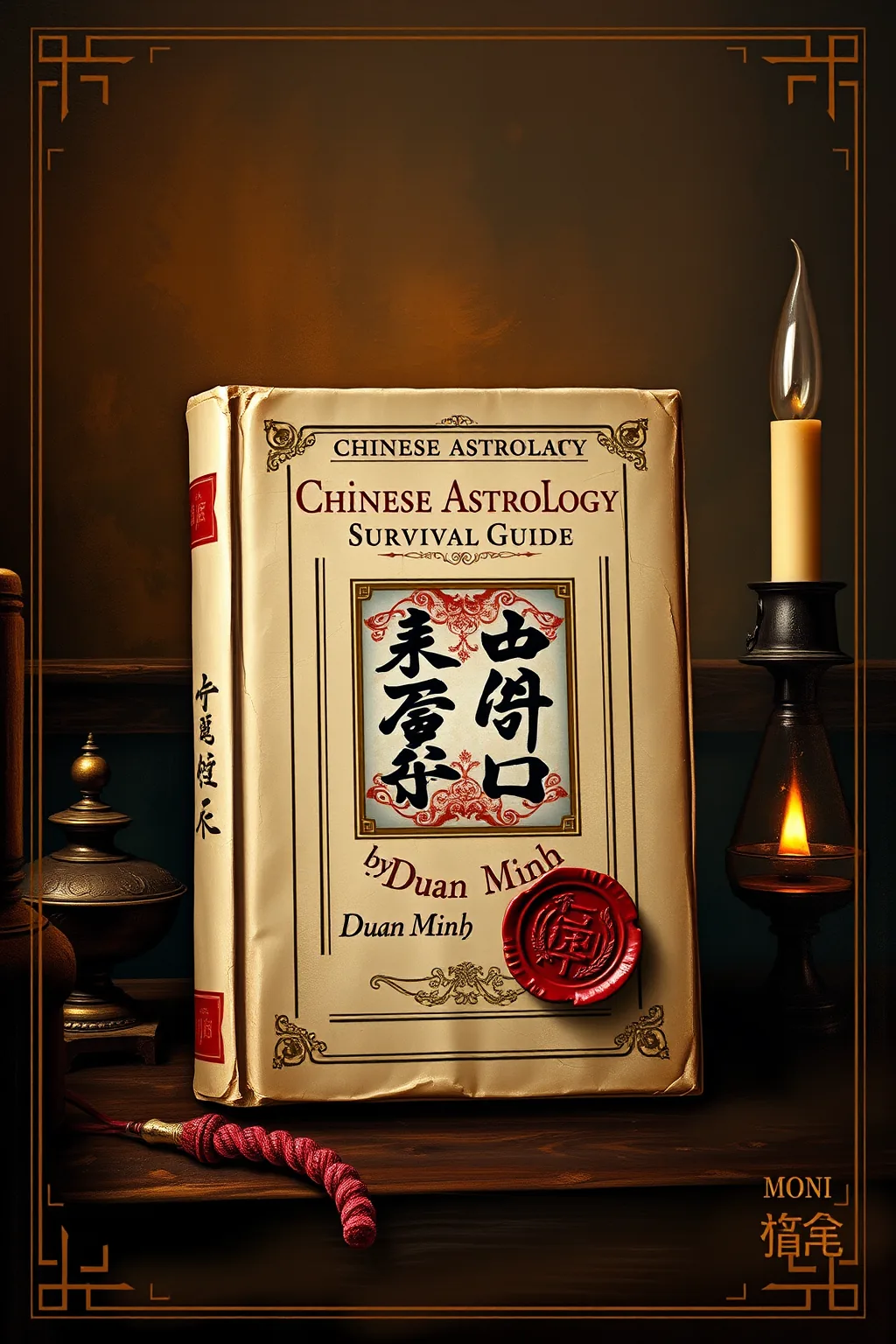
Chinese Astrology Survival Guide
 61
61

Chinese Astrology Survival Guide


Duan Minh's "Chinese Astrology Survival Guide" is a masterful exposition of a complex system, rendered with clarity and esoteric depth. Blackwood lauds the author's ability to distill millennia of wisdom into actionable insights, making the arcane accessible without sacrificing its mystique. The text not only deciphers the zodiacal animals and elemental interactions but also illuminates their philosophical resonance, offering a potent toolkit for self-awareness. This guide is an indispensable companion for those seeking to understand the subtle currents of fate and fortune, ideal for both neophytes and seasoned practitioners of esoteric arts. Minh's contribution is a beacon for anyone wishing to align their life with cosmic order.
📝 Description
61
Duan Minh's 2008 "Chinese Astrology Survival Guide" explains how to use the zodiac for practical life choices.
This book by Duan Minh focuses on the practical application of Chinese astrology, moving beyond simple prediction. It details the twelve zodiac animals, their associated elements, and how these interact with time cycles. Minh explains the symbolism of Yin and Yang, the five elements, and the concept of celestial palaces.
The text aims to provide a framework for understanding oneself and one's destiny through this ancient system. It is written for those interested in personal development and spiritual understanding, suggesting that knowledge of these universal rhythms can lead to self-discovery. The book also touches on the philosophical roots of Chinese astrology and its historical influence.
Chinese astrology, known as Sheng Xiao, is a traditional system based on a 12-year cycle, with each year represented by an animal and its reputed attributes. This system is part of a broader cosmology that includes concepts like Yin and Yang and the Five Elements (Wu Xing). These elements are not static but interact in cycles of generation and control, influencing events and personalities. The astrological system is used for understanding personality, compatibility, and fortune, forming a significant part of East Asian esoteric thought.
💡 Why Read This Book?
Unravel the ancient secrets of the Chinese zodiac and harness its potent energies for personal transformation. This guide offers practical wisdom for navigating life's challenges and opportunities, providing profound insights into destiny, relationships, and success. Ideal for spiritual seekers, students of Eastern philosophy, and practitioners of divination arts, it unlocks a deeper understanding of yourself and the universe.
⭐ Reader Reviews
Honest opinions from readers who have explored this book.
❓ Frequently Asked Questions
What is the core philosophy behind Chinese Astrology?
At its heart, Chinese Astrology is rooted in Taoist principles, emphasizing the interconnectedness of humanity and the cosmos. It views life as a dynamic interplay of Yin and Yang, the Five Elements (Wood, Fire, Earth, Metal, Water), and the cyclical energies represented by the twelve zodiac animals, guiding individuals towards harmony and balance.
How does the Chinese Zodiac differ from Western Astrology?
While both are systems of celestial interpretation, Chinese Astrology is based on a 12-year lunar cycle tied to animal signs, each with distinct characteristics and elemental affiliations. It focuses more on inherent personality traits, life paths, and compatibility, often incorporating Feng Shui principles for environmental harmony.
Can I use this guide to predict my future?
This guide offers insights into potentials and tendencies, rather than deterministic predictions. It empowers you to understand your inherent strengths and challenges, enabling you to make conscious choices and navigate your life path with greater wisdom and foresight.
Is Chinese Astrology relevant in the modern world?
Absolutely. Its principles offer timeless wisdom for understanding human behavior, fostering stronger relationships, and making informed decisions in career and personal life, providing a framework for resilience and self-awareness in our fast-paced world.
What are the Five Elements and their significance?
The Five Elements (Wu Xing) are fundamental forces that interact in cycles of creation and destruction, shaping personality, relationships, and the environment. Understanding their interplay is crucial for a comprehensive grasp of Chinese Astrology and its influence on your life.
🔮 Key Themes & Symbolism
The Twelve Animal Signs and Their Archetypes
This section explores the strong symbolism of the twelve animals—Rat, Ox, Tiger, Rabbit, Dragon, Snake, Horse, Goat, Monkey, Rooster, Dog, and Pig. Each animal embodies unique personality traits, strengths, weaknesses, and inherent destinies. Duan Minh illuminates how these archetypes influence individuals born under their sign, offering clear insights into motivations, interpersonal dynamics, and potential life paths. Understanding these archetypes is the foundational step in unlocking the personal narrative woven by the celestial collection, providing a framework for self-reflection and greater empathy towards others.
The Interplay of the Five Elements
The Five Elements—Wood, Fire, Earth, Metal, and Water—form the energetic bedrock of Chinese Astrology. This theme explores their cyclical relationships: the nurturing cycle of creation and the destructive cycle of control. Duan Minh reveals how these elements, in conjunction with Yin and Yang, shape the character, fortune, and health of individuals. Understanding elemental balance and imbalance is crucial for diagnosing influences, harmonizing energies, and making informed choices to foster well-being and prosperity. It provides a dynamic lens through which to view the ever-shifting cosmic currents.
Navigating Destiny and Personal Growth
Beyond mere prediction, this guide emphasizes the empowering aspect of Chinese Astrology: its role in personal growth and navigating destiny. Duan Minh offers practical advice on how to leverage one's astrological blueprint to overcome challenges, cultivate strengths, and achieve fulfillment. The text explores themes of karma, fate, and free will within the context of the celestial cycles, encouraging readers to become active participants in their own lives. It provides a spiritual framework for understanding life's journey, fostering resilience, wisdom, and a deeper connection to the universal order.
💬 Memorable Quotes
Direct passages from the work, attributed to the author.
“Harmony is not the absence of conflict, but the skillful dance within it.”
— This aphorism highlights the dynamic nature of balance in life and the universe, suggesting that true harmony comes from navigating challenges with grace and understanding, a core tenet of astrological wisdom.
“The elements breathe life into time, and time molds our existence.”
— This evocative statement underscores the fundamental connection between the primal forces of the Five Elements and the passage of time, illustrating how their interplay shapes the human experience.
💡 Key Ideas
Editorial paraphrase of the work's core concepts — not direct quotes.
The stars whisper secrets, if only we learn to listen.
This quote emphasizes the inherent wisdom present in celestial patterns, suggesting that understanding Chinese Astrology is akin to learning a cosmic language that reveals profound truths about ourselves and our journey.
Your birth chart is a map, not a prison.
This quote empowers the reader, framing astrological influences as guiding points rather than unchangeable dictates, encouraging agency and conscious choice in shaping one's destiny.
Know your animal, know your path.
A concise distillation of the book's premise, this quote suggests that self-knowledge, derived from understanding one's zodiacal sign, is the key to navigating one's life journey effectively.
🌙 Esoteric Significance
Tradition
Rooted in the ancient Chinese philosophical and cosmological tradition, Chinese Astrology is intrinsically linked to Taoism, Yin-Yang philosophy, and the Five Elements (Wu Xing). It represents a profound esoteric system that views the universe as a unified, interconnected whole where human life is a microcosm reflecting macrocosmic patterns. Its esoteric nature lies in its symbolic language, its emphasis on hidden energetic currents, and its aim to facilitate spiritual alignment and self-mastery by understanding these subtle forces.
Symbolism
The core symbolism revolves around the 12 Earthly Branches (represented by animals), the 10 Heavenly Stems (associated with Yin-Yang and the Five Elements), and the concept of Qi (vital energy). Each animal sign, element, and their combinations carry rich symbolic meanings related to personality, destiny, and potential life challenges. The cyclical nature of the elements (creation and destruction) and the Yin-Yang duality further enrich this symbolic language, offering a complex yet coherent system for interpreting cosmic influences on human life.
Modern Relevance
In our increasingly secularized and often chaotic modern world, the esoteric wisdom of Chinese Astrology offers a grounding and profound framework for self-understanding and connection. It provides timeless insights into human psychology, interpersonal dynamics, and the cyclical nature of life, fostering resilience, empathy, and a sense of cosmic belonging. Its principles can be applied to personal development, relationship counseling, strategic decision-making, and even mindfulness practices, helping individuals navigate contemporary challenges with greater awareness and intention.
👥 Who Should Read This Book
This comprehensive guide is a treasure for a diverse range of readers. Beginners will find clear explanations of fundamental concepts, clarifying the zodiac and elements. Scholars and enthusiasts of Eastern philosophy will appreciate the depth of historical context and esoteric insights. Spiritual seekers looking for a profound path to self-discovery will find ample wisdom for introspection and personal growth. Practitioners of divination arts, from astrologers to Feng Shui consultants, will discover valuable tools and nuanced interpretations to enhance their craft and deepen their understanding of cosmic influences.
📜 Historical Context
Emerging from the philosophical and cosmological field of ancient China, Chinese Astrology developed over thousands of years, deeply interwoven with Taoism, Yin-Yang theory, and the Five Elements (Wu Xing). Its origins are often traced to the Han Dynasty (206 BCE – 220 CE), though its roots likely extend much further into shamanistic and calendrical practices. Initially used for imperial divination, agricultural planning, and understanding natural phenomena, it gradually permeated all levels of society. The system's enduring appeal lies in its comprehensive framework for understanding human nature, interpersonal relationships, and the cyclical flow of time, offering a deeply integrated worldview. It has historically served as a vital tool for self-awareness, guidance, and fostering harmony with the natural and spiritual realms, influencing everything from personal life choices to architectural design (Feng Shui).
📔 Journal Prompts
Reflect on the dominant animal sign in your chart and how its traits manifest in your daily life. Are there aspects you embrace and others you struggle with?
Consider the interplay of the Five Elements in your birth chart. How do they create balance or tension, and how might you harmonize these energies through your actions?
How does your understanding of your Chinese Zodiac sign influence your relationships with others? Identify potential areas of compatibility and conflict.
What challenges or opportunities does your astrological blueprint suggest for the coming year? How can you proactively navigate these based on the wisdom presented?
Explore a time when you felt particularly in sync with the natural or cosmic cycles. How did this alignment feel, and what can you learn from that experience?
🗂️ Glossary
Yin and Yang
The fundamental dualistic principle in Chinese philosophy representing complementary opposites, such as passive/active, dark/light, female/male. Their dynamic balance is crucial in understanding cosmic and human energies.
Wu Xing (Five Elements)
The five fundamental forces or phases of change in traditional Chinese cosmology: Wood, Fire, Earth, Metal, and Water. They interact in cycles of creation and destruction, influencing all phenomena.
Earthly Branches
The twelve cyclical signs of the Chinese zodiac, each represented by an animal (Rat, Ox, Tiger, etc.). They correspond to specific years, months, days, and hours, imbuing them with unique characteristics.
Heavenly Stems
The ten cyclical signs that combine with the Earthly Branches to form the sixty-year cycle (Sexagenary cycle). They are associated with Yin-Yang and the Five Elements.
Qi (Chi)
The vital life force or energy that flows through all things. In Chinese Astrology, understanding the flow and balance of Qi is central to interpreting astrological influences and promoting well-being.
This book appears in 2 collections
🔮 Readers Also Liked
Browse all →








More by Duan Minh
All books →
From the “Astrology” Collection
View all →







More Free Astrology & Cosmology Books
View all →