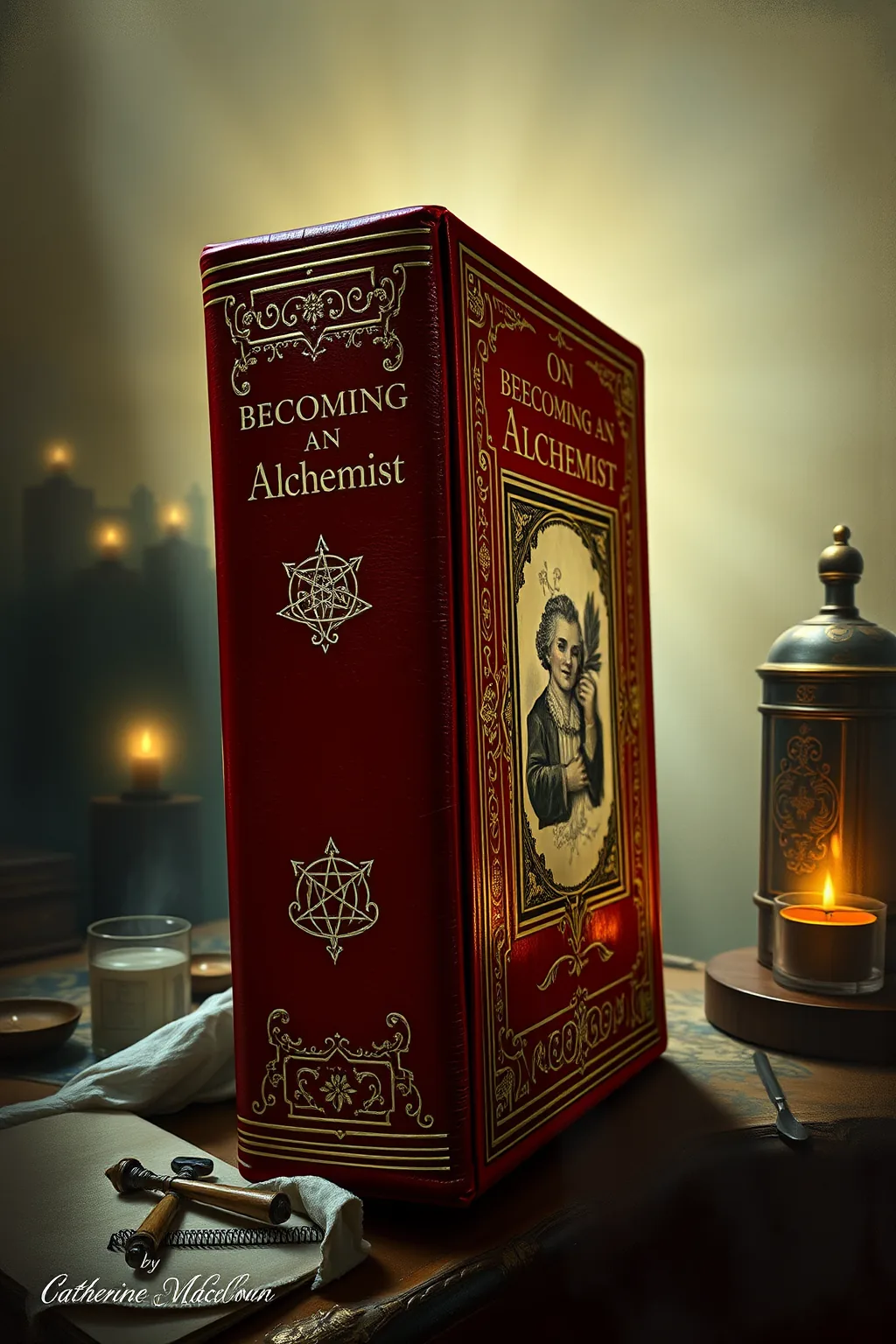
On Becoming an Alchemist

 78
78

On Becoming an Alchemist
Catherine MacCoun's "On Becoming an Alchemist" presents a compelling case for alchemy as a potent symbolic system for inner transformation. The author skillfully unpacks complex alchemical stages, such as the 'nigredo' and 'albedo,' grounding them in both historical context and psychological relevance. A particular strength lies in MacCoun's ability to articulate the 'Great Work' not as a mystical fantasy, but as a tangible process of self-cultivation. The limitation, however, is that the book's depth might prove challenging for absolute beginners without some prior exposure to Jungian psychology or Hermetic philosophy. The discussion on the 'coniunctio' as the integration of opposites is particularly illuminating. This work is a valuable contribution for those seeking to understand the alchemical path as a profound method of personal development.
📝 Description
78
Catherine MacCoun’s 2013 book examines alchemy as a symbolic language and a path for spiritual development.
Published in 2013, Catherine MacCoun's "On Becoming an Alchemist" considers alchemy not simply as a precursor to chemistry, but as a symbolic language and a method for spiritual growth. The book connects alchemical principles to personal evolution and psychological integration, making them relevant for contemporary readers. It is written for serious students of esoteric traditions, especially Western esotericism and Hermeticism. Individuals interested in the psychology of transformation, deeper comprehension of alchemical symbolism, or comparative studies of mystical paths will find this work valuable. It requires a commitment to engaging with complex symbolic systems.
Catherine MacCoun's text enters a scholarly conversation about Western esotericism that gained momentum in the mid-20th century, building on figures like Frances Yates and Carl Jung. Her work contributes to a contemporary understanding of alchemy that balances historical inquiry with psychospiritual interpretation. It engages with the legacy of alchemists such as Paracelsus, offering a perspective that moves beyond purely historical or materialistic viewpoints. The book situates alchemical practice within a framework of personal transformation and psychological integration.
💡 Why Read This Book?
• Understand alchemy as a psychological process: Learn how stages like the 'nigredo' can be interpreted as confronting shadow aspects of the self, offering a framework for personal growth beyond historical practices. • Explore the symbolism of the 'prima materia': Gain insight into the concept of raw, unformed potential and how alchemists viewed this as the crucial starting point for all transformation. • Grasp the 'coniunctio' beyond mere union: Discover how this alchemical symbol represents the integration of dualities within the psyche, providing a model for achieving inner harmony.
⭐ Reader Reviews
Honest opinions from readers who have explored this book.
❓ Frequently Asked Questions
What is the primary focus of Catherine MacCoun's "On Becoming an Alchemist"?
The book focuses on alchemy as a symbolic language and a path for spiritual and psychological transformation, rather than solely as a historical chemical practice. It explores the stages of the Great Work for personal development.
Is "On Becoming an Alchemist" suitable for beginners?
While accessible, the book delves into complex symbolic and psychological concepts. Beginners with some interest in Hermeticism or Jungian psychology will find it rewarding, but it might be challenging without any prior context.
When was "On Becoming an Alchemist" first published?
The book was first published in 2013, placing it within contemporary scholarship on Western esoteric traditions and their psychological interpretations.
What is the 'Great Work' as discussed in the book?
The 'Great Work' (Magnum Opus) in MacCoun's context refers to the alchemical process of spiritual and psychological transformation, aiming for self-mastery and enlightenment through stages of purification and integration.
Does the book discuss specific alchemical symbols?
Yes, "On Becoming an Alchemist" explores key symbols such as the 'prima materia' (first matter), the stages of 'nigredo,' 'albedo,' and 'rubedo,' and the 'coniunctio' (union).
How does the book relate alchemy to psychology?
It connects alchemical stages and symbols to psychological processes, particularly drawing parallels with Carl Jung's work on individuation and the integration of the unconscious.
🔮 Key Themes & Symbolism
The Alchemical Stages of Transformation
MacCoun meticulously details the core alchemical phases: 'nigredo' (blackening), 'albedo' (whitening), and 'rubedo' (reddening). The work posits these are not merely chemical processes but represent a profound inner journey. The 'nigredo' signifies dissolution and confrontation with the shadow, the 'albedo' a purification and illumination, and the 'rubedo' the achievement of wholeness and spiritual realization. This framework offers a structured approach to understanding personal crises and breakthroughs as integral parts of a larger transformative process.
The Prima Materia and Potential
Central to the alchemical quest is the concept of the 'prima materia,' the irreducible, undifferentiated substance from which all things are made. In "On Becoming an Alchemist," this is interpreted as the raw, unformed potential within the individual. MacCoun highlights how alchemists believed that by understanding and working with this primordial matter, one could unlock immense creative and transformative power, both externally and internally, representing the foundational state of the psyche before conscious shaping.
The Coniunctio and Integration
The 'coniunctio,' or alchemical marriage, represents the union of opposites – an important concept in MacCoun's analysis. This theme explores the reconciliation of dualistic forces within the psyche, such as masculine and feminine, conscious and unconscious, spirit and matter. The successful 'coniunctio' signifies a state of wholeness and balance, where integration replaces conflict. This symbolic union is presented as the ultimate goal of the Great Work, leading to spiritual enlightenment and psychological integrity.
Alchemy as a Spiritual Discipline
Beyond its historical context, the book firmly establishes alchemy as a rigorous spiritual discipline. MacCoun emphasizes that the alchemical laboratory is, in essence, the human psyche. The meticulous processes, the symbolic language, and the pursuit of the Philosopher's Stone all serve as metaphors for the arduous yet rewarding path of self-discovery, purification, and the attainment of spiritual perfection. It is presented as a practical methodology for cultivating inner wisdom and connection to the divine.
💬 Memorable Quotes
Direct passages from the work, attributed to the author.
“The alchemist's laboratory is the human psyche itself.”
— This statement reframes the entire practice of alchemy from a physical pursuit to an internal, psychological, and spiritual discipline. It suggests that the true 'work' is the transformation of one's own consciousness and being.
“Nigredo signifies the necessary dissolution before reconstruction.”
— This highlights the destructive yet essential nature of the first alchemical stage. It implies that confronting darkness, chaos, or the shadow is a prerequisite for any genuine personal growth or renewal.
“The prima materia is the unmanifest potential within.”
— This interpretation of the first matter emphasizes its role as the source of all possibility. It suggests that true transformation begins with recognizing and engaging with the fundamental, untapped capacities of the self.
“Coniunctio is the integration of opposing forces.”
— This concisely defines the alchemical marriage as a process of reconciliation. It points towards achieving balance and wholeness by bringing together seemingly contradictory aspects of one's personality or experience.
“The Great Work is the path to spiritual realization.”
— This frames the entire alchemical endeavor not as an end goal in itself, but as a continuous journey toward higher consciousness and spiritual understanding.
🌙 Esoteric Significance
Tradition
This work is firmly rooted in the Western Esoteric tradition, specifically within Hermeticism and its later developments, including Rosicrucianism and aspects of Jungian psychology's engagement with alchemy. It interprets the alchemical 'Great Work' as a spiritual discipline aimed at achieving inner perfection and gnosis, aligning with the Hermetic principle of 'As Above, So Below.' MacCoun's approach emphasizes the internal, psychological dimension, a characteristic prominent in 20th-century interpretations but grounded in the ancient symbolic language of transformation.
Symbolism
Key symbols explored include the 'prima materia,' representing the undifferentiated potential and chaos from which transformation begins, and the stages of 'nigredo' (blackening), 'albedo' (whitening), and 'rubedo' (reddening) as phases of purification and spiritual realization. The 'coniunctio,' or alchemical marriage, is another central motif, symbolizing the integration of opposites and the achievement of psychological and spiritual wholeness, a recurring theme in Hermetic and Gnostic thought.
Modern Relevance
MacCoun's work speaks to contemporary practitioners of Jungian psychology, transpersonal psychology, and various modern spiritual paths that incorporate symbolic work. It informs individuals interested in self-transformation, individuation, and the integration of the shadow. Thinkers and practitioners exploring the intersection of ancient wisdom traditions and modern psychological understanding find value in its detailed exposition of alchemical symbolism as a map for personal evolution.
👥 Who Should Read This Book
• Students of Hermeticism and Western Esotericism: Individuals seeking a deeper understanding of the symbolic language and practical philosophy behind alchemical traditions will find a scholarly yet accessible guide. • Seekers of psychological transformation: Those interested in Jungian psychology, individuation, and integrating unconscious aspects of the self will appreciate the book's interpretation of alchemical stages as psychological processes. • Comparative religion and philosophy scholars: Researchers exploring mystical paths and the evolution of spiritual thought will benefit from its detailed analysis of alchemy's historical and symbolic dimensions.
📜 Historical Context
Published in 2013, Catherine MacCoun's "On Becoming an Alchemist" arrives in an era of robust academic interest in Western Esotericism, building upon the foundational scholarship of figures like Frances Yates, whose work revitalized the study of Renaissance Hermeticism in the mid-20th century. The book engages with the psychological interpretations of alchemy, particularly those inspired by Carl Jung and his contemporaries, who viewed alchemical symbolism as a projection of the unconscious mind. MacCoun's work participates in a contemporary discourse that seeks to understand alchemy not as a primitive precursor to chemistry, but as a complex symbolic system with wide implications for personal transformation. It situates itself within the ongoing exploration of Hermetic philosophy, Gnosticism, and Kabbalah, offering a modern synthesis that acknowledges both historical practices and their psychological resonance. The reception of such works often highlights the tension between historical accuracy and the perceived relevance of esoteric traditions for contemporary spiritual seekers.
📔 Journal Prompts
The 'nigredo' as personal dissolution: How have you experienced moments of breakdown or dissolution that preceded a period of growth?
Reflecting on the 'prima materia' of your own life: What are the raw, unformed potentials you sense within yourself?
The 'coniunctio' of internal opposites: Identify a significant duality within yourself and explore how integration might be possible.
Interpreting the alchemical laboratory: What aspects of your inner world represent the 'laboratory' for your own Great Work?
The symbolism of transformation: Consider how the stages of alchemical purification (nigredo, albedo, rubedo) might apply to a current challenge you face.
🗂️ Glossary
Prima Materia
The first matter or primordial substance from which all things are believed to originate in alchemical philosophy. It represents the chaotic, unformed potential for transformation.
Nigredo
The first stage of the alchemical Great Work, often symbolized by blackening or putrefaction. It represents dissolution, confrontation with darkness, and the breakdown of the old form.
Albedo
The second stage of the alchemical process, symbolized by whitening or purification. It signifies cleansing, illumination, and the emergence of a refined state after the 'nigredo'.
Rubedo
The third and final stage of the alchemical Great Work, symbolized by reddening or the attainment of the Philosopher's Stone. It represents completion, integration, and spiritual realization.
Coniunctio
The alchemical marriage or union of opposites, such as masculine and feminine principles or spirit and matter. It symbolizes the integration of dualities and the achievement of wholeness.
Great Work (Major work)
The entire alchemical process aimed at spiritual transformation, purification, and the creation of the Philosopher's Stone, often interpreted as a metaphor for personal enlightenment and self-mastery.
Philosopher's Stone
The legendary alchemical substance said to transmute base metals into gold and/or grant immortality. In esoteric interpretation, it symbolizes perfected consciousness or spiritual enlightenment.
🔮 Readers Also Liked
Browse all →








More by Catherine MacCoun
All books →
More Free Alchemy & Hermeticism Books
View all →