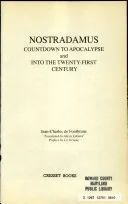
Nostradamus
 71
71

Nostradamus
De Fontbrune's "Nostradamus" is less a narrative and more a forensic examination of the seer's quatrains, particularly those concerning future events. The sheer volume of analysis is impressive, with the author dedicating significant effort to aligning specific verses with historical occurrences and projecting potential future scenarios. A notable strength is the detailed, almost academic, approach to breaking down individual prophecies, often referencing astrological data purportedly used by Nostradamus. However, the work occasionally suffers from an over-reliance on speculative connections; the leap from a cryptic verse to a specific 20th-century event, for instance, can feel tenuous. One passage that exemplifies this is the interpretation of quatrains related to the "Great King of Terror," where the author posits a direct link to contemporary geopolitical tensions with a certainty that outpaces textual evidence. The book serves as a comprehensive catalog of interpretations, but readers must remain critical of the definitive pronouncements. It offers a deep dive for the dedicated, but might alienate those seeking clearer answers.
📝 Description
71
Jean-Charles de Fontbrune's 1993 study dissects Nostradamus's prophecies with a structured approach.
Originally published in two volumes in 1993, Jean-Charles de Fontbrune's work offers a systematic analysis of Nostradamus's quatrains. The book attempts to correlate these cryptic verses with historical events and potential future occurrences. De Fontbrune structures his interpretation to unpack the layered meanings within Nostradamus's writings, providing a comprehensive view for those interested in prophetic literature and its historical context.
This study is aimed at serious students of prophecy, historical researchers, and anyone intrigued by Michel de Nostredame's enduring legacy. It appeals to readers seeking a detailed, analytical examination rather than a superficial overview. Individuals interested in the intersection of history, occultism, and eschatology will find substantial material for contemplation, especially those with a background in or curiosity about European prophetic traditions.
Published in the early 1990s, de Fontbrune's work emerged during a period of heightened interest in eschatological themes, coinciding with the approaching millennium. It engaged with existing scholarship on Nostradamus, aiming to provide a more structured and exhaustive interpretation than many popular treatments. The book's reception occurred within a broader cultural fascination with predictions and end-time narratives, influenced by global events and technological shifts.
💡 Why Read This Book?
• Gain an in-depth understanding of Jean-Charles de Fontbrune's specific methodology for interpreting Nostradamus's quatrains, including his emphasis on chronological sequencing and astrological references, as detailed in the 1993 publication. • Explore concrete analyses of specific quatrains and their purported connections to historical events between the 16th century and the late 20th century, as presented in Volume 1, "Countdown to Apocalypse." • Confront detailed interpretations of prophecies concerning the 21st century, as de Fontbrune lays them out in Volume 2, "Into the Twenty-First Century," for a structured view of future predictions.
⭐ Reader Reviews
Honest opinions from readers who have explored this book.
❓ Frequently Asked Questions
What is the primary focus of Jean-Charles de Fontbrune's "Nostradamus"?
The book meticulously analyzes the quatrains of Nostradamus, attempting to map their cryptic verses onto historical events and future predictions. It is divided into two volumes, focusing on the path to apocalypse and the 21st century.
When was Jean-Charles de Fontbrune's "Nostradamus" first published?
The original publication date for Jean-Charles de Fontbrune's comprehensive work on Nostradamus was 1993, released in two distinct volumes.
Does the book offer interpretations of specific future events?
Yes, the second volume, "Nostradamus: Into the Twenty-First Century," specifically dedicates itself to interpreting prophecies related to future events, particularly those anticipated in the 21st century.
Who is the author of this extensive analysis of Nostradamus?
The author is Jean-Charles de Fontbrune, whose detailed work on the prophecies of Nostradamus was first published in 1993.
Are there specific historical periods covered by the book's interpretations?
Indeed. The first volume, "Nostradamus: Countdown to Apocalypse," covers historical events leading up to and potentially including apocalyptic scenarios, while the second volume focuses on the unfolding of the 21st century.
What is the structure of de Fontbrune's "Nostradamus"?
The work is structured into two volumes: "Nostradamus: Countdown to Apocalypse" and "Nostradamus: Into the Twenty-First Century." Each volume systematically analyzes Nostradamus's quatrains.
🔮 Key Themes & Symbolism
Deciphering the Quatrains
De Fontbrune's work centers on the intricate process of interpreting Michel de Nostredame's quatrains. He employs a method that emphasizes chronological order, astrological conjunctions cited within the verses, and the interrelation of different prophecies. The aim is to move beyond vague generalizations, providing a structured framework for understanding the seer's often obscure language and symbolic imagery. This systematic approach is crucial for readers seeking to engage with the prophecies on a deeper, analytical level, rather than accepting surface-level interpretations.
Apocalypse and Future Foretelling
A significant portion of de Fontbrune's analysis, particularly in "Countdown to Apocalypse," addresses eschatological predictions. The book attempts to correlate specific quatrains with major historical upheavals and potential future cataclysms. It explores the concept of a preordained future as suggested by Nostradamus, examining how historical events might align with prophetic timelines. This theme studies the human fascination with the end of times and the search for meaning in moments of global uncertainty.
Nostradamus's Historical Milieu
Understanding the context in which Nostradamus wrote is presented as key to unlocking his prophecies. De Fontbrune situates the seer within the turbulent field of 16th-century France, a period marked by religious wars, political intrigue, and widespread superstition. This historical grounding helps explain the symbolic language and allegorical references used, suggesting that the prophecies were intended for an audience familiar with the era's specific cultural and intellectual currents, including Renaissance humanism and occult philosophies.
Astrology as a Predictive Key
De Fontbrune highlights the role of astrology in Nostradamus's prophetic system. The book suggests that astrological charts, planetary alignments, and celestial events are not merely decorative but integral to the decipherment of the quatrains. By analyzing these astronomical references, de Fontbrune argues, one can pinpoint the specific times and contexts Nostradamus intended for his prophecies. This focus underscores the esoteric nature of Nostradamus's work, blending divination with celestial observation.
💬 Memorable Quotes
Direct passages from the work, attributed to the author.
“The quatrains are keys that unlock epochs and major events.”
— This statement captures the author's belief that Nostradamus's verses are not random poetic expressions but coded historical and future markers, intended to be systematically deciphered.
“Chronological order is essential for understanding the sequence of the seer's visions.”
— De Fontbrune emphasizes that the prophecies must be read in the order they unfold in time, suggesting a structured narrative of history and future events rather than isolated predictions.
“Astrological configurations provide the temporal anchors for the prophecies.”
— This highlights the author's method of using celestial events and astrological data mentioned in the quatrains to date and contextualize Nostradamus's predictions.
“The 16th-century context illuminates the symbolic language of the verses.”
— The interpretation suggests that to truly grasp Nostradamus's meaning, one must understand the historical, cultural, and intellectual environment in which he lived and wrote.
“Interlinking quatrains reveals a larger, coherent prophetic design.”
— This points to the author's approach of cross-referencing different verses to build a comprehensive understanding, indicating that individual prophecies gain clarity when viewed as part of a larger whole.
🌙 Esoteric Significance
Tradition
De Fontbrune's work engages with the Western esoteric tradition, specifically the lineage of prophetic literature and Renaissance occultism. While Nostradamus himself drew from various sources including Kabbalah and Hermeticism, de Fontbrune's analysis primarily focuses on interpreting these influences through a lens of historical correlation and future prediction. It fits within the broader tradition of divinatory arts and prophetic interpretation that has persisted through various esoteric schools, offering a structured method for understanding esoteric texts as predictive historical maps.
Symbolism
Key symbols de Fontbrune analyzes include celestial bodies (planets, stars) which he interprets as astrological markers indicating specific times or events. Another motif is the 'Great King' or 'Antichrist' figures, often linked to specific historical or future leaders and conflicts. The concept of 'conflagration' or 'great wars' also appears frequently, symbolizing periods of immense global upheaval and transformation, which de Fontbrune attempts to chronologically place within his prophetic timeline.
Modern Relevance
Contemporary interest in Nostradamus continues, and de Fontbrune's structured analytical approach, though debated, remains a reference point for those seeking detailed interpretations. His emphasis on cross-referencing quatrains and correlating them with historical and astrological data informs modern discussions among prophecy enthusiasts and researchers. While not directly tied to a specific modern esoteric school, the work's detailed methodology contributes to the ongoing discourse on predictive techniques within esoteric studies and popular culture.
👥 Who Should Read This Book
• Students of prophecy and esoteric history interested in detailed analytical methods for interpreting predictive texts, particularly those focusing on the quatrains of Nostradamus. • Researchers examining the history of eschatology and end-times predictions, seeking a comprehensive breakdown of interpretations relevant to the late 20th and early 21st centuries. • Individuals fascinated by the intersection of history, astrology, and divination who wish to explore a systematic approach to understanding prophetic literature from the Renaissance period onward.
📜 Historical Context
Jean-Charles de Fontbrune's "Nostradamus" emerged in 1993, a period marked by heightened global anxieties and a growing fascination with eschatology, particularly as the millennium approached. This era saw a resurgence of interest in prophetic figures and end-times scenarios, influenced by geopolitical shifts like the dissolution of the Soviet Union in 1991 and rapid technological advancement. De Fontbrune's work positioned itself within this climate, offering a detailed, two-volume analysis that sought to provide a more rigorous interpretation of Nostradamus's quatrains than many popular accounts. It engaged with a long tradition of Nostradamus scholarship, which had been active since the seer's death in 1566, and competed with contemporary interpretations that often focused on sensationalism. The book aimed to provide a systematic, almost academic, approach, distinguishing itself from more speculative or New Age treatments of the prophecies. Its reception occurred against a backdrop where figures like Hal Lindsey had already popularized apocalyptic narratives.
📔 Journal Prompts
The chronological sequencing of quatrains as a method of interpretation.
Nostradamus's use of astrological configurations to anchor prophecies in time.
The symbolic representation of major historical upheavals in the quatrains.
Connecting 16th-century symbolism to predictions about the 21st century.
The concept of the 'Great King of Terror' and its potential historical or future manifestations.
🗂️ Glossary
Quatrain
A stanza of four lines, specifically referring to the four-line verses written by Nostradamus, which form the basis of his prophecies. These are the primary texts analyzed in de Fontbrune's work.
Michel de Nostredame
The 16th-century French astrologer and physician, widely known as Nostradamus, famous for his book 'Les Prophéties,' a collection of quatrains that have been interpreted as predictions of future events.
Eschatology
The branch of theology concerned with death, judgment, and the final destiny of the soul and of humankind. In the context of Nostradamus studies, it refers to prophecies concerning the end of the world or major historical finales.
Chronological Sequencing
The principle of arranging events or prophecies according to their order in time. De Fontbrune emphasizes this as a critical method for understanding the progression of Nostradamus's visions.
Astrological Conjunctions
The alignment of celestial bodies (planets, stars) in specific positions relative to each other. De Fontbrune uses these as potential markers for dating Nostradamus's prophecies.
Renaissance Occultism
The esoteric and magical beliefs and practices prevalent in Europe during the Renaissance (roughly 14th to 17th centuries), which often blended Neoplatonism, Hermeticism, Kabbalah, and astrology. Nostradamus's work is situated within this intellectual milieu.
Great King of Terror
A term interpreted from Nostradamus's quatrains, often associated with a prophesied malevolent leader or a period of intense global conflict and suffering in the future.
This book appears in 1 collection
🔮 Readers Also Liked
Browse all →






From the “Nostradamus” Collection
View all →







More Free Occult Philosophy Books
View all →