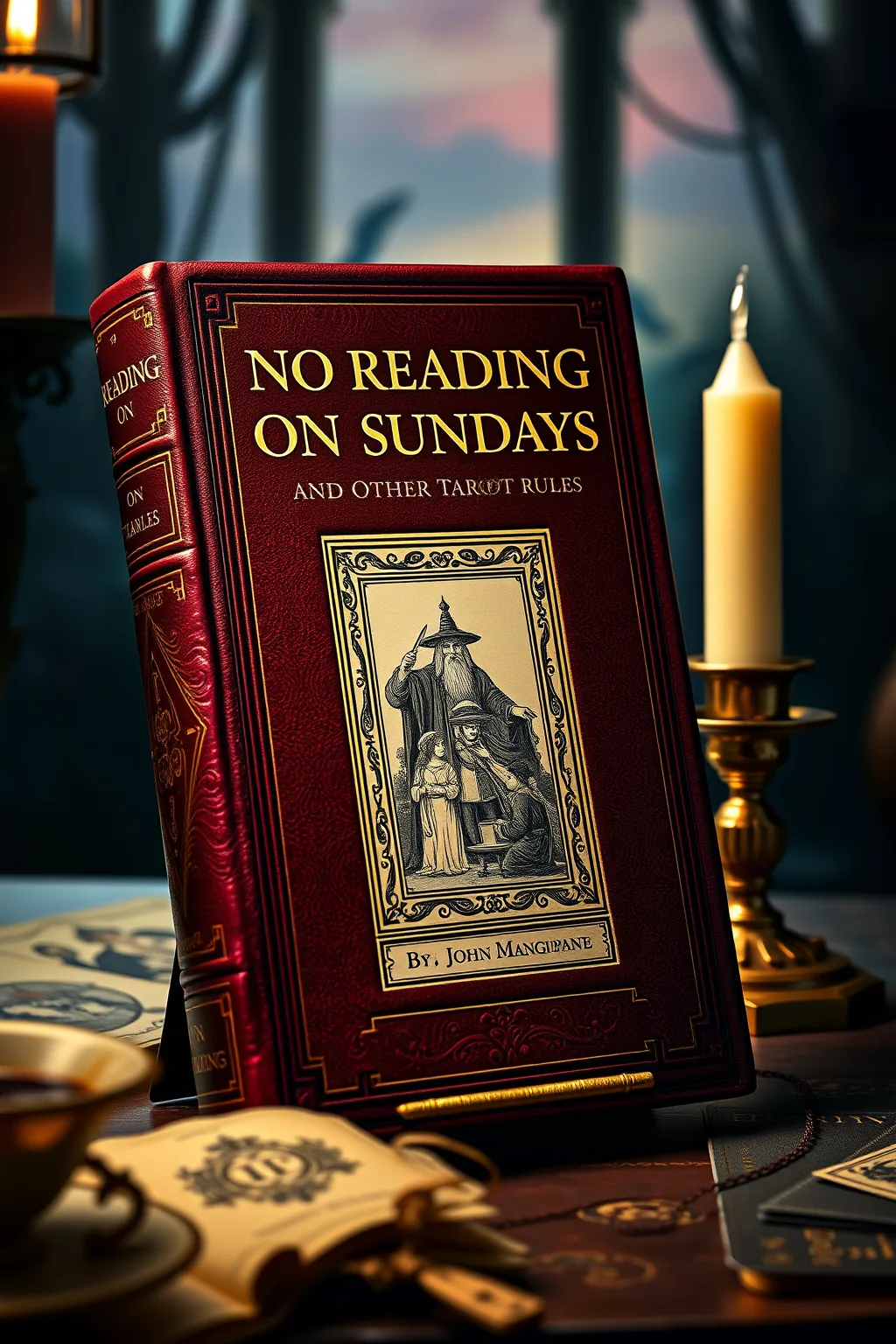
No Reading on Sundays - and Other Tarot Rules
 61
61

No Reading on Sundays - and Other Tarot Rules



John Mangiapane's "No Reading on Sundays" offers a refreshingly rigorous yet deeply spiritual approach to Tarot practice. Moving beyond superficial interpretations, Mangiapane excavates the esoteric principles and forgotten traditions that lend true power to the cards. His insights into the 'rules' are not arbitrary restrictions but keys to unlocking deeper, more potent readings. This work is essential for anyone seeking to elevate their Tarot practice from casual scrying to a profound dialogue with the cosmos. It's a scholarly yet accessible guide for serious students of divination.
📝 Description
61
John Mangiapane’s 2019 book argues that specific, often overlooked, rules shape Tarot readings.
In "No Reading on Sundays - and Other Tarot Rules," John Mangiapane examines the unwritten laws that guide the practice of Tarot divination. The book goes beyond basic card meanings to discuss the philosophical ideas and esoteric practices that give weight to Tarot work. Mangiapane outlines how these traditions add depth and significance to every reading.
The author structures the book for a range of readers, from those new to Tarot to experienced practitioners and academic students. It aims to build a stronger relationship with the Tarot's symbolic system. The goal is to move readings from simple prediction toward a more introspective examination of personal meaning. The book encourages readers to connect with the symbolic language and archetypal forces that influence human experience and destiny.
This work fits within the modern esoteric tradition of Tarot study, which often seeks to uncover or codify specific practices and philosophical frameworks beyond simple cartomancy. It addresses the idea that Tarot is not just a tool for fortune-telling but a complex system with its own internal logic and spiritual dimensions. The book engages with the hermetic, Qabalistic, or psychological interpretations that have shaped Western esoteric Tarot since the late 19th century, suggesting that adherence to certain guidelines enhances the efficacy and depth of the practice.
💡 Why Read This Book?
Uncover the hidden, sacred laws governing Tarot practice. "No Reading on Sundays" offers profound insights into the esoteric traditions and philosophical depth behind divination. Ideal for seekers yearning for authentic connection, practitioners aiming to refine their craft, and scholars interested in the mystical underpinnings of Tarot. Elevate your understanding and deepen your practice with this essential guide.
⭐ Reader Reviews
Honest opinions from readers who have explored this book.
❓ Frequently Asked Questions
What is the significance of the 'No Reading on Sundays' rule?
This 'rule' often signifies a need for rest and integration, allowing the intuitive channels to remain clear. It emphasizes the importance of honoring sacred time and avoiding energetic depletion, a concept rooted in various spiritual traditions.
Are these 'rules' absolute mandates or guidelines?
Mangiapane presents these as guidelines rooted in esoteric wisdom and practical experience, encouraging readers to understand the underlying energetic principles rather than blindly following dogma.
Who is the ideal reader for this book?
This book is perfect for intermediate to advanced Tarot enthusiasts, spiritual seekers, occult scholars, and anyone who feels a calling to explore the deeper, more mystical dimensions of Tarot reading.
Does the book cover specific Tarot spreads?
While the focus is on the foundational rules and principles, the insights provided will enhance the understanding and interpretation of any Tarot spread, traditional or modern.
What esoteric traditions does the book draw upon?
The book subtly weaves in concepts from hermeticism, Kabbalah, and folk magic, presenting a synthesis of wisdom that enriches the practice of Tarot divination.
🔮 Key Themes & Symbolism
Sacred Protocols of Divination
This theme explores the concept of established, often unwritten, protocols that govern the sacred practice of Tarot reading. It moves beyond simple technique to examine the energetic, ethical, and spiritual considerations that ensure a clear and potent connection to the cards and the querent's higher self. Mangiapane looks at the 'why' behind these guidelines, suggesting they are not arbitrary but are designed to maintain energetic integrity and foster a profound dialogue with the archetypal forces.
The Esoteric Language of Tarot
Here, the focus shifts to the deep symbolic language embedded within the Tarot deck. Mangiapane guides readers to perceive the archetypal narratives, the celestial correspondences, and the alchemical processes reflected in the cards. This section illuminates how the imagery and numerology of each card form a complex, interconnected system of wisdom, offering useful insights into the human condition and the unfolding of destiny. It encourages a shift from literal interpretation to a more intuitive, symbolic apprehension of the cards' messages.
Intuition vs. Dogma in Tarot
This theme critically examines the balance between established 'rules' and the development of personal intuition in Tarot practice. Mangiapane posits that while traditional wisdom offers a strong foundation, the true power of divination lies in the practitioner's ability to connect with their inner knowing. The book encourages readers to discern the spirit behind the letter of the law, fostering an adaptable and deeply personal approach to reading the cards that honors both ancient knowledge and individual psychic attunement.
💬 Memorable Quotes
Direct passages from the work, attributed to the author.
“The cards are not merely paper; they are conduits.”
— This highlights the esoteric view of Tarot as more than just a deck, but as active participants and channels for spiritual insight and energetic exchange.
“Silence is a dialogue with the unseen.”
— Emphasizes the importance of quiet contemplation and mindful presence in Tarot practice, suggesting that true understanding comes from listening to subtle energies.
“Each shuffle is a prayer, each draw a revelation.”
— Elevates the physical actions of Tarot reading into sacred rituals, connecting the mundane act with profound spiritual significance and the unveiling of truth.
“The boundaries of the deck mirror the boundaries of the soul.”
— Suggests a profound connection between the structure and limitations of the Tarot deck and the inner field of the individual, implying that exploring one reveals the other.
“Seek not to predict, but to understand the currents.”
— Encourages a shift from fortune-telling to a deeper, more philosophical engagement with Tarot, focusing on understanding life's underlying forces and potentials.
🌙 Esoteric Significance
Tradition
This work draws heavily from Hermetic philosophy and Kabbalistic principles, viewing the Tarot as a microcosm of the universe and a map of the soul's journey. It carries the occult tradition of seeing hidden order and divine correspondence in seemingly mundane elements, suggesting that the deck itself is imbued with ancient wisdom designed to guide the practitioner towards self-understanding and spiritual enlightenment.
Symbolism
The book emphasizes the profound symbolic language of the Tarot, urging readers to look beyond literal meanings to the archetypal narratives and hidden correspondences within each card. It highlights how the imagery, numbers, and suits are not arbitrary but represent fundamental forces and concepts, acting as keys to unlock deeper psychological and spiritual truths about life, death, and the cosmos.
Modern Relevance
In an age often characterized by rapid change and superficial information, "No Reading on Sundays" offers a timeless anchor to deeper wisdom. Its emphasis on mindful practice, energetic integrity, and intuitive discernment provides essential tools for working through the complexities of modern life. The book's insights remain profoundly relevant for anyone seeking authentic spiritual growth, robust self-awareness, and a more meaningful connection to the subtle energies that shape our reality.
👥 Who Should Read This Book
This book is a treasure for the dedicated Tarot enthusiast, whether a seasoned practitioner seeking to deepen their understanding or a beginner with a serious inclination towards esoteric study. Scholars of occultism and divination will find its rigorous approach invaluable. Spiritual seekers yearning for authentic connection to archetypal wisdom and practitioners aiming to refine their intuitive faculties and energetic boundaries will discover profound guidance within its pages. It is for those who see Tarot not just as a tool for prediction, but as a sacred path to self-discovery and cosmic understanding.
📜 Historical Context
Published in an era where interest in esoteric traditions and divination arts was experiencing a resurgence, "No Reading on Sundays" emerged as a significant contribution to the modern Tarot canon. It arrived at a time when many were seeking to move beyond simplistic interpretations and explore the deeper philosophical and spiritual underpinnings of Tarot. The book taps into a lineage of occult scholarship that viewed Tarot not just as a predictive tool, but as a complex symbolic system deeply interwoven with Western esotericism, including Hermeticism, Kabbalah, and various folk magic traditions. Its emphasis on 'rules' reflects a desire to preserve and transmit established practices, while its underlying message encourages a personal, intuitive engagement that was characteristic of the era's spiritual seekers.
📔 Journal Prompts
Reflect on a time you felt a 'sacred pause' was necessary in your spiritual practice. How did it benefit you?
What 'unwritten rule' do you feel guides your intuition most strongly, and why?
Consider the concept of Tarot cards as 'conduits.' What energies do you believe are channeled through your readings?
How does the idea of 'silence as dialogue' apply to your personal approach to Tarot or meditation?
Explore the symbolic connection between the physical act of shuffling and the unfolding of your life's narrative.
🗂️ Glossary
Esoteric
Pertaining to knowledge or wisdom that is intended for or likely to be understood by only a small number of people with a specialized background or interest, often concerning mystical or spiritual truths.
Archetype
A recurrent symbolic image, character, or pattern of circumstances that is universally understood, representing fundamental human experiences and motivations, as seen in Tarot imagery.
Divination
The practice of seeking knowledge of the future or the unknown by supernatural means, such as through the interpretation of omens, signs, or symbolic systems like the Tarot.
Hermeticism
A religious, philosophical, and esoteric tradition based primarily upon writings attributed to Hermes Trismegistus, emphasizing unity, correspondence, and the pursuit of spiritual wisdom through understanding the cosmos.
Kabbalah
A system of Jewish mysticism and esoteric interpretation of the Torah, often involving complex symbolic diagrams and philosophies concerning the nature of God and creation.
This book appears in 3 collections
🔮 Readers Also Liked
Browse all →








More by John Mangiapane
All books →



From the “Tarot” Collection
View all →





More Free Divination & Tarot Books
View all →