Nietzsche and Jung
 74
74

Nietzsche and Jung
Huskinson's "Nietzsche and Jung" provides a rigorous, if at times dense, exploration of the philosophical lineage underpinning analytical psychology. Its strength lies in meticulously drawing out the conceptual threads connecting Nietzsche's critique of Western metaphysics and morality to Jung's psychological framework. The author avoids superficial comparisons, instead engaging deeply with primary texts from both thinkers. A particular triumph is the section discussing Nietzsche's concept of eternal recurrence and its subtle echoes in Jung's cyclical view of psychic development. However, the book's academic focus can make it challenging for those without a solid background in both Nietzschean philosophy and Jungian theory; the prose occasionally becomes overly specialized. While it illuminates the intellectual soil from which Jung's ideas grew, it might have benefited from broader contextualization within other contemporaneous psychological movements. Despite these limitations, it remains a significant contribution for specialists seeking to understand the philosophical bedrock of depth psychology.
📝 Description
74
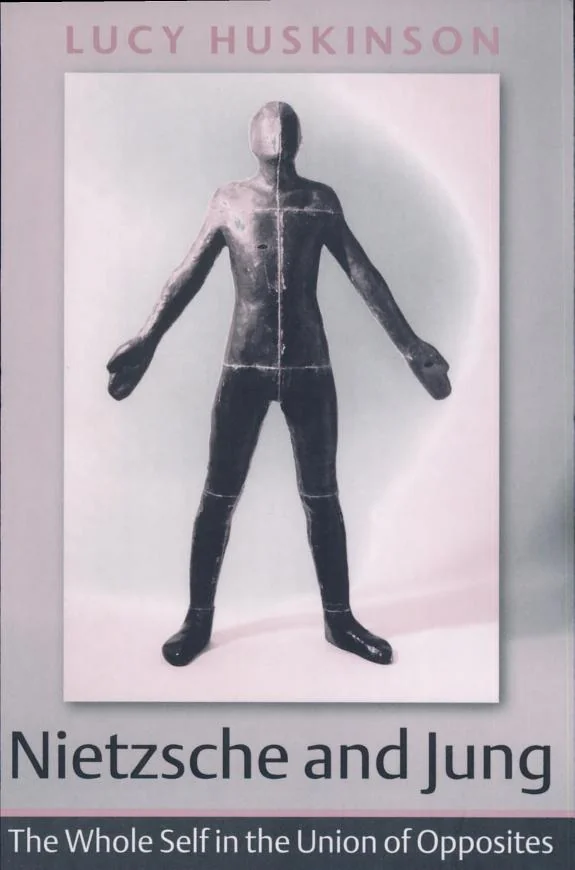
Lucy Huskinson's 2004 book examines the intellectual links between Nietzsche and Jung.
Published in 2004, Lucy Huskinson's "Nietzsche and Jung" offers a scholarly analysis of the connections between these two major modern thinkers. The book systematically investigates the philosophical basis of Carl Jung's analytical psychology, drawing comparisons and distinctions with Friedrich Nietzsche's critiques of existentialism and nihilism. Huskinson positions Jung's psychological theories not as isolated developments, but as a response to and evolution from Nietzsche's radical re-evaluation of Western values.
This work is primarily for academics and postgraduate students in psychology, philosophy, and comparative literature, as well as scholars of 19th and 20th-century intellectual history. It will interest those studying the origins of depth psychology and its philosophical influences, particularly how existential anxieties and Nietzsche's critique of traditional morality may have shaped Jung's exploration of the psyche. The book is not an introduction for general readers new to either philosopher.
This book situates Jungian psychology within a broader philosophical tradition that grapples with meaning in a post-religious world. By linking Jung's concepts to Nietzsche's existential and nihilistic critiques, Huskinson highlights how depth psychology can be understood as a response to the perceived crisis of meaning in modern Western culture. It engages with the intellectual currents that sought to understand the human condition through both philosophical inquiry and psychological exploration, particularly in the wake of traditional value systems' erosion.
💡 Why Read This Book?
• Gain a clearer understanding of how Nietzsche's critique of morality and his concept of the 'will to power' provide a philosophical backdrop for Jung's theories on the collective unconscious, a core element of analytical psychology. • Appreciate the intellectual genealogy of depth psychology by examining specific parallels between Nietzsche's 19th-century philosophical challenges and Jung's 20th-century psychological responses. • Explore the concept of psychological transformation through the lens of Nietzsche's Übermensch and Jung's individuation process, understanding how these ideas intersect in the pursuit of self-realization.
⭐ Reader Reviews
Honest opinions from readers who have explored this book.
❓ Frequently Asked Questions
What is the primary focus of Lucy Huskinson's "Nietzsche and Jung"?
The book focuses on how Friedrich Nietzsche's philosophical ideas, particularly his critiques of morality and religion, influenced and enriched the development of Carl Jung's analytical psychology.
Which philosophical concepts of Nietzsche are most explored in relation to Jung's work?
Key Nietzschean concepts examined include the 'will to power,' the Übermensch, eternal recurrence, and his critique of traditional values, often contrasted with Jung's notions of individuation and the collective unconscious.
Is "Nietzsche and Jung" suitable for beginners in philosophy or psychology?
No, the book is written for an academic audience with existing knowledge of both Nietzsche's philosophy and Jung's psychological theories. It delves into complex theoretical intersections.
What year was Lucy Huskinson's "Nietzsche and Jung" first published?
Lucy Huskinson's "Nietzsche and Jung" was first published in 2004.
How does the book connect Nietzsche's ideas to Jung's concept of the collective unconscious?
It explores how Nietzsche's philosophical challenges to established truths and his analyses of human drives might have provided a conceptual framework for Jung's later formulation of the collective unconscious.
What is the main argument regarding the enrichment of analytical psychology?
The book argues that analytical psychology, as developed by Jung, can be significantly enriched by a deeper understanding of its philosophical roots in Nietzsche's radical critiques of Western thought and culture.
🔮 Key Themes & Symbolism
Nietzschean Critique and Jungian Psyche
This theme examines how Friedrich Nietzsche's radical philosophical critiques of Western morality, religion, and metaphysics laid conceptual groundwork for Carl Jung's psychological explorations. Huskinson investigates how Nietzsche's ideas, such as the 'will to power' and the critique of Christian values, might have informed Jung's understanding of the psyche's inherent drives and the need for psychological liberation from societal constraints. The work suggests that Jung's development of concepts like the collective unconscious and archetypes can be seen, in part, as a response to the existential void and nihilism that Nietzsche's philosophy illuminated.
The Übermensch and Individuation
A central theme is the comparison between Nietzsche's concept of the Übermensch (Overman) and Jung's process of individuation. Huskinson analyzes how both thinkers envisioned a path towards a higher state of human existence, albeit through different means. Nietzsche's Übermensch represents a self-overcoming individual who creates their own values, while Jung's individuation is the lifelong process of integrating conscious and unconscious aspects of the self to achieve wholeness. The book explores the potential overlaps and divergences in their visions of human potential and self-realization.
Philosophical Roots of Depth Psychology
This theme addresses the book's core argument: that analytical psychology is deeply indebted to philosophical traditions, particularly those of the 19th century. Huskinson traces the intellectual lineage, demonstrating how Jung's psychological theories did not emerge in a vacuum but were shaped by engagement with philosophers like Nietzsche. By highlighting these philosophical roots, the work aims to enrich the understanding of Jungian psychology, positioning it as an intellectual descendant of existentialist and critical philosophical movements that grappled with meaning, consciousness, and the human condition.
Eternal Recurrence and Psychic Cycles
The concept of eternal recurrence, a thought experiment proposed by Nietzsche, is examined for its potential resonance within Jungian thought. Huskinson explores how this idea, which asks one to affirm life in its entirety, repeating infinitely, might parallel Jung's understanding of cyclical patterns in the psyche and the potential for psychological renewal. The connection suggests a shared concern with affirming existence and finding meaning within the vastness of time and human experience, viewed through different disciplinary lenses.
💬 Memorable Quotes
Direct passages from the work, attributed to the author.
“The work explores how Nietzsche's critique of Western morality provides a philosophical context for Jung's psychological theories.”
— This highlights the book's central thesis: that understanding Nietzsche's radical questioning of established ethical systems is crucial for grasping the impetus behind Jung's exploration of the unconscious and the individual's psychological journey.
“Huskinson examines the parallels between Nietzsche's Übermensch and Jung's concept of individuation.”
— This points to a key comparative analysis within the book, focusing on how both thinkers conceptualized the ultimate goal of human development—Nietzsche's self-created, value-generating individual versus Jung's integrated, whole self.
“The book investigates the philosophical underpinnings of analytical psychology.”
— This emphasizes the scholarly approach of the work, positioning Jungian psychology not merely as a clinical tool but as a discipline deeply rooted in and informed by broader philosophical debates of its time.
“Nietzsche's critique of religion is considered in relation to Jung's archetypes.”
— This suggests a specific line of inquiry within the book, exploring how Nietzsche's dismantling of traditional religious frameworks might have influenced Jung's understanding of universal psychic patterns and symbols.
“The 2004 publication situates Jung's thought within its philosophical lineage.”
— This indicates the book's contribution to intellectual history, offering a specific academic perspective from the early 21st century on how to understand Jung's psychological system through its philosophical antecedents.
🌙 Esoteric Significance
Tradition
While not strictly an esoteric text itself, "Nietzsche and Jung" operates at the intersection of philosophy and depth psychology, which have significant esoteric dimensions. It touches upon Gnostic themes of liberation from oppressive structures (Nietzsche's critique of morality) and the arduous journey toward self-knowledge (Jung's individuation). Its relevance lies in informative the philosophical underpinnings of psychological systems that explore the hidden, unconscious areas of the psyche, a core concern in many esoteric traditions seeking inner transformation.
Symbolism
The book implicitly engages with symbolic language by contrasting Nietzsche's existential pronouncements with Jung's archetypal psychology. While not detailing specific symbols, it touches on concepts that function symbolically: Nietzsche's 'will to power' can be seen as a primal, driving force akin to archetypal energies, and the Übermensch represents an ideal archetype of self-mastery. Jung's 'shadow' and the 'collective unconscious' are themselves potent symbolic reservoirs of human experience, explored through the philosophical lens provided by Nietzsche.
Modern Relevance
Contemporary thinkers in transpersonal psychology, consciousness studies, and even certain branches of philosophical hermeneutics draw upon the intellectual currents explored in "Nietzsche and Jung." The book's examination of existential angst and the search for meaning speaks to modern challenges of secularization and the crisis of values. Practitioners interested in the philosophical underpinnings of therapeutic approaches that integrate spiritual or existential inquiry find value in understanding how foundational psychological concepts evolved from profound philosophical questioning.
👥 Who Should Read This Book
• Advanced students of Jungian psychology seeking to understand the philosophical origins of key concepts like the collective unconscious and individuation. • Scholars of 19th and 20th-century philosophy interested in the reception and influence of Nietzsche's work on later intellectual movements. • Researchers in comparative literature and intellectual history exploring the cross-pollination between philosophical critique and psychological theory. • Individuals interested in the existential dimensions of psychology and how philosophical ideas address the human search for meaning.
📜 Historical Context
Lucy Huskinson's "Nietzsche and Jung" was published in 2004, a period marked by continued interdisciplinary scholarship seeking to bridge philosophy and psychology. The late 20th and early 21st centuries saw a re-examination of foundational thinkers like Nietzsche (d. 1900) and Jung (d. 1961) through post-structuralist and hermeneutic lenses. Huskinson's work engaged with a robust academic discourse that had been exploring the philosophical roots of psychoanalysis and depth psychology for decades. Notably, it spoke to ongoing debates about existentialism's influence on psychology, positioning Jung's work in dialogue with thinkers like Heidegger and Sartre, who were themselves deeply engaged with Nietzsche's legacy. While not facing overt censorship, the academic reception of such comparative works typically involved rigorous peer review within specialized journals, assessing their contribution to Nietzsche studies and Jungian scholarship respectively.
📔 Journal Prompts
Nietzsche's critique of morality and Jung's individuation process: explore their potential synthesis.
The concept of the 'will to power' as an archetypal force in the psyche.
Reflect on the Übermensch and its relation to personal goals of self-overcoming.
Jung's collective unconscious: how might philosophical challenges inform its structure?
The philosophical roots of analytical psychology and their impact on modern self-understanding.
🗂️ Glossary
Analytical Psychology
The school of psychology founded by Carl Jung, focusing on the interplay of the conscious and unconscious mind, archetypes, and the process of individuation.
Will to Power
A central concept in Nietzsche's philosophy, often interpreted as a fundamental drive for growth, expansion, and self-mastery, not necessarily aggressive domination.
Übermensch
Nietzsche's concept of a higher type of human being who transcends conventional morality and creates their own values, embodying self-mastery and affirmation of life.
Individuation
In Jungian psychology, the lifelong process of psychological development whereby a person becomes an individual, a whole, integrated self, differentiating from the collective.
Collective Unconscious
A concept developed by Carl Jung, referring to a layer of the unconscious mind shared by all humanity, containing archetypes and inherited predispositions.
Eternal Recurrence
Nietzsche's thought experiment proposing that one must live life as if it were to be repeated eternally, emphasizing the affirmation of all existence.
Nihilism
The philosophical belief that life is without objective meaning, purpose, or intrinsic value, a concept critically examined by Nietzsche.
This book appears in 1 collection
🔮 Readers Also Liked
Browse all →









From the “Jungian Psychology” Collection
View all →








More Free Occult Philosophy Books
View all →