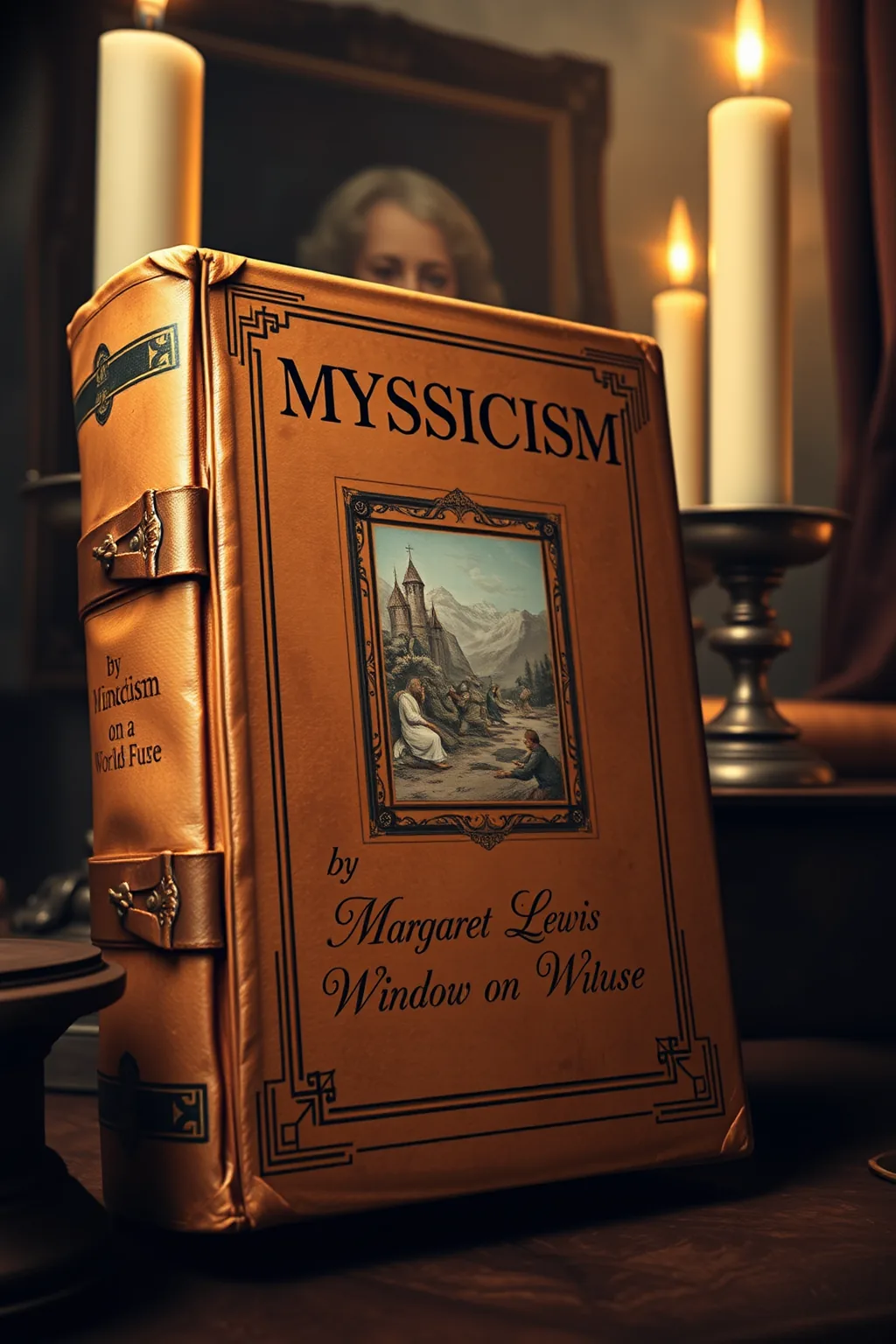
Mysticism: Window on a World View
 76
76

Mysticism: Window on a World View



Margaret Lewis Furse's 'Mysticism: Window on a World View' stands as a compelling testament to the enduring power of contemplative inquiry. Furse offers a lucid and accessible exploration of mystical experiences, bridging the gap between ancient wisdom and the modern seeker. Her insightful analysis delves into the common threads that bind diverse mystical traditions, highlighting the subjective nature of spiritual awakening. This volume is particularly valuable for its ability to articulate complex metaphysical concepts with clarity and grace, making it an ideal resource for those embarking on their own path of self-discovery or seeking to deepen their understanding of esoteric philosophies. A truly illuminating read.
📝 Description
76
Margaret Lewis Furse published 'Mysticism: Window on a World View' around 1977.
Margaret Lewis Furse's 1977 book, 'Mysticism: Window on a World View,' examines the ways mystics throughout history perceived reality. Furse connects these varied experiences by identifying common patterns in mystical thought and practice. She suggests that these patterns offer a framework for understanding a different kind of knowledge, one that goes beyond ordinary sensory input and rational thought.
The book details specific symbolic systems and contemplative techniques used by mystics. Furse argues that by studying these, readers can gain insight into a worldview that prioritizes inner experience. The text aims to show how these mystical perspectives function as a coherent, albeit unconventional, way of understanding existence.
Published in the late 1970s, 'Mysticism: Window on a World View' sits within a tradition of esoteric studies that gained traction in the 20th century. This period saw increased interest in comparative mysticism and the psychological underpinnings of spiritual experience, moving beyond purely religious dogma. Furse's work participates in this trend by analyzing mystical phenomena as a distinct mode of cognition and consciousness, often referencing figures and traditions like Christian mysticism, Sufism, and Eastern contemplative paths.
💡 Why Read This Book?
This book is essential for anyone seeking to understand the fundamental nature of consciousness and reality beyond the mundane. It provides a comprehensive yet accessible overview of mystical traditions, offering practical insights for spiritual growth. Ideal for those who are curious about esoteric knowledge, practicing meditators, and students of comparative religion or philosophy looking to explore the universal language of the soul.
⭐ Reader Reviews
Honest opinions from readers who have explored this book.
❓ Frequently Asked Questions
What is the primary focus of this book?
The book's primary focus is to explore the nature of mysticism as a unique way of knowing and experiencing reality, offering a window into diverse world views shaped by spiritual insight.
Is this book suitable for beginners in mysticism?
Yes, 'Mysticism: Window on a World View' is highly recommended for beginners due to its clear explanations and accessible approach to complex spiritual concepts.
What does the author mean by 'Window on a World View'?
Furse uses this metaphor to suggest that mystical experience offers a unique and profound perspective, revealing dimensions of reality not accessible through ordinary sensory perception or rational thought.
Does the book discuss specific mystical traditions?
Yes, the book draws from and discusses various mystical traditions, highlighting their commonalities and unique expressions of spiritual truth.
What is the philosophical significance of this work?
The book challenges materialistic and purely rationalistic views of the world, advocating for the validity of intuitive and contemplative knowing as a crucial aspect of human understanding.
🔮 Key Themes & Symbolism
The Nature of Mystical Experience
This theme examines the subjective and transformative nature of mystical encounters, exploring how these profound experiences transcend ordinary consciousness. It examines the inner range of the mystic, the role of intuition, and the ineffable qualities of spiritual revelation. Furse illuminates how these experiences offer a distinct form of knowledge, often expressed through metaphor and symbolism, that fundamentally alters one's perception of self and the universe. This section is crucial for understanding the experiential core of mysticism.
Cross-Cultural Mystical Traditions
Furse masterfully combines insights from various spiritual and religious traditions, demonstrating the universal threads that connect diverse mystical paths. The book explores how different cultures and historical periods have articulated similar spiritual aspirations and experiences, revealing an underlying unity in the human quest for the divine. It highlights shared symbols, practices, and ultimate aims, emphasizing that the mystical impulse is a fundamental aspect of the human condition, transcending geographical and temporal boundaries.
Symbolism and the Unseen
This theme focuses on the language of symbolism as a key to unlocking deeper spiritual truths. Furse explains how mystics utilize symbols, metaphors, and allegories to communicate insights that are often beyond direct verbal articulation. The book explores the power of these symbolic representations in bridging the gap between the manifest and the unmanifest, the temporal and the eternal. Understanding this symbolic language is presented as essential for interpreting the profound messages embedded within mystical literature and experiences.
💬 Memorable Quotes
Direct passages from the work, attributed to the author.
“Mysticism is the art of seeing the eternal in the ephemeral.”
— This highlights the mystical ability to perceive timeless reality within the fleeting moments of everyday life.
“Beyond the veil of reason lies the luminous range of the soul.”
— This points to the limitations of intellect and the vast, radiant realm accessible through spiritual intuition and inner exploration.
“Each soul is a universe, reflecting the divine.”
— This emphasizes the inherent divinity and infinite potential within every individual, suggesting a microcosm-macrocosm connection.
“Contemplation is the key that unlocks the door to true understanding.”
— This underscores the transformative power of deep, focused meditation and introspection in achieving profound spiritual insight.
💡 Key Ideas
Editorial paraphrase of the work's core concepts — not direct quotes.
The universe whispers its secrets to the quiet heart.
This quote suggests that profound truths and hidden knowledge are not found through external searching but through inner stillness and receptivity.
🌙 Esoteric Significance
Tradition
This work draws from and synthesizes insights across a broad spectrum of esoteric and mystical traditions, including Neoplatonism, Sufism, Christian mysticism, and Eastern contemplative paths. It emphasizes the universal principles underlying these diverse expressions of spiritual seeking, presenting mysticism as a trans-traditional phenomenon rather than exclusive to any single lineage. The focus is on the direct experience of the divine or ultimate reality, common to all genuine esoteric paths.
Symbolism
The book deeply explores the role of symbolism as a primary vehicle for conveying esoteric truths. It examines how archetypal images, allegories, and metaphors found in myths, scriptures, and contemplative visions serve as essential tools for understanding the unseen realms. Furse highlights that these symbols are not mere decorations but represent profound spiritual realities and psychological states, acting as keys to unlock deeper levels of consciousness and perception for the initiated or the dedicated seeker.
Modern Relevance
In an age often characterized by materialism and rapid technological advancement, Furse's work offers a vital counterpoint, reminding us of the enduring human need for inner exploration and transcendent experience. The book's emphasis on contemplative practice and direct knowing remains highly relevant for individuals seeking meaning, peace, and a deeper connection to themselves and the universe amidst the complexities of modern life. It provides a framework for integrating spiritual wisdom into contemporary existence.
👥 Who Should Read This Book
This book is important for spiritual seekers eager to explore the common threads of diverse mystical traditions and understand the transformative power of contemplative experience. Scholars of comparative religion and philosophy will find it a well-researched and insightful resource. Practitioners of meditation and mindfulness will appreciate its depth in articulating the subtle states of consciousness. Beginners curious about the esoteric nature of reality and experienced practitioners alike will find 'Mysticism: Window on a World View' to be a guiding light on their journey towards deeper self-awareness and spiritual insight.
📜 Historical Context
Published in the late 1970s, 'Mysticism: Window on a World View' emerged during a period of significant interest in Eastern philosophies, consciousness studies, and alternative spiritualities. The countercultural movements of the preceding decades had opened many Western minds to contemplative practices and esoteric traditions. This era saw a burgeoning of literature exploring the intersection of psychology, spirituality, and philosophy. Furse's work fits within this context, offering a thoughtful and scholarly yet accessible bridge for readers seeking to understand the perennial wisdom traditions and the depths of human spiritual potential, moving beyond purely dogma-bound religious frameworks.
📔 Journal Prompts
Reflect on a moment when you felt a profound connection to something larger than yourself. What was the experience like, and how did it change your perspective?
Explore the meaning of a symbol that resonates deeply with you. How does this symbol speak to your inner experience or spiritual path?
Describe a time when your intuition guided you. How did this inner knowing feel, and what was the outcome?
Consider the concept of 'seeing the eternal in the ephemeral.' How can you cultivate this awareness in your daily life?
What aspects of your current worldview might be expanded by a more contemplative or intuitive approach to understanding?
🗂️ Glossary
Mysticism
The pursuit of achieving communion with, identity in manifestation with, or conscious awareness of an ultimate reality, the divine, spiritual truth, or God, through direct experience, intuition, and contemplation rather than through rational thought or sensory perception.
Contemplation
A prolonged period of meditation or reflection focused on spiritual themes or the divine, aiming for inner stillness, insight, and union with ultimate reality.
Esoteric
Intended for or likely to be understood by only a small number of people with a specialized knowledge or interest; relating to the hidden or inner meaning of something.
Transcendence
Existence or experience beyond the normal or physical level; the state of being or going beyond the limits of ordinary reality or consciousness.
Intuition
The ability to understand something immediately, without the need for conscious reasoning; a direct perception or apprehension of truth, often arising from the subconscious mind.
This book appears in 1 collection
🔮 Readers Also Liked
Browse all →









More by Margaret Lewis Furse
All books →
From the “Christian Mysticism” Collection
View all →







More Free Mysticism & Contemplation Books
View all →






![The Conference Of The Birds Penguin Classics [download]](/img/thumb/the-conference-of-the-birds-penguin-classics-download.webp)