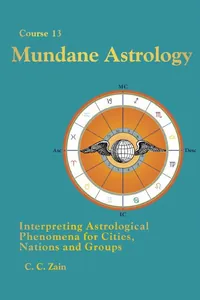
Mundane Astrology

 71
71

Mundane Astrology
Michael Baigent, Nicholas Campion, and Charles Harvey’s *Mundane Astrology* offers a rigorous examination of a specialized branch of astrological study. Its strength lies in its comprehensive approach, presenting a coherent methodology for analyzing the celestial influences on nations and collective bodies. The detailed discussions on national horoscopes and their interpretation, particularly concerning the astrological significance of sovereign states, are meticulously researched. However, for the uninitiated, the sheer density of information and the specialized terminology might present a steep learning curve. A passage detailing the astrological chart for the founding of Rome, for instance, highlights the depth of analysis, connecting planetary positions to the empire's trajectory. While some sections could benefit from more accessible explanations, the work remains an indispensable resource for those dedicated to understanding the astrological dimensions of world events. It stands as a significant scholarly contribution to the field.
📝 Description
71
Published in 1992, Mundane Astrology systematically examines celestial patterns correlating with historical events.
This book moves beyond individual horoscopes to analyze astrological influences on nations, groups, and collective human affairs. It systematically examines how celestial patterns correlate with historical events, political shifts, and societal trends on a global scale. The authors address a gap in contemporary astrological literature, which had largely focused on natal and event astrology. They sought to revive and systematize the study of national horoscopes and world affairs, drawing on historical precedents.
Mundane Astrology is aimed at serious students of astrology, political scientists, historians, and anyone interested in the macro-level forces shaping world events. It provides a framework for interpreting collective consciousness, the astrological underpinnings of geopolitics, economic cycles, and international relations.
The book emerged during a period of renewed interest in traditional astrological disciplines, particularly within academic and esoteric circles. It sought to revive and systematize the study of national horoscopes and world affairs, drawing on historical precedents. This work addresses a specific branch of astrology that interprets the collective destiny of nations and peoples, distinct from individual horary or natal interpretations.
💡 Why Read This Book?
• Learn a systematic approach to interpreting national charts, including specific techniques for analyzing the horoscopes of countries like the United States, as detailed in the book's analytical sections. • Understand the astrological implications of major world events and historical shifts by examining the authors' correlations between celestial patterns and collective human affairs, as explored in the early chapters. • Gain insight into the astrological significance of geopolitical structures and national identities, moving beyond personal horoscopes to grasp the forces shaping global dynamics, a core concept presented throughout the text.
⭐ Reader Reviews
Honest opinions from readers who have explored this book.
❓ Frequently Asked Questions
What is mundane astrology and how does it differ from natal astrology?
Mundane astrology focuses on the collective, analyzing the astrological influences on nations, cities, and global events. Unlike natal astrology, which interprets an individual's birth chart, mundane astrology examines charts for national beginnings or significant collective occurrences to understand world affairs.
Who are the primary authors of Mundane Astrology?
The book is authored by Michael Baigent, Nicholas Campion, and Charles Harvey. It was first published in 1992, consolidating their expertise in astrological scholarship and historical analysis.
What historical periods or events does the book reference?
The work references historical periods and events relevant to national chart interpretation, drawing on examples from ancient civilizations to more modern nation-states to illustrate astrological principles in collective contexts.
Does the book provide practical techniques for casting mundane charts?
Yes, the book details the principles and methodologies for casting and interpreting mundane charts, offering practical guidance for practitioners interested in applying astrological analysis to geopolitical and societal phenomena.
What is the significance of the 'mundane chart'?
The mundane chart is an astrological chart cast for a specific event or entity of collective significance, such as a nation's independence day or the founding of a city. It is used to interpret the destiny and characteristics of that entity.
Is this book suitable for beginners in astrology?
While comprehensive, the book is geared towards those with a solid foundation in astrological principles. Beginners might find the specialized subject matter and depth of analysis challenging without prior astrological knowledge.
🔮 Key Themes & Symbolism
National Horoscopes
The book meticulously details the construction and interpretation of national horoscopes, considering charts cast for moments of independence, constitution signing, or foundational events. It explores how planetary positions and aspects at these crucial junctures correlate with a nation's character, historical trajectory, and collective destiny. The authors analyze specific examples, demonstrating how astrological symbolism can be applied to understand the unique energies and challenges faced by different countries on the world stage.
Geopolitical Astrology
This theme examines the astrological underpinnings of international relations, conflicts, and alliances. The work posits that celestial cycles influence the rise and fall of empires, the outcomes of wars, and the stability of global powers. It provides a framework for understanding how astrological factors might contribute to geopolitical trends, economic cycles, and societal shifts on a large scale, moving beyond individual destinies to collective movements.
Collective Consciousness
Mundane Astrology explores how astrological patterns reflect and potentially influence the collective consciousness of populations. It suggests that shared beliefs, cultural trends, and mass psychological phenomena can be correlated with specific planetary configurations and transits affecting entire nations or regions. This perspective bridges astrology with sociology and psychology, offering a lens through which to view societal moods and historical turning points.
Historical Cycles
The book examines the cyclical nature of history as viewed through an astrological lens. It investigates how recurring planetary patterns may correspond to recurring historical events or archetypal themes in human civilization. By analyzing past eras and major shifts in global power or culture, the authors illustrate how mundane astrology can offer insights into the ebb and flow of collective human experience over centuries.
💬 Memorable Quotes
Direct passages from the work, attributed to the author.
“The astrology of nations and groups.”
— This concise statement expresses the book's core subject matter, distinguishing it from individual horoscopes and defining its scope as the study of collective astrological influences.
“The standard reference work.”
— This phrase highlights the book's ambition and achievement in aiming to establish a definitive and comprehensive guide to the complex field of mundane astrology for practitioners and scholars.
“Examining the astrological influences on collective human affairs.”
— This interpretation underscores the book's focus on macro-level astrological correlations, linking celestial movements to historical events, political structures, and societal trends rather than individual destinies.
“Understanding the celestial basis of national character and destiny.”
— This interpretation points to the book's exploration of how a nation's founding chart or significant celestial events might shape its inherent qualities and historical path, offering a unique perspective on collective identity.
💡 Key Ideas
Editorial paraphrase of the work's core concepts — not direct quotes.
The application of astrology to the international stage.
This paraphrase emphasizes the geopolitical dimension of mundane astrology as presented in the book, suggesting how astrological principles can be used to analyze and understand global power dynamics and international relations.
🌙 Esoteric Significance
Tradition
This work fits within the Western Esoteric Tradition, specifically drawing from Hermetic principles and historical astrological practices. It revives and systematizes a branch of astrology that has historically been linked to statecraft, divination, and understanding cosmic influences on collective human destiny. It departs from purely psychological or spiritual interpretations by grounding its practice in empirical observation of historical events and political structures, aligning with the Hermetic emphasis on correspondence between the macrocosm and microcosm.
Symbolism
Key symbols include national horoscopes, which serve as the primary symbolic representation of a nation's identity and destiny, analogous to an individual's birth chart. Planetary cycles and aspects are interpreted not just as personal indicators but as forces shaping geopolitical events and societal trends. The symbolism of fixed stars and their influence on national destinies is also explored, adding another layer to the interpretation of collective astrological influences.
Modern Relevance
Contemporary practitioners of political astrology, geopolitical analysts, and scholars of esoteric history continue to draw upon *Mundane Astrology*. Its rigorous methodology and comprehensive scope make it a reference for understanding the astrological dimensions of international relations, economic cycles, and societal shifts. Thinkers exploring the intersection of astrology and global events, as well as those researching the history of astrological practices, reference this book as a definitive source.
👥 Who Should Read This Book
• Students of Western Esotericism seeking to understand the historical and practical applications of astrology beyond the individual horoscopes, particularly those interested in political and world events. • Astrologers aiming to expand their practice into the area of mundane astrology, requiring a foundational text for interpreting national charts and geopolitical trends. • Historians and social scientists interested in interdisciplinary approaches to understanding collective human affairs, offering a unique symbolic framework for analyzing historical cycles and societal developments.
📜 Historical Context
Published in 1992, *Mundane Astrology* emerged at a time when astrological studies were experiencing a resurgence, particularly in academic and occult circles. The late 20th century saw a growing interest in revitalizing older, more complex astrological traditions that had been overshadowed by personal natal astrology. This work by Baigent, Campion, and Harvey sought to fill a significant void by providing a scholarly and systematic treatment of the astrology of nations and world events. It directly engaged with the historical legacy of mundane astrology, which had roots in ancient Babylonian, Greek, and Renaissance practices but had become less prevalent. While contemporary astrological discourse often focused on psychological interpretations, this book deliberately turned outwards, addressing the macro-level forces shaping human societies. Its reception within the astrological community was significant, establishing it as a key text for those interested in political and world astrology, though its complex methodology required dedicated study.
📔 Journal Prompts
National Horoscopes: How might the astrological chart for your nation's founding influence its current collective identity?
Geopolitical Astrology: Reflect on a significant global event and consider if its astrological timing aligns with patterns discussed in the book.
Collective Consciousness: How do planetary cycles, as described in mundane astrology, potentially correlate with observable shifts in public mood or societal focus?
Historical Cycles: Identify a recurring theme in your nation's history and explore its potential astrological symbolism based on the principles of mundane astrology.
Interpreting Mundane Charts: Practice casting and analyzing a mundane chart for a chosen city or significant national event, applying the methods outlined.
🗂️ Glossary
Mundane Astrology
The branch of astrology concerned with the affairs of nations, cities, and collective human groups, as distinct from individual horoscopes.
National Horoscope
An astrological chart cast for the inception of a nation, such as its date of independence or the signing of its constitution, used to interpret its collective destiny.
Geopolitics
The study of the influence of geography, economics, and demography on the politics and international relations of states, here viewed through an astrological lens.
Collective Consciousness
A concept referring to the shared beliefs, ideas, and attitudes which operate as a unifying force within society, explored through astrological correlations.
Planetary Cycles
The recurring periods of time associated with the orbits and relative positions of planets, considered significant indicators of historical and societal trends in mundane astrology.
Ascendant (in Mundane Charts)
The zodiacal sign rising on the eastern horizon at the time a mundane chart is cast, representing the outward persona and initial approach of the nation or entity.
Midheaven (in Mundane Charts)
The highest point in the sky at the time a mundane chart is cast, often associated with the public image, reputation, and ultimate aims of the nation or entity.
This book appears in 1 collection
🔮 Readers Also Liked
Browse all →








From the “Mundane Astrology” Collection
View all →








More Free Astrology & Cosmology Books
View all →