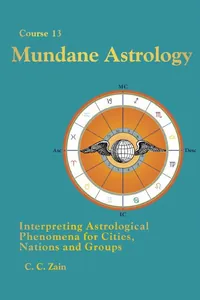
Mundane Astrology

 82
82

Mundane Astrology
C. C. Zain’s "Mundane Astrology" presents a rare technical manual for understanding world affairs through an astrological framework. Its strength lies in its systematic approach to applying astrological cycles to collective phenomena, moving beyond individual horoscopes to analyze the forces shaping nations and societies. The work’s detailed methodology for interpreting mundane cycle charts, particularly those involving the outer planets, offers a unique perspective on geopolitical forecasting. However, the dense, technical nature of the text, characteristic of the Brotherhood of Light series, requires significant prior astrological knowledge. A limitation is its somewhat dated perspective, reflecting early 20th-century geopolitical assumptions. A particularly insightful section discusses the astrological implications of national founding charts, demonstrating how celestial patterns at inception can inform a nation's trajectory. The book serves as a valuable, albeit challenging, resource for those committed to a deep study of astrological influences on a grand scale.
📝 Description
82
C. C. Zain's 1920s work applies astrological principles to global and national events.
Mundane Astrology, the thirteenth volume in the Brotherhood of Light Course, examines how celestial configurations affect collective human affairs. This book moves beyond individual horoscopes to analyze the astrological underpinnings of nations, cities, states, and world events. It provides a framework for understanding geopolitical shifts and societal movements through the lens of planetary cycles.
This manual is for serious students of astrology and Hermetic sciences interested in the larger currents of history and society. It is particularly relevant for those studying comparative astrology, geopolitical analysis from an esoteric perspective, and the practical application of astrological principles to collective phenomena. A basic understanding of astrological concepts is necessary to engage with the technical material.
The study of mundane astrology traces back to ancient Babylonian and Hellenistic traditions. This volume situates itself within the Hermetic revival of the late 19th and early 20th centuries, a period of renewed interest in occult sciences. C. C. Zain, a key figure in this revival, draws upon a long tradition of astrological interpretation applied to the affairs of peoples and nations, bridging ancient wisdom and modern esoteric thought.
💡 Why Read This Book?
• Learn to interpret major planetary cycles (e.g., Saturn-Uranus conjunctions) as indicators of significant shifts in global political and social structures, a method detailed within the 'mundane cycle charts' discussed in the book. • Gain practical techniques for analyzing the astrological influences on nations and cities, moving beyond personal horoscopes to understand collective trends as presented in this specific technical manual. • Understand the historical lineage of mundane astrology, tracing its roots and application to statecraft and societal forecasting as explored in the context of the Brotherhood of Light Course series.
⭐ Reader Reviews
Honest opinions from readers who have explored this book.
❓ Frequently Asked Questions
What is mundane astrology according to C. C. Zain?
C. C. Zain defines mundane astrology as the study of how astrological influences affect nations, cities, states, communities, corporations, and groups, focusing on world trends rather than individual destinies.
What are mundane cycle charts?
Mundane cycle charts are astrological charts designed to study local and world trends, often utilizing the cycles of major planets to forecast collective influences and societal shifts.
Is "Mundane Astrology" suitable for beginners?
No, this book is a technical manual intended for those with a foundational understanding of astrological principles, as it delves into complex interpretations of planetary cycles for collective phenomena.
What makes this book a "rare technical manual"?
It is considered rare because it provides detailed, practical methods for applying astrological analysis to world affairs, a subject often treated more theoretically or superficially in other astrological texts.
What other subjects are covered in the Brotherhood of Light Course series?
The series broadly covers Hermetic Sciences, Astrology, Alchemy, Tarot, Kabbalah, and the Occult, with "Mundane Astrology" being the thirteenth volume focusing specifically on astrological influences on collective entities.
When was "Mundane Astrology" first published?
The book was first published in 2014, as part of the Brotherhood of Light Course series by C. C. Zain, though the core teachings may originate from earlier material.
🔮 Key Themes & Symbolism
Planetary Cycles in World Affairs
The book meticulously details how the long-term cycles of major planets, from Jupiter's roughly 12-year orbit to Pluto's multi-century journey, correlate with significant shifts in global events. Zain posits that these planetary movements are not mere symbols but active influences shaping the collective consciousness and destiny of nations. The work guides readers in tracking these cycles to anticipate periods of societal upheaval, transformation, or stability.
Astrology of Nations and Cities
Mundane Astrology provides a framework for analyzing the astrological 'birth charts' of nations and cities, examining the ingress charts of capital cities and national beginnings. It explores how planetary positions at these foundational moments can be interpreted to understand a collective entity's character, potential challenges, and historical trajectory. This approach allows for a deeper comprehension of geopolitical dynamics through an esoteric lens.
Hermetic Principles in Collective Studies
As part of the Brotherhood of Light Course, this volume is deeply rooted in Hermetic philosophy, emphasizing the principle of "As Above, So Below" applied to macrocosmic events. It demonstrates how the same laws governing the individual psyche and destiny are mirrored in the collective sphere. The book integrates astrological interpretations with broader Hermetic concepts of cosmic order and universal law.
Forecasting Global Trends
The primary aim of Mundane Astrology is to equip students with tools for forecasting trends affecting large groups and entire populations. By analyzing the interplay of planetary cycles and conjunctions, readers are shown how to identify potential periods of economic fluctuation, political change, or social unrest. This offers a unique, non-conventional method for understanding the underlying astrological drivers of historical movements.
💬 Memorable Quotes
Direct passages from the work, attributed to the author.
“Mundane astrology is the study of how astrological influences affect nations, cities, states, communities, corporations and groups.”
— This foundational statement precisely defines the scope of the book, distinguishing it from personal astrology and highlighting its focus on collective entities and broad societal influences.
“Local and world trends can be studied through the use of mundane cycle charts of the major planets.”
— This highlights the core methodology of the book: utilizing specific astrological charts based on planetary cycles to analyze and understand global patterns and shifts.
“This book is one of the rare technical manuals covering the astrology of world affairs.”
— This emphasizes the unique and specialized nature of the content, positioning the work as a practical guide for a specific, less commonly explored branch of astrology.
“The 21 Brotherhood of Light Course series covers the Hermetic Sciences, Astrology, Alchemy, Tarot, Kabbalah and the Occult.”
— This contextualizes 'Mundane Astrology' within a broader curriculum of esoteric studies, indicating the depth and interconnectedness of the knowledge presented across the entire series.
💡 Key Ideas
Editorial paraphrase of the work's core concepts — not direct quotes.
Interpretation: The book offers methods to study the astrological implications of national beginnings and founding charts.
This paraphrased concept points to a key practical application discussed, where the astrological charts of a nation's inception are used to understand its ongoing development and character.
🌙 Esoteric Significance
Tradition
This work is firmly situated within the Western Hermetic tradition, specifically as transmitted through the Brotherhood of Light Course. It extends Hermetic principles, particularly the axiom "As Above, So Below," to the collective sphere of nations and global events. While drawing on classical astrology, Zain's approach is distinct in its systematic, didactic presentation and its integration with broader occult philosophy, aiming to provide a coherent map of cosmic influences on human societies.
Symbolism
Key symbols involve the major planets (Jupiter, Saturn, Uranus, Neptune, Pluto) whose cycles are central to understanding societal rhythms. National founding charts and ingress charts act as symbolic representations of a collective entity's inherent astrological blueprint. The book interprets these charts not as passive indicators but as dynamic forces that influence historical epochs, national characters, and geopolitical trends, reflecting a Hermetic view of cosmic correspondence.
Modern Relevance
Contemporary practitioners of geopolitical astrology and researchers into esoteric influences on history draw upon the systematic approach found in "Mundane Astrology." Thinkers exploring the astrological underpinnings of societal cycles, economic trends, and political shifts often reference or build upon the methodologies outlined by Zain. The book's focus on collective charts and long-term planetary cycles continues to inform modern attempts to correlate celestial mechanics with large-scale human events.
👥 Who Should Read This Book
['• Students of Hermeticism seeking to understand the application of "As Above, So Below" to geopolitical analysis, and how collective entities are influenced by celestial cycles.', '• Advanced astrology practitioners interested in moving beyond natal charts to explore the astrological drivers of world events, national trends, and societal transformations.', '• Researchers of esoteric history and comparative occultism looking for a foundational text on the specific branch of mundane astrology within the Brotherhood of Light tradition.']
📜 Historical Context
Published as the thirteenth volume in C. C. Zain's extensive Brotherhood of Light Course series, "Mundane Astrology" emerges from the early 20th-century esoteric revival. This era saw figures like Helena Blavatsky and Rudolf Steiner popularizing complex metaphysical systems, and astrological societies flourished. Zain's work stands within this tradition, aiming to systematize occult knowledge. While contemporary astrologers like Marc Edmund Jones were exploring psychological astrology, Zain’s focus remained resolutely on the macrocosmic, drawing from older traditions of state astrology. The Brotherhood of Light itself, though its teachings were compiled and published later, aimed to present a coherent, structured curriculum of Hermetic sciences. The reception of such works was largely within dedicated esoteric circles, often viewed with skepticism by mainstream academic and scientific communities of the time, but they formed the bedrock of modern occult studies.
📔 Journal Prompts
Reflect on the significance of Saturn-Pluto cycles in historical periods of major global power shifts.
Analyze the concept of a nation's "birth chart" and its potential influence on its collective destiny.
Consider how the astrological cycles of outer planets might manifest in contemporary world events.
Explore the connection between the Brotherhood of Light's Hermetic principles and the study of mundane astrology.
How do the "mundane cycle charts" offer a different perspective on societal trends compared to individual horoscopes?
🗂️ Glossary
Mundane Astrology
The branch of astrology concerned with the study of astrological influences on collective human affairs, including nations, cities, states, and global events, rather than individual horoscopes.
Mundane Cycle Charts
Specific astrological charts constructed to analyze local and world trends, often focusing on the cyclical movements and conjunctions of major planets to forecast collective influences.
Brotherhood of Light Course
A series of 21 books authored by C. C. Zain, covering a comprehensive curriculum of Hermetic sciences, including astrology, alchemy, Kabbalah, and occult philosophy.
Hermetic Sciences
A body of knowledge and practices derived from the teachings attributed to Hermes Trismegistus, emphasizing principles of correspondence, polarity, and causality in the universe.
Ingress Charts
Astrological charts cast for the moment a planet enters a new zodiac sign, often used in mundane astrology to interpret the influences associated with that planetary placement for a given period or entity.
Planetary Cycles
The recurring periods of time it takes for planets to orbit the Sun, considered by mundane astrologers to correlate with significant shifts and phases in collective human affairs and world events.
Occult
Referring to hidden or secret knowledge, typically related to supernatural, mystical, or magical powers and practices, often studied within esoteric traditions.
This book appears in 1 collection
🔮 Readers Also Liked
Browse all →

![ERIC ED476541: Animals of the Chinese Zodiac. [Lesson Plan].](/img/thumb/eric-ed476541-animals-of-the-chinese-zodiac-lesson-plan-eric.webp)






From the “Mundane Astrology” Collection
View all →







More Free Astrology & Cosmology Books
View all →