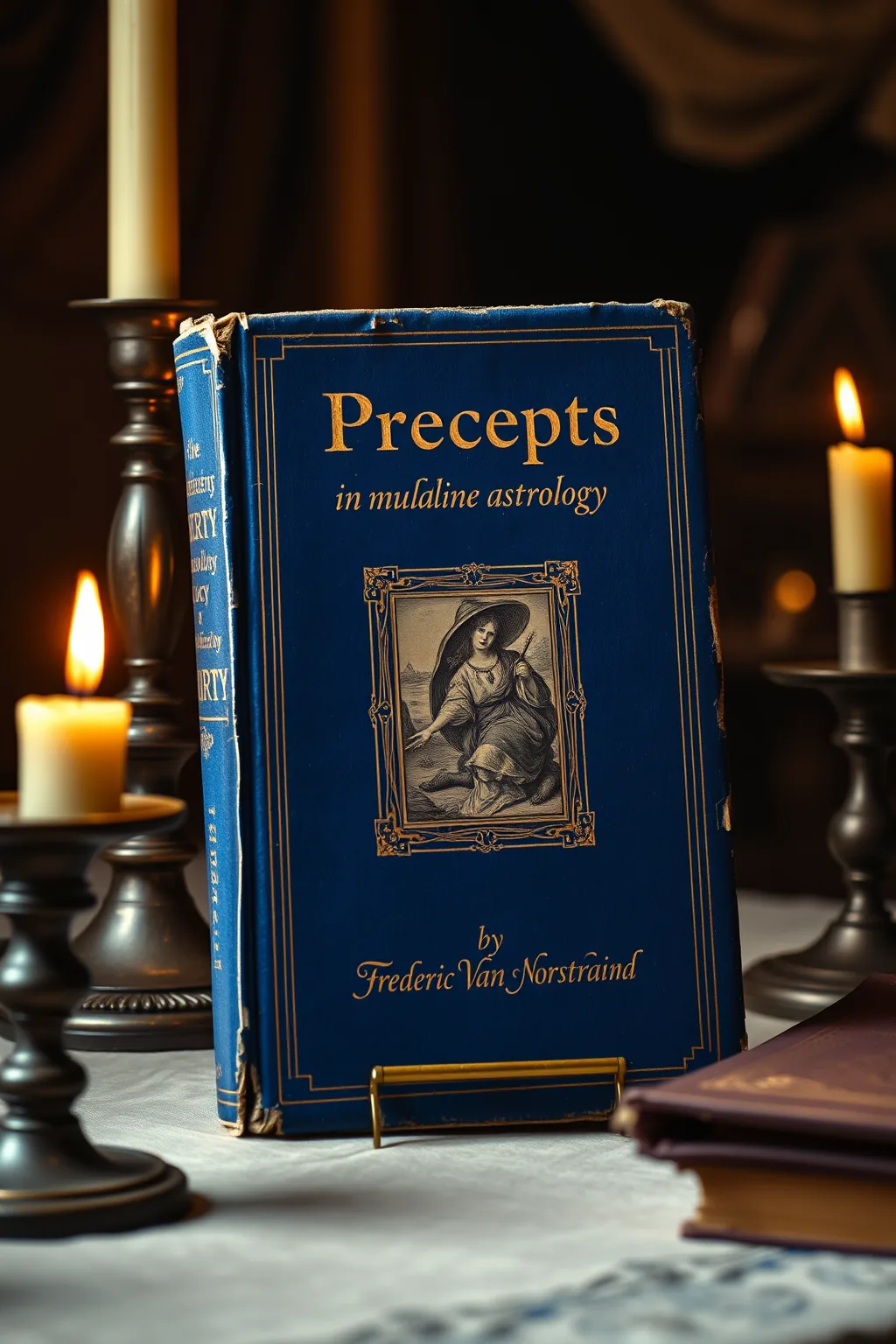
Precepts in mundane astrology
 61
61

Precepts in mundane astrology


Sophia Crane (Associate Editor) — Frederic Van Norstrand's 'Precepts in Mundane Astrology' is a luminous beacon for practitioners seeking to deepen their understanding of astrological application. Van Norstrand masterfully bridges the esoteric and the practical, offering insights that resonate with ancient wisdom while remaining relevant to contemporary concerns. His prose is both scholarly and evocative, guiding the reader through complex astrological principles with clarity and grace. This work is particularly valuable for its emphasis on the philosophical underpinnings of mundane astrology, encouraging a more nuanced and profound interpretation of charts. It is an essential read for serious students and seasoned astrologers alike, promising to elevate their practice and illuminate the sacred geometry of human affairs.
📝 Description
61
Frederic Van Norstrand's 'Precepts in Mundane Astrology' was published in 1928.
Frederic Van Norstrand's 'Precepts in Mundane Astrology' examines how celestial bodies influence human affairs. The book moves beyond simple predictions to consider astrology as a system of universal law. Van Norstrand details the symbolic connections between planetary movements and daily life, presenting the cosmos as a form of communication about destiny.
This work is intended for serious students of astrology. It aims to help readers decode cosmic signals and understand the deeper philosophical underpinnings of astrological practice. The author encourages a perception of universal interconnectedness and seeks to reveal the subtle forces that shape human experience, fostering a sense of cosmic belonging.
This book fits within the Western esoteric tradition that views astrology not merely as a predictive tool but as a symbolic language reflecting cosmic principles. It aligns with astrological philosophies that seek to interpret the 'celestial mechanics' as a manifestation of divine order or universal mind. Such works often aim to bridge the gap between the observable heavens and the human experience, suggesting that understanding celestial patterns can lead to greater self-awareness and a more meaningful engagement with life.
💡 Why Read This Book?
Uncover the hidden language of the cosmos and its direct impact on your life. 'Precepts in Mundane Astrology' offers profound insights into the symbolic interplay between celestial movements and earthly events, guiding seekers and practitioners toward a deeper understanding of destiny and purpose. Ideal for those who wish to move beyond superficial astrological interpretations and engage with its more profound, philosophical dimensions.
⭐ Reader Reviews
Honest opinions from readers who have explored this book.
❓ Frequently Asked Questions
What is 'mundane astrology' according to Van Norstrand?
Mundane astrology, as presented by Van Norstrand, focuses on the astrological influences affecting collective human affairs, societies, nations, and global events, rather than solely individual horoscopes. It seeks to interpret the celestial timings of historical occurrences and societal trends.
Is this book suitable for beginners?
While it offers profound insights, the book assumes a foundational understanding of basic astrological concepts. Beginners may find it beneficial to consult introductory astrological texts alongside this work to fully grasp the deeper philosophical and symbolic layers.
What kind of 'precepts' does the book contain?
The precepts are not rigid rules but rather guiding principles and symbolic interpretations that help readers understand the subtle yet powerful ways celestial configurations influence human experiences and collective destinies.
Does the book offer predictive techniques?
While the book provides a framework for understanding cosmic influences, its primary focus is on philosophical interpretation and the symbolic meaning behind astrological phenomena rather than specific predictive techniques.
What is the philosophical significance of 'mundane astrology' in this book?
Van Norstrand emphasizes the interconnectedness of the macrocosm and microcosm, positing that understanding celestial patterns offers a profound lens through which to comprehend the underlying order and meaning of human existence and collective destiny.
🔮 Key Themes & Symbolism
The Cosmic Blueprint of Existence
This theme explores the fundamental concept that the universe operates according to an underlying, intelligent order, mirrored in the celestial spheres. Van Norstrand suggests that astrological symbols are not mere coincidences but rather a divine language conveying the blueprint of existence. The book examines how these cosmic patterns, observable in the movements of planets and stars, serve as a profound commentary on earthly events, human psychology, and the unfolding destiny of individuals and societies. It encourages readers to perceive the universe not as a random collection of matter, but as a divinely orchestrated symphony where every celestial movement holds symbolic weight and meaning.
Symbolism as Universal Language
Van Norstrand posits that astrological symbols are a universal language, a form of divine communication that transcends human words and cultural barriers. The book meticulously unpacks the rich symbolic meanings embedded within planetary placements, zodiacal signs, and astrological aspects. It argues that by deciphering these symbols, one can gain access to hidden knowledge about the nature of reality, the human soul, and the intricate web of cause and effect that governs the cosmos. This theme invites readers to engage with astrology not just as a system of prediction, but as a profound hermeneutic tool for understanding the deeper spiritual and psychological currents at play.
The Interplay of Celestial and Terrestrial Realms
Fundamentally, this theme investigates the profound interconnectedness between the macrocosm (the heavens) and the microcosm (earthly life). Van Norstrand illustrates how the grand cycles and movements in the celestial realm have direct, albeit often subtle, repercussions on human affairs, collective consciousness, and historical trends. The book emphasizes that understanding mundane astrology allows one to perceive the synchronicity between cosmic events and earthly occurrences, fostering a sense of belonging within a larger, divinely ordered universe. It encourages a holistic view of existence, where the spiritual and material are not separate but intrinsically linked through the universal laws of resonance and correspondence.
💬 Memorable Quotes
Direct passages from the work, attributed to the author.
“In the celestial dance, we find the rhythm of our own soul.”
— This speaks to the profound introspective power of astrology, linking the cosmic movements to the inner range of an individual's spirit and emotional being.
“Mundane astrology is the whisper of the cosmos in the ear of humanity.”
— This evocative phrase frames astrology as a form of divine communication, conveying subtle yet vital wisdom about collective human experience and destiny.
“The chart is a map, not a prison.”
— This emphasizes the empowering nature of astrological insight, positioning it as a tool for navigation and self-awareness rather than a rigid sentence.
💡 Key Ideas
Editorial paraphrase of the work's core concepts — not direct quotes.
The stars do not compel, they reveal.
This quote highlights the deterministic yet free-will aspect of astrology, suggesting that celestial influences point towards potential pathways and inherent tendencies rather than absolute, unavoidable fates.
To read the heavens is to read the soul of the world.
This quote underscores the holistic perspective of astrology, suggesting that by understanding celestial patterns, one can gain clear insights into the collective consciousness and the universal spirit.
🌙 Esoteric Significance
Tradition
This work draws heavily from the Hermetic and Neoplatonic traditions, viewing the cosmos as a living, intelligent entity governed by divine principles. It aligns with the Hermetic axiom 'As Above, So Below,' positing a direct correspondence between celestial phenomena and terrestrial realities. The book carries the Gnostic emphasis on hidden knowledge and the pursuit of spiritual enlightenment through understanding cosmic laws, framing astrology as a key to unlocking these deeper mysteries.
Symbolism
The core symbolism lies in the archetypal meanings of planets, zodiacal signs, and houses, interpreted through a lens of universal forces and energies. Van Norstrand explores how these symbols represent fundamental psychological drives, societal structures, and cosmic cycles. For instance, the movement of Jupiter might symbolize collective expansion and societal growth, while Saturn could represent societal limitations and karmic lessons. The book encourages a symbolic interpretation of mundane events, seeing them as manifestations of these deeper celestial archetypes.
Modern Relevance
In an age often characterized by disconnection and a search for meaning, 'Precepts in Mundane Astrology' offers a timeless framework for understanding our place within the larger cosmic order. Its emphasis on symbolic interpretation and the interconnectedness of all things provides a valuable lens for navigating complex global events and personal challenges. The book's philosophical depth encourages a more conscious engagement with life, fostering a sense of awe and responsibility towards the world and our role within it.
👥 Who Should Read This Book
This profound work is essential for serious students of astrology, particularly those interested in the philosophical and symbolic dimensions of mundane astrology. Esoteric scholars seeking to understand the historical trajectory of occult thought will find invaluable context. Astrological practitioners aiming to deepen their interpretive skills and move beyond superficial readings will benefit immensely. Spiritual seekers yearning for a more profound understanding of cosmic influences on collective and individual destinies will discover a rich source of wisdom and guidance, encouraging a more integrated and meaningful approach to life.
📜 Historical Context
Written during a period of renewed interest in esoteric thought and occultism in the early 20th century, Frederic Van Norstrand's 'Precepts in Mundane Astrology' emerged as a significant contribution to the resurgence of astrological studies. This era saw a divergence from purely materialistic scientific paradigms, with many intellectuals and spiritual seekers turning towards ancient wisdom traditions for deeper meaning. The book reflects this intellectual climate, aiming to bridge the gap between empirical observation and metaphysical understanding. Van Norstrand's work stands alongside other contemporary astrological texts that sought to re-establish astrology's legitimacy not just as a divinatory tool, but as a philosophical system and a sacred science, influencing generations of astrologers and esoteric scholars.
📔 Journal Prompts
How does the concept of 'As Above, So Below' manifest in a recent major world event?
Reflect on a personal experience that you now see mirrored in a significant astrological transit or configuration.
In what ways do the archetypal energies of the planets seem to be playing out in your current community or nation?
Consider a societal trend you've observed and explore its potential symbolic connection to celestial cycles discussed in the book.
How can a deeper understanding of mundane astrology foster a greater sense of personal responsibility and cosmic connection in your daily life?
🗂️ Glossary
Mundane Astrology
A branch of astrology focused on interpreting astrological influences on collective human affairs, nations, cities, and global events, distinct from individual horoscopy.
Celestial Spheres
The theoretical, concentric shells of the heavens in ancient and medieval astronomy, believed to carry the celestial bodies and influence earthly events.
Archetype
A primordial, universal pattern or symbol that represents fundamental human experiences, emotions, and behaviors, often associated with astrological imagery.
Hermeticism
A philosophical and religious tradition based on the writings attributed to Hermes Trismegistus, emphasizing esoteric knowledge, alchemy, and the interconnectedness of the universe.
Synchronicity
Meaningful coincidences that suggest an underlying order or connection between inner psychological states and outer events, often explored in astrological contexts.
This book appears in 2 collections
🔮 Readers Also Liked
Browse all →








From the “Astrology” Collection
View all →








More Free Astrology & Cosmology Books
View all →