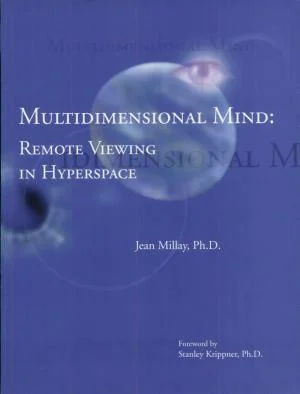
Multidimensional Mind
 83
83

Multidimensional Mind
Jean Millay’s "Multidimensional Mind" is an ambitious attempt to map the inner landscape of consciousness, treating it as a spatial construct with distinct, navigable regions. The book’s strength lies in its systematic deconstruction of mental processes, particularly its detailed examination of how belief systems act as structural foundations for perception and memory. Millay’s concept of "resonance" as a fundamental energetic interaction offers a compelling alternative to purely electrochemical explanations of consciousness. However, the work occasionally suffers from an overreliance on intricate metaphor, which, while illuminating, can sometimes obscure the practical application of its theories. The passage detailing the "logic pathways" as distinct from "belief structures" is particularly insightful, highlighting how cognitive dissonance arises not from faulty reasoning but from conflicting foundational assumptions. While not a simple read, "Multidimensional Mind" provides a unique framework for understanding subjective experience.
📝 Description
83
Jean Millay's 1999 book, "Multidimensional Mind," maps consciousness as a complex, maze-like structure.
Published in 1999, "Multidimensional Mind" by Jean Millay presents consciousness not as a single unit but as a layered architecture. Millay details how perception works, the role of resonance, methods for entering altered states via trance, memory's functions, and how belief systems construct our perceived reality. The book is for readers interested in the mind's inner workings beyond standard psychology, particularly those drawn to metaphysical concepts and comparative studies of awareness. It encourages questioning conventional thought and examining less explored aspects of human consciousness.
Millay's work distinguishes itself by offering a structured, almost architectural, perspective on the mind. This approach, while drawing from esoteric traditions, provides a systematic view that differs from purely philosophical or spiritual writings. The book's focus on belief systems as concrete mental constructs finds resonance with modern discussions in cognitive science and philosophy of mind. Readers will find substantial material for thought regarding altered states, the nature of reality, and the subjective construction of belief.
Emerging in 1999, "Multidimensional Mind" followed a lineage of esoteric thought that gained traction in the late 19th and 20th centuries, notably through figures like Helena Blavatsky and the Theosophical Society. Millay's contribution is her structured, almost architectural, mapping of consciousness. This systematic approach, while rooted in occult philosophy, aimed to delineate the mind's various dimensions and pathways in a manner distinct from earlier, more broadly philosophical or spiritual expositions. The book's examination of belief systems as tangible mental architecture aligns with later developments in consciousness studies.
💡 Why Read This Book?
• Understand the architecture of belief systems as presented in "Multidimensional Mind," learning how they actively shape your sensory input and memory recall, a concept explored in the book's 1999 publication context. • Gain practical insight into altered states by examining Millay's description of trance as an access point to different dimensions of consciousness, a core tenet of the work. • Explore the principle of resonance as a mechanism for mental interaction, as detailed by Millay, which offers a unique perspective on consciousness beyond purely biological explanations.
⭐ Reader Reviews
Honest opinions from readers who have explored this book.
❓ Frequently Asked Questions
What year was Jean Millay's "Multidimensional Mind" first published?
Jean Millay's "Multidimensional Mind" was first published in 1999, placing it within the late 20th-century surge of interest in consciousness studies and esoteric literature.
What is the central metaphor used to describe the mind in "Multidimensional Mind"?
The central metaphor employed in "Multidimensional Mind" is that of a maze, with multiple pathways representing different aspects of consciousness and perception.
Which cognitive functions does "Multidimensional Mind" explore in detail?
The book meticulously explores sensory perception, resonance, trance, memory, logic, and belief systems, dissecting their roles within the multidimensional structure of the mind.
Is "Multidimensional Mind" considered a scientific or esoteric text?
While drawing on concepts that bridge psychology and philosophy, "Multidimensional Mind" is primarily categorized as an esoteric text, exploring metaphysical and consciousness-based frameworks.
What does the book suggest about the nature of reality?
The work suggests that our perception of reality is heavily constructed by our internal mental architecture, particularly our belief systems and how we process information through resonance and logic.
Who is the author of "Multidimensional Mind"?
The author of "Multidimensional Mind" is Jean Millay, whose exploration of consciousness was first published in 1999.
🔮 Key Themes & Symbolism
The Mind as a Labyrinth
Millay conceptualizes the mind as an intricate maze, moving beyond linear models to embrace a multidimensional architecture. This perspective allows for the exploration of consciousness not as a singular point of awareness, but as a vast network of interconnected pathways. Each pathway represents a different facet of experience—sensory input, logical deduction, the formation of belief systems, or access to altered states. Understanding this labyrinthine structure is presented as key to navigating one's own subjective reality and unlocking deeper levels of awareness.
Resonance and Interconnectedness
A central concept in "Multidimensional Mind" is resonance, described as a fundamental principle of energetic interaction. This goes beyond simple empathy, suggesting that consciousness itself operates on vibrational frequencies that can align or clash with external phenomena and other minds. Millay explores how this principle underlies phenomena such as intuition, synchronicity, and the collective unconscious, positing that our reality is not passively received but actively co-created through these resonant connections. The 1999 publication context saw growing interest in quantum entanglement theories, offering a parallel to this concept.
Belief Systems as Architecture
The book posits that belief systems are not mere opinions but the very architectural framework of the multidimensional mind. These structures dictate how sensory data is filtered, how memories are stored and retrieved, and what logical conclusions are deemed valid. Millay suggests that by understanding and consciously altering these foundational beliefs, individuals can reshape their perception of reality and expand their mental capabilities. This view challenges the notion of objective truth, emphasizing the subjectively constructed nature of our experienced world.
Trance as a Dimensional Gateway
Trance states are characterized in "Multidimensional Mind" not as mere dissociation or sleep, but as deliberate states of altered consciousness that allow access to other dimensions of the mind. Millay describes these states as portals, enabling a different mode of perception and interaction with reality, distinct from the ordinary waking consciousness. This exploration aligns with various esoteric traditions that utilize altered states for spiritual insight, divination, or communication with non-physical realms.
💬 Memorable Quotes
Direct passages from the work, attributed to the author.
“The mind is not a single room but a mansion with infinite corridors.”
— This interpretation highlights Millay's core metaphor of the mind as a complex, expansive structure, contrasting it with simpler, singular conceptions of consciousness. It emphasizes the potential for exploration and discovery within one's own psyche.
“Trance offers a map to inner landscapes previously uncharted.”
— This interpretation frames trance not as an escape, but as a navigational tool. It suggests that altered states provide access to deeper, less understood regions of the mind and consciousness.
💡 Key Ideas
Editorial paraphrase of the work's core concepts — not direct quotes.
Beliefs are the architects of our perceived reality.
This paraphrase underscores the active, formative role Millay assigns to belief systems. It suggests that what we hold to be true fundamentally constructs the world we experience, rather than merely reflecting an objective external truth.
Resonance allows us to tune into the frequencies of existence.
This paraphrased concept explains resonance as a principle of vibrational alignment. It implies that consciousness interacts with the universe by matching its energetic state to that of its surroundings or other entities.
Logic pathways can be as rigid as any belief structure.
This paraphrased idea points to the potential for rigid thinking, even within rational frameworks. It suggests that the very rules of logic can become limiting if not examined critically, akin to ingrained belief patterns.
🌙 Esoteric Significance
Tradition
Millay's work draws implicitly from Gnostic and Hermetic traditions, which emphasize the hidden nature of true reality and the potential for human consciousness to transcend material limitations. It aligns with the Hermetic principle of "As Above, So Below," suggesting a correspondence between the inner world of the mind and the outer manifest reality. However, "Multidimensional Mind" departs by offering a more systematic, almost architectural, framework for understanding these concepts, presenting them with a clarity that bridges traditional esoteric esotericism and modern psychological inquiry.
Symbolism
The primary symbol is the "maze" or "labyrinth," representing the complex, often non-linear pathways of consciousness, perception, and memory. Another key motif is "resonance," symbolizing the vibrational interconnectedness of all things and the fundamental principle by which consciousness interacts with itself and the external world. These symbols function not merely as metaphors but as conceptual tools for understanding the underlying structure and dynamics of subjective experience.
Modern Relevance
Contemporary thinkers in fields like consciousness studies, transpersonal psychology, and even some areas of quantum physics and philosophy of mind find resonance with Millay's ideas. Practices involving neuro-linguistic programming (NLP), lucid dreaming, and certain forms of meditation can be seen as practical applications of mapping and working through the 'multidimensional mind.' Her emphasis on belief systems as foundational structures continues to inform discussions on cognitive biases and subjective reality construction.
👥 Who Should Read This Book
• Students of consciousness seeking to move beyond dualistic mind-body paradigms will find Millay's architectural model of the mind particularly clear. • Practitioners of esoteric disciplines interested in understanding the mechanics of perception, trance, and belief formation will gain a structured framework for their practices. • Researchers in comparative psychology and philosophy interested in alternative models of subjective experience will find "Multidimensional Mind" offers a unique perspective from its 1999 publication.
📜 Historical Context
Published in 1999, Jean Millay's "Multidimensional Mind" emerged during a period of burgeoning interest in consciousness studies, paralleling advancements in neuroscience and the increasing influence of digital technologies on conceptualizing information and networks. The late 20th century saw a resurgence of esoteric thought, building upon foundations laid by figures like Carl Jung and his exploration of archetypes and the collective unconscious. Millay's work can be seen as contributing to this landscape, offering a structured, almost architectural, model of the mind that differed from the more purely philosophical or spiritual treatises common in earlier decades. While not directly engaging with contemporary scholars in the manner of, for instance, Stanislav Grof's work on transpersonal psychology, Millay's text offered a unique framework for understanding subjective experience that resonated with individuals exploring metaphysical concepts outside mainstream academic discourse.
📔 Journal Prompts
The mind's labyrinthine pathways: Map a recent decision through its perceived logic and belief corridors.
Resonance patterns: Identify a situation where you felt a strong sense of energetic alignment or dissonance.
Belief system architecture: Examine one foundational belief and how it shapes your sensory input.
Trance states as gateways: Reflect on a moment of altered awareness and what it revealed.
Memory pathways: Trace how a significant memory is accessed and potentially altered by current beliefs.
🗂️ Glossary
Multidimensional Mind
The concept of the mind as a complex, layered structure with multiple interconnected pathways, rather than a singular, linear entity. It encompasses perception, logic, memory, and belief as constituent dimensions.
Resonance
A principle of energetic interaction where consciousness aligns with or influences external phenomena or other minds through vibrational frequencies. It is posited as a fundamental mechanism of connection and perception.
Trance
An altered state of consciousness characterized by focused attention and reduced external awareness, viewed not as an escape but as a gateway to accessing different dimensions of the mind and reality.
Logic Pathways
The structured sequences of reasoning and deduction that the mind employs. In Millay's model, these are distinct but interconnected with belief structures, influencing how information is processed.
Belief Systems
The foundational frameworks of assumptions and convictions that shape an individual's perception, interpretation, and experience of reality. These are presented as active architectural components of the mind.
Sensory Perception
The process by which external stimuli are received and interpreted by the mind. Millay's work emphasizes how this process is filtered and shaped by the mind's multidimensional structure, particularly beliefs.
Memory
The faculty by which the mind stores and retrieves information and experiences. The book explores memory not just as a passive archive but as an active component within the multidimensional mental structure.
This book appears in 1 collection
🔮 Readers Also Liked
Browse all →









From the “Remote Viewing” Collection
View all →







More Free Occult Philosophy Books
View all →