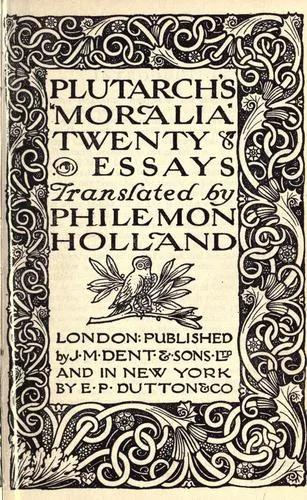
Moralia
 75
75

Moralia



Sophia Crane (Associate Editor) — Plutarch's *Moralia* transcends its ancient origins to offer timeless wisdom for the contemporary esoteric student. While its focus is primarily ethical and biographical, the subtle explorations of animal consciousness and the philosophical underpinnings of human behavior reveal profound symbolic layers. Plutarch masterfully dissects virtue, vice, and the pursuit of a meaningful life, providing a rich tapestry of thought that can inform divinatory practices and personal gnosis. This collection is invaluable for scholars of ancient philosophy and practitioners seeking a deeper understanding of ethical frameworks that resonate with archetypal truths, guiding the reader toward intellectual and spiritual refinement.
📝 Description
75
Plutarch's Moralia, written around the 2nd century CE, examines ethics, animal psychology, and human nature.
The Moralia is a compilation of Plutarch's diverse essays, not a single unified work. These writings cover a wide range of topics, from the ethics of eating animals and the philosophical implications of the Delphic maxims to discussions on fate, virtue, and the nature of the gods. Plutarch uses literary examples and historical anecdotes to illustrate his points, often contrasting different philosophical viewpoints. While not a guide to occult practices, the essays engage with ideas about self improvement and the organization of a good life that resonate with contemplative traditions.
Throughout the collection, Plutarch reflects on character, the influence of custom, and the relationship between individuals and the larger cosmos. He considers how different societies and historical figures embody or fail to embody certain virtues. The essays invite readers to think critically about their own beliefs and actions, drawing lessons from both classical literature and Plutarch's own philosophical inquiries. The work offers a rich source for understanding ancient Greek and Roman thought on moral and philosophical matters.
The Moralia engages with philosophical and ethical concepts that have informed later esoteric traditions. Plutarch's examination of the soul, the divine, and the interconnectedness of existence touches upon themes found in Neoplatonism and other schools of thought that sought deeper, hidden meanings in the cosmos. His interest in the moral order and the forces shaping human destiny aligns with contemplative practices that aim for self-knowledge and alignment with universal principles. The essays offer a framework for understanding the ancient world's approach to spiritual and moral development, distinct from but related to more overtly mystical texts.
💡 Why Read This Book?
Uncover the ethical foundations of ancient thought and their subtle, symbolic resonance. *Moralia* offers profound insights into human nature, virtue, and the animal kingdom, providing a philosophical bedrock for esoteric practitioners and seekers of wisdom. Explore timeless dialogues that illuminate the path to self-understanding and moral clarity.
⭐ Reader Reviews
Honest opinions from readers who have explored this book.
❓ Frequently Asked Questions
Is *Moralia* a book of spells or rituals?
No, *Moralia* is a collection of essays focused on ethics, philosophy, and biography. Its esoteric value lies in the profound ethical insights and symbolic interpretations of human and animal nature it offers, which can inform spiritual practice.
What is the primary focus of Plutarch's *Moralia*?
The primary focus is on ethics, moral philosophy, and the lives of notable figures, exploring themes of virtue, vice, courage, and the good life through essays and biographical sketches.
Does *Moralia* discuss Greek Oracles?
Yes, *Moralia* contains essays that touch upon various aspects of Greek culture, including discussions that indirectly relate to oracles and their perceived significance within ancient society.
What kind of reader would most appreciate *Moralia*?
Readers interested in ancient Greek philosophy, ethics, biography, and those seeking a deeper understanding of moral principles and human nature will find *Moralia* highly rewarding.
How does *Moralia* relate to esoteric traditions?
While not overtly occult, *Moralia*'s deep exploration of virtue, symbolism, and the interconnectedness of life provides a rich philosophical foundation that resonates with many esoteric traditions, offering timeless ethical guidance.
🔮 Key Themes & Symbolism
The Architecture of Virtue
Plutarch meticulously dissects the nature of virtue, not as a rigid set of rules, but as a living, breathing force shaped by habit, reason, and circumstance. He explores how courage, temperance, and justice are cultivated through conscious effort and the understanding of their interconnectedness. This theme examines the practical application of ethical principles, urging readers to examine their own moral compass and the subtle influences that guide their actions, revealing the profound beauty in living a life aligned with higher principles.
Traces of the Animal Soul
Within *Moralia*, Plutarch offers a fascinating and surprisingly nuanced perspective on animal consciousness and behavior. He posits that animals possess a degree of rationality and moral capacity, challenging anthropocentric views. This exploration invites contemplation on the shared essence of life, the spectrum of sentience, and our ethical responsibilities towards the natural world. It encourages a re-evaluation of our place within the grand range of existence, hinting at a universal consciousness that binds all living things together.
The Wisdom of Biography
Plutarch masterfully employs biography as a vehicle for moral instruction, showcasing how the lives of historical figures serve as potent exemplars and cautionary tales. By informative the triumphs and failures of great individuals, he reveals the enduring patterns of human behavior and the consequences of choices. This thematic thread underscores the idea that understanding the past is crucial for working through the present, offering a rich source of inspiration and ethical guidance for those seeking to forge their own noble paths.
💬 Memorable Quotes
Direct passages from the work, attributed to the author.
“It is a man's own mind, not his country, that makes him great.”
— This underscores the internal locus of power and greatness, suggesting that personal character and wisdom are the true determinants of a person's stature.
“Nature has given us two ears, but only one tongue, in order that we may hear more and speak less.”
— A timeless reminder of the importance of active listening and thoughtful deliberation before speaking, promoting wisdom and reducing impulsive pronouncements.
“To live is to fight.”
— This aphorism speaks to the inherent struggle and effort required in life, viewing existence as a continuous process of overcoming challenges and striving for growth.
“The soul is the whole body.”
— A philosophical statement suggesting a profound unity between the spiritual and the physical, implying that the essence of being permeates one's entire existence.
💡 Key Ideas
Editorial paraphrase of the work's core concepts — not direct quotes.
We are more firmly bound by reason than by oaths.
This quote highlights the supremacy of internal moral guidance over external obligations, emphasizing self-governance and ethical integrity.
🌙 Esoteric Significance
Tradition
While *Moralia* is not a text of specific occult practices, its profound ethical discourse and exploration of virtue align with the foundational principles of many esoteric traditions, particularly those emphasizing self-mastery and the pursuit of wisdom. It carries the ethical frameworks found in Neoplatonism and Hermeticism, which seek to understand the divine order through moral refinement and intellectual contemplation, offering a philosophical bedrock for spiritual seekers.
Symbolism
The essays within *Moralia* are rich with symbolic meaning, particularly in Plutarch's discussions of animals, nature, and the lives of exemplary figures. These elements can be interpreted as allegories for spiritual states, psychological archetypes, and the forces that shape human destiny. The careful consideration of animal behavior, for instance, can be seen as a symbolic exploration of primal instincts and their integration into a balanced, ethical life.
Modern Relevance
In an age often characterized by moral ambiguity and a disconnect from nature, *Moralia*'s emphasis on virtue, reasoned discourse, and the interconnectedness of all life holds significant modern relevance. Its insights into character development, ethical decision-making, and the philosophical understanding of our place in the natural world offer a vital counterpoint to superficiality, guiding individuals toward a more grounded and meaningful existence.
👥 Who Should Read This Book
This volume is a treasure for several distinct groups. For the **beginner seeker**, *Moralia* offers accessible yet profound lessons in ethics and character building, laying a solid groundwork for personal growth. **Scholars of ancient philosophy** will find an invaluable primary source, rich with nuanced interpretations of Greek thought and historical context. **Practitioners of esoteric arts** will appreciate the deep dives into virtue and the symbolic interpretations of nature and human behavior, which can powerfully inform their practices. Finally, **anyone yearning for intellectual and moral clarity** will find in Plutarch a wise and enduring guide to living a more examined and purposeful life.
📜 Historical Context
Written during the Roman Empire, a period of immense cultural exchange and philosophical flourishing, Plutarch's *Moralia* emerged from the intellectual milieu of the late 1st and early 2nd centuries CE. This era saw a revival of interest in classical Greek thought, with philosophers like Plutarch synthesizing Hellenistic traditions with Roman practicality. He drew heavily on Platonic and Aristotelian philosophy, but also incorporated Stoic and Cynic ideas, combining them into accessible essays on a wide range of subjects. The work reflects a society grappling with questions of governance, morality, and the meaning of life amidst political stability and intellectual ferment, providing a window into the enduring human quest for wisdom.
📔 Journal Prompts
Reflect on a time you acted out of pure reason versus impulse. What was the outcome?
Consider an animal whose behavior you find particularly insightful. What moral or philosophical lesson can you draw from it?
Identify a virtue Plutarch discusses that you wish to cultivate more deeply. What practical steps can you take this week?
How does understanding the past, through biography or history, inform your present ethical choices?
In what ways does your 'mind' contribute to your personal 'greatness' beyond societal recognition?
🗂️ Glossary
Ethos
The characteristic spirit of a culture, era, or community as manifested in its beliefs and aspirations; often refers to the ethical character or guiding principles of an individual or group.
Arete
Greek for 'virtue' or 'excellence.' In ancient Greek philosophy, it encompassed moral virtue, but also excellence in any capacity, such as courage, wisdom, or skill.
Logos
A Greek term signifying 'reason,' 'word,' or 'discourse.' In philosophy, it often refers to the divine reason or universal principle that orders the cosmos.
Hellenistic
Relating to Greek history, language, and culture from the death of Alexander the Great in 323 BC to the defeat of Cleopatra and Mark Antony in 30 BC.
Anthropocentric
Regarding humankind as the central or most important element of existence; viewing the world solely from a human perspective.
This book appears in 3 collections
🔮 Readers Also Liked
Browse all →





More by Plutarch
All books →

From the “Tarot” Collection
View all →







More Free Divination & Tarot Books
View all →