Plutarch
Pseudo-Plutarch refers to unknown authors of works falsely attributed to the historian Plutarch, mostly from late antiquity.
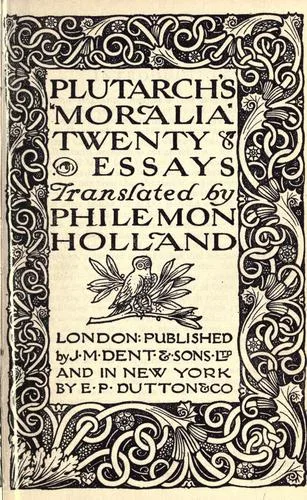
Pseudo-Plutarch is the designation for the actual but unidentified authors responsible for a collection of writings that were erroneously attributed to the well-known historian Plutarch. These texts, which were not authored by Plutarch himself, have sometimes been included in collections of his works, particularly in editions of his "Moralia." The majority of these pseudepigraphal works originate from late antiquity, with most dating to the 3rd and 4th centuries AD, though some are believed to be from the 2nd century AD. One philosophical work, "De Fato," is considered a Middle Platonic text from the 2nd century. Other texts attributed to Plutarch are thought to be of medieval origin, and recent scholarship has identified specific medieval authors for some pieces, such as Arnoul Le Ferron for "Pro Nobilitate."
Attributed Works and Authorship
The writings known under the name Pseudo-Plutarch are a collection of texts that, while not penned by the historical Plutarch, have been associated with him. These works, often appearing in editions of Plutarch's "Moralia," include a variety of subjects. Among them are biographical accounts like "Lives of the Ten Orators," philosophical treatises such as "The Doctrines of the Philosophers" and "De Fato," and discussions on topics ranging from music and natural philosophy to ethics and history. For instance, "De Fato" is identified as a Middle Platonic work from the second century. The authorship of these pieces remains anonymous, with the actual writers belonging to periods slightly after Plutarch, predominantly late antiquity (3rd-4th centuries AD).
Content and Philosophical Relevance
The corpus attributed to Pseudo-Plutarch covers a diverse range of subjects, some of which hold interest for philosophical and esoteric studies. Works like "The Doctrines of the Philosophers" offer insights into ancient philosophical schools, while "De Fato" delves into Platonic thought. "Stromateis," falsely attributed to Plutarch, is noted as a significant source for pre-Socratic philosophy. Other texts, such as "On Music" and "Greek and Roman Parallel Stories," provide cultural and historical perspectives. The dating of these works, mostly from late antiquity, places them within a crucial period of philosophical development and syncretism, making them valuable for understanding the intellectual currents of the time.
Dating and Later Attributions
While the bulk of the works attributed to Pseudo-Plutarch date from late antiquity, specifically the 3rd and 4th centuries AD, some are pinpointed to earlier periods. "De Fato," for example, is considered a 2nd-century Middle Platonic text. The attribution process has also been complex, with some works later identified as medieval in origin. Modern scholarship continues to refine our understanding of these attributions. For instance, the work "Pro Nobilitate" was recently shown to have been written by Arnoul Le Ferron and first published in the 16th century, highlighting the evolving nature of authorship studies concerning these ancient texts.
Key Ideas
- Pseudepigraphy in ancient literature
- Compilation of philosophical doctrines
- Historical and biographical accounts from antiquity
- Late antique philosophical and cultural texts
Books by Plutarch
3 free public domain books · Read online or download