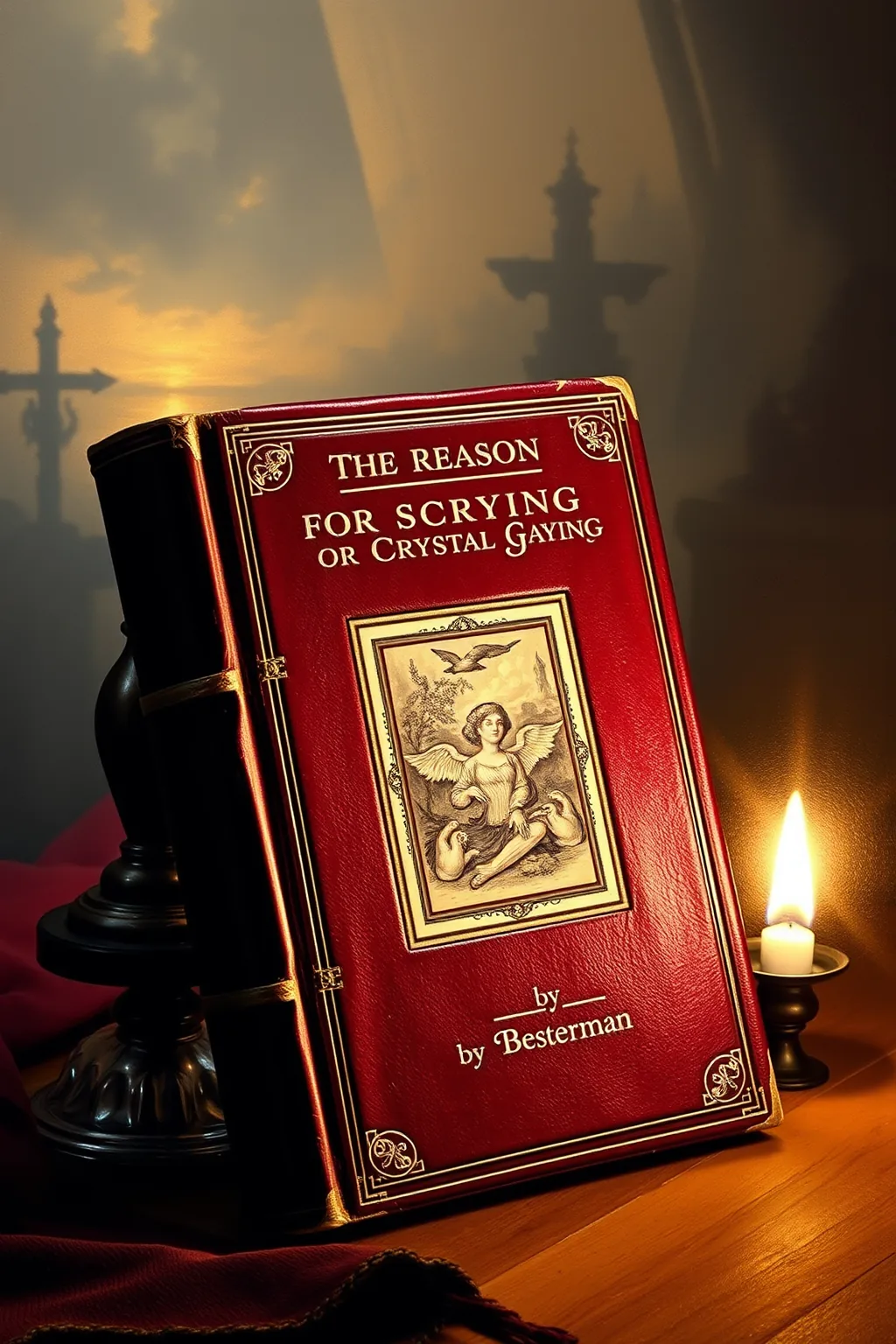
The Reason for Scrying Or Crystal Gazing
 71
71

The Reason for Scrying Or Crystal Gazing
Theodore Besterman's 'The Reason for Scrying or Crystal Gazing' approaches its subject with a scholarly rigor often absent in popular treatments of divination. Rather than providing step-by-step instructions, Besterman aims to dissect the *why* behind the practice, a commendable if ambitious goal. The book's strength lies in its historical grounding, tracing the lineage of scrying practices and contextualizing them within broader patterns of human belief and psychological phenomena. A notable limitation is the work's inherent distance from the lived experience of scrying; it analyzes the practice from an external, academic perspective, which may leave some readers wanting more on the subjective phenomenological aspect. The discussion around the psychological interpretation of visions, particularly the interplay of expectation and subconscious projection, offers a concrete example of Besterman's analytical approach. This book is a valuable resource for understanding the historical and theoretical dimensions of scrying.
📝 Description
71
Theodore Besterman's 1935 study investigates the psychological and historical roots of crystal gazing.
This book examines the practice of scrying, or crystal gazing, not as a how-to guide, but as a subject for serious study. Besterman delves into the reasons why people have long used reflective surfaces, from ancient mirrors to modern crystals, to seek knowledge beyond the ordinary. The work addresses the concept of the 'visual trance,' a receptive state induced by the scrying medium. It considers the psychological elements at play, including suggestion and the interpretation of subconscious imagery. The physical tools of scrying, such as crystal balls and dark mirrors, are discussed as aids to concentration and altered perception.
Besterman's research places scrying within a long historical tradition. While this edition is a 2005 facsimile, the original work emerged during a time when psychical research and occult studies were gaining academic attention. The book differentiates scrying from more formal methods of prophecy, situating it as a unique human attempt to access hidden information. It is intended for those deeply interested in divination, altered states of consciousness, parapsychology, and cultural history.
Theodore Besterman's work situates scrying within the broader history of divination and Western esotericism. It examines the practice as a method for achieving altered states of consciousness and accessing non-ordinary knowledge, a common thread in many esoteric traditions. By focusing on the psychological mechanisms and historical context, Besterman connects the seemingly simple act of gazing into a reflective surface to a persistent human impulse for insight, placing it alongside other divinatory arts and contemplative practices.
💡 Why Read This Book?
• Understand the historical evolution of scrying, noting its presence across various cultures as documented in the text, and gain insight into why this practice endured. • Explore the psychological underpinnings of visual trance states, as Besterman analyzes the mechanisms of suggestion and subconscious imagery in relation to crystal gazing. • Appreciate the symbolic significance of the scrying medium itself, recognizing how polished surfaces and reflective objects have served as focal points for divinatory intent across different eras.
⭐ Reader Reviews
Honest opinions from readers who have explored this book.
❓ Frequently Asked Questions
What is the primary focus of Theodore Besterman's 'The Reason for Scrying or Crystal Gazing'?
The book primarily focuses on the historical, theoretical, and psychological reasons behind the practice of scrying or crystal gazing, rather than offering instructions on how to perform it.
When was Theodore Besterman's 'The Reason for Scrying or Crystal Gazing' first published?
While this facsimile edition was published on December 1, 2005, the original work's publication date would be earlier, reflecting research from a period when psychical research was more prominent.
Does the book provide practical techniques for crystal gazing?
No, the book's aim is analytical and historical. It explores the rationale and psychology of scrying rather than serving as a practical guide for practitioners.
What kind of historical evidence does the book draw upon?
The book likely examines historical accounts and theoretical discussions concerning divination and altered states of consciousness from various periods and cultures.
Who is Theodore Besterman?
Theodore Besterman was a significant figure in the study of parapsychology and psychical research, known for his extensive bibliographies and scholarly work on these subjects.
Is this book a modern interpretation or a facsimile of an older text?
This edition is a facsimile reprint of an older antiquarian book, aiming to preserve the original work's integrity despite potential age-related imperfections.
🔮 Key Themes & Symbolism
The Scrying Medium
The book examines the physical object used in scrying—be it a crystal ball, a dark mirror, or even water—not merely as a tool, but as a crucial component in the divinatory process. It explores how the reflective or translucent nature of these surfaces acts as a focal point for the scryer's attention, facilitating the induction of a trance state. The choice and preparation of these mediums are discussed in relation to their historical use and their perceived ability to bridge the visible and invisible realms.
Visual Trance States
A central concept is the nature of the 'visual trance' experienced during scrying. Besterman looks at the psychological states that enable individuals to perceive visions within the scrying medium. This includes an analysis of how prolonged focus, altered perception, and subconscious projections contribute to the formation of these visual experiences, moving beyond simplistic notions of supernatural communication to a more psychological interpretation.
Historical Roots of Divination
The work situates scrying within the broader context of ancient and historical divinatory practices. It traces the lineage of using reflective surfaces for insight, connecting it to older forms of augury and prophecy. By exploring these historical antecedents, the book aims to demonstrate the enduring human impulse to seek knowledge through indirect means and the evolution of specific techniques like crystal gazing.
Psychological Interpretation of Visions
Rather than accepting visions at face value, Besterman emphasizes a psychological lens for understanding their origin. The book discusses theories of suggestion, autosuggestion, and the role of the subconscious mind in generating the imagery perceived during scrying sessions. This approach seeks to clarify the process by examining the internal mental field of the practitioner.
💬 Memorable Quotes
Direct passages from the work, attributed to the author.
“The scryer’s mind is turned inward, the external world receding as the surface of the crystal becomes a screen for subconscious projection.”
— This interpretation highlights the psychological mechanism at play in scrying, suggesting that the visions are not external messages but rather internal imagery made manifest through focused attention on the reflective medium.
“Ancient mirrors and polished obsidian served the same purpose as the modern crystal ball: a focal point for concentration and a gateway to altered perception.”
— This emphasizes the continuity of scrying practices across history, illustrating how different cultures and eras utilized varied materials to achieve a similar divinatory outcome by focusing the mind.
“The perceived clarity of a vision in scrying is often directly proportional to the scryer's expectation and the depth of their receptive state.”
— This points to the subjective nature of scrying experiences, suggesting that the practitioner's mental preparation and willingness to enter a trance significantly influence the perceived authenticity and content of the visions.
“Understanding the 'reason' for scrying requires examining not just the technique, but the persistent human need to probe the unknown.”
— This highlights the book's core thesis: that scrying is rooted in a fundamental human desire for knowledge beyond the immediately observable, and its study must encompass both method and motivation.
“The efficacy of the crystal ball lies less in inherent magical properties and more in its capacity to concentrate the user's psychic energy.”
— This perspective suggests that the power of the scrying tool is largely derived from the practitioner's own mental faculties and focused intent, rather than any intrinsic supernatural quality of the object itself.
🌙 Esoteric Significance
Tradition
While not strictly tied to a single esoteric lineage like Kabbalah or Hermeticism, Besterman's work interfaces with the broader tradition of Western esotericism, particularly its interest in divination and altered states of consciousness. It can be seen as an attempt to rationalize or psychologize practices that have been historically incorporated into various occult systems, from ancient Greek divination to Renaissance magic. The book offers a critical perspective that can inform practitioners by explaining the psychological mechanics behind phenomena they might otherwise attribute solely to external spiritual agencies.
Symbolism
The primary symbol is the 'crystal' or 'mirror' itself. In esoteric traditions, such reflective surfaces symbolize clarity, purity, and the ability to act as a conduit between worlds. The act of gazing into the crystal can be seen as a metaphor for introspection – looking into one's own inner depths to find answers. The visions perceived are often symbolic, representing subconscious desires, fears, or potential future events, requiring interpretation by the scryer.
Modern Relevance
Contemporary practitioners of modern witchcraft, neo-paganism, and various forms of New Age spirituality continue to engage with scrying, often drawing on historical texts and psychological interpretations. Besterman's work provides a valuable historical and analytical counterpoint to purely intuitive or dogmatic approaches. Thinkers interested in consciousness studies, dream analysis, and the psychology of belief systems also find relevance in his examination of how humans perceive and interpret phenomena beyond ordinary sensory input.
👥 Who Should Read This Book
• Students of divination and esoteric history seeking a reasoned examination of crystal gazing's origins and purpose. • Psychologists and researchers interested in altered states of consciousness, suggestion, and the interpretation of subjective experiences. • Practitioners of occult arts who wish to deepen their understanding of the psychological and historical context of the tools and techniques they employ.
📜 Historical Context
Theodore Besterman's exploration of scrying emerges from a fertile period of inquiry into psychical phenomena, roughly spanning the late 19th and early 20th centuries. During this era, figures like F.W.H. Myers and the Society for Psychical Research were actively investigating telepathy, clairvoyance, and other purported paranormal abilities. Besterman's work implicitly engages with the scientific rationalism of the time, seeking to understand practices like crystal gazing through psychological and historical analysis, rather than purely supernatural explanations. This contrasted with more spiritualist interpretations prevalent in some circles. While direct engagement with specific contemporaries might vary by edition, the intellectual currents of comparative religion, anthropology, and early psychology provided the backdrop against which such studies of esoteric practices were undertaken. The reception of such works often oscillated between academic skepticism and genuine interest from those exploring the boundaries of consciousness.
📔 Journal Prompts
The scryer's motivation: What underlying human needs does the practice of scrying fulfill?
The crystal as a focal point: How does concentration on a physical object facilitate altered perception?
Interpreting the visions: What are the potential psychological sources of imagery perceived in scrying?
Historical echoes: How do the reasons for scrying in antiquity compare to modern motivations?
The 'reason' itself: What does Besterman's analysis reveal about the enduring appeal of divination?
🗂️ Glossary
Scrying
The practice of looking into a reflective surface, such as a crystal ball, mirror, or water, with the intention of receiving visions or insights.
Crystal Gazing
A specific form of scrying that utilizes a crystal sphere or ball as the reflective medium for divination.
Visual Trance
An altered state of consciousness characterized by intense focus on visual input, often leading to the perception of visions or images.
Autosuggestion
The process by which an individual influences their own thoughts, feelings, or behavior through their own suggestions or affirmations.
Divination
The practice of seeking knowledge of the future or the unknown by supernatural means.
Psychical Research
The study of alleged psychic phenomena and other paranormal claims, often through scientific investigation.
Facsimile Reprint
A reproduction of an older book that closely matches the original in appearance, including format and layout.