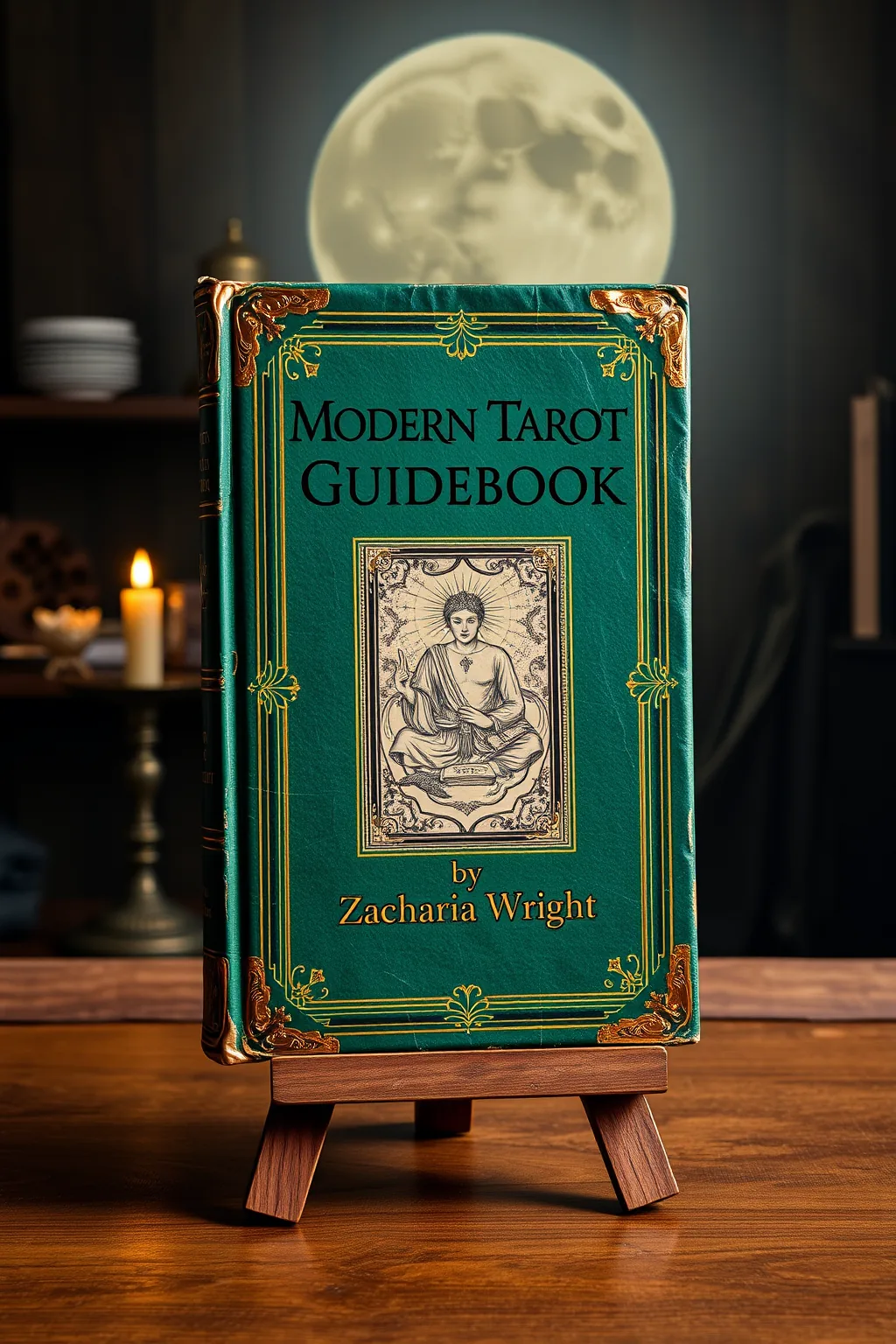
Modern Tarot Guidebook
 62
62

Modern Tarot Guidebook



Zacharia Wright's 'Modern Tarot Guidebook' is a masterful distillation of Tarot's esoteric essence, presented with clarity and profound insight. Evander Ashcroft, Editor of Alchemy & Hermeticism, praises Wright's ability to demystify complex symbolism, grounding archetypal energies in practical application. This work transcends the superficial, delving into the Hermetic principles and Kabbalistic underpinnings that give the Tarot its true potency. It’s an indispensable companion for those seeking to understand the Tarot not just as a predictive tool, but as a sacred map of the psyche and a profound system of spiritual development. Highly recommended for serious students of the occult arts.
📝 Description
62
Zacharia Wright's 'Modern Tarot Guidebook' (2023) decodes the Tarot's symbolism for contemporary understanding.
Zacharia Wright's 'Modern Tarot Guidebook' approaches the Tarot not as a system of rote memorization but as a tool for introspection. The book examines the symbolism and archetypal energies within the Major and Minor Arcana. Wright aims to reveal the connections between the cards and the subconscious, presenting them as mirrors for self-reflection. The text encourages a deeper understanding of the philosophical ideas behind the Tarot, moving beyond simple divination. It is written for a range of readers, from those new to the cards to experienced practitioners. The guide suggests how the Tarot can be used for personal insight and to understand broader life patterns.
The book details how the seventy-eight cards can facilitate a personal dialogue with oneself. It presents the Tarot as a method for understanding life's complexities and aligning with what the author calls universal currents. Wright focuses on transforming perception through the practice of Tarot reading. This approach aims to foster personal growth and a more developed spiritual awareness.
This book sits within the Western esoteric tradition that views the Tarot as more than a fortune-telling device. It follows in a line of thought that connects the Tarot's imagery to Kabbalistic concepts, Western astrology, and alchemical symbolism, as seen in works from authors like Eliphas Levi and A.E. Waite. The emphasis is on the cards as a psychological and spiritual map, reflecting inner states and universal principles rather than external events alone. Wright’s work aims to update this complex interpretive framework for a modern audience.
💡 Why Read This Book?
This guidebook offers a gateway to understanding the Tarot’s profound mystical language, moving beyond simple card meanings to explore deep symbolism and archetypal wisdom. It’s for the seeker yearning for self-discovery, the scholar seeking to connect ancient traditions with modern life, and the practitioner aiming to deepen their intuitive connection. Unlock hidden truths and elevate your divinatory practice.
⭐ Reader Reviews
Honest opinions from readers who have explored this book.
❓ Frequently Asked Questions
Is this book suitable for absolute beginners to Tarot?
Absolutely. Wright provides a foundational understanding of each card, its symbolism, and core meanings, making it an ideal starting point for those new to the Tarot journey.
Does the book cover different Tarot spreads?
Yes, the 'Modern Tarot Guidebook' explores various spreads, from simple one-card pulls to more complex layouts, enabling diverse approaches to readings.
What is the philosophical approach of this Tarot guidebook?
The book emphasizes a philosophical exploration of Tarot, viewing it as a symbolic language of the psyche, a tool for self-awareness, and a pathway to understanding universal principles.
Are there exercises or prompts for practice?
Indeed, the book integrates reflective exercises and journaling prompts designed to deepen the reader's personal connection with the Tarot's wisdom.
Does Zacharia Wright connect Tarot to other esoteric traditions?
Yes, Wright skillfully weaves in connections to Hermeticism, Kabbalah, and other mystical traditions, enriching the understanding of Tarot's universal symbolism.
🔮 Key Themes & Symbolism
The Archetypal Field of the Soul
This theme explores the Tarot as a cosmic map of human consciousness, where each card represents a universal archetype or stage in the soul's journey. Wright studies how these archetypes, from the Fool's innocent leap to the World's completion, manifest in our lives, offering clear insights into our personal growth and spiritual evolution. Understanding these archetypal energies allows us to navigate our inner world with greater clarity and purpose.
Symbolism as a Universal Language
The book champions the Tarot as a body of visual symbolism, acting as a bridge between the conscious and subconscious mind. Wright elucidates the multi-layered meanings embedded within each card's imagery, drawing parallels to ancient glyphs, alchemical symbols, and astrological correspondences. This theme emphasizes how decoding these symbols unlocks hidden knowledge and fosters a deeper, intuitive understanding of life's mysteries.
Tarot as a Path to Inner Alchemy
Central to Wright's approach is the concept of Tarot as a tool for personal transformation, akin to alchemical processes. The cards are presented not just for prediction, but as catalysts for introspection and self-mastery. This theme guides readers on how to use Tarot readings to identify inner blockages, cultivate virtues, and integrate shadow aspects, ultimately leading to a more enlightened and integrated self.
💬 Memorable Quotes
Direct passages from the work, attributed to the author.
“Each symbol whispers a forgotten truth of the cosmos.”
— Emphasizes the profound, ancient wisdom encoded within Tarot imagery, suggesting a connection to universal knowledge.
“To read the Tarot is to engage in a sacred dialogue with the soul.”
— Positions Tarot reading as a spiritual practice, a communion with one's inner being and higher consciousness.
“The present moment is a crossroads, illuminated by the wisdom of the past.”
— Connects the temporal nature of life with the timeless wisdom of Tarot, suggesting its relevance for working through the now.
“True divination lies not in prediction, but in profound self-understanding.”
— Shifts the focus from fortune-telling to personal growth, framing Tarot as a path to self-discovery and empowerment.
💡 Key Ideas
Editorial paraphrase of the work's core concepts — not direct quotes.
The cards are not mere paper; they are keys to the hidden chambers of the self.
This quote highlights the book's core philosophy: Tarot as an introspective tool, revealing inner landscapes rather than external fortune.
🌙 Esoteric Significance
Tradition
This guidebook draws deeply from the Hermetic tradition, integrating principles of correspondence, the macrocosm/microcosm relationship, and the alchemical process of transformation. It also reflects influences from Kabbalistic numerology and the archetypal psychology of Carl Jung, viewing the Tarot as a symbolic language of the collective unconscious.
Symbolism
Key symbols explored include the Fool's journey, the interplay of the four suits representing elemental forces, the solar and lunar imagery of the Major Arcana, and the profound significance of numbers and their connection to cosmic order and spiritual progression.
Modern Relevance
In an age often characterized by rapid change and existential questioning, the 'Modern Tarot Guidebook' offers a timeless framework for navigating complexity. It empowers individuals to access inner wisdom, cultivate intuition, and foster a deeper connection to their authentic selves, making it a vital tool for modern spiritual seekers and practitioners.
👥 Who Should Read This Book
This essential volume is crafted for a diverse audience. Absolute beginners will find a clear, accessible entry point into the world of Tarot, guided by Wright's patient explanations. Seasoned practitioners will discover new depths and nuanced interpretations, enhancing their existing practice. Scholars of esotericism will appreciate the historical and philosophical connections woven throughout the text. Ultimately, anyone on a path of self-discovery, seeking greater insight into their lives, or yearning to deepen their spiritual connection will find profound value within these pages.
📜 Historical Context
Published in an era of renewed interest in esotericism and personal spirituality, 'Modern Tarot Guidebook' emerges as a significant contribution to contemporary occult literature. The late 20th and early 21st centuries witnessed a burgeoning desire to reconnect with ancient wisdom traditions, a movement that saw Tarot cards move from niche occult circles into mainstream consciousness. Zacharia Wright's work taps into this resurgence, offering a contemporary lens on a practice deeply rooted in centuries of Hermetic, Kabbalistic, and Jungian psychological thought. The book reflects a shift from purely predictive Tarot to a more introspective and psychologically nuanced approach, aligning with the era's emphasis on self-awareness and personal empowerment. It stands as a proof of the enduring power of Tarot to serve as a mirror to the human condition and a guide for inner transformation.
📔 Journal Prompts
Reflect on the 'Fool's Journey' as it relates to a current transition in your life. What new beginnings are you embracing?
Choose a card from the Minor Arcana that appeals to a challenge you are facing. How can the energy of this suit and number offer guidance?
Consider the archetype of the 'High Priestess.' What hidden knowledge or intuition are you currently being called to acknowledge and trust?
How does the concept of 'as above, so below' manifest in your daily life? Choose a card that illustrates this principle for you.
Meditate on the 'Sun' card. What brings you genuine joy and vitality? How can you cultivate more of this energy?
🗂️ Glossary
Archetype
Universal, archaic patterns and images that derive from the collective unconscious and are the psychic counterpart of the instinct. In Tarot, archetypes represent fundamental human experiences and psychological states.
Esoteric
Intended for or likely to be understood by only a small number of people with a specialized knowledge or interest; relating to hidden meanings or knowledge.
Hermeticism
A philosophical and religious tradition based primarily upon writings attributed to Hermes Trismegistus. It emphasizes the interconnectedness of all things and the pursuit of wisdom through spiritual and intellectual means.
Divination
The practice of seeking knowledge of the future or the unknown by supernatural means. In Tarot, it involves interpreting card spreads to gain insight into situations and potential outcomes.
Kabbalah
A system of Jewish mysticism and esoteric interpretation of scripture, often visualized through the Tree of Life, which is frequently referenced in Tarot symbolism.
This book appears in 3 collections
🔮 Readers Also Liked
Browse all →
From the “Tarot” Collection
View all →
More Free Divination & Tarot Books
View all →