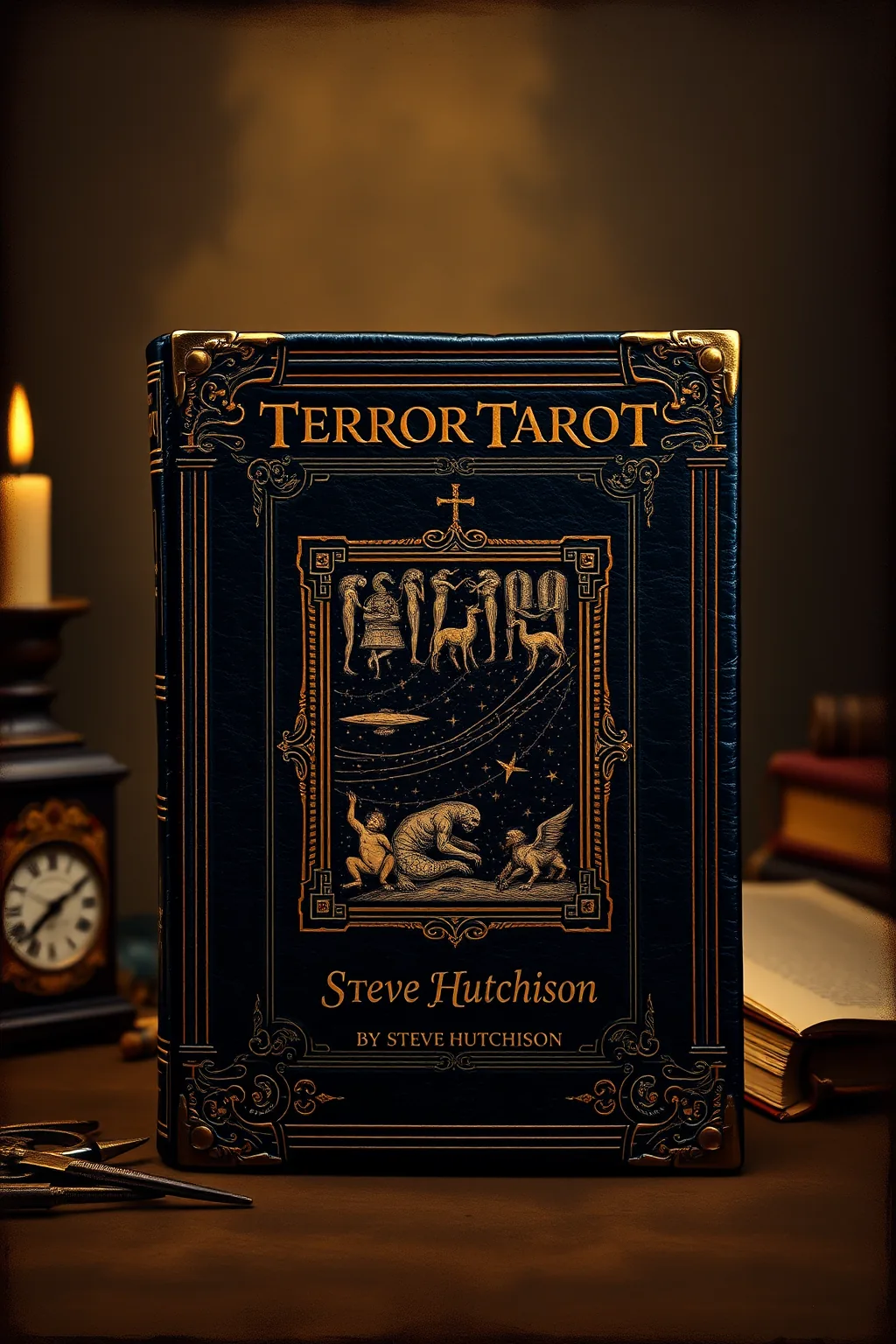
Terror Tarot
 62
62

Terror Tarot



Isolde Whitaker (Sacred Texts Editor) — 'Terror Tarot' by Steve Hutchison is a luminous descent into the profound, often unsettling, depths of the human condition as reflected through the archetypal imagery of the Tarot. Hutchison’s scholarship is evident, revealing connections to ancient mythologies and esoteric philosophies that resonate with an uncanny power. This is not a deck for the faint of heart, but for those who understand that true wisdom often emerges from confronting our deepest fears. The author’s insightful interpretations unlock a potent dialogue between the reader and the cards, fostering a unique path to self-awareness and spiritual resilience. Highly recommended for advanced practitioners and those seeking a more challenging, yet ultimately rewarding, engagement with Tarot.
📝 Description
62
Steve Hutchison's 'Terror Tarot' (2019) examines archetypal fears through Tarot symbolism.
Steve Hutchison's 'Terror Tarot' approaches the Tarot not as a tool for prediction, but as a system for confronting fundamental human anxieties. The book argues that the imagery of the Tarot, particularly when framed through a lens of fear and darkness, can illuminate hidden aspects of the psyche. Hutchison connects this to historical occult practices and psychological concepts, suggesting that facing these primal fears is a path to self-understanding and inner strength.
The work presents each Tarot card as a symbolic gateway. It encourages readers to engage with the 'shadow' aspects of their lives, viewing these elements not as threats but as opportunities for introspection. Hutchison aims to guide the reader toward a more courageous acceptance of life's challenges, moving beyond simple divinatory practices. The book is written for those deeply interested in esoteric studies and psychological exploration.
This work fits within a modern esoteric tradition that uses established symbolic systems, like the Tarot, for psychological and spiritual introspection. It draws on historical occultism and Jungian psychology, framing the Tarot's imagery as a mirror to the unconscious mind. Rather than focusing on predictive outcomes, 'Terror Tarot' emphasizes self-knowledge gained through confronting difficult emotions and existential concerns, aligning with a trend of integrating esoteric practices with depth psychology.
💡 Why Read This Book?
Unearth the hidden wisdom within your deepest fears. 'Terror Tarot' offers a unique lens for self-discovery, transforming anxieties into powerful insights. Ideal for seekers of profound personal growth, practitioners yearning for deeper esoteric understanding, and scholars interested in the psychological and symbolic dimensions of divination. Confront the shadows to find your light.
⭐ Reader Reviews
Honest opinions from readers who have explored this book.
❓ Frequently Asked Questions
What makes the 'Terror Tarot' unique compared to traditional decks?
The 'Terror Tarot' distinguishes itself by focusing on the archetypal fears and existential anxieties that often remain unaddressed in conventional decks. It delves into the darker, more primal aspects of the human psyche, offering a powerful tool for confronting and integrating these often-suppressed energies for profound self-understanding.
Is this book suitable for beginners?
While the themes can be intense, the book provides comprehensive guidance. Beginners willing to engage with challenging concepts will find it a potent, albeit advanced, introduction to a deeper layer of Tarot symbolism and psychological exploration.
What kind of symbolism is explored in the 'Terror Tarot'?
The symbolism delves into primal fears, the shadow self, existential dread, and the confronting aspects of transformation. It draws from archetypal psychology, ancient mythologies, and occult traditions to imbue each card with layers of meaning that speak to the soul's deepest challenges.
Can this Tarot deck be used for everyday readings?
Absolutely. While the themes are profound, the 'Terror Tarot' can offer unique perspectives on everyday situations by illuminating the underlying anxieties or challenges that might be influencing them, leading to more nuanced and honest readings.
What is the philosophical significance of confronting 'terror' in divination?
Philosophically, confronting 'terror' in divination acknowledges that true growth often arises from facing discomfort. It suggests that by understanding and integrating our fears, we can achieve a more complete and authentic self, moving beyond superficial understandings to embrace the totality of our existence.
🔮 Key Themes & Symbolism
Archetypal Shadow Work
This theme looks at the 'Terror Tarot's' exploration of the shadow self – the repressed aspects of our personality that often manifest as fear and anxiety. Hutchison guides readers to recognize these archetypal patterns within themselves, understanding how they influence our perceptions and behaviors. It’s about acknowledging the primal forces that shape our inner world, not to be consumed by them, but to integrate them consciously, transforming potential sources of terror into catalysts for personal power and authentic expression. This journey into the shadow is essential for holistic self-awareness and liberation.
Existential Confrontation and Growth
The 'Terror Tarot' confronts the fundamental existential questions that lie at the core of the human experience: mortality, meaning, and isolation. Hutchison posits that by engaging with these profound, often fear-inducing, concepts through the symbolic language of the Tarot, readers can develop a more robust framework for navigating life's inevitable challenges. This theme encourages a courageous embrace of vulnerability, recognizing that true resilience is forged not in the absence of fear, but in the willingness to face it, leading to a deeper appreciation for existence and a more profound sense of purpose and self-acceptance.
The Alchemy of Fear into Wisdom
A central tenet of the 'Terror Tarot' is the transformative power of fear. This theme explores how the intense energies associated with terror, when understood and approached with intention, can be alchemized into profound wisdom and spiritual insight. Hutchison illustrates how the cards of this deck act as potent alchemical vessels, enabling the practitioner to transmute raw, unsettling emotions into valuable lessons, heightened intuition, and a more integrated consciousness. It's a process of turning perceived weaknesses into sources of strength, revealing the hidden potential for enlightenment that lies within our most challenging inner landscapes.
💬 Memorable Quotes
Direct passages from the work, attributed to the author.
“In the void, we find not emptiness, but the fertile ground of creation.”
— This highlights the esoteric concept that periods of apparent nothingness or existential dread are not devoid of potential, but rather are essential spaces from which new possibilities and understanding can emerge.
“The Tarot is a mirror, reflecting the specters we must embrace to truly see ourselves.”
— This emphasizes the Tarot's role as a divinatory tool that reveals not just external circumstances, but also our internal landscape, particularly the aspects of ourselves we might resist acknowledging.
“Terror is the echo of the soul’s unfulfilled potential.”
— This profound statement posits that fear is not merely a negative emotion, but a signal from our inner selves, indicating areas where growth and self-realization are being hindered or are yet to be explored.
“To master the shadows is to command the light.”
— This captures the core principle of integrating one's darker aspects. By understanding and accepting the 'shadow' self, one gains a more complete and balanced perspective, leading to greater inner control and illumination.
💡 Key Ideas
Editorial paraphrase of the work's core concepts — not direct quotes.
The deepest fears are often the keys to our greatest liberation.
This quote suggests that confronting our most profound anxieties, rather than avoiding them, unlocks hidden potentials for freedom and self-empowerment, transforming perceived weaknesses into pathways for growth.
🌙 Esoteric Significance
Tradition
This work is deeply rooted in the Western Esoteric Tradition, drawing heavily from Hermeticism, Gnosticism, and Jungian psychology. It aligns with the esoteric principle of 'As Above, So Below,' applying the macrocosmic archetypes of the Tarot to the microcosmic journey of the individual soul. The emphasis on confronting primal fears and integrating the shadow echoes Gnostic ideas of overcoming ignorance and illusion to achieve gnosis, or direct knowledge of the divine within oneself. Its psychological depth also places it within the modern esoteric movement that integrates spiritual inquiry with psychological exploration.
Symbolism
The symbolism in 'Terror Tarot' is deliberately evocative and often unsettling, designed to bypass the rational mind and speak directly to the subconscious. It draws on archetypes of primal fear, the abyss, the monstrous, and the uncanny. Unlike decks that focus on comfort or straightforward guidance, this deck utilizes imagery that represents existential anxieties, the unknown, and the transformative power of confronting one's deepest vulnerabilities. The symbolism serves as a powerful catalyst for introspection, encouraging the reader to find meaning and strength not in the absence of fear, but in the courageous engagement with it.
Modern Relevance
In an age often characterized by anxiety, uncertainty, and a disconnect from deeper existential truths, the 'Terror Tarot' offers profound modern relevance. It provides a framework for understanding and working through the pervasive feelings of fear and unease that many experience. By reframing these challenges not as weaknesses but as integral parts of the human journey and potential sources of useful insights, the deck empowers individuals to engage with their inner lives more honestly and courageously, fostering resilience, self-awareness, and a more authentic connection to themselves and the world.
👥 Who Should Read This Book
This work is essential for seasoned Tarot practitioners seeking to deepen their understanding of the cards' more challenging aspects and expand their interpretive repertoire. It is highly recommended for individuals engaged in shadow work, psychological exploration, and those on a serious path of spiritual development. Scholars of esotericism and comparative mythology will find its unique perspective valuable. Beginners interested in a more profound, albeit intense, dive into Tarot’s symbolic language, who are ready to confront difficult emotions, will also find significant rewards, though it is advised to approach with an open and courageous mind.
📜 Historical Context
The 'Terror Tarot' emerges from a collection of occult and psychological thought that gained significant traction in the late 20th and early 21st centuries. This era saw a resurgence of interest in esoteric traditions, coupled with a growing understanding of the human psyche through depth psychology, Jungian archetypes, and existential philosophy. Authors like Steve Hutchison built upon the foundations laid by pioneers of Tarot interpretation, such as A.E. Waite and Aleister Crowley, but pushed the boundaries by directly addressing the darker, more unsettling facets of human experience. The cultural milieu fostered a willingness to explore taboo subjects and to seek spiritual and personal growth through unconventional means, making the 'Terror Tarot' a timely and resonant contribution to the field of esoteric literature and contemporary divination practices.
📔 Journal Prompts
Which card from the 'Terror Tarot' most appeals to a current fear you are experiencing, and how can its symbolism offer a new perspective?
Explore a time when confronting a deep-seated fear led to unexpected personal growth. What lessons did you learn?
How does the concept of the 'shadow self' manifest in your daily life, and what steps can you take to integrate it more consciously?
Consider the 'void' as depicted in the 'Terror Tarot.' What creative potential might be hidden within periods of uncertainty or emptiness in your life?
Reflect on how embracing vulnerability, rather than resisting it, could transform your approach to challenges and relationships.
🗂️ Glossary
Archetype
In Jungian psychology, a universal, archaic pattern and image that derives from the collective unconscious and is the psychic counterpart of an instinct. These are fundamental building blocks of the human psyche that manifest in myths, dreams, and symbols.
Shadow Self
The unconscious or disowned parts of the personality. It's often seen as the repository of repressed desires, fears, and instincts, which, when unacknowledged, can exert a negative influence on behavior and perception.
Gnosis
Direct, intuitive knowledge of spiritual truths, often obtained through mystical experience or insight. It is a central concept in Gnosticism, representing a profound understanding of the divine and one's place within it.
Hermeticism
A philosophical and religious tradition based on the purported teachings of Hermes Trismegistus. It emphasizes esoteric knowledge, the interconnectedness of all things, and the potential for human spiritual transformation through understanding divine principles.
Alchemical Transformation
In an esoteric context, the process of purifying and perfecting the self, often likened to the alchemical transmutation of base metals into gold. It involves integrating opposing forces and transforming lower aspects of the self into higher spiritual qualities.
This book appears in 3 collections
🔮 Readers Also Liked
Browse all →








From the “Tarot” Collection
View all →








More Free Divination & Tarot Books
View all →