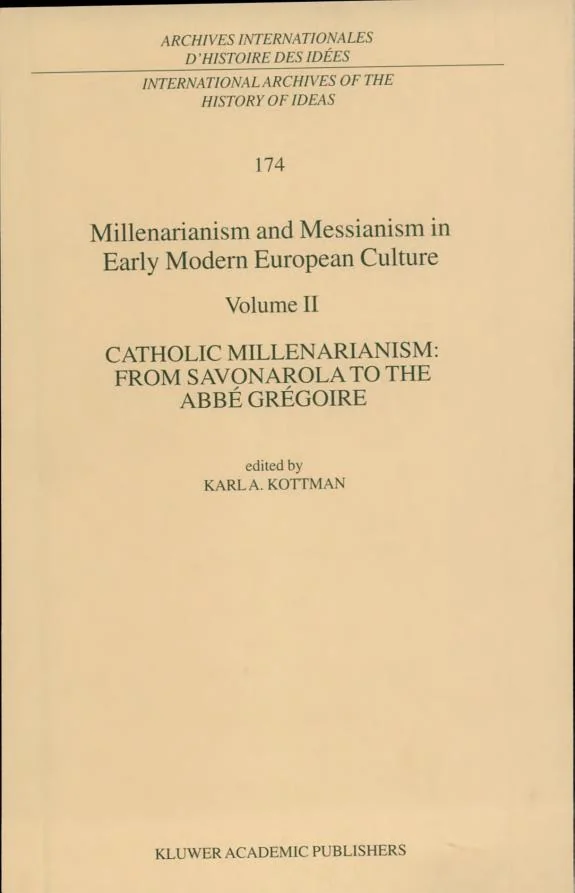
Millenarianism and Messianism in Early Modern European Culture
 81
81

Millenarianism and Messianism in Early Modern European Culture
Karl A. Kottman's collection offers a rigorous exploration of the persistent anxieties and hopes surrounding the end of days in early modern Europe. The strength of the volume lies in its detailed examination of how diverse thinkers, from Savonarola to António Vieira, integrated millenarian and messianic frameworks into their worldviews. Kottman highlights the surprising prevalence of such beliefs even among figures not typically associated with apocalyptic fervor. A limitation, however, is the dense academic prose which may present a barrier to readers unfamiliar with the specific theological and philosophical jargon of the period. The original blurb's reference to Cornelius a Lapide's specific date for the end of the world (March 25, 2000) serves as a compelling hook, illustrating the precise, almost calendrical, nature of some of these predictions, a facet the book unpacks with considerable scholarly depth. Millenarianism and Messianism in Early Modern European Culture is an essential, albeit challenging, resource for understanding the eschatological underpinnings of early modern thought.
📝 Description
81
Karl A. Kottman's 2023 book analyzes millenarianism and messianism in Europe between 1500 and 1800.
This study examines the widespread belief in apocalyptic events and the coming of a messianic era across Europe from approximately 1500 to 1800. It investigates how religious doctrines, political shifts, and intellectual movements shaped these eschatological expectations. The work moves beyond simple interpretations to show the complex theological, philosophical, and social structures behind these end-times visions.
The early modern period, marked by religious division, global exploration, and scientific advancement, fostered potent millenarian and messianic narratives. Events like the Reformation, the Counter-Reformation, the Thirty Years' War, and the scientific revolution created fertile ground for speculation about divine intervention and the end of history. Thinkers like Cornelius a Lapide contributed detailed eschatological calculations, showing how deeply these ideas were ingrained even in established religious circles. Apocalypticism was not a marginal belief but a significant way of understanding history and the universe.
The book is intended for scholars and advanced students of early modern history, religious studies, and intellectual history. Those interested in the history of eschatology, the impact of apocalyptic thought on society, and the relationship between faith and reason in pre-modern Europe will find it valuable. Readers seeking a detailed understanding of how beliefs about the end of the world influenced actions and ideas in past eras will find it particularly relevant.
This book situates itself within the study of Western esotericism and historical theology, specifically focusing on how apocalyptic and messianic currents shaped early modern European thought and society. It examines how prophetic traditions and chiliastic expectations, often considered fringe or heterodox, were in fact woven into the fabric of intellectual and religious discourse. By analyzing the specific concepts and anxieties surrounding the end of times, the work illuminates a significant, often overlooked, dimension of historical consciousness and its influence on events.
💡 Why Read This Book?
• Gain insight into the specific calculations and predictions made by figures like Cornelius a Lapide regarding the end of the world, understanding the intellectual rigor applied to eschatological timelines. • Explore the diverse interpretations of messianic figures and events by examining detailed presentations on nine major Catholic authors, revealing the breadth of thought on salvation and future transformation. • Understand how the intellectual currents of the Reformation and Counter-Reformation, including the widespread engagement with apocalyptic thought, shaped societal anxieties and hopes in early modern Europe.
⭐ Reader Reviews
Honest opinions from readers who have explored this book.
❓ Frequently Asked Questions
What is millenarianism as discussed in this book?
Millenarianism refers to the belief in a future 1000-year period of peace and righteousness on Earth, often associated with the second coming of Christ or the advent of a messianic era, as explored through various early modern European thinkers.
Which Catholic authors are featured in Millenarianism and Messianism?
The book offers detailed presentations on nine major Catholic authors, including prominent figures such as Girolamo Savonarola, Luis de León, and António Vieira, highlighting their contributions to apocalyptic and messianic thought.
When was the book first published?
Millenarianism and Messianism in Early Modern European Culture, edited by Karl A. Kottman, was first published on March 9, 2013.
What is the significance of Cornelius a Lapide's prediction?
Cornelius a Lapide, a prominent Catholic exegete, famously calculated March 25, 2000, as a likely date for the world's end, illustrating the precise and influential nature of millenarian calculations in the early modern period.
Does this book focus only on Catholic thought?
While the original blurb specifically mentions Catholic authors and Catholic apocalyptic thought, the broader scope of early modern European culture suggests an engagement with various intellectual and religious currents of the era.
What historical period does the book cover?
The book focuses on early modern European culture, broadly spanning the period from the late 15th century through the 18th century, examining eschatological beliefs within this dynamic era.
🔮 Key Themes & Symbolism
Apocalyptic Calculations
The work scrutinizes the detailed, often precise, calculations made by early modern thinkers regarding the timing of apocalyptic events. The reference to Cornelius a Lapide's prediction for March 25, 2000, exemplifies this tendency. This theme explores how eschatological beliefs were not merely abstract notions but were often integrated into systematic theological frameworks, involving prophecy interpretation and numerological analysis to pinpoint the end of days and the dawn of a new era.
Messianic Expectations
This theme looks at the varied conceptions of messianic figures and transformative events anticipated in early modern Europe. It examines how these expectations were shaped by religious doctrine, political aspirations, and societal anxieties. The book showcases how different authors, such as Savonarola or Vieira, conceptualized the role of a messiah or a divinely ordained intervention that would usher in a period of ultimate justice and spiritual renewal.
Catholic Esotericism
The volume highlights the significant role of Catholic thinkers and institutions in developing and disseminating millenarian and messianic ideas. It moves beyond a monolithic view of Catholic thought, revealing internal debates and diverse interpretations of scripture and tradition concerning end-times prophecies. This theme addresses how esoteric interpretations of religious texts flourished within Catholic contexts, influencing intellectual and devotional life.
The Reformation's Impact
The collection investigates how the seismic shifts brought about by the Protestant Reformation and the Catholic Counter-Reformation fueled apocalyptic discourse. Religious divisions, conflicts, and the search for divine vindication intensified eschatological speculation. This theme analyzes how these profound historical circumstances provided fertile ground for interpreting current events as signs of the approaching end, influencing theological arguments and popular belief.
💬 Memorable Quotes
Direct passages from the work, attributed to the author.
“the 25th of March, 2000, was the most likely date for the world to end.”
— This specific prediction, attributed to Cornelius a Lapide, captures the early modern drive to apply systematic, even calendrical, reasoning to eschatological frameworks, demonstrating a surprising degree of temporal specificity in end-times speculation.
“detailed presentations by specialists on nine major Catholic authors”
— This indicates the book's methodological approach, focusing on in-depth analysis of canonical figures like Savonarola and Vieira to understand the nuances of their millenarian and messianic doctrines within the Catholic tradition.
“Catholic Millenarianism offers an authoritative overview”
— This highlights the book's aim to provide a comprehensive and scholarly account of apocalyptic thought specifically within the Catholic context of early modern Europe, positioning it as a definitive resource.
“Over three hundred years ago”
— This temporal marker, referencing a time predating the book's original publication, situates the discussion within a deep historical lineage of eschatological thought, emphasizing the enduring nature of these beliefs.
“Catholic apocalyptic thought”
— This phrase defines the core subject matter, indicating a focus on the specific theological and philosophical frameworks concerning the end of the world as developed and debated within the Catholic Church during the early modern period.
🌙 Esoteric Significance
Tradition
This work engages with the esoteric dimensions of Christian eschatology, particularly within the Catholic tradition, during the early modern period. It highlights how interpretations of biblical prophecy, divine revelation, and apocalyptic symbolism often diverged from purely dogmatic exegesis, incorporating elements that resonated with mystical and visionary experiences. While not strictly a manual of esoteric practice, it illuminates the esoteric undercurrents within mainstream religious discourse concerning the ultimate fate of the world and the establishment of a divine kingdom.
Symbolism
Key symbols explored include the Antichrist, often personified as a malevolent force or institution heralding the end times; the concept of the 'Third Age' or a renewed earth following cataclysm; and divine signs in the heavens or earthly events interpreted as portents. These symbols served as potent vehicles for expressing societal anxieties, hopes for redemption, and the perceived cosmic struggle between good and evil.
Modern Relevance
Contemporary scholars of religion, history, and political science continue to draw upon the study of early modern millenarianism to understand recurring patterns of apocalyptic thinking in modern political and religious movements. The work's examination of how eschatological beliefs can mobilize populations and shape responses to crisis remains pertinent in analyzing contemporary phenomena, from religious fundamentalism to theories of societal collapse.
👥 Who Should Read This Book
• Scholars of early modern European history and religious studies will find detailed case studies on key figures and theological debates that illuminate the intellectual range of the period. • Students of comparative eschatology can explore the specific manifestations of millenarian and messianic thought within a crucial historical epoch, providing a rich comparative framework. • Readers interested in the history of ideas will gain an understanding of how beliefs about the end of the world profoundly influenced philosophical discourse, political action, and cultural expression in early modern Europe.
📜 Historical Context
The early modern period in Europe (roughly 1500-1800) was a crucible of profound religious, political, and intellectual transformation. The Protestant Reformation fractured the religious unity of Western Christendom, leading to intense theological debates and widespread conflict, including the devastating Thirty Years' War. Simultaneously, the Catholic Counter-Reformation sought to reassert papal authority and doctrinal purity. This era of upheaval and uncertainty fostered a fertile ground for millenarian and messianic speculation, as people sought meaning and divine intervention amidst perceived chaos. Thinkers grappled with prophecies, interpreted contemporary events as signs of the end times, and anticipated the advent of a messianic age. Cornelius a Lapide, a prominent Jesuit theologian, exemplified this trend with his detailed eschatological calculations. The intellectual currents of the time saw apocalypticism as a serious subject, debated within scholarly circles and influencing broader cultural consciousness, rather than solely a fringe phenomenon. This work situates itself within this complex milieu, examining how such beliefs were articulated and propagated.
📔 Journal Prompts
The precise calculation of the end of the world by Cornelius a Lapide.
The diverse interpretations of messianic figures by nine major Catholic authors.
The influence of the Reformation on apocalyptic thought.
The concept of Catholic millenarianism as an authoritative overview.
António Vieira's specific contributions to messianic discourse.
🗂️ Glossary
Millenarianism
A belief system centered on the expectation of a future 1,000-year period of peace and righteousness on Earth, often associated with the second coming of Christ or a similar messianic event.
Messianism
Belief in the coming of a messiah or a divinely appointed savior figure who will bring about a period of salvation, justice, and redemption for humanity or a specific community.
Eschatology
The branch of theology concerned with the final events of history, the ultimate destiny of humanity, and the end of the world.
Chiliasm
A specific form of millenarianism that anticipates a literal 1,000-year reign of Christ on Earth before the final judgment.
Exegesis
The critical explanation or interpretation of a text, especially of a religious text like the Bible.
Savonarola, Girolamo
A Dominican friar active in Florence in the late 15th century, known for his fiery preaching against corruption and his apocalyptic prophecies, which led to his execution.
Vieira, António
A Portuguese Jesuit missionary, diplomat, and writer of the 17th century, known for his sermons and his complex messianic and millenarian theories, particularly concerning the restoration of Portugal.
This book appears in 1 collection
🔮 Readers Also Liked
Browse all →









From the “Millenarianism” Collection
View all →






More Free Occult Philosophy Books
View all →