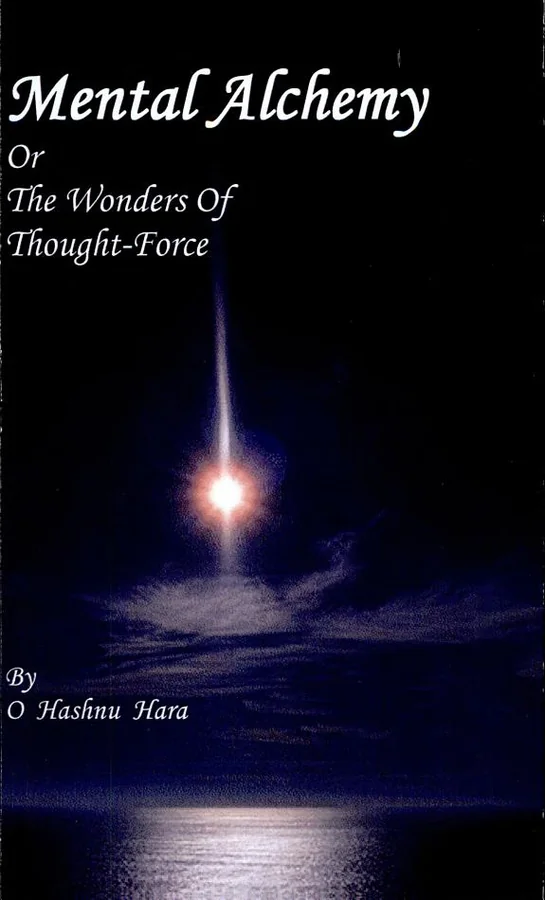
Mental Alchemy
 76
76

Mental Alchemy
O. Hashnu Hara's 'Mental Alchemy' offers a robust framework for self-mastery, treating the mind as a laboratory for transformation. The book's strength lies in its systematic approach, presenting complex ideas with a clarity that belies their esoteric nature. Hara's insistence on practical application, rather than mere intellectualization, is commendable. However, the text can sometimes feel dense, requiring a dedicated reader to fully grasp its intricate methodologies. A particularly striking passage details the "distillation" of emotional residue, a vivid metaphor for processing difficult experiences. The work's value is in its actionable guidance for those committed to deep internal work.
📝 Description
76
Published in 1968, 'Mental Alchemy' proposes a system for psychological and spiritual change through alchemical metaphor.
O. Hashnu Hara's 'Mental Alchemy' is a manual for internal transformation that uses alchemical processes as a model for refining consciousness. The author outlines a method for purifying the mind, overcoming personal limitations, and attaining elevated states of awareness. This work is presented not as abstract theory, but as a practical guide for dedicated self-development.
It is aimed at individuals serious about personal growth and esoteric study who desire a structured way to understand and reshape their inner lives. Those interested in the overlap between psychology, philosophy, and occult traditions will find ample material for reflection and practice. The book's approach focuses on active shaping of the mental and spiritual self.
Emerging in 1968, 'Mental Alchemy' appeared during a period of heightened interest in consciousness expansion and alternative spiritual paths. This era saw a significant rise in movements examining Eastern philosophies, Western esotericism, and psychological ideas that questioned mainstream thought. The cultural climate was receptive to works suggesting radical personal transformation through inner work.
💡 Why Read This Book?
• Gain a practical method for mental purification, inspired by alchemical processes described in the text, allowing you to address and transform limiting thought patterns. • Understand the concept of the "Great Work" as applied to individual consciousness, offering a structured path for psychological refinement and self-realization. • Explore the symbolic language of alchemy, learning how to interpret its principles as a guide for internal development and achieving higher awareness.
⭐ Reader Reviews
Honest opinions from readers who have explored this book.
❓ Frequently Asked Questions
What is the primary goal of 'Mental Alchemy'?
The primary goal is to achieve psychological and spiritual transformation through systematic internal work, akin to alchemical processes, leading to self-mastery and higher consciousness.
When was 'Mental Alchemy' first published?
'Mental Alchemy' was first published in 1968, a period marked by significant interest in consciousness studies and esoteric thought.
Who is the author O. Hashnu Hara?
O. Hashnu Hara is the author of 'Mental Alchemy,' a work that emerged from the esoteric and philosophical currents of the mid-20th century.
What esoteric tradition does 'Mental Alchemy' draw from?
The book draws heavily from alchemical symbolism and Hermetic principles, applying them to the transformation of the human mind and spirit.
Is 'Mental Alchemy' a theoretical work or a practical guide?
While it contains theoretical underpinnings, 'Mental Alchemy' is primarily presented as a practical manual for internal work and self-transformation.
What does the book say about the 'Great Work'?
It interprets the 'Great Work' as a process of refining one's own consciousness, transmuting base mental and emotional states into higher forms of awareness and virtue.
🔮 Key Themes & Symbolism
Alchemical Transmutation of Mind
The core of 'Mental Alchemy' lies in its reinterpretation of alchemical processes for the inner life. Concepts like calcination, dissolution, and coagulation are applied to mental states, beliefs, and emotions. The book argues that through deliberate 'distillation' and 'sublimation' of psychological material, individuals can purify their consciousness, much like an alchemist purifies base metals into gold. This transformative process aims to eliminate impurities like fear, doubt, and egoic attachments, fostering clarity and inner strength.
The Great Work Within
Hara frames personal development as a 'Great Work' (Major work) undertaken internally. This involves a dedicated, systematic effort to integrate fragmented aspects of the self and to elevate the personality to a higher octave of being. It's presented as a spiritual discipline requiring patience, perseverance, and a keen understanding of one's own psychological landscape. The book suggests that achieving this internal Great Work leads to a profound sense of wholeness and alignment with one's true potential.
Consciousness as a Laboratory
The text treats the human mind as a dynamic field where transformative experiments can be conducted. It encourages readers to observe their thoughts, feelings, and reactions with detached awareness, identifying patterns that hinder progress. By applying alchemical principles, the reader learns to actively 'work' these patterns, transforming reactive tendencies into conscious responses. This approach empowers individuals to become active agents in their own evolution rather than passive recipients of circumstance.
Integration of Higher Self
A central theme is the integration of the 'Higher Self' with the everyday personality. The book posits that the Higher Self holds wisdom and potential that can be accessed and embodied. The process involves clearing away the psychic and mental obstacles that prevent this connection. Through the practices outlined in 'Mental Alchemy,' readers are guided towards a state where their actions and thoughts are more aligned with this higher intelligence, leading to greater purpose and authenticity.
💬 Memorable Quotes
Direct passages from the work, attributed to the author.
“The mind is the true laboratory for the Great Work.”
— This statement expresses the book's central thesis: that profound spiritual and psychological transformation occurs not through external rituals alone, but through diligent internal effort and re-patterning of one's mental processes.
“Purification is the dissolution of all that is not essential.”
— This highlights the alchemical principle of 'solve et coagula' (dissolve and coagulate) applied to the psyche. It suggests that shedding limiting beliefs, negative emotions, and egoic attachments is a prerequisite for building a refined and integrated self.
“Transmutation elevates the base metal of personality into the gold of spirit.”
— This metaphor illustrates the transformative potential of the practices. It suggests that ordinary human experiences and psychological traits, when properly worked upon, can be refined into qualities of higher consciousness and spiritual wisdom.
“Observe the subtle currents of thought without judgment.”
— This points to the importance of mindful awareness. By developing the ability to witness one's thoughts non-judgmentally, one gains the distance needed to identify habitual patterns and begin the process of conscious alteration.
“The Higher Self awaits integration, not mere contemplation.”
— This emphasizes the active, participatory nature of spiritual growth. The book encourages readers to actively work towards embodying their higher potential, rather than passively admiring it from afar.
🌙 Esoteric Significance
Tradition
The work is firmly rooted in the Hermetic and alchemical traditions, reinterpreting their symbolic language for psychological application. It moves beyond literal chemical processes to view alchemy as a metaphor for inner transformation. While drawing from this lineage, it emphasizes a practical, individualistic approach rather than adherence to specific dogmas, fitting within the broader trend of esoteric thought in the mid-20th century.
Symbolism
Key symbols include the 'Great Work' itself, representing the entire process of personal transmutation; the 'Philosopher's Stone,' symbolizing the perfected state of consciousness or integrated self; and the alchemical stages of dissolution and synthesis, applied to breaking down limiting beliefs and rebuilding a more coherent psyche.
Modern Relevance
Contemporary practitioners of Jungian psychology, self-help methodologies focused on mindset, and modern occultists often engage with alchemical symbolism. The book's emphasis on systematic internal transformation and consciousness refinement continues to inform approaches to personal growth and spiritual development in various modern esoteric and psychological circles.
👥 Who Should Read This Book
• Students of Hermeticism and Western Esotericism seeking practical applications of alchemical principles to their inner lives. • Individuals interested in comparative psychology and philosophy who wish to explore the symbolic connections between ancient traditions and modern self-development. • Seekers of profound personal transformation who are prepared for rigorous self-examination and dedicated practice.
📜 Historical Context
Emerging in 1968, 'Mental Alchemy' arrived during a vibrant counter-cultural milieu fascinated with consciousness expansion and alternative paths to self-understanding. The era was marked by the widespread influence of Eastern philosophies like Zen Buddhism and Vedanta, as well as a renewed interest in Western esoteric traditions such as Hermeticism and Theosophy. Thinkers like Carl Jung were exploring the archetypal dimensions of the psyche, providing a psychological framework that resonated with alchemical symbolism. While not directly engaging with figures like Alan Watts or Timothy Leary in its text, the book shared the period's spirit of questioning established norms and seeking deeper meaning beyond materialism. Its reception was likely within circles already exploring these diverse intellectual currents, offering a unique synthesis of alchemical allegory and psychological practice.
📔 Journal Prompts
The concept of the 'Great Work' as applied to your daily life.
Reflecting on the alchemical principle of dissolution in relation to a personal belief system.
Identifying 'base metals' within your own thought patterns that require transmutation.
Exploring the 'Philosopher's Stone' as a symbol for your ultimate potential.
Practicing the observation of subtle thought currents without judgment.
🗂️ Glossary
Great Work
In 'Mental Alchemy,' this refers to the entire process of psychological and spiritual transformation undertaken by the individual, analogous to the alchemical quest for the Philosopher's Stone.
Transmutation
The process of changing or refining one's mental and emotional states from a lower, less desirable form (e.g., fear, anger) to a higher, more refined state (e.g., courage, compassion).
Purification
A stage in the transformative process involving the removal of impurities, such as negative habits, limiting beliefs, and egoic attachments, to achieve a clearer and more refined state of consciousness.
Dissolution
An alchemical process applied mentally, involving breaking down rigid structures of thought, belief, or personality to allow for new formation and integration.
Higher Self
The spiritual or divine aspect of an individual, often considered a source of wisdom and guidance, which the book aims to integrate with the personality.
Laboratory (Mental)
The mind itself, conceived as the space where the processes of psychological and spiritual transformation, or 'Mental Alchemy,' are actively carried out.
Sublimation
In this context, the process of elevating base desires or energies into higher forms of expression or consciousness, a key alchemical operation.
This book appears in 1 collection
🔮 Readers Also Liked
Browse all →









From the “Mental Alchemy” Collection
View all →









More Free Alchemy & Hermeticism Books
View all →