What is Mental Alchemy?
Mental alchemy is the practice of consciously directing one's thoughts and mental energies to effect transformation, both internally and externally. It posits that the mind is a creative force capable of altering circumstances and one's own state of being. This discipline draws from Hermetic philosophy, New Thought, and various esoteric traditions, emphasizing principles like correspondence, vibration, and mental causation. The goal is to transmute lower mental states into higher ones and to manifest desired outcomes through focused intention and belief.
Best Books for Complete Beginners
For those new to mental alchemy, starting with accessible texts is crucial. Florence Scovel Shinn's 'The Game of Life and How to Play It' provides a clear, parable-driven introduction to affirming principles. Lilian Whiting's 'The Life Radiant' explores the power of positive thought and spiritual well-being. 'Infinite Possibilities' by Mike Dooley offers modern, motivational insights into manifesting desires. Charles Dwight Morris's 'Demonstration Through Mental Alchemy' presents a direct approach to practical application, while Julia Seton Sears' 'THE SHORT CUT' offers concise guidance for beginners.
Intermediate Reading
Moving beyond initial concepts, intermediate study deepens the understanding of mental alchemy's mechanics. William Walker Atkinson's 'The Arcane Formulas Or Mental Alchemy' is essential for exploring systematic techniques. Mabel Collins' 'Light on the Path and Through the Gates of Gold' guides the student through inner development and ethical considerations. Warren Felt Evans' 'Esoteric Christianity and Mental Therapeutics' bridges spiritual healing with mental control. C. C. Zain's 'Spiritual Alchemy' provides further exploration into the transformative power of consciousness.
Classical / Advanced Texts
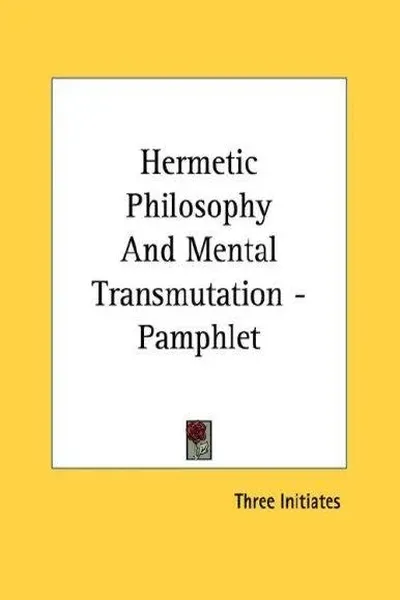
Advanced study of mental alchemy requires engaging with primary Hermetic and esoteric sources. 'The Kybalion' by Three Initiates is a cornerstone text, outlining the Seven Hermetic Principles that underpin mental alchemy. William Walker Atkinson's 'The Arcane Formulas: Or Mental Alchemy' (often presented as a series) offers detailed esoteric methods. 'The Word' by Zeda Christiam explores the power of divine utterance and its connection to mental creation. These works demand focused study and contemplation of complex philosophical ideas.
Reading Order — Step by Step
Begin with Florence Scovel Shinn's 'The Game of Life and How to Play It' (Week 1) for foundational affirmation principles. Follow with Lilian Whiting's 'The Life Radiant' (Week 2) to grasp the connection between thought and vitality. In Month 2, engage with William Walker Atkinson's 'The Arcane Formulas' (Weeks 5-8) for systematic techniques. Transition to 'The Kybalion' (Month 3, Weeks 9-10) to understand the core Hermetic Principles. Conclude with Mabel Collins' 'Light on the Path' (Month 3, Weeks 11-12) for ethical and spiritual progression.
Frequently Asked Questions
Which mental alchemy book should I read first?
For a gentle introduction, start with Florence Scovel Shinn's 'The Game of Life and How to Play It'. It uses simple parables to explain core concepts of positive affirmation and the power of belief in shaping one's reality.
What is the difference between mental alchemy and the Law of Attraction?
Mental alchemy is a broader discipline focused on conscious thought transformation and creation. The Law of Attraction is often considered one principle within mental alchemy, specifically focusing on 'like attracting like' through focused thought and emotion.
Are these books religious?
While many texts draw from spiritual or esoteric traditions, they are not necessarily tied to a single organized religion. They focus on universal principles of mind and consciousness applicable to individuals of various beliefs.
How can I practice mental alchemy daily?
Daily practice involves consistent affirmation, visualization of desired outcomes, mindful awareness of your thoughts, and journaling (like H. Madison's 'Daily Journal') to track progress and intentions.
What are the Seven Hermetic Principles?
These are fundamental laws outlined in 'The Kybalion': Mentalism (The All is Mind), Correspondence (As Above, So Below), Vibration (Nothing rests), Polarity (Duality), Rhythm (Constant Flux), Cause and Effect (Every cause has its effect), and Gender (Masculine and Feminine principles).
Is 'The Kybalion' difficult to understand?
'The Kybalion' presents profound concepts. While accessible, it requires focused study. Reading introductory texts like Shinn's or Atkinson's first can provide a helpful foundation before tackling its core principles.
Can mental alchemy help with financial success?
Yes, many texts, including 'The Game of Life and How to Play It' and works by Atkinson, address how to use mental alchemy principles like positive thinking, clear intention, and belief to attract financial abundance.
What is 'thought-force'?
Thought-force refers to the inherent energy and power of thoughts. It's the concept that directed mental energy can influence events, attract circumstances, and create change in one's life.