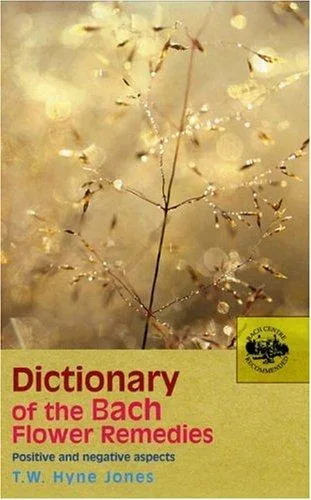
Dictionary of the Bach Flower Remedies
 77
77

Dictionary of the Bach Flower Remedies
T. W. Hyne Jones’s *Dictionary of the Bach Flower Remedies* provides a necessary, if somewhat dry, compendium for anyone serious about Dr. Bach’s system. Its strength lies in its systematic approach, offering clear entries for each remedy, detailing its associated emotional state and therapeutic use. The inclusion of preparation methods and historical context adds depth. However, the prose can be overly academic, lacking the evocative quality that makes the remedies themselves so appealing. A passage detailing *Crab Apple*, described as the remedy for "self-disgust" and "feeling unclean," accurately captures its function, but the explanation feels more like a clinical definition than an exploration of its subtle energetic qualities. For its intended purpose as a reference, it succeeds, but it doesn't quite capture the 'spirit' of the flowers. It’s a functional tool for the practitioner's shelf.
📝 Description
77
First published in 1984, T. W. Hyne Jones's dictionary details all 38 Bach Flower Remedies.
This book serves as a detailed catalog of the 38 Bach Flower Remedies and the Rescue Remedy. It explains the origins of each essence, how it is prepared, and its applications. The author structured this information to help practitioners and individuals understand Dr. Edward Bach's system. The dictionary traces the system's development from Bach's initial work in the early 20th century.
This volume is useful for herbalists, naturopaths, energy healers, and students of botanical medicine. It provides a reference for those wanting to grasp the energetic qualities of each flower and its connection to emotional or mental states. Anyone interested in the history of natural healing, especially vibrational medicine, will find value here. It also assists those looking into complementary therapies for personal wellness.
The Bach Flower Remedies system arose during a time of growing interest in holistic health in the early to mid-20th century. Dr. Edward Bach, a surgeon, sought alternatives to conventional medicine, drawing on homeopathic ideas and his own spiritual beliefs. His work grew alongside other natural healing practices, often separate from mainstream medicine. This dictionary, released after Bach's death in 1936, secures the system's place within alternative healing circles.
The Bach Flower Remedies belong to the tradition of vibrational medicine, which posits that plant and mineral essences carry subtle energetic properties capable of influencing human consciousness and well-being. Developed by Dr. Edward Bach in the early 20th century, this system is rooted in a holistic view of health, connecting emotional states to physical ailments. It draws parallels with homeopathy's use of highly diluted substances and aligns with esoteric philosophies that emphasize the energetic interconnectedness of nature and humanity.
💡 Why Read This Book?
• Learn the precise indications for each of the 38 Bach Flower Remedies, understanding their specific vibrational correspondence to emotional states, as detailed in the remedy entries. • Gain insight into the historical development of the Bach Flower Remedies, including Dr. Edward Bach's personal journey and the context of his work from the early 20th century. • Understand the distinct preparation methods, such as sun infusion or boiling, employed to capture the energetic essence of the flowers, as explained in the foundational sections of the dictionary.
⭐ Reader Reviews
Honest opinions from readers who have explored this book.
❓ Frequently Asked Questions
What is the origin of the Bach Flower Remedies?
The Bach Flower Remedies were developed by Dr. Edward Bach, an English physician and homeopath, between the 1920s and 1930s. He sought gentler, natural healing methods derived from wild plants.
How many Bach Flower Remedies are there, and what is the Rescue Remedy?
There are 38 distinct Bach Flower Remedies, each corresponding to a specific negative emotional state. The Rescue Remedy is a combination of five of these essences, designed for acute crisis situations.
What is the difference between this dictionary and other Bach Flower books?
This dictionary provides a systematic, encyclopedic reference to all 38 remedies, focusing on their definitions, uses, and preparation, serving as a comprehensive resource for practitioners.
Can the Bach Flower Remedies be used alongside conventional medicine?
Yes, Bach Flower Remedies are considered a complementary therapy and are generally safe to use alongside conventional medical treatments without interference.
What does 'vibrational medicine' mean in the context of Bach Flowers?
Vibrational medicine suggests that remedies like Bach Flowers contain subtle energetic patterns or frequencies that interact with the body's own energy field to restore balance.
When was the first edition of the Dictionary of the Bach Flower Remedies published?
The first edition of T. W. Hyne Jones's *Dictionary of the Bach Flower Remedies* was published in 1984, consolidating information on the remedies.
🔮 Key Themes & Symbolism
Emotional States as Imbalances
The work centers on the principle that specific negative emotional states—such as fear, despair, impatience, or indecision—represent energetic imbalances within an individual. Each of the 38 Bach Flower Remedies is presented as a direct antidote to a particular emotional discord. For instance, *Agrimony* addresses those who mask their troubles with cheerfulness, while *Cerato* is for those who lack confidence in their own judgment. This framework positions emotional well-being as paramount for overall health.
Energetic Preparation of Essences
A significant aspect of the Bach Flower system, as detailed in this dictionary, involves the unique methods of preparing the remedies. These typically include the sun infusion method, where flower heads are floated in spring water and exposed to sunlight, or the boiling method for hardier plants. These processes are not merely about extracting physical constituents but about capturing the subtle energetic 'signature' or 'vibration' of the plant, aligning with principles of vibrational medicine.
Dr. Edward Bach's Philosophy
The dictionary implicitly and explicitly grounds itself in the philosophy of Dr. Edward Bach, who sought a simpler, natural system of healing. Bach believed that true healing involved addressing the underlying emotional and mental causes of illness, rather than just the physical symptoms. His work, originating in the early 20th century, emphasized the spiritual and energetic dimensions of health, advocating for a return to nature for remedies.
The 38 Remedies and Rescue Remedy
The core of this work is the systematic presentation of the 38 individual flower remedies and the well-known Rescue Remedy. Each remedy is meticulously described with its botanical name, common name, associated emotional state, and therapeutic application. This detailed cataloguing allows users to identify the appropriate essence for a given emotional pattern, facilitating a precise and personalized approach to natural healing.
💬 Memorable Quotes
Direct passages from the work, attributed to the author.
“Mimulus is for the fear of known things.”
— This succinctly captures the essence of *Mimulus*, highlighting its specific application for anxieties that have a clear source, differentiating it from more generalized fears addressed by other remedies.
“Aspen is for vague fears, dreads, and worries.”
— This defines *Aspen*'s role in addressing anxieties that lack a specific origin, such as unexplained apprehension or a sense of impending doom.
“Crab Apple is the cleansing remedy.”
— This points to *Crab Apple*'s function in situations of perceived impurity or self-disgust, suggesting a need for internal and external purification.
“Rescue Remedy is for emergencies.”
— This straightforward statement emphasizes the primary use of this combination essence: to provide immediate support during acute crises or stressful events.
“Star of Bethlehem is for shock and its effects.”
— This highlights *Star of Bethlehem*'s critical role in addressing the aftermath of trauma, both physical and emotional, aiding in recovery from shock.
🌙 Esoteric Significance
Tradition
The Bach Flower Remedies align with the broader tradition of vibrational medicine and natural magic, particularly within Western esotericism. While not directly tied to Hermeticism or Kabbalah in its structure, it shares the Hermetic principle of 'as above, so below,' applying the energetic patterns of nature (the flowers) to the inner human landscape (emotions). It can be seen as a modern manifestation of herbalism infused with homeopathic principles and a distinct spiritual philosophy focused on emotional harmony.
Symbolism
The primary symbolism lies in the specific flowers chosen and their perceived energetic qualities. For example, *Holly* is associated with feelings of anger, jealousy, and suspicion, symbolically representing the need to open the heart. *Willow* signifies bitterness and resentment, symbolizing the release of victimhood and a return to personal responsibility. The very act of drawing remedies from nature reflects a reverence for the Earth's healing powers and a connection to elemental forces.
Modern Relevance
Contemporary practitioners of energy healing, naturopathy, and holistic wellness frequently incorporate Bach Flower Remedies into their practices. Thinkers and authors in the self-help and spiritual development spheres often reference the system as a foundational tool for emotional self-care. Schools of thought focusing on mind-body connections and psychosomatic healing also find value in Bach's approach to treating illness through emotional balance.
👥 Who Should Read This Book
• Individuals seeking to understand and manage specific negative emotional states, offering a natural approach to emotional self-regulation. • Practitioners of alternative and complementary therapies, such as naturopathy and energy healing, who require a detailed reference for client consultations. • Students of botanical medicine and the history of natural healing, providing context on the development of vibrational remedies in the 20th century.
📜 Historical Context
The Bach Flower Remedies emerged in the early to mid-20th century, a period marked by a growing disillusionment with purely materialistic science and an increasing interest in holistic and spiritual approaches to health. Dr. Edward Bach, a London-based surgeon and bacteriologist, developed his system between the 1920s and his death in 1936. His work drew inspiration from homeopathy but diverged by focusing solely on the energetic properties of flowers. While figures like Rudolf Steiner were exploring anthroposophy and other alternative paradigms around the same time, Bach's system offered a uniquely accessible and gentle method. His remedies gained a following among natural health practitioners but remained largely outside conventional medical discourse, sometimes viewed with skepticism by the established medical community.
📔 Journal Prompts
The specific indications for *Mimulus* versus *Aspen*.
Dr. Edward Bach's shift from conventional medicine to flower remedies.
The energetic principles behind the sun infusion preparation method.
Personal experiences with the 'cleansing' quality of *Crab Apple*.
The role of *Star of Bethlehem* in processing recent emotional shocks.
🗂️ Glossary
Bach Flower Remedies
A system of 38 flower essences developed by Dr. Edward Bach, each targeting a specific negative emotional state to promote emotional well-being and balance.
Rescue Remedy
A combination of five Bach Flower Remedies (*Cherry Plum*, *Clematis*, *Impatiens*, *Rock Rose*, and *Star of Bethlehem*) used for acute distress and emergencies.
Vibrational Medicine
A category of alternative medicine that posits that all matter, including living organisms and remedies, emits energy fields or vibrations that can be used for healing.
Sun Infusion Method
A primary method for preparing Bach Flower Remedies, involving floating flower heads in spring water and exposing them to sunlight to capture their energetic essence.
Boiling Method
An alternative preparation method for Bach Flower Remedies, used for hardier plants, involving boiling flower material in spring water to extract its energetic properties.
Emotional State
In the context of Bach Flowers, a specific negative feeling or disposition (e.g., fear, despair, impatience) that the remedies are designed to address and transform.
Energetic Signature
The unique vibrational pattern or essence of a plant or substance, believed to hold healing properties in systems like vibrational medicine.
🔮 Readers Also Liked
Browse all →









More by T. W. Hyne Jones
All books →
More Free Occult Philosophy Books
View all →