Los Mensajes Ocultos del Agua / The Water's Hidden Messages

 84
84

Los Mensajes Ocultos del Agua / The Water's Hidden Messages
Masaru Emoto's "The Water's Hidden Messages" offers a visually arresting, if scientifically contentious, proposition: that water crystals reveal the impact of human thought and intention. The book's strength lies in its striking photographic evidence, presenting images of water crystals formed after exposure to positive phrases like "I love you" versus negative ones. These stark visual contrasts are compelling, even without accepting Emoto's broader conclusions. However, the primary limitation is the lack of rigorous scientific methodology; the experiments are not described with the detail needed for independent replication, and the leap from observed crystal formation to definitive proof of water consciousness is significant. One memorable passage describes how water from a hot spring, treated with gratitude, formed a particularly beautiful crystal, illustrating the book's central thesis through evocative imagery. Ultimately, the book serves more as a philosophical prompt and a work of art than a scientific treatise.
📝 Description
84
Masaru Emoto's 2005 book presents photographs of water crystals exposed to different words and sounds.
Masaru Emoto's "Los Mensajes Ocultos del Agua" (The Water's Hidden Messages) displays photographs of water crystals. Emoto claimed these crystals formed unique patterns based on the stimuli water received. He exposed water samples to various influences, such as classical music, positive affirmations, negative words, and even environmental pollutants. The book's central argument is that water can record information and that its crystalline structure visually represents this 'consciousness' or receptivity.
The work is intended for those interested in the connection between consciousness, science, and spirituality. It particularly appeals to individuals exploring alternative healing, water dowsing, or the energetic properties of nature. Readers open to non-traditional scientific ideas and seeking to understand subtle forces affecting reality will find Emoto's research thought-provoking. Those interested in bioenergetics, vibrational medicine, or the philosophical significance of water's role in life may also find value here.
Published in 2005, Emoto's book appeared as interest grew in how quantum physics might explain consciousness and challenge materialistic science. It connected with a desire for holistic explanations of well-being, aligning with earlier movements like Theosophy and New Age thought that focused on universal interconnectedness. Although mainstream science did not accept his methods, Emoto's ideas found an audience in alternative health circles.
💡 Why Read This Book?
• Learn about the "water crystal" phenomenon, a specific visual representation Emoto used to demonstrate water's purported ability to record and respond to vibrations, as detailed in his experiments. • Understand the concept of "hado" (vibrational energy), a core principle in Emoto's work suggesting that everything, including water, is composed of energy and vibrates at specific frequencies. • Gain insight into the practical application of positive affirmations and intentions, as demonstrated by Emoto's photographic results showing how words like "thank you" allegedly influence crystal formation.
⭐ Reader Reviews
Honest opinions from readers who have explored this book.
❓ Frequently Asked Questions
What year was Masaru Emoto's 'The Water's Hidden Messages' first published?
Masaru Emoto's 'The Water's Hidden Messages' was first published in 2005, introducing his unique photographic experiments with water crystals to a global audience.
What is the core scientific claim made by Masaru Emoto in this book?
Emoto claimed that water possesses a form of consciousness and can record information from its environment, visually represented by the formation of distinct crystalline structures when exposed to various stimuli.
Are Masaru Emoto's findings widely accepted by the scientific community?
No, Emoto's research is generally considered pseudoscience by the mainstream scientific community due to a lack of reproducible experimental controls and peer-reviewed data.
What kind of images does the book feature?
The book features high-resolution photographs of frozen water crystals, presented as evidence of how different words, sounds, and intentions affect water's structure.
What is the term Emoto uses for the vibrational energy he believed water responded to?
Emoto referred to this vibrational energy as 'hado,' a Japanese concept that suggests everything in the universe is composed of energy and vibrates at unique frequencies.
Can I perform Emoto's water crystal experiments at home?
While the basic concept of freezing water and observing ice formations is simple, replicating Emoto's specific methodology for controlled experimentation and photography requires specialized equipment and techniques.
🔮 Key Themes & Symbolism
Water as a Sentient Medium
This theme explores the radical notion that water is not inert but possesses a form of consciousness, capable of receiving, processing, and reflecting information. Emoto's work posits that water acts as a universal medium, absorbing the energetic imprints of its surroundings. The book presents photographic evidence of water crystals forming distinct patterns when exposed to positive versus negative stimuli, suggesting that our thoughts and intentions have a tangible, albeit subtle, effect on the physical world. This concept challenges conventional materialism by assigning a form of awareness to a fundamental element of life.
The Power of Vibration and Intention
Central to Emoto's thesis is the idea that 'hado,' or vibrational energy, influences the structure of water. The book details experiments where water samples were exposed to different frequencies – from classical music and positive affirmations to harsh words and polluted environments. The resulting crystalline structures are presented as visual proof of this energetic transfer. Beautiful, symmetrical hexagons allegedly form from positive vibrations like "love" and "gratitude," while fragmented, asymmetrical shapes are attributed to negative frequencies. This theme emphasizes how focused intention can manifest physical changes, aligning with principles found in various spiritual traditions.
Visualizing the Unseen
Emoto's work provides a visual language for concepts that are typically intangible. The book's primary contribution is its extensive collection of water crystal photographs, serving as a bridge between the esoteric concept of water consciousness and observable phenomena. Each image is presented as a direct representation of the energetic state of the water at the moment of freezing. This approach allows readers to engage with abstract ideas about energy and consciousness through concrete, aesthetic evidence, making the unseen world of vibrations more accessible and relatable.
Holistic Health and Environmentalism
Beyond its philosophical implications, Emoto's research touches upon holistic health and environmental consciousness. The book suggests that the quality of our water, both internally and externally, is profoundly influenced by the collective consciousness and individual intentions. By demonstrating how positive thoughts can purportedly create 'healthy' water structures, Emoto implies that fostering positive environments and cultivating mindful intentions can contribute to well-being. This perspective encourages a more responsible relationship with water resources and highlights the interconnectedness of human consciousness and the natural world.
💬 Memorable Quotes
Direct passages from the work, attributed to the author.
“Water is the mirror of the soul.”
— This statement expresses Emoto's core idea that water's crystalline formations reflect the energetic state of its environment, including the consciousness and intentions of those interacting with it.
“When we say 'thank you' to water, it forms a beautiful crystal.”
— This highlights a specific experimental result where the affirmation of gratitude was shown to produce a geometrically pleasing hexagonal water crystal, illustrating the book's central thesis.
“The energy of prayer can transform water.”
— This interpretation reflects Emoto's findings regarding the impact of focused spiritual intentions, suggesting that the act of prayer can alter the physical structure of water.
💡 Key Ideas
Editorial paraphrase of the work's core concepts — not direct quotes.
Negative words result in fragmented, distorted ice structures.
This paraphrased concept describes the visual outcome Emoto attributed to exposure to negative language, contrasting sharply with the formations allegedly produced by positive affirmations.
Each drop of water contains information.
This paraphrased concept conveys the idea that water acts as a recording medium, capable of holding and transmitting energetic data from its surroundings, as evidenced by the crystal patterns.
🌙 Esoteric Significance
Tradition
Emoto's work can be loosely associated with modern esoteric traditions that emphasize the energetic nature of reality and the power of consciousness, particularly those influenced by vibrational healing and New Thought philosophies. While not directly tied to a specific lineage like Hermeticism or Kabbalah, it speaks to the Hermetic principle of 'As Above, So Below,' suggesting macrocosmic (consciousness) and microcosmic (water structure) correspondences. It departs from classical esoteric systems by relying on photographic 'evidence' rather than traditional meditative or symbolic interpretation, aiming for a more empirical, albeit unconventional, validation.
Symbolism
The primary symbol in Emoto's work is the water crystal itself. The hexagonal, symmetrical structure is presented as representing harmony, purity, and coherence – qualities associated with positive energy and divine order across many spiritual traditions. Conversely, fragmented or distorted ice formations symbolize chaos, discord, and negativity. Water itself is a potent symbol, representing life, consciousness, the subconscious, and emotional fluidity. Emoto's methodology imbues these traditional symbols with a new layer of visual representation, linking abstract concepts to concrete, observable (though debated) forms.
Modern Relevance
Emoto's research continues to influence contemporary practices in areas like water vitalization, alternative healing, and consciousness studies. Thinkers and practitioners in bioenergetics, vibrational medicine, and mindfulness often cite his work as inspiration for understanding the subtle energies that impact health and well-being. His visual approach has also found resonance in art therapy and eco-spiritual movements, encouraging a more mindful and respectful interaction with natural resources. The ongoing discussion surrounding his findings highlights a persistent cultural desire to bridge the gap between subjective experience and objective scientific proof.
👥 Who Should Read This Book
• Individuals exploring the relationship between consciousness and the physical world, seeking to understand how thoughts and emotions might influence their environment. • Practitioners of alternative healing modalities, such as energy medicine or vibrational therapy, who are interested in the energetic properties of water and its role in health. • Students of comparative spirituality and esoteric philosophies looking for modern, visually-driven interpretations of concepts like universal interconnectedness and subtle energies.
📜 Historical Context
Masaru Emoto's "Los Mensajes Ocultos del Agua" emerged in 2005, a period marked by burgeoning interest in quantum mechanics' potential to explain consciousness and a growing disillusionment with purely materialistic scientific frameworks. The book tapped into the prevailing New Age zeitgeist, which emphasized interconnectedness and subtle energies, echoing earlier movements like Theosophy. While Emoto's photographic experiments gained significant traction within alternative health and spiritual communities, they were largely met with skepticism by mainstream science. Critics pointed to the lack of rigorous controls and the subjective interpretation of the images. Notably, Emoto's work gained popularity alongside other popularizers of consciousness studies, such as Lynne McTaggart, though their methodologies differed significantly. The book's reception highlighted a cultural divide regarding the definition of scientific validity and the acceptance of phenomena outside conventional paradigms.
📔 Journal Prompts
The concept of 'hado' and its potential influence on water.
Reflect on the visual contrast between positive and negative water crystals presented in the book.
Consider the symbolism of water's hexagonal crystal formation in relation to other esoteric traditions.
How might the principle of 'water consciousness' apply to other elements or systems?
Personal affirmations and their potential energetic impact, as suggested by Emoto's experiments.
🗂️ Glossary
Hado
A Japanese concept representing vibrational energy or frequency. Emoto proposed that everything in the universe, including water, emits and responds to 'hado,' influencing its physical state and structure.
Water Crystal
The frozen, crystalline structure of water as captured in Emoto's photographs. He claimed these formations visually represent the 'information' or 'energy' the water had been exposed to.
Consciousness of Water
Emoto's central hypothesis that water is not merely a chemical substance but possesses a form of awareness or sentience, capable of receiving and reflecting external influences.
Affirmation
Positive statements or phrases used in Emoto's experiments, such as 'I love you' or 'Thank you,' which he believed imparted beneficial energy to water, resulting in beautiful crystal formation.
Hexagonal Structure
The geometric shape of the ice crystals allegedly formed by water exposed to positive stimuli. This symmetrical form is often associated with purity and harmony in spiritual symbolism.
Distorted Structure
The irregular or fragmented shapes of ice crystals that Emoto claimed resulted from water exposed to negative words, polluted environments, or discordant energies.
Energetic Imprint
The idea that environments, thoughts, and emotions leave a residual energetic signature that water can absorb and reflect in its crystalline structure.
🔮 Readers Also Liked
Browse all →









More by Masaru Emoto
All books →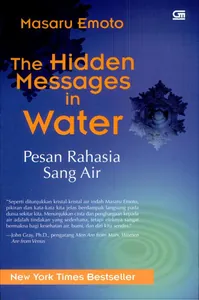

More Free Occult Philosophy Books
View all →