The hidden messages in water
 78
78

The hidden messages in water
Masaru Emoto's *The Hidden Messages in Water* is less a scientific treatise and more a visual philosophy presented through a series of photographic experiments. The book's primary strength lies in its striking imagery: the contrast between the pristine, geometric ice crystals attributed to positive intent and the fractured, chaotic forms associated with negativity is undeniably arresting. Emoto's meticulous presentation of these visuals, accompanied by handwritten words and musical notations, creates a powerful, albeit subjective, narrative. However, the work falters significantly in its scientific rigor. The methodology, relying on subjective interpretation of photographic evidence and lacking robust controls, places it firmly outside empirical science. A passage detailing the formation of crystals from water exposed to the word 'love' versus 'hate' exemplifies this dichotomy – visually persuasive but scientifically unsubstantiated. Ultimately, *The Hidden Messages in Water* serves as a compelling visual allegory for the power of positive thought, rather than a verifiable scientific discovery.
📝 Description
78
Masaru Emoto first published 'The Hidden Messages in Water' in 2004.
Masaru Emoto's 2004 book documents experiments observing water crystals formed after exposure to different stimuli. He exposed water samples to various words, music, and environments. These samples were then frozen to analyze the resulting crystalline structures. Emoto claimed that water exposed to positive influences, such as kind words or classical music, formed beautiful, hexagonal crystals. Conversely, water exposed to negative influences, like harsh words or heavy metal music, produced distorted or amorphous formations.
The book is aimed at individuals interested in alternative healing, consciousness studies, and subtle energies. It speaks to those who wish to understand how thought and intention might affect physical reality, especially through water, a major component of living organisms. Readers open to non-traditional scientific exploration and those seeking spiritual or metaphysical links to the environment will find much to consider in Emoto's visual evidence.
Emoto's work emerged in the early 2000s, coinciding with a rise in public interest in mind-body connections and holistic wellness. While outside mainstream scientific acceptance, his visual data presented a debated argument for the power of intention. The book's release followed a surge in New Age thought and alternative healing practices. It provided a visual representation for abstract ideas of energetic resonance, echoing earlier concepts like vitalism and subtle energies found in various spiritual traditions.
💡 Why Read This Book?
• Understand the concept of 'hado' as presented by Emoto, learning how this proposed life force in water might be influenced by human intention, a unique perspective not found in conventional physics. • Examine Emoto's photographic evidence of water crystals, appreciating the visual representation of how specific words like 'Gratitude' allegedly impact water's structure, offering a tangible, albeit debated, link between thought and form. • Explore the experimental methodology Emoto employed, including the freezing technique and observation of ice crystals, to grasp his unique approach to investigating consciousness's effect on physical matter, distinct from standard scientific protocols.
⭐ Reader Reviews
Honest opinions from readers who have explored this book.
❓ Frequently Asked Questions
What is Masaru Emoto's central claim about water?
Masaru Emoto's central claim is that water possesses a form of consciousness and can record and transmit human thoughts and emotions. He proposed that water exposed to positive influences forms beautiful ice crystals, while negative influences result in distorted structures.
How did Masaru Emoto conduct his experiments?
Emoto collected water samples, exposed them to various stimuli like words, music, or prayers, then froze them. He photographed the resulting ice crystals, presenting these images as evidence of water's response to the applied influences.
What is 'hado' in the context of Emoto's work?
'Hado' is a Japanese term often translated as wave energy or life force. Emoto believed that water could carry and amplify this 'hado,' and that human consciousness could positively or negatively affect its quality.
Is Masaru Emoto's work scientifically accepted?
No, Emoto's work is not widely accepted by the mainstream scientific community. Critics point to a lack of rigorous controls, potential for subjective bias in interpretation, and insufficient evidence to support the claims within established scientific frameworks.
Where was Masaru Emoto from?
Masaru Emoto was from Japan. He began his research into the properties of water and its crystalline structures in the 1990s, leading to the publication of his influential book in 2004.
What kind of crystals did Emoto associate with negative words?
Emoto associated negative words, such as 'hate' or 'you are useless,' with the formation of distorted, fragmented, or amorphous ice structures, lacking the symmetry and beauty of crystals formed from positive stimuli.
🔮 Key Themes & Symbolism
Water's Sentience
The core theme posits that water is not an inert substance but possesses a latent consciousness capable of responding to external stimuli. Emoto's experiments, particularly his photographic documentation of ice crystals formed from water exposed to different environments, aim to visually demonstrate this sentience. The book suggests that water can 'remember' and reflect the energetic signatures of words, sounds, and even human emotions, challenging conventional materialist viewpoints and proposing a more dynamic, interconnected reality where consciousness plays an active role in shaping physical forms.
The Power of Intention
This theme highlights how human thought and intention can directly influence the physical world, using water as the primary medium. Emoto illustrates this by showing how water treated with positive affirmations, prayers, or loving words forms aesthetically pleasing, symmetrical ice crystals. Conversely, water exposed to negative or hateful messages allegedly produces fragmented, asymmetrical structures. This concept implies that by consciously directing our thoughts and intentions, particularly towards water, we can foster positive energetic changes, with potential implications for health, environment, and well-being.
Energetic Resonance and 'Hado'
Emoto introduces the concept of 'hado,' a Japanese term representing life force or vibrational energy, which he believed water could capture and transmit. The book explores the idea that everything in the universe vibrates at a certain frequency, and water acts as a powerful conduit for these vibrations. Positive 'hado' is associated with harmonious crystal formation, while negative 'hado' leads to discord. This theme suggests that by cultivating positive energetic states, individuals can contribute to a more harmonious energetic field, influencing not only water but potentially all aspects of existence.
Visualizing the Unseen
A significant aspect of the book is its reliance on visual evidence to convey abstract concepts. Emoto's collection of over 150,000 photographs of water crystals serves as the primary 'proof' for his theories. The distinct visual differences between crystals are presented as direct correlations to the nature of the stimuli applied. This theme underscores the power of visual representation in making complex or esoteric ideas accessible, encouraging readers to perceive the world through a lens that acknowledges subtle energies and the potential for hidden messages within everyday phenomena.
💬 Memorable Quotes
Direct passages from the work, attributed to the author.
“Water is the mirror of the soul.”
— This statement expresses Emoto's core idea: that water, through its crystalline structure, reflects the state of consciousness it is exposed to, much like a mirror reflects an image. It suggests a deep, intrinsic connection between the inner world of beings and the physical substance of water.
“The words we speak and the thoughts we think create vibrations that affect the water around us.”
— This interpretation highlights the energetic transmission of consciousness. Emoto proposed that thoughts and words are not merely abstract concepts but generate tangible energetic frequencies that interact with water, influencing its physical form and properties.
“Beautiful crystals form when water is exposed to love and gratitude.”
— This observation points to the positive impact of benevolent emotions. Emoto's work suggests that sentiments like love and gratitude generate a harmonic resonance within water, leading to the formation of ordered, aesthetically pleasing ice structures.
“Distorted structures appear when water encounters negativity.”
— This concept illustrates the perceived detrimental effect of negative emotions or words on water. Emoto's research implies that fear, anger, or hate disrupt the inherent harmony of water, resulting in chaotic and fragmented crystal formations.
“Water is a living entity that responds to us.”
— This phrase emphasizes the active nature of water in Emoto's model. It suggests that water is not passive but a responsive medium, capable of interaction and change based on the energetic input it receives from its environment, particularly from conscious beings.
🌙 Esoteric Significance
Tradition
While not directly belonging to a specific historical esoteric tradition like Gnosticism or Theosophy, Emoto's work can be seen as a modern interpretation of animistic beliefs and vitalistic philosophies that pervade many spiritual systems. It echoes ancient ideas of water spirits and the sacredness of natural elements, re-framing them through a lens of contemporary scientific imagery. His concept of 'hado' bears resemblance to concepts of 'prana' or 'chi' found in Eastern traditions, suggesting a universal life force that water can channel and reflect, aligning with a pan-entheistic worldview.
Symbolism
The primary symbolism in Emoto's work lies in the water crystals themselves. The hexagonal, symmetrical structures are presented as symbols of purity, harmony, and divine order, often associated with positive intentions like love and gratitude. Conversely, the fragmented, asymmetrical, or absent crystals symbolize discord, chaos, and the negative impact of harmful thoughts or environments. The act of freezing and photographing water becomes a ritualistic process, transforming the invisible energetic realm into observable visual forms, thereby symbolizing the manifestation of consciousness into matter.
Modern Relevance
Emoto's ideas continue to influence contemporary wellness practices, mindfulness movements, and discussions on environmental consciousness. Practitioners of positive affirmations, water charging, and intentional healing often cite his work as inspiration. Contemporary thinkers exploring quantum entanglement and interconnectedness sometimes draw parallels, albeit loosely, to Emoto's visual representations of energetic influence. His work remains a touchstone for those seeking tangible, visual evidence for the impact of consciousness on the material world, particularly in fields like alternative medicine and eco-spirituality.
👥 Who Should Read This Book
• Individuals curious about the intersection of consciousness and the physical world, seeking visual representations of abstract energetic concepts. • Practitioners of meditation, affirmations, or energy healing modalities who wish to explore potential influences on water and, by extension, on biological systems. • Researchers or students of comparative spirituality and alternative science looking to understand popular, visually-driven theories about water's role in consciousness.
📜 Historical Context
Masaru Emoto's *The Hidden Messages in Water* emerged in 2004, a period marked by a growing global interest in holistic health, mindfulness, and the potential for consciousness to influence physical reality. This era saw the popularization of concepts like the placebo effect and the mind-body connection, making Emoto's visually striking claims about water's responsiveness particularly resonant. While not directly tied to established esoteric lineages like Hermeticism or Kabbalah, his work tapped into a broader New Age zeitgeist that embraced subtle energies and interconnectedness. Contemporary popularizers of consciousness studies, such as those influenced by the work of Fritjof Capra's *The Tao of Physics* (1975) which explored parallels between modern physics and Eastern mysticism, created fertile ground for Emoto's ideas. The book's reception was largely polarized: embraced by alternative health communities and spiritual seekers, while largely dismissed by the scientific establishment due to methodological concerns, echoing debates around earlier pseudoscientific claims regarding water memory.
📔 Journal Prompts
The crystalline formations associated with 'love' and 'hate'.
The concept of 'hado' and its potential manifestations.
Water's response to different musical genres.
Personal intentions directed towards water.
The visual differences in ice crystals.
🗂️ Glossary
Hado
A Japanese term often translated as wave energy or life force. Masaru Emoto proposed that water can carry and amplify this energy, which is influenced by consciousness and external stimuli.
Crystalline Structure
The geometric arrangement of atoms or molecules in a solid material. Emoto focused on the hexagonal ice crystals formed from water samples as visual indicators of water's response to various energies.
Water Consciousness
The theory, central to Emoto's work, that water possesses a form of awareness or sentience capable of recording and reflecting information from its environment, including human thoughts and emotions.
Positive Stimuli
In Emoto's context, this refers to influences such as positive words ('love', 'thank you'), prayers, or harmonious music that allegedly cause water to form beautiful, symmetrical ice crystals.
Negative Stimuli
Influences such as negative words ('hate', 'useless'), discordant music, or pollution that Emoto claimed resulted in distorted, fragmented, or amorphous ice formations in water samples.
Freezing Method
Emoto's experimental technique involving exposing water samples to specific conditions, then freezing them rapidly to observe and photograph the resulting ice crystal formations.
Emoto's Photographs
The collection of thousands of images taken by Masaru Emoto, documenting the ice crystals formed from treated water samples, presented as evidence for his theories on water's response to consciousness.
🔮 Readers Also Liked
Browse all →







More by Masaru Emoto
All books →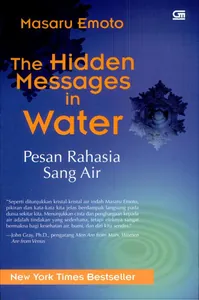

More Free Occult Philosophy Books
View all →