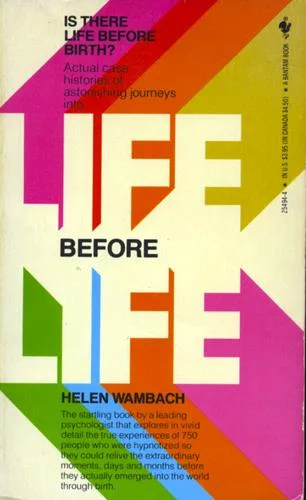
Life Before Life
 74
74

Life Before Life
Wambach's "Life Before Life" is a significant, albeit dated, attempt to bring empirical rigor to the contentious field of past-life regression. Her statistical approach, analyzing hundreds of regression sessions for recurring details, represents a commendable effort to move beyond mere anecdote. The sheer volume of data presented offers a compelling look at the patterns emerging from subjective recall. A particular strength lies in the detailed description of her methodology, allowing readers to understand the controls and parameters she imposed on the research. However, the book's primary limitation is its reliance on hypnosis, a state inherently susceptible to suggestion and confabulation, which Wambach acknowledges but does not fully overcome. The detailed cataloging of recalled occupations and social strata, while fascinating, still leaves room for interpretation regarding the source of this information. The work explores the possibility of genuine memory recall, but the evidence, while suggestive, remains inconclusive for the skeptic. It stands as a foundational text for those interested in quantitative approaches to past-life phenomena.
📝 Description
74
Helen Wambach's 1984 book compiles research on past-life recall from hundreds of subjects.
Helen Wambach's "Life Before Life," published in 1984, details her systematic research into past-life recall. Wambach conducted controlled regression sessions, using hypnotic induction to guide subjects to perceived prior existences. Her aim was to move beyond anecdotal accounts by identifying common patterns and historical consistencies within these recalled experiences. The book outlines her methodology, which sought to establish a more empirical basis for studying reincarnation and memory. This work is for individuals interested in parapsychology, consciousness studies, and the empirical investigation of reincarnation. It suits readers who approach esoteric subjects with a critical yet open mind, seeking evidence-based explorations. Those curious about memory, the subconscious, and consciousness beyond a single life will find substantial material. Therapists and researchers interested in hypnotherapy's applications in exploring subjective experience may also find it relevant.
Published in 1984, "Life Before Life" emerged during a time of renewed interest in parapsychological research. Wambach's work built on earlier investigations into phenomena like children remembering past lives, but her contribution was a more quantitative approach. By using hypnosis across a large sample, she aimed for controlled elicitation of recall. This placed her research within a discourse on psychic phenomena, often viewed with skepticism by mainstream academia but pursued by dedicated research organizations seeking to understand consciousness and memory outside conventional frameworks.
💡 Why Read This Book?
• Learn about Helen Wambach's specific statistical methodology for analyzing past-life recall, which involved categorizing details such as occupations and social classes from hundreds of hypnotic regression sessions. • Understand the historical context of parapsychological research in the late 20th century, specifically how Wambach's 1984 publication engaged with contemporary studies on hypnosis and consciousness. • Examine the concept of 'historical consistency' as Wambach defined it, by analyzing her data for recurring patterns across multiple subjects' supposed past-life experiences.
⭐ Reader Reviews
Honest opinions from readers who have explored this book.
❓ Frequently Asked Questions
What was Helen Wambach's primary research method in 'Life Before Life'?
Helen Wambach utilized controlled hypnotic regression sessions with hundreds of subjects. She then statistically analyzed the recalled details, seeking common themes and historical consistencies across these diverse experiences to investigate past-life memories.
When was 'Life Before Life' first published?
The book 'Life Before Life' by Helen Wambach was first published in 1984, placing it within a period of active research into parapsychology and consciousness.
Did Wambach claim to prove reincarnation?
Wambach presented her findings as strong evidence suggestive of past-life recall, focusing on historical consistencies and patterns found in regressions. However, the work does not definitively 'prove' reincarnation, instead offering empirical data for consideration.
What kind of details did Wambach's subjects recall?
Subjects recalled a wide range of details, including names, dates, locations, occupations, family structures, and significant life events, all presented as memories from previous lifetimes during hypnotic regression.
How does Wambach's work differ from Ian Stevenson's research?
While both explored past-life phenomena, Wambach focused on statistical analysis of hypnotic regression data from a large sample, whereas Ian Stevenson meticulously documented spontaneous childhood memories of past lives, often involving detailed case studies.
Is 'Life Before Life' still considered relevant today?
Yes, the book remains relevant for its pioneering statistical approach to past-life regression research and its contribution to the ongoing discourse on consciousness, memory, and the empirical study of phenomena beyond conventional explanation.
🔮 Key Themes & Symbolism
Statistical Analysis of Recall
Wambach's core contribution lies in her systematic, statistical approach to analyzing data gathered from hypnotic past-life regressions. She moved beyond individual case studies to identify trends across hundreds of subjects. By categorizing recalled information such as occupations, social classes, and historical periods, she sought to detect patterns that might indicate genuine memory rather than imagination or cryptomnesia. This method aimed to lend empirical weight to the concept of past-life recall, providing a quantitative framework for a subject often confined to anecdotal evidence.
Hypnotic Regression Methodology
The book meticulously details the process of hypnotic regression used to elicit past-life memories. Wambach outlines the techniques for inducing trance states and guiding subjects to access perceived prior existences. She discusses the challenges and potential pitfalls, including the influence of the subconscious and the possibility of suggestion, while maintaining that her controlled protocols minimized these factors. The emphasis is on the structured nature of these sessions as a tool for empirical investigation into the continuity of consciousness.
Historical Consistency and Accuracy
A central theme is the exploration of historical consistency within the recalled past-life narratives. Wambach's research sought to determine if the details provided by subjects aligned with known historical facts and social conditions of specific eras. The presence of recurring details, names, and historical contexts across different individuals and regressions was interpreted as evidence supporting the authenticity of these memories. The work examines how this consistency might challenge conventional explanations for such phenomena.
The Nature of Consciousness and Memory
Beyond reincarnation, 'Life Before Life' touches upon fundamental questions regarding the nature of human consciousness and memory. Wambach's research implicitly challenges materialist views by suggesting that memory and identity might not be solely confined to the biological brain of a single lifetime. The book probes the potential for consciousness to persist and retain information across lifetimes, opening avenues for contemplation on the deeper structures of awareness and the subjective experience of time.
💬 Memorable Quotes
Direct passages from the work, attributed to the author.
“Statistical analysis of the data revealed a significant number of recurring elements across the regressions.”
— This statement highlights Wambach's core finding: that patterns emerged from her research, suggesting a level of shared experience or objective recall beyond random chance.
“The subjects were guided to recall details of their perceived former lives.”
— This describes the fundamental technique employed in the research, emphasizing the active process of accessing information through hypnotic states.
“Occupation was one of the most frequently recalled categories of information.”
— This points to a specific, quantifiable result from Wambach's statistical analysis, indicating a consistent type of detail that emerged from the regressions.
“The research sought to identify historical consistencies in the recalled data.”
— This explains the objective of the statistical analysis – to find evidence that the recalled memories aligned with known historical realities.
“Hypnotic regression was employed as the primary research tool.”
— This directly states the methodology, framing the book's investigation within the context of parapsychological research using altered states of consciousness.
🌙 Esoteric Significance
Tradition
Wambach's work engages with the modern esoteric tradition of reincarnation studies, which has roots in Theosophy and later flourished within New Age thought. While not strictly aligned with Hermetic, Gnostic, or Kabbalistic lineages, it draws from a broader spiritualist interest in the survival of consciousness after death. Her contribution is primarily in attempting to apply empirical, albeit unconventional, research methods to validate these beliefs, bridging the gap between subjective spiritual experience and objective data collection.
Symbolism
The book's primary 'symbols' are not traditional esoteric iconography but rather the statistical patterns themselves. Recurring numbers (like specific dates or age spans), consistent social roles (e.g., farmer, soldier, mother), and geographical locations emerge as symbolic data points. These recurring motifs function as markers, pointing towards a perceived continuity of experience and identity across lifetimes, acting as empirical signposts for the concept of soul transmigration.
Modern Relevance
Contemporary thinkers and practitioners in fields like transpersonal psychology, consciousness studies, and hypnotherapy continue to reference Wambach's research. Her statistical approach provides a framework for those seeking to investigate past-life recall more systematically. While methodologies have evolved, her work remains a touchstone for discussions on the empirical potential of altered states of consciousness to reveal information about existence beyond a single human lifespan.
👥 Who Should Read This Book
• Students of parapsychology and consciousness studies seeking empirical data on past-life recall, particularly those interested in quantitative research methods. • Individuals curious about the therapeutic potential of hypnotherapy for exploring subconscious memories and personal history. • Researchers in comparative religion and philosophy of mind interested in evidence that challenges conventional views on memory and personal identity.
📜 Historical Context
Published in 1984, Helen Wambach's "Life Before Life" emerged during a period when parapsychology was exploring various avenues for empirical investigation, often outside mainstream scientific acceptance. This era saw continued interest in phenomena like reincarnation, near-death experiences, and psychic abilities, influenced by earlier pioneers such as J.B. Rhine and later by researchers like Ian Stevenson. Wambach's work distinguished itself through its large-scale statistical analysis of hypnotic regression data, a quantitative approach that contrasted with more qualitative case-study methods. The book entered a discourse where spiritualism and New Age thought were gaining traction, but it aimed for a more scientifically grounded presentation. While not directly engaged by major philosophical movements, it contributed to the ongoing debate between materialist explanations of consciousness and theories suggesting non-local or persistent forms of awareness, particularly within circles interested in alternative spirituality and the study of consciousness.
📔 Journal Prompts
The statistical significance of recurring occupations in past-life recall.
Patterns of social class recalled across different hypnotic regressions.
The historical accuracy of details provided during hypnotic states.
Personal reflections on the concept of continuity of consciousness.
Investigating potential sources for recalled historical information.
🗂️ Glossary
Hypnotic Regression
A technique used in hypnotherapy where a subject is guided under hypnosis to recall past events, experiences, or perceived memories from earlier in their life or, in this context, from previous lifetimes.
Past-Life Recall
The phenomenon where individuals, often under hypnosis, report memories or experiences attributed to a previous existence before their current birth.
Statistical Analysis
The method of collecting, organizing, analyzing, and interpreting numerical data to identify patterns, relationships, and trends, used by Wambach to study regression data.
Cryptomnesia
A psychological phenomenon where a forgotten memory returns without being recognized as such by the subject, who believes it is a new idea or a spontaneously generated memory.
Historical Consistency
The degree to which recalled details from past-life regressions align with verifiable facts and social conditions of the historical periods described by the subjects.
Parapsychology
A field of study that investigates purported psychic phenomena and other paranormal claims, such as telepathy, precognition, and reincarnation.
Altered State of Consciousness
Any mental state significantly different from the normal waking state, often induced by hypnosis, meditation, or psychoactive substances.
🔮 Readers Also Liked
Browse all →









More by Helen Wambach
All books →


More Free Occult Philosophy Books
View all →