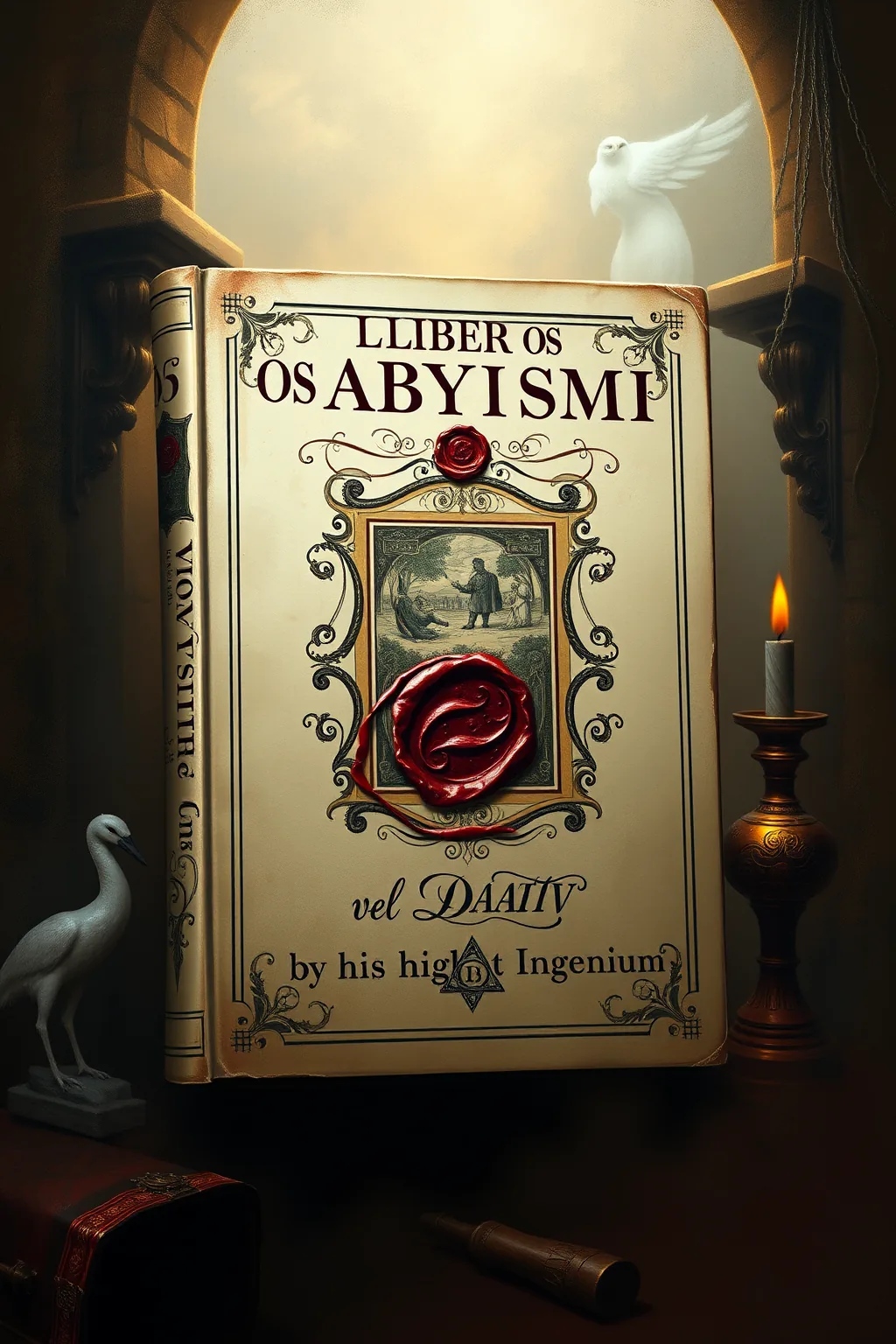
Liber OS ABYSMI vel DAATH sub figura CDLXXIV
 74
74

Liber OS ABYSMI vel DAATH sub figura CDLXXIV


Celeste Moreau (Divination & Symbolism Reviewer) — 'Liber OS ABYSMI vel DAATH' is a masterclass in veiled instruction, a rare gem for those initiated into the deeper currents of Western esotericism. The anonymous author, 'his right Ingenium,' skillfully navigates the symbolic language of Freemasonry to reveal profound truths about spiritual alchemy and the gnosis of the Absolute. Its strength lies in its density of meaning, requiring careful contemplation and a willingness to engage with multi-layered symbolism. This is not light reading; it is a spiritual discipline. It is ideally suited for advanced practitioners of ceremonial magic, seasoned Masonic researchers, and philosophical minds seeking to integrate esoteric principles into their understanding of reality. A truly illuminating, albeit challenging, addition to any serious occult library.
📝 Description
74
Published as 'sub figura CDLXXIV', Liber OS ABYSMI vel DAATH is a cryptic text from 'his right Ingenium'.
This book, known as 'Liber OS ABYSMI vel DAATH sub figura CDLXXIV', is attributed to 'his right Ingenium'. It presents occult knowledge, drawing connections to Freemasonry and secret societies. The text functions as a guide to spiritual development, aiming to reveal hidden aspects of the self and the path of initiation. It addresses those who seek deeper understanding beyond conventional views, encouraging a confrontation with self-knowledge. The work suggests a process of transformation, where ordinary perception recedes and a truer reality emerges.
It is intended for individuals committed to occult studies and philosophical inquiry. The book's content challenges superficial understanding and prompts a rigorous examination of existence. It speaks to those curious about hidden truths and the nature of reality that lies beyond ordinary experience. The writing aims to evoke a sense of ancient mystery and the numinous.
Liber OS ABYSMI vel DAATH exists within the Western esoteric tradition, often associated with ceremonial magic and grimoire literature. Its attribution to 'his right Ingenium' suggests a personal or idiosyncratic source rather than a widely recognized school, though its thematic links to Freemasonry place it in a broader context of fraternal and initiatory societies that often incorporate esoteric symbolism. The book's structure and content are meant to guide the practitioner through stages of spiritual development, a common feature in texts aimed at occult adepts.
💡 Why Read This Book?
Uncover the hidden allegories and symbolic language of Freemasonry, revealing profound mystical doctrines. 'Liber OS ABYSMI vel DAATH' offers a unique path to self-discovery and spiritual awakening for those drawn to the esoteric traditions. Ideal for serious occult practitioners, philosophical seekers, and scholars of secret societies who crave deeper understanding beyond superficial interpretations. This text promises an alchemical journey into the self.
⭐ Reader Reviews
Honest opinions from readers who have explored this book.
❓ Frequently Asked Questions
What is the primary focus of 'Liber OS ABYSMI vel DAATH'?
The book primarily focuses on esoteric Masonic symbolism, spiritual alchemy, and the hidden pathways to gnosis, exploring the concept of 'Daath' as a bridge between realms and states of consciousness.
Who is 'his right Ingenium'?
'His right Ingenium' is the attributed author, suggesting an individual possessing exceptional intellectual and spiritual faculty, dedicated to revealing esoteric truths through this work.
Is this book suitable for beginners in esotericism?
While valuable, its dense symbolism and advanced concepts make it more suitable for those with prior exposure to esoteric thought, Masonic lore, or a strong philosophical inclination.
What kind of knowledge can one expect to gain from this text?
Readers can expect to gain insights into advanced Masonic degrees, alchemical processes, Kabbalistic correspondences, and the nature of spiritual initiation and attainment.
How does 'Liber OS ABYSMI vel DAATH' relate to Freemasonry?
It delves into the deeper, often concealed, metaphysical and mystical interpretations of Masonic rituals, symbols, and teachings, bridging the gap between the exoteric and esoteric aspects of the fraternity.
🔮 Key Themes & Symbolism
The Mystical Significance of Daath
This theme unpacks the crucial role of Daath, the eleventh Sephirah, as the gateway to higher knowledge and the abyss. It explores its representation in Kabbalistic cosmology and its reinterpretation within Masonic symbolism. The text elucidates how Daath serves as a liminal space, a point of transition and potential transformation, where the profane can ascend to the sacred through rigorous inner work and the unveiling of hidden truths. Understanding Daath is presented as essential for working through the labyrinthine path of spiritual evolution.
Alchemical Transformation Through Masonic Allegory
The book masterfully ties alchemical principles into the fabric of Masonic allegory, portraying the spiritual journey as a process of purification, dissolution, and reintegration. It reveals how the rituals and symbols of Freemasonry are not merely historical or social constructs, but potent vehicles for the Great Work. Readers are guided to perceive the symbolic stages of alchemical transformation – from the prima materia to the philosopher's stone – mirrored within the degrees and ceremonies of the Craft, fostering a deeper understanding of inner transmutation.
The Unveiling of Esoteric Masonic Doctrine
This theme focuses on the deliberate concealment and subsequent revelation of advanced metaphysical teachings within Freemasonry. 'Liber OS ABYSMI vel DAATH' acts as a cipher, decoding the cryptic language and symbolic structures used to safeguard profound spiritual knowledge. It highlights how certain 'degrees' and 'secrets' are not merely historical relics but keys to unlocking a deeper gnosis, challenging the practitioner to look beyond the literal and embrace the profound philosophical and mystical underpinnings of the initiatory path. The work emphasizes the importance of inner perception for true comprehension.
💬 Memorable Quotes
Direct passages from the work, attributed to the author.
“The square and compasses are but earthly shadows of celestial geometry.”
— This highlights the idea that Masonic tools represent higher, cosmic principles, urging the reader to look beyond their physical form to grasp their underlying spiritual significance.
“To know Daath is to stand at the threshold of true becoming.”
— This emphasizes Daath as a critical point of transition and potential, where the seeker gains the awareness necessary for profound spiritual growth and self-realization.
“Seek not to master the symbols, but to be mastered by their truth.”
— This advises against a superficial intellectual understanding of symbols, encouraging a deep, transformative engagement where their inherent wisdom shapes the seeker.
💡 Key Ideas
Editorial paraphrase of the work's core concepts — not direct quotes.
The Abyss is not a void, but a fertile darkness from which all light springs forth.
This quote suggests that the perceived emptiness or unknown ('Abyss') is not to be feared but understood as the primordial source of creation and potential, from which all manifest reality emerges.
The true temple is not built of stone, but of purified consciousness.
This quote redirects the focus from external structures to the inner spiritual work, asserting that genuine sacred space is cultivated within the individual's mind and spirit.
🌙 Esoteric Significance
Tradition
This work is deeply rooted in the Western Esoteric Tradition, drawing heavily from Kabbalistic mysticism, Hermetic philosophy, and the symbolic language of Freemasonry. It acts as a bridge between these streams, reinterpreting Masonic rituals and degrees through an alchemical and gnosis-oriented lens. The text is a key example of how secret society teachings can be transmuted into a potent vehicle for spiritual development and the attainment of higher consciousness, aligning with Gnostic and Hermetic ideals.
Symbolism
The symbolism within 'Liber OS ABYSMI vel DAATH' is rich and multi-layered, employing Masonic tools, architectural motifs, and Kabbalistic concepts to represent stages of spiritual evolution. Key symbols like the Abyss (Daath), the square, the compasses, and the Great Architect are recontextualized to illuminate the process of inner transformation, the journey from ignorance to gnosis, and the alchemical transmutation of the self. The text invites contemplation, encouraging readers to perceive the universal truths embedded within these familiar yet profound symbols.
Modern Relevance
In an age often characterized by superficiality and disconnection, 'Liber OS ABYSMI vel DAATH' offers a profound call to introspection and the pursuit of deeper meaning. Its exploration of hidden knowledge, spiritual alchemy, and self-mastery appeals to contemporary seekers grappling with existential questions. The book provides a framework for understanding esoteric principles that can be applied to personal growth, ethical development, and the cultivation of a more profound connection to the universe, making its ancient wisdom relevant to the modern spiritual landscape.
👥 Who Should Read This Book
This text is a profound resource for seasoned practitioners of ceremonial magic and occultism seeking to deepen their understanding of Masonic esoteric traditions and alchemical symbolism. It will also greatly appeal to scholars of secret societies and Western esotericism who wish to explore the philosophical underpinnings of these organizations. For the dedicated spiritual seeker who feels a pull towards hidden knowledge and is ready for a challenging yet rewarding intellectual and spiritual journey, 'Liber OS ABYSMI vel DAATH' offers a potent gateway. Beginners with a strong philosophical inclination and a genuine curiosity for esoteric lore may find it a stimulating, albeit advanced, introduction.
📜 Historical Context
Emerging from the rich intellectual and spiritual currents of the late 19th or early 20th century, a period marked by a resurgence of interest in occultism, esoteric philosophy, and secret societies, 'Liber OS ABYSMI vel DAATH' reflects the era's fascination with Kabbalah, Hermeticism, and the deeper mystical interpretations of Masonic traditions. This was a time when scholars and practitioners alike sought to synthesize ancient wisdom with modern understanding, often through coded texts and allegorical narratives. The attribution to 'his right Ingenium' further aligns with the tradition of anonymous or pseudonymous authorship common in esoteric circles, preserving the sanctity of the knowledge and emphasizing the divine inspiration behind the work. The book stands as a proof of the enduring human quest for hidden knowledge and spiritual enlightenment, contributing to the complex set of Western esotericism.
📔 Journal Prompts
Reflect on the concept of 'Daath' as presented in the text. How does it challenge your understanding of knowledge and consciousness?
Identify one Masonic symbol discussed and explore its alchemical parallel in your own life or spiritual practice.
How can the principles of purification and transformation described in the text be applied to overcoming personal obstacles?
Consider the idea of the 'true temple' being within. What practices can you cultivate to build and maintain this inner sanctuary?
What is the most potent piece of 'hidden knowledge' you have encountered in your spiritual journey, and how did it shape your perspective?
🗂️ Glossary
Abyss (Daath)
In Kabbalistic and esoteric traditions, Daath represents the eleventh Sephirah, often depicted as the abyss or the hidden knowledge, a gateway between the higher and lower realms and a point of profound realization.
Gnosis
A Greek term meaning 'knowledge,' Gnosis refers to spiritual insight, intuitive understanding, and direct experiential knowledge of divine truths, often sought in esoteric and Gnostic traditions.
Prima Materia
In alchemy, the Prima Materia is the fundamental, undifferentiated substance from which all things are believed to originate, representing the raw, chaotic potentiality that must be refined through the Great Work.
Allegory
A symbolic narrative or representation where characters, events, and settings have deeper, often moral or spiritual, meanings beyond their literal interpretation.
Esotericism
A broad category of mystical and occult philosophies and practices that emphasize the pursuit of hidden knowledge, spiritual enlightenment, and direct experience of the divine, often through symbolic language and initiatory paths.
This book appears in 2 collections
🔮 Readers Also Liked
Browse all →









From the “Secret Societies” Collection
View all →






More Free Freemasonry & Secret Societies Books
View all →