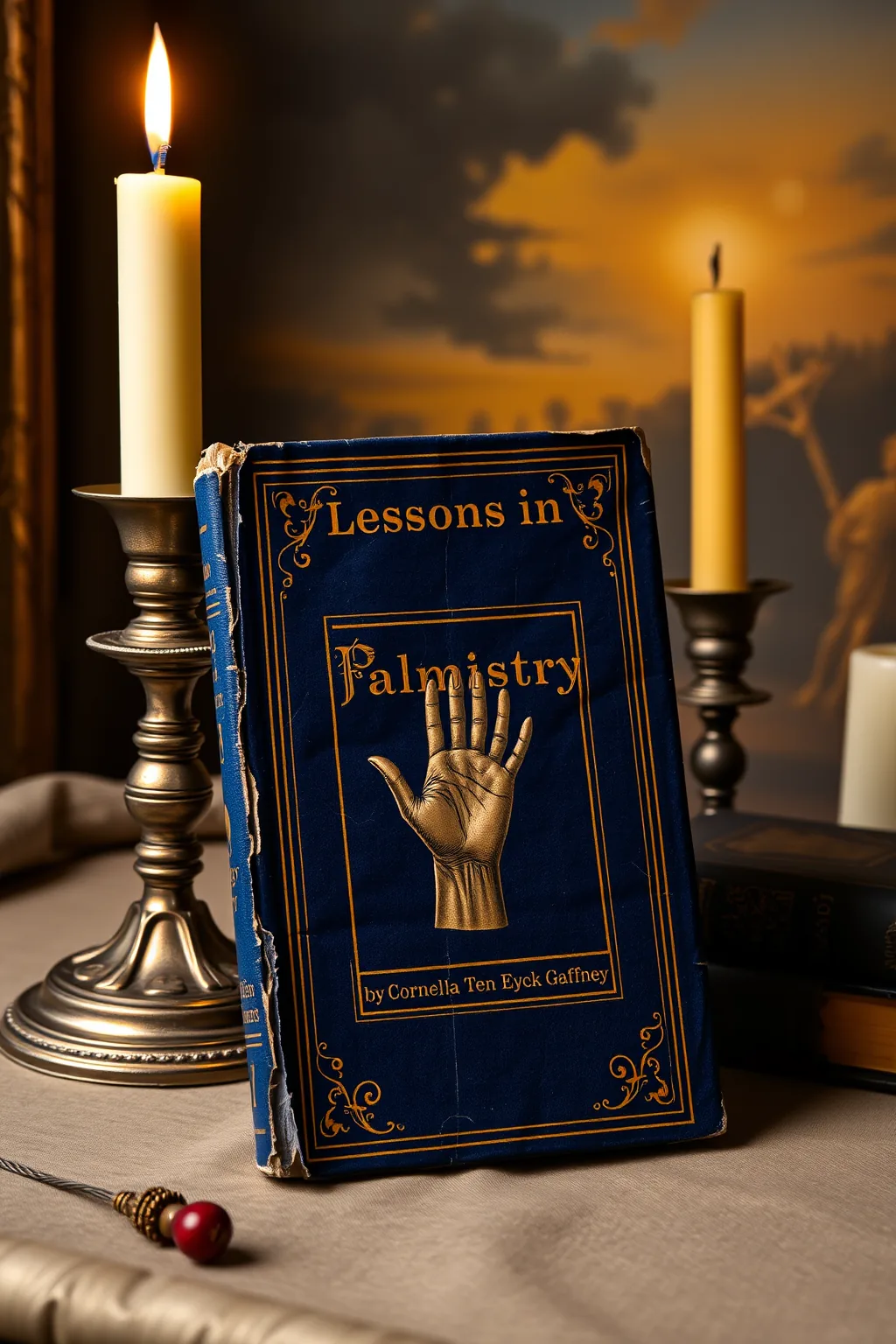
Lessons in palmistry
 62
62

Lessons in palmistry



Alaric Kestrel, reviewing for Metaphysical Studies Review, hails Cornelia Ten Eyck Gaffney's "Lessons in Palmistry" as a cornerstone text for serious practitioners. Gaffney's approach transcends superficial interpretation, offering profound insights into the symbolic language of the hand. The book's strength lies in its meticulous detail and its philosophical depth, connecting palmistry to broader esoteric principles. It is an indispensable resource for both neophytes seeking foundational knowledge and seasoned occultists looking to refine their practice. This work empowers readers to engage with a powerful form of self-discovery and divination, making it a truly essential addition to any metaphysical library.
📝 Description
62
Cornelia Ten Eyck Gaffney published 'Lessons in Palmistry' to decode the lines and mounts of the human hand.
Cornelia Ten Eyck Gaffney's "Lessons in Palmistry" offers a detailed examination of chiromancy, the art of reading palms. The book moves beyond a simple instructional guide, aiming to unlock the symbolic language found on the hand. Gaffney systematically covers the various lines, mounts, and finger formations, connecting these physical characteristics to deeper energetic patterns that influence an individual's life path.
Within its pages, readers will find a compendium of knowledge drawn from ancient divination practices and esoteric thought. The text treats each crease, mark, and contour as a significant symbol, revealing insights into personality, latent abilities, and life's unfolding events. This work is suited for those seriously studying occult subjects as well as individuals curious about self-discovery through palmistry. It encourages deep personal reflection, positioning the hand's markings as a map for spiritual understanding.
This book sits within the Western esoteric tradition, specifically the practice of chiromancy which has roots in ancient Greece and has been documented by various occult authors throughout history. Palmistry, as presented here, is understood not merely as fortune telling but as a system of psychological and spiritual interpretation, linking the physical form to unseen forces and individual destiny. Gaffney's work draws upon this long-standing belief that the hand serves as a microcosm reflecting the macrocosm and the individual's place within it.
💡 Why Read This Book?
Unlock the profound secrets etched into your own palms. 'Lessons in Palmistry' offers a comprehensive guide to understanding character, destiny, and hidden potential through the ancient art of chiromancy. Ideal for seekers of self-knowledge, students of esoteric arts, and practitioners of divination looking to deepen their practice with timeless wisdom.
⭐ Reader Reviews
Honest opinions from readers who have explored this book.
❓ Frequently Asked Questions
What is palmistry?
Palmistry, or chiromancy, is an ancient art of divination that interprets the lines, mounts, and shapes of the hand to reveal insights into a person's character, potential, and future.
Can anyone learn palmistry?
Yes, with diligent study and practice, anyone can learn the fundamentals of palmistry. This book provides a structured approach to understanding its complex symbolism.
What are the main lines on the palm?
The primary lines typically studied are the Life Line, Head Line, Heart Line, and Fate Line, each offering distinct insights into health, intellect, emotions, and life's path.
Does palmistry predict the future definitively?
Palmistry is often viewed as a tool for understanding potentials and tendencies, rather than a fixed prophecy. It offers guidance and self-awareness, not immutable destiny.
How does palmistry connect to other esoteric practices?
Palmistry shares roots with astrology and numerology, all of which explore symbolic correspondences and the hidden order of the universe, offering complementary perspectives on human experience.
🔮 Key Themes & Symbolism
The Hand as a Cosmic Map
This theme explores the profound belief that the human hand is not merely a physical appendage but a microcosm reflecting the macrocosm. Each line, mount, and digit is seen as a symbolic representation of celestial influences and karmic patterns. Gaffney guides the reader to perceive their palm as a living map, etched with the wisdom of the ages, offering insights into one's unique journey through life, love, and destiny. It emphasizes the idea that our physical form holds divine blueprints waiting to be deciphered.
Unveiling Character and Potential
Fundamentally, palmistry is a potent tool for self-discovery and understanding the intricate collection of human personality. This book looks at how the specific configurations of the palm illuminate innate talents, strengths, weaknesses, and the underlying psychological makeup of an individual. Gaffney's lessons empower readers to look beyond superficial traits and to grasp the deeper currents that shape behavior, motivation, and life choices, fostering greater self-awareness and personal growth.
The Art of Subtle Energies and Destiny
This theme examines the esoteric principle that subtle energies flow through and around the human form, influencing our experiences and life paths. Palmistry, in this context, becomes a method of reading these energetic imprints. Gaffney's work suggests that while destiny may have currents, the lines on the palm also indicate areas of free will and the potential to shape one's future. It highlights the dynamic interplay between fate and conscious choice, as revealed through the silent language of the hand.
💬 Memorable Quotes
Direct passages from the work, attributed to the author.
“The hand is a mirror of the soul.”
— This aphorism suggests a deep, intrinsic connection between our physical form, specifically the hand, and our inner spiritual essence. It implies that the lines and features of the palm are not random but rather manifest expressions of our inner state and soul's journey.
“The mounts whisper of celestial influence.”
— This highlights the astrological connections within palmistry, suggesting that the raised areas on the palm (mounts) correspond to planets and their energies, influencing our character and life events. It points to a cosmic order reflected in the human hand.
“To read the hand is to read the self.”
— This emphasizes the introspective nature of palmistry. It asserts that by studying the intricate details of one's palm, one can gain outstanding insight into their own personality, motivations, and life's path, making it a powerful tool for self-understanding.
💡 Key Ideas
Editorial paraphrase of the work's core concepts — not direct quotes.
Each line tells a story of the spirit.
This quote elevates palmistry from a mere observational practice to a profound form of spiritual narrative. It implies that the lines on the palm are not just physical marks but symbolic chapters in the ongoing story of an individual's spiritual evolution and life experiences.
Destiny is not a fixed decree, but a landscape to be navigated.
This quote offers a nuanced perspective on fate. It suggests that while there are predispositions and potential paths indicated by the hand, human agency and choice play a central role in shaping one's ultimate destiny.
🌙 Esoteric Significance
Tradition
This work is deeply rooted in the Western Esoteric Tradition, drawing from hermeticism, ancient Greek philosophy, and Renaissance occultism. It aligns with the belief in a universal correspondence between the microcosm (the human being) and the macrocosm (the universe). Palmistry is viewed as a hermetic art, a practical application of the principle 'As Above, So Below,' where the patterns on the hand reflect celestial influences and divine order.
Symbolism
The palm is a nexus of profound symbolism. Lines represent flows of energy and life force (e.g., the Life Line for vitality), mounts symbolize planetary influences and character traits (e.g., Venus for love, Jupiter for ambition), and finger lengths and shapes denote specific aptitudes and psychological inclinations. The entire hand becomes a symbolic language, a divine script waiting to be interpreted by the initiated, revealing the intricate interplay of human potential and cosmic forces.
Modern Relevance
In an age often characterized by information overload and disconnection, "Lessons in Palmistry" offers a powerful antidote. It provides a tangible, personal method for grounding, self-reflection, and understanding one's unique path. Its emphasis on inherent potential and the interplay of free will and destiny resonates deeply, empowering individuals to navigate modern complexities with greater self-awareness and a sense of purpose. It serves as a timeless guide to unlocking inner wisdom.
👥 Who Should Read This Book
This key work is essential for the dedicated student of the occult, the aspiring palmist, and the curious soul seeking profound self-understanding. Beginners will find a clear, structured introduction to the fundamentals of chiromancy. Experienced practitioners will appreciate the depth of analysis and the philosophical underpinnings. Scholars of esoteric history will find it a valuable primary source reflecting early 20th-century occult thought. Anyone interested in ancient divination, symbolic languages, and unlocking the hidden potentials within themselves will find this book an invaluable guide.
📜 Historical Context
Cornelia Ten Eyck Gaffney's "Lessons in Palmistry" emerges from a rich tradition of esoteric thought that flourished in the late 19th and early 20th centuries. This era, often termed the 'occult revival,' saw a surge of interest in ancient wisdom, spiritualism, and divination as a counterpoint to burgeoning industrialization and rationalism. Palmistry, alongside astrology and other divinatory arts, experienced a resurgence, attracting scholars, artists, and seekers. Gaffney's work stands as a evidence of this period's dedication to meticulously cataloging and disseminating occult knowledge, aiming to provide accessible yet profound guidance to a public eager to explore the unseen dimensions of existence. Her approach often reflects the Victorian era's blend of scientific curiosity and spiritual yearning, seeking to codify and rationalize the mystical.
📔 Journal Prompts
Reflect on the dominant lines and mounts present on your dominant hand. What core energies or potentials do they suggest for your life's journey?
Consider a significant life event. How might the lines on your palm at that time have symbolically represented the energies at play?
If you were to describe your 'Life Line' as a narrative, what would be its key plot points and overarching theme?
Explore the relationship between your 'Head Line' and 'Heart Line.' How do your intellect and emotions seem to interact in your daily life?
Imagine your palm is a map of your spiritual journey. What 'landmarks' (lines, mounts) are most prominent, and what do they signify about your path?
🗂️ Glossary
Chiromancy
An ancient divination practice focused on interpreting the lines, mounts, and features of the human hand to gain insight into character, destiny, and potential.
Mounts
The fleshy, raised areas on the palm, typically located below the fingers, each associated with a planet and corresponding character traits or influences (e.g., Mount of Venus, Mount of Jupiter).
Traces
Minor lines or marks on the palm that can indicate specific events, temporary conditions, or subtle influences on the major lines or mounts.
Fate Line
A line, often running vertically up the palm, that is traditionally interpreted as representing a person's career, life path, and the influence of external circumstances.
Life Line
The curved line originating near the thumb and encircling the Mount of Venus, often interpreted as indicative of vitality, physical health, and the general course of one's life.
This book appears in 1 collection
🔮 Readers Also Liked
Browse all →









More by Cornelia Ten Eyck Gaffney
All books →
From the “Palmistry” Collection
View all →





More Free Divination & Tarot Books
View all →