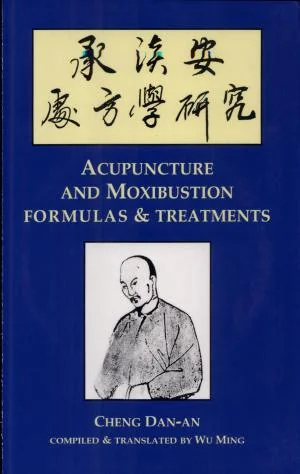
Acupuncture and Moxibustion Formulas & Treatments
 80
80

Acupuncture and Moxibustion Formulas & Treatments
Dan'an Cheng's 'Acupuncture and Moxibustion Formulas & Treatments' is less a narrative and more an expansive clinical manual. Its strength lies in its directness, offering a clear presentation of Cheng's established methods. The work meticulously details point prescriptions and moxibustion techniques for conditions ranging from 'colic' to more complex internal disorders. One notable aspect is the sheer volume of specific formulas presented, reflecting Cheng's vast clinical experience. However, the book's original publication in 1996 and its focus on a specific era of TCM development mean that some contemporary perspectives or integration with modern medical research are not its primary concern. A particularly illuminating section details the treatment of 'wind-stroke' (stroke), showcasing precise point selections and therapeutic strategies. This volume is a critical reference for practitioners seeking historical grounding in Chinese medical practice.
📝 Description
80
Dan'an Cheng's 1996 volume compiles acupuncture and moxibustion formulas and treatments.
This book details specific therapeutic approaches for a wide range of ailments within the framework of Traditional Chinese Medicine (TCM). Dan'an Cheng, a significant figure in 20th-century TCM, authored this work, which was originally published in 1996. It functions as a core text for those wishing to understand classical formulas and treatment protocols.
The work is useful for acupuncturists, herbalists, and students of TCM. Researchers studying the history and development of Chinese medical practices will also find value here. Individuals interested in alternative health modalities with historical roots can also benefit from its contents. Dan'an Cheng's clinical experience and teaching contributions are reflected throughout the text.
Central to the book are diagnostic methods and treatment principles drawn from classical Chinese medical theory. It covers the use of specific acupuncture points, moxibustion techniques, and herbal combinations. These are presented in relation to particular disease patterns, highlighting TCM's holistic view of healing.
As a work on acupuncture and moxibustion, this book belongs to the lineage of Traditional Chinese Medicine, a system that views the body and its ailments through energetic pathways and balances. Its esoteric context lies in the application of these ancient theories to precise therapeutic interventions. The formulas and treatments described are not merely symptomatic relief but are designed to restore a perceived internal harmony, often referencing classical texts and a philosophical understanding of Qi, Yin, and Yang dynamics that underpin the practice.
💡 Why Read This Book?
• Gain specific treatment protocols for a wide array of traditional Chinese diseases, directly from Dan'an Cheng's influential work, understanding the application of formulas for conditions like 'colic' as detailed in the text. • Study the foundational principles of acupuncture and moxibustion as codified by Cheng, who shaped modern Chinese acupuncture education, offering insights into the curriculum he helped establish. • Explore the practical application of classical diagnostic patterns and their corresponding therapeutic strategies, providing a direct link to the medical theories prevalent in mid-20th century China.
⭐ Reader Reviews
Honest opinions from readers who have explored this book.
❓ Frequently Asked Questions
Who was Dan'an Cheng and why is he significant in acupuncture history?
Dan'an Cheng (1905-1981) is considered the father of modern Chinese acupuncture. He was crucial in developing the modern acupuncture college curriculum in China and revitalizing the practice of acupuncture and moxibustion in its native country.
What kind of diseases does 'Acupuncture and Moxibustion Formulas & Treatments' cover?
The book covers a wide range of traditional Chinese diseases, as understood within the framework of Traditional Chinese Medicine (TCM). It details formulas and treatments for various ailments, including but not limited to conditions like 'colic'.
Is this book suitable for beginners in acupuncture?
While it contains foundational information, the book is dense with specific formulas and treatment protocols. It is best suited for students and practitioners of Traditional Chinese Medicine who have a basic understanding of TCM theory and practice.
What is moxibustion and how is it presented in this book?
Moxibustion is a traditional therapy involving the burning of dried mugwort (Artemisia vulgaris) to warm and stimulate acupuncture points. The book details specific moxibustion techniques and their application in conjunction with acupuncture formulas for various conditions.
When was the original publication of Dan'an Cheng's work?
The original publication of 'Acupuncture and Moxibustion Formulas & Treatments' by Dan'an Cheng was in 1996, compiling his extensive work and teachings.
Does this book include herbal formulas alongside acupuncture?
Yes, the book is a collection of 'formulas and treatments,' which in the context of Traditional Chinese Medicine often includes both acupuncture point prescriptions and relevant herbal combinations used synergistically.
🔮 Key Themes & Symbolism
Classical Formulas
The core of this work lies in its meticulous presentation of classical formulas for acupuncture and moxibustion. Dan'an Cheng, a key figure in mid-20th century Traditional Chinese Medicine (TCM), details specific point combinations and therapeutic strategies. These formulas are designed to address a spectrum of diseases as categorized within the TCM system, reflecting a lineage of knowledge passed down through generations and codified for modern practice. The emphasis is on precise application derived from extensive clinical experience.
Moxibustion Techniques
Beyond needle techniques, the book significantly elaborates on moxibustion, a vital component of TCM. It outlines the application of burning mugwort (Artemisia vulgaris) to specific acupuncture points to generate therapeutic heat. Cheng's work details how moxibustion can complement acupuncture, offering distinct therapeutic effects for various conditions, particularly those characterized by cold or deficiency patterns within the body's energetic system.
Standardization of TCM
Dan'an Cheng's influence extended to the standardization of acupuncture education in China. This book embodies that effort, presenting a structured and comprehensive approach to diagnosis and treatment. It reflects his role in rescuing TCM practices from obscurity and establishing them within formal academic curricula, thereby ensuring the preservation and dissemination of these ancient medical arts.
Disease Patterns in TCM
The text systematically categorizes diseases according to Traditional Chinese Medicine principles, moving beyond symptomatic treatment to address underlying imbalances. It details diagnostic patterns and prescribes corresponding formulas, illustrating the holistic diagnostic framework of TCM. This approach emphasizes treating the root cause of illness rather than merely its manifestations.
💬 Memorable Quotes
Direct passages from the work, attributed to the author.
“Formulas and treatments for a wide range of traditional Chinese diseases.”
— This concise statement captures the book's purpose: a practical compendium of therapeutic strategies derived from classical Chinese medicine for specific ailments recognized within that system.
“Cheng Dan-an created the modern acupuncture college curriculum in China.”
— This highlights Cheng's monumental role in formalizing TCM education. His pedagogical contributions ensured that the complex art of acupuncture and moxibustion could be systematically taught and preserved for future generations.
“Rescued acupuncture and moxibustion from oblivion in its native land.”
— This emphasizes the historical context of Cheng's work, suggesting that TCM practices faced decline and that his efforts were crucial in their revival and continued existence within China.
“The father of modern Chinese acupuncture.”
— This appellation underscores Cheng's foundational impact. His innovations and educational reforms are seen as the bedrock upon which contemporary Chinese acupuncture practice and study are built.
“As a teacher of many other famous teachers of acupuncture.”
— This points to Cheng's significant influence through his disciples. His mentorship extended the reach of his knowledge and methods, shaping the practice of numerous influential practitioners who followed.
🌙 Esoteric Significance
Tradition
While primarily a medical text, 'Acupuncture and Moxibustion Formulas & Treatments' draws from the deep philosophical underpinnings of Taoism and Traditional Chinese Medicine, which themselves have esoteric dimensions. The concept of Qi (vital energy), meridians, and the balance of Yin and Yang are not merely physiological but also metaphysical principles governing the cosmos and the individual. Cheng's work, by applying these principles with clinical precision, bridges the practical application of these esoteric concepts.
Symbolism
The acupoints themselves can be viewed as symbolic gateways within the body's energetic map, each representing a specific function or connection within the Qi network. The concept of 'meridians' acts as a symbolic circulatory system for vital energy, guiding treatment. Furthermore, the diagnostic categories, such as 'wind' or 'dampness,' are symbolic representations of pathogenic influences that disrupt the body's harmonious energetic state.
Modern Relevance
Contemporary practitioners of TCM, both in China and globally, continue to rely on the foundational principles and formulas codified by figures like Dan'an Cheng. His emphasis on curriculum standardization has made his methods accessible to a vast number of students. Furthermore, researchers exploring the efficacy of acupuncture and moxibustion for various conditions often reference the systematic approaches detailed in works like this, seeking to understand and validate these ancient practices through modern scientific inquiry.
👥 Who Should Read This Book
['• Acupuncturists and TCM practitioners seeking to deepen their knowledge of classical formulas and historical treatment protocols established by a key figure in the field.', '• Students of Traditional Chinese Medicine studying the foundational texts and educational frameworks that shaped modern practice in China.', '• Researchers interested in the history of medicine, comparative health systems, and the development of standardized medical curricula.']
📜 Historical Context
Dan'an Cheng's work emerged during a central period in the mid-20th century, a time when Traditional Chinese Medicine (TCM) was undergoing a significant revival and standardization in the People's Republic of China. Following decades of relative decline and marginalization, the government actively promoted TCM as a valuable national heritage and a complement to Western medicine. Cheng (1905-1981) was at the forefront of this movement, particularly in the field of acupuncture and moxibustion. His efforts in establishing the modern acupuncture college curriculum were instrumental in creating a standardized educational framework, moving away from purely lineage-based transmission. This period also saw the development of the 'Eight Principles' and 'Six Stages' diagnostic systems, which provided a more systematic theoretical underpinning for clinical practice. While figures like Dr. James Tin Yau So, a student of Cheng, were crucial in transmitting these methods internationally, Cheng's primary impact was within China, shaping the very structure of TCM education and practice from the 1950s onwards.
📔 Journal Prompts
Dan'an Cheng's role in standardizing the acupuncture college curriculum.
The application of specific formulas for 'colic' as presented.
Moxibustion techniques described for deficiency patterns.
The concept of Qi as a fundamental energetic principle.
Cheng's influence as a teacher of famous acupuncture educators.
🗂️ Glossary
Acupuncture
A therapeutic technique originating from Traditional Chinese Medicine involving the insertion of fine needles into specific points on the body to influence the flow of Qi (vital energy).
Moxibustion
A traditional therapy that involves burning dried mugwort (Artemisia vulgaris) near the surface of the skin to warm and stimulate acupuncture points or areas of the body.
Qi (Chi)
The fundamental vital life force or energy that flows through the body according to Traditional Chinese Medicine, influencing all physiological and spiritual functions.
Meridians
Specific pathways or channels within the body through which Qi and blood are believed to circulate, connecting acupuncture points and internal organs.
Yin and Yang
The fundamental Taoist concept representing complementary and interdependent forces (e.g., passive/active, dark/light, cold/hot) whose balance is essential for health.
Formulas
In TCM, this refers to specific combinations of acupuncture points, moxibustion techniques, or herbal prescriptions designed to treat particular diseases or patterns of imbalance.
Colic
A symptom characterized by severe, often sudden, abdominal pain, which in TCM is understood through specific patterns of disharmony in the digestive system.
This book appears in 1 collection
🔮 Readers Also Liked
Browse all →








From the “Acupuncture” Collection
View all →







More Free Occult Philosophy Books
View all →