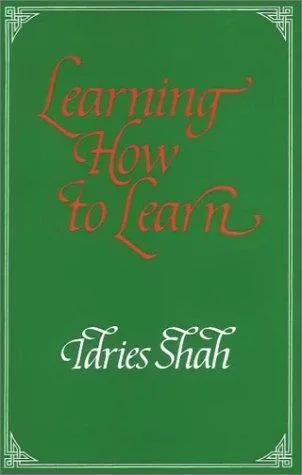
Learning how to learn
 72
72

Learning how to learn
Idries Shah’s Learning How to Learn is less a manual and more a series of pointed observations on the nature of acquiring understanding. Shah, writing with his characteristic directness, bypasses conventional academic discourse to address the functional aspects of learning. He doesn't offer step-by-step instructions but rather cultivates an awareness of how conventional approaches can fall short. A particular strength lies in his critique of 'information overload' and the superficiality it engenders. The work's limitation, perhaps, is its density; it demands active engagement rather than passive consumption. Shah’s assertion that 'the capacity to learn is the capacity to be changed' serves as a potent reminder of learning's true purpose. It is a book for the serious student of self-cultivation, not the casual browser.
📝 Description
72
Idries Shah's 1993 book, Learning How to Learn, argues for cognitive tools beyond rote memorization.
Published in 1993, Learning How to Learn by Idries Shah presents a practical method for acquiring and using knowledge. It focuses on developing mental skills that lead to deeper understanding and better information assimilation, moving past simple memorization. The book offers a flexible system for intellectual growth, not a rigid set of rules, making it adaptable to different learning situations.
This book is for anyone wanting to improve their learning abilities, including students, teachers, and professionals. It will appeal to those who find their current learning methods lacking or who want to develop a more adaptable mind. Individuals interested in personal development and enhancing their cognitive functions will find its ideas useful. Shah connects these ideas to older systems of teaching.
Learning How to Learn draws upon Idries Shah's extensive work within Sufi traditions and his engagement with esoteric thought. While presented as a practical guide to learning, it implicitly carries the underpinnings of these traditions, which often emphasize direct experience and the overcoming of mental conditioning. Shah frequently linked such practical wisdom to ancient teaching systems, suggesting that effective learning requires more than intellectual accumulation; it involves a transformation of one's cognitive approach.
💡 Why Read This Book?
• Gain a framework for understanding how to process information effectively, moving beyond simple memorization, by engaging with Shah's emphasis on the 'inner framework for organizing knowledge' discussed in the text. • Develop a more critical approach to learning that questions passive absorption of facts, informed by Shah's critique of superficial understanding, a concept explored in the book's early chapters. • Cultivate a flexible mindset for acquiring new skills and insights, understanding that true learning involves adaptability, as highlighted by the book's exploration of learning as a 'capacity to be changed'.
⭐ Reader Reviews
Honest opinions from readers who have explored this book.
❓ Frequently Asked Questions
What is Idries Shah's primary goal with 'Learning How to Learn'?
Shah aims to equip readers with practical cognitive tools to enhance their understanding and application of knowledge, moving beyond superficial memorization towards deeper integration and adaptability.
How does 'Learning How to Learn' differ from typical study guides?
Unlike typical guides, it focuses on the underlying principles of cognition and the development of a flexible mental framework, rather than specific study techniques for academic subjects.
When was 'Learning How to Learn' first published?
The book was first published in 1993, reflecting a period of growing interest in metacognitive strategies.
Does the book offer specific exercises for improving memory?
While it emphasizes the importance of association and context for memory, it does not provide prescriptive memory exercises, focusing instead on the broader architecture of learning.
What kind of reader would benefit most from this book?
Individuals seeking to enhance their intellectual capacity, overcome learning plateaus, or develop a more profound understanding of any subject matter will find value.
Is 'Learning How to Learn' related to Sufi teachings?
Yes, Idries Shah was a prominent figure in bringing Sufi thought to the West, and this work applies principles derived from those traditions to the universal act of learning.
🔮 Key Themes & Symbolism
Cognitive Frameworks
The book stresses the creation of an internal 'framework' for knowledge, rather than mere accumulation of facts. This framework, developed through conscious effort and association, allows individuals to connect disparate pieces of information and apply them contextually. Shah suggests this is crucial for moving beyond superficial understanding to genuine intellectual grasp, a concept he often illustrated through analogies from traditional teaching systems.
The Nature of Understanding
Shah critiques the passive reception of information prevalent in many educational settings. He argues that true understanding arises from active engagement, contextualization, and the ability to see relationships between ideas. This perspective challenges readers to question how they approach new information, encouraging a more dynamic and integrated learning process that fosters adaptability and insight.
Learning as Transformation
A central idea is that genuine learning inherently involves a capacity for change – the learner is altered by the process. This transformative aspect moves learning beyond a purely intellectual exercise into the field of personal development. Shah implies that resisting this change can be a significant impediment to acquiring deeper knowledge and wisdom.
Practical Application of Knowledge
The work consistently emphasizes that knowledge is most valuable when it can be practically applied. This requires not just memorization but a deep, integrated understanding that allows for flexible use in diverse situations. Shah advocates for learning methods that bridge the gap between theoretical knowledge and real-world efficacy.
💬 Memorable Quotes
Direct passages from the work, attributed to the author.
“The capacity to learn is the capacity to be changed.”
— This statement expresses Shah's view that true learning is not static but dynamic. It implies that an unwillingness or inability to adapt based on new knowledge signifies a failure in the learning process itself.
“Knowledge is not a collection of facts, but a way of understanding.”
— This highlights the book's core argument against rote memorization. Shah differentiates between accumulating data and developing a coherent, contextualized comprehension that enables effective application.
“We often learn in order to avoid learning.”
— This provocative idea suggests that certain learning habits or defenses can actually prevent deeper understanding, creating an illusion of knowledge without genuine insight.
“The context of knowledge determines its meaning.”
— Shah underscores the critical role of context in interpreting and utilizing information. Without understanding the surrounding circumstances or framework, facts can be easily misunderstood or misapplied.
“Learning requires an inner framework.”
— This points to the necessity of developing personal cognitive structures to organize and integrate new information effectively, rather than relying solely on external structures or methods.
🌙 Esoteric Significance
Tradition
While not strictly aligned with a single esoteric lineage like Hermeticism or Kabbalah, Idries Shah's work draws heavily from the practical, non-dogmatic traditions of Sufism. His approach to learning emphasizes the development of the 'inner man' and the cultivation of practical wisdom, aligning with Sufi methods of self-cultivation and the understanding of reality through direct experience and applicable knowledge.
Symbolism
The book frequently employs the concept of the 'inner framework' as a key symbol for organized understanding. This framework can be seen as analogous to the symbolic 'maps' or 'structures' used in various esoteric traditions to represent cosmic or psychological order. Another implicit symbol is the 'obstacle' to learning, representing the ego's resistance to change or new perspectives, a common theme in spiritual development literature.
Modern Relevance
Contemporary thinkers and practitioners in fields ranging from cognitive psychology to personal development continue to find value in Shah's pragmatic approach. His emphasis on contextual understanding and the transformative nature of learning speaks to modern discussions on critical thinking, lifelong learning, and the development of adaptable intelligence in a rapidly changing world. Practices focused on mindfulness and integrated knowledge acquisition echo his core tenets.
👥 Who Should Read This Book
• Aspiring autodidacts seeking to move beyond passive information consumption and develop genuine intellectual mastery, by learning to construct their own cognitive frameworks. • Professionals and academics feeling overwhelmed by information overload, who wish to cultivate a more effective and integrated approach to knowledge acquisition and application. • Individuals interested in the practical psychology and self-cultivation aspects of esoteric traditions, particularly those drawn to Sufi thought and its application to everyday mental development.
📜 Historical Context
Learning How to Learn, published in 1993, emerged during a period when cognitive science and metacognition were gaining significant traction in academic circles. Idries Shah, an author already known for disseminating Sufi thought and practical psychology to Western audiences, brought a unique perspective to the discourse on learning. While scholars like Howard Gardner were exploring multiple intelligences, and educational psychology grappled with constructivist theories, Shah offered a more direct, less institutionally bound approach. His work often drew upon ancient teaching methodologies, contrasting them with contemporary educational practices he sometimes critiqued for their superficiality. The book's reception was largely within the sphere of self-improvement and esoteric studies, appealing to those seeking practical wisdom beyond conventional academic frameworks. It implicitly engaged with the broader intellectual current that sought to understand the human mind and its potential for development.
📔 Journal Prompts
The concept of an 'inner framework' for knowledge: how is yours currently structured, and what gaps exist?
Reflect on a time when learning a new skill felt transformative; what enabled that change?
Analyze how the context of information influences your understanding and recall.
Identify one learning habit that might be preventing deeper understanding.
Consider the statement 'the capacity to learn is the capacity to be changed' in relation to your own intellectual growth.
🗂️ Glossary
Inner Framework
A conceptual structure developed by the learner to organize, connect, and apply new information. It represents a personalized mental architecture for understanding, distinct from simply memorizing facts.
Contextual Understanding
The ability to grasp the meaning and significance of information based on its surrounding circumstances, relationships, and purpose, rather than in isolation.
Passive Reception
The act of taking in information without active engagement, critical analysis, or integration into existing knowledge structures. Often associated with superficial learning.
Association
The psychological process of linking one idea, memory, or sensation with another. Shah emphasizes its importance in building coherent knowledge structures.
Transformative Learning
A form of learning that fundamentally changes a person's perspective, beliefs, or worldview. It implies that the learner is altered by the process of acquiring knowledge.
Cognitive Tools
Mental techniques, strategies, or frameworks that enhance the process of thinking, understanding, and problem-solving.
Superficial Understanding
Knowledge that is limited to the surface level, lacking depth, context, or the ability to be applied effectively. Often a result of rote memorization.
🔮 Readers Also Liked
Browse all →








More by Idries Shah, Idries Shah
All books →

More Free Occult Philosophy Books
View all →