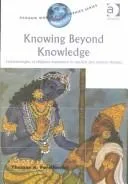
Knowing beyond knowledge
 73
73

Knowing beyond knowledge
Forsthoefel’s "Knowing Beyond Knowledge" offers a rigorous, if occasionally dense, exploration into the limitations of intellect when confronting profound subjective experience. The strength of the book lies in its meticulous dissection of epistemological categories, particularly its sustained argument for forms of knowing that operate outside conventional frameworks. Forsthoefel adeptly draws parallels between disparate philosophical and mystical traditions, demonstrating a broad scholarly reach. However, the work's very rigor can sometimes feel like a barrier. The lengthy exposition on the nature of "non-conceptual knowing" in chapter 4, while crucial, demands significant reader concentration. A passage discussing the limitations of language in describing mystical states, though accurate, could benefit from more varied illustrative examples beyond philosophical discourse.
Ultimately, this is a valuable contribution for those willing to engage deeply with its challenging arguments.
📝 Description
73
Thomas A. Forsthoefel's 2018 book examines how we know beyond empirical or rational limits.
Published in 2018, Thomas A. Forsthoefel's "Knowing Beyond Knowledge" scrutinizes the limits of conventional ways of knowing. The book questions whether standard empirical and rational methods fully capture reality. Forsthoefel suggests that certain experiences or altered states of consciousness can lead to a form of understanding not accessible through analytical thought alone. He proposes that these alternative modes of apprehension offer insights that standard frameworks cannot.
This work is geared toward students of philosophy, comparative religion, and esoteric studies. It will appeal to those who question the completeness of materialist or rationalist viewpoints and are interested in the nature of human awareness. The book also serves individuals who wish to articulate their own intuitive or mystical experiences within a clear intellectual structure, connecting felt reality with conceptual understanding.
Forsthoefel's book arrives at a time of renewed interest in consciousness studies and perennial philosophy. It connects with traditions that have long explored non-dual states and direct apprehension of truth, echoing figures like Plotinus and early mystics. The work participates in ongoing critiques of positivism, drawing parallels to the Romantic emphasis on intuition and William James's investigations into religious experience.
💡 Why Read This Book?
• Gain a framework for understanding intuitive or mystical insights that defy rational explanation, specifically by examining Forsthoefel's concept of 'non-conceptual knowing' presented in the text. • Challenge your assumptions about the nature of reality and knowledge acquisition, learning how the book contrasts propositional knowledge with experiential apprehension. • Explore the philosophical underpinnings of esoteric traditions, drawing connections between Forsthoefel's arguments and historical thinkers like Plotinus.
⭐ Reader Reviews
Honest opinions from readers who have explored this book.
❓ Frequently Asked Questions
What is the central argument of "Knowing Beyond Knowledge"?
The book argues that conventional, rational, and empirical methods of knowing are insufficient to grasp the full spectrum of reality and consciousness. It posits the existence and validity of 'non-conceptual knowing,' a mode of apprehension that bypasses intellect.
Who is Thomas A. Forsthoefel?
Thomas A. Forsthoefel is the author of "Knowing Beyond Knowledge." His work engages with philosophy of mind, consciousness studies, and the history of ideas concerning knowledge and mysticism.
When was "Knowing Beyond Knowledge" first published?
The book "Knowing Beyond Knowledge" by Thomas A. Forsthoefel was first published in 2018.
What kind of knowledge does the book explore beyond traditional intellect?
It explores experiential knowledge, intuitive apprehension, and direct insight that arises from states of consciousness or being, often associated with mystical or contemplative traditions.
Does the book offer practical exercises for achieving non-conceptual knowing?
While the book focuses on theoretical exploration and philosophical analysis, it provides the conceptual groundwork for understanding and valuing non-rational modes of knowing that practitioners may seek to cultivate.
What philosophical traditions does "Knowing Beyond Knowledge" draw upon?
The book draws upon a wide range of philosophical and mystical traditions, including discussions related to Neoplatonism, consciousness studies, and critiques of positivism, examining how different eras have approached the limits of knowledge.
🔮 Key Themes & Symbolism
The Limits of Intellect
The book systematically deconstructs the sufficiency of rational thought and empirical observation as sole pathways to truth. Forsthoefel argues that these methods, while valuable, are inherently bounded and fail to encompass certain dimensions of reality, particularly subjective experience and spiritual insight. He examines how Western philosophical traditions, heavily reliant on logic and analysis, have often marginalized or dismissed forms of understanding that do not conform to these strictures. This theme is critical for readers seeking to validate intuitive leaps or mystical experiences that logic cannot easily explain.
Non-Conceptual Apprehension
This central theme introduces the idea of 'knowing' that bypasses symbolic representation, language, and linear reasoning. Forsthoefel posits that direct apprehension, often experienced in altered states of consciousness or profound meditative moments, yields a form of knowledge that is immediate and non-discursive. The work explores how such knowing might function, its relationship to consciousness, and its significance for a more complete understanding of existence. It challenges readers to consider how such insights are cultivated and recognized.
Epistemology and Mysticism
The book bridges the gap between academic epistemology and the study of mystical traditions. Forsthoefel investigates how mystics across various cultures and historical periods have described states of "knowing" that transcend ordinary cognition. By analyzing these accounts through a philosophical lens, the work seeks to legitimize these experiences not merely as psychological phenomena but as valid, albeit unconventional, sources of knowledge. This theme is crucial for understanding esoteric traditions within a broader intellectual framework.
The Nature of Consciousness
Underlying the discussion of knowledge is an exploration of consciousness itself. Forsthoefel examines how different states of consciousness correlate with different modes of knowing. The work implicitly or explicitly engages with questions about the relationship between the observer and the observed, and how the structure of consciousness shapes our capacity for understanding. This focus on consciousness is vital for anyone interested in contemplative practices or the philosophical implications of altered states.
💬 Memorable Quotes
Direct passages from the work, attributed to the author.
“The map of rational thought is not the territory of lived experience.”
— This interpretation highlights the distinction between intellectual models and direct, subjective reality. It suggests that conceptual frameworks, while helpful, can never fully replicate or contain the richness and immediacy of actual experience.
“Certain truths are apprehended, not deduced.”
— This concise statement expresses the idea of non-conceptual knowing. It implies that some forms of understanding arrive instantaneously, without the need for step-by-step reasoning or logical proof, often through insight or intuition.
“To know beyond knowledge is to transcend the limitations of knowing *that*.”
— This highlights the book's focus on moving beyond mere factual or propositional knowledge (knowing *that* something is true) towards a more embodied, experiential form of understanding (knowing *how* or knowing *what it is like*).
“The veil of language often obscures rather than reveals ultimate realities.”
— This interpretation suggests that while language is a tool for communication, it can also be a barrier to direct experience and understanding. Mystical or profound truths may be ineffable, meaning they cannot be adequately expressed through conventional linguistic means.
💡 Key Ideas
Editorial paraphrase of the work's core concepts — not direct quotes.
Reason can only take us so far; beyond its limits lie modes of apprehension that are direct and non-discursive.
This paraphrase captures Forsthoefel's core argument that intellect, while useful, has boundaries. It emphasizes the existence of intuitive or experiential knowing that doesn't rely on logical steps or language, suggesting these are essential for a fuller understanding.
🌙 Esoteric Significance
Tradition
The work fits within the broader Western Esoteric Tradition, particularly its philosophical and contemplative branches. While not overtly practicing a specific magical or alchemical system, it studies the epistemological foundations that underpin many esoteric claims. It appeals to Gnostic and Hermetic concerns about direct apprehension of truth, distinct from conventional learning. Forsthoefel's exploration of 'non-conceptual knowing' aligns with the contemplative methods found in mystical paths across traditions, seeking to validate and articulate forms of insight often dismissed by mainstream academia.
Symbolism
While the book is primarily philosophical, its discussion of 'non-conceptual knowing' can be seen as symbolic of direct spiritual insight. The 'veil of language' serves as a motif representing the limitations of the rational mind, which must be transcended to reach deeper truths. The concept of 'apprehension' itself acts as a symbol for the unmediated, intuitive grasp of reality, akin to the illumination sought in mystical traditions or the 'direct vision' described in some esoteric texts.
Modern Relevance
Contemporary thinkers and practitioners in fields such as consciousness research, contemplative neuroscience, and integral philosophy find resonance in Forsthoefel's arguments. His work provides a philosophical vocabulary for discussing subjective states and intuitive knowledge, supporting modern explorations into meditation, mindfulness, and altered states of consciousness. It also appeals to those within esoteric communities seeking intellectual validation for their experiences and practices, bridging the gap between ancient wisdom and contemporary inquiry.
👥 Who Should Read This Book
• Students of philosophy and epistemology seeking to expand their understanding of knowledge beyond rational and empirical paradigms. • Practitioners of contemplative or meditative disciplines who wish to articulate the nature of their insights and experiences within a structured framework. • Researchers in consciousness studies and comparative religion interested in the philosophical underpinnings of mystical experiences and non-ordinary states of awareness.
📜 Historical Context
Published in 2018, Thomas A. Forsthoefel's "Knowing Beyond Knowledge" arrived in an intellectual climate where the philosophy of mind, consciousness studies, and the critique of purely materialist worldviews were gaining significant traction. The work implicitly engages with a lineage stretching back to figures like Plotinus and the Neoplatonists, whose ideas on intellect and the One explored realms beyond discursive reason. It also speaks to contemporary debates in cognitive science and contemplative studies, which increasingly acknowledge the validity of subjective experience. While not a direct engagement, its arguments echo critiques of scientific positivism that gained prominence in the mid-20th century, particularly through thinkers who explored existentialism and phenomenology. Unlike the more overtly spiritualist movements of the late 19th and early 20th centuries, Forsthoefel’s approach is grounded in philosophical analysis, positioning it as a more academic contribution to understanding the boundaries of human apprehension.
📔 Journal Prompts
The distinction between propositional knowledge and non-conceptual apprehension.
Experiences where language failed to capture the depth of understanding.
The role of intuition in decision-making and problem-solving.
How might one cultivate a greater receptivity to non-conceptual knowing?
The philosophical implications of knowing beyond the intellect.
🗂️ Glossary
Non-conceptual Knowing
A mode of apprehension that bypasses symbolic representation, language, and linear thought processes. It refers to direct, immediate insight or understanding that is not mediated by the intellect.
Epistemology
The branch of philosophy concerned with the theory of knowledge, investigating its nature, scope, and the justification of belief.
Propositional Knowledge
Knowledge of facts or truths that can be expressed in propositions, typically of the form 'knowing that X is true.' Also known as 'knowing that'.
Experiential Knowledge
Understanding gained through direct experience or participation, often involving subjective states or practical engagement. Also known as 'knowing how' or 'knowing what it is like'.
Discursive Thought
Reasoning or understanding that proceeds step-by-step, involving logical progression and the use of language or symbols.
Apprehension
In this context, refers to the act of grasping or perceiving something directly, without the usual mediation of thought or language.
Positivism
A philosophical theory stating that certain knowledge is based only on natural phenomena, observable evidence, and their logical or mathematical treatment, rejecting metaphysics and theology.
🔮 Readers Also Liked
Browse all →









More by Thomas A. Forsthoefel
All books →
More Free Occult Philosophy Books
View all →