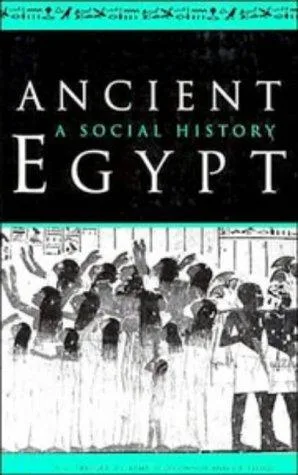
Ancient Egypt
 79
79

Ancient Egypt
Trigger, Kemp, and O'Connor's "Ancient Egypt" presents a meticulously researched account, eschewing sensationalism for scholarly rigor. The section detailing the administrative structures of the Old Kingdom, particularly the bureaucratic organization supporting pyramid construction projects, is a standout. It offers a clear-eyed view of state power and resource mobilization. However, the book’s dense academic prose can, at times, make the intricate details of dynastic shifts feel somewhat arid for a reader less steeped in Egyptology. The examination of religious iconography, while thorough, could perhaps benefit from more direct engagement with comparative mythological frameworks. Ultimately, this volume serves as a valuable, albeit demanding, reference for understanding the mechanics of Egyptian civilization.
📝 Description
79
Bruce G. Trigger, B. J. Kemp, and D. O'Connor's 2012 volume examines ancient Egyptian civilization.
This book offers a scholarly look at ancient Egypt, moving beyond simple descriptions to analyze the complex social structures, religious ideas, and material culture of the civilization. It draws on archaeological findings and written records to build a detailed picture of Egyptian life through its many dynasties. The authors consider the development of Egyptian statecraft, from early settlements to a unified kingdom.
The study also looks at how religious beliefs helped keep social order, how hieroglyphic writing developed, and the detailed burial customs that offer insight into their view of the universe. The everyday items and large buildings serve as important ways to understand how Egyptians saw the world. This work is for students and readers interested in a detailed, academic study of ancient Egypt, avoiding popular myths or speculative ideas.
While categorized as esoteric, this book focuses on scholarly reconstruction of ancient Egyptian society based on archaeological and textual evidence. It does not engage with speculative or mystical interpretations often found in esoteric literature. Instead, it provides a rigorous academic analysis of the historical and cultural development of ancient Egypt, grounding its conclusions in empirical research and established historical methods. Readers seeking a factual, evidence-based understanding of the civilization will find it here.
💡 Why Read This Book?
• Gain a nuanced understanding of the administrative evolution of the Egyptian state, including the bureaucratic mechanisms that facilitated monumental construction projects during the Old Kingdom. • Explore the complex interplay between religious ideology and social order, specifically how concepts like Ma'at were used to legitimize pharaonic rule. • Analyze the development of hieroglyphic writing and its function within the Egyptian administration and religious practices, as detailed in the text.
⭐ Reader Reviews
Honest opinions from readers who have explored this book.
❓ Frequently Asked Questions
What is the primary focus of Bruce G. Trigger's "Ancient Egypt"?
The book's primary focus is a scholarly examination of ancient Egyptian civilization, analyzing its socio-political structures, religious beliefs, and material culture through archaeological and textual evidence.
When was "Ancient Egypt" by Trigger, Kemp, and O'Connor first published?
"Ancient Egypt" by Bruce G. Trigger, B. J. Kemp, and D. O'Connor was first published in 2012.
Does the book discuss Egyptian mythology extensively?
While it addresses religious beliefs and ideology, the book's emphasis is on the scholarly analysis of societal structures and practices, rather than extensive mythological narratives.
Who would benefit most from reading this book?
Serious students of history, archaeology, and comparative religion seeking a rigorous, academic approach to understanding ancient Egypt will find this book highly beneficial.
What kind of evidence does the book rely on?
The work is grounded in archaeological evidence and detailed textual analysis, providing a reconstruction of Egyptian life based on material remains and ancient writings.
How does the book approach the concept of Egyptian kingship?
It engages with scholarly debates concerning the nature of Egyptian kingship and state formation, examining its evolution and the structures that supported it across different dynasties.
🔮 Key Themes & Symbolism
State Formation and Bureaucracy
This theme examines the intricate processes by which ancient Egypt coalesced into a unified state, moving from predynastic settlements to the centralized administration of the Old and Middle Kingdoms. The work details the hierarchical structures, bureaucratic roles, and the logistical challenges of managing a large territory. It highlights how the development of writing systems, particularly hieroglyphs, was instrumental in facilitating record-keeping, taxation, and the dissemination of royal decrees, thereby solidifying pharaonic authority and enabling massive state projects like pyramid construction.
Religious Ideology and Social Control
The text explores the pervasive influence of religious beliefs on Egyptian society, focusing on concepts like Ma'at (cosmic order, truth, justice) and its role in legitimizing the pharaoh's divine kingship. It analyzes how rituals, temple cults, and funerary practices reinforced social hierarchies and the cosmic order. The meticulous construction of tombs and the elaborate preparations for the afterlife reflect a deep-seated belief system that shaped daily life, monumental architecture, and the understanding of mortality and immortality.
Material Culture and Worldview
This theme centers on the interpretation of ancient Egypt's material remains—from grand temples and pyramids to everyday tools and personal adornments—as reflections of their cultural values and worldview. The book uses artifacts and architectural designs to illustrate concepts of power, divinity, and the Egyptian perception of the cosmos. It discusses how artistic conventions, symbolic motifs, and the use of specific materials conveyed meaning and reinforced the societal and religious order, offering tangible evidence of their beliefs and practices.
The Evolution of Writing and Language
The development and application of the hieroglyphic writing system are central to understanding Egyptian civilization. This theme discusses the origins of hieroglyphs, their evolution, and their many-sided uses, ranging from monumental inscriptions and religious texts to administrative records and personal correspondence. The book illustrates how literacy, even if confined to a select elite, was a critical tool for governance, religious practice, and the preservation of knowledge and cultural identity across millennia.
💬 Memorable Quotes
Direct passages from the work, attributed to the author.
“The administrative structures were fundamental to mobilizing resources for monumental construction.”
— This highlights the practical, organizational backbone required for Egypt's most famous architectural achievements, suggesting that state power and efficient bureaucracy were as crucial as labor or materials.
“Ma'at provided a framework for both cosmic and social order.”
— This concept is presented as a core principle that not only governed the universe but also dictated the expected conduct within Egyptian society, reinforcing the pharaoh's role as its upholder.
“The development of hieroglyphic script enabled complex state management.”
— This points to the direct link between advancements in writing technology and the capacity for sophisticated governance, record-keeping, and communication within the ancient Egyptian administration.
“Funerary practices reveal clear insights into Egyptian cosmology.”
— The elaborate rituals and tomb constructions associated with death are interpreted not merely as customs, but as direct expressions of their fundamental beliefs about the afterlife and the universe.
“Archaeological evidence offers a tangible connection to daily life.”
— This emphasizes the importance of material remains—tools, pottery, settlements—in reconstructing the lived experiences of ordinary Egyptians, complementing textual sources.
🌙 Esoteric Significance
Tradition
While not explicitly an esoteric text in the vein of Hermeticism or Kabbalah, "Ancient Egypt" offers foundational knowledge crucial for understanding Western esoteric traditions that draw heavily on Egyptian symbolism. It provides the historical and cultural context for later interpretations of Egyptian deities, cosmology, and magic, which became integral to occult systems during the Renaissance and subsequent periods.
Symbolism
The book details the symbolism of the Ankh, representing life and immortality, and the Eye of Horus (Wedjat), a potent symbol of protection, royal power, and good health. These symbols, analyzed within their original Egyptian religious and political contexts, are essential for comprehending their adoption and reinterpretation within later esoteric and alchemical traditions.
Modern Relevance
Contemporary practitioners of ceremonial magic, Rosicrucianism, and Theosophy often refer to scholarly works like this to ground their understanding of Egyptian mythology and symbolism. It provides a factual basis against which esoteric interpretations can be measured, allowing for a more informed engagement with ancient Egyptian themes in modern spiritual practices.
👥 Who Should Read This Book
• Archaeology and ancient history students seeking detailed analysis of Egyptian statecraft and material culture, benefiting from the authors' deep engagement with archaeological findings. • Comparative religion scholars interested in the historical development of religious ideology and its role in social control, particularly concerning concepts like Ma'at. • Esoteric practitioners aiming to understand the historical roots and original contexts of Egyptian symbols and deities that are frequently incorporated into modern occult traditions.
📜 Historical Context
Published in 2012, "Ancient Egypt" by Trigger, Kemp, and O'Connor arrives within a robust academic tradition of Egyptology, one that has seen significant revisions since the pioneering work of figures like Flinders Petrie in the late 19th and early 20th centuries. The intellectual currents of the time favored rigorous archaeological fieldwork and comparative analysis. This work engages with ongoing debates, particularly concerning the precise mechanisms of state formation and the nature of early Egyptian political and social structures, often challenging earlier, more simplistic models. It stands in contrast to earlier, more speculative or nationalist interpretations of Egyptian history prevalent in the early 20th century. The reception of such scholarly works typically involves peer review within academic journals, rather than broad public discourse, cementing its place within established historical scholarship.
📔 Journal Prompts
The role of Ma'at in Egyptian governance and cosmic order.
The administrative necessity for hieroglyphic script.
Symbolic interpretations of the Ankh and Wedjat eye.
Evidence for daily life derived from material culture.
The evolution of Egyptian state structures pre-dynastic to Old Kingdom.
🗂️ Glossary
Ma'at
An ancient Egyptian concept representing cosmic order, truth, justice, and balance. It was personified as a goddess and served as a fundamental principle for both the universe and human society, upheld by the pharaoh.
Wedjat
The Eye of Horus, a powerful ancient Egyptian symbol representing protection, healing, royal power, and good health. It was often depicted in amulets and ornamentation.
Ankh
A hieroglyphic symbol representing 'life'. It is one of the most recognizable ancient Egyptian symbols, often depicted in the hands of deities or pharaohs, signifying divine life and immortality.
Predynastic Period
The period in ancient Egyptian history preceding the establishment of the First Dynasty, generally considered to be before c. 3100 BCE. This era saw the development of early settlements and the beginnings of social stratification.
Old Kingdom
A period in ancient Egyptian history from roughly 2686 to 2181 BCE, known for the development of pyramid building and a strong centralized state, often considered the 'Age of the Pyramids'.
Hieroglyphs
The formal writing system used in ancient Egypt, combining logographic, syllabic, and alphabetic elements. It was used for religious texts, monumental inscriptions, and official records.
Pharaoh
The title given to the rulers of ancient Egypt, considered divine or semi-divine kings who held absolute political and religious authority over the kingdom.
🔮 Readers Also Liked
Browse all →









More by Bruce G. Trigger, B. J. Kemp, D. O'Connor
All books →
More Free Occult Philosophy Books
View all →