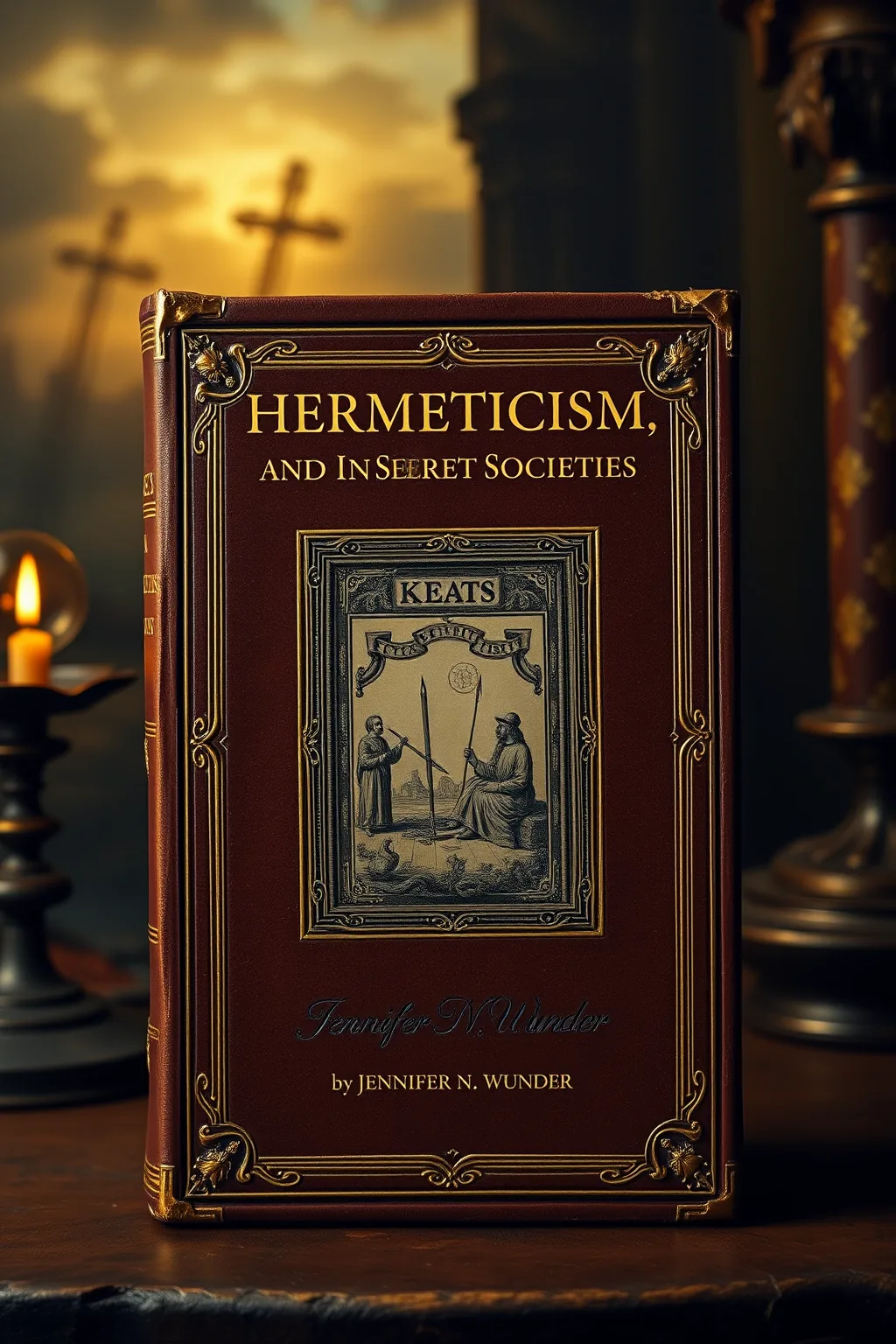
Keats, Hermeticism, and the Secret Societies
 72
72

Keats, Hermeticism, and the Secret Societies
Jennifer N. Wunder's "Keats, Hermeticism, and the Secret Societies" offers a vital corrective to Romantic studies, arguing that the poet's work cannot be fully grasped without acknowledging the pervasive influence of hermetic thought and clandestine organizations. Wunder's primary strength lies in her meticulous research, uncovering the extent to which esoteric ideas circulated in the late 18th and early 19th centuries, a period often characterized by its intellectual ferment but understudied in terms of its secret societies. The book's most potent section details how Keats's "Ode on a Grecian Urn" can be read as a meditation on alchemical processes and the quest for eternal forms, linking the poet's artistic concerns directly to hermetic symbolism. A limitation, however, is that the case for direct membership or deep personal engagement by Keats with specific societies remains inferential, relying heavily on textual parallels and the general intellectual climate. Despite this, the work convincingly demonstrates that an awareness of these hidden currents enriches our understanding of Keats's speculative poetry immeasurably. It is an essential read for anyone seeking to understand the esoteric underpinnings of Romanticism.
📝 Description
72
Jennifer N. Wunder's study argues Keats's poetry is inseparable from hermeticism and secret societies.
Jennifer N. Wunder's book asserts that John Keats's poetry and philosophical inquiries are deeply connected to the esoteric currents of his era. The study contends that a full understanding of Romantic literature, particularly its engagement with existence and the divine, requires acknowledging the influence of hermeticism and secret societies. Wunder challenges the common scholarly focus by demonstrating the significant, though often overlooked, presence of secret societies in late eighteenth and early nineteenth century culture. These groups, operating in the background, shaped art, literature, and intellectual life, their influence spreading beyond initiates.
The book reorients the study of Keats by centering hermetic thought and the clandestine networks of his time. Wunder examines Keats's engagement with concepts such as transmutation, gnosis, and initiation. This approach reveals deeper meanings within his odes and other poems. By foregrounding the esoteric dimensions of Keats's intellectual life, the work offers a new framework for analyzing his meditations on beauty, truth, mortality, and consciousness. The book also considers potential connections between Keats and groups like the Rosicrucians, providing fresh perspectives on his complex relationship with religious and philosophical traditions.
This book situates itself within the study of Western esotericism, specifically examining how Hermetic philosophy and the practices of secret societies intersected with literary creation. It builds upon scholarship that recognizes the historical impact of these traditions on intellectual and artistic movements. By focusing on the Romantic period and the figure of John Keats, the work contributes to understanding how esoteric ideas regarding initiation, hidden knowledge, and spiritual transformation found expression in poetry and philosophical speculation. It links contemporary understandings of alchemy and mysticism to the creative output of a major English poet.
💡 Why Read This Book?
• Gain a nuanced understanding of John Keats's poetry by exploring its connections to hermeticism, a significant esoteric tradition, as detailed in Jennifer N. Wunder's analysis of his "Ode on a Grecian Urn. • Discover the often-overlooked cultural impact of secret societies during the late eighteenth and early nineteenth centuries, moving beyond conventional literary analysis to appreciate their wider influence. • Learn how concepts like alchemical transmutation and gnosis, central to hermetic philosophy, provided frameworks for Keats's speculations on beauty, truth, and consciousness, as explored throughout the book.
⭐ Reader Reviews
Honest opinions from readers who have explored this book.
❓ Frequently Asked Questions
What is the primary argument of "Keats, Hermeticism, and the Secret Societies"?
The book argues that understanding John Keats's poetry and his philosophical speculations requires acknowledging the significant influence of hermeticism and secret societies prevalent in his era, a topic often neglected by Romantic scholars.
Which secret societies are discussed in relation to Keats?
While not definitively linking Keats to specific groups, the work explores the general milieu of secret societies and mentions groups like the Rosicrucians as examples of organizations that held significant cultural influence during the Romantic period.
How does hermeticism relate to Keats's poetry?
Jennifer N. Wunder demonstrates how hermetic concepts such as transmutation, the pursuit of hidden knowledge (gnosis), and symbolic interpretation provide a lens through which to understand the deeper meanings and philosophical inquiries embedded in Keats's most famous poems.
What is the historical period covered by the book?
The book focuses on the late eighteenth and early nineteenth centuries, a period known as the Romantic era, examining the intellectual and cultural landscape in which John Keats lived and wrote.
What is the publication date of Jennifer N. Wunder's book?
Jennifer N. Wunder's "Keats, Hermeticism, and the Secret Societies" was first published on April 22, 2016.
Does the book claim Keats was a member of a secret society?
The book makes a strong case for the *importance* of secret societies and hermeticism to an understanding of Keats's work, suggesting he was aware of and influenced by these currents, rather than definitively claiming his membership in any specific group.
🔮 Key Themes & Symbolism
Hermetic Philosophy
This work posits that hermeticism, with its emphasis on hidden knowledge, spiritual alchemy, and the correspondence between the microcosm and macrocosm, provided a crucial intellectual framework for John Keats. Wunder traces how concepts like the pursuit of gnosis and the symbolic understanding of nature informed Keats's meditations on beauty, truth, and the human condition, suggesting a profound, though often veiled, engagement with these esoteric traditions that scholars have historically overlooked.
The Role of Secret Societies
The book highlights the pervasive cultural influence of secret societies during the late 18th and early 19th centuries, arguing that their presence and impact on intellectual discourse have been significantly underestimated in Romantic studies. Wunder suggests that these clandestine groups, such as the Rosicrucians, fostered an environment where esoteric ideas could circulate and influence artistic creation, providing a context for understanding Keats's speculative inquiries and artistic output.
Keats's Poetic Speculations
Jennifer N. Wunder's research reinterprets Keats's poetry by placing it within the context of hermeticism and secret societies. The analysis focuses on how Keats's engagement with these esoteric currents shaped his philosophical questions regarding religious and existential matters. The book explores how symbols and concepts derived from these traditions might illuminate the layers of meaning in his odes and other works, offering a fresh perspective on his intellectual development.
Esoteric Currents in Romanticism
This study contends that a significant aspect of Romanticism, particularly John Keats's work, is deeply intertwined with esoteric traditions like hermeticism and the influence of secret societies. Wunder argues that these elements were not marginal but integral to the intellectual landscape, shaping the ways in which poets of the era explored profound questions about life, death, and the divine, challenging more secular interpretations of the period.
💬 Memorable Quotes
Direct passages from the work, attributed to the author.
“Information about the societies permeated all aspects of Romantic culture.”
— This statement underscores the pervasive, yet often unacknowledged, influence of clandestine organizations on the broader intellectual and artistic milieu of the Romantic era, suggesting their impact extended far beyond their immediate membership.
“A strong case for the importance of hermeticism and the secret societies to an understanding of John Keats's poetry.”
— This highlights the book's central thesis: that a full appreciation of Keats's poetic genius and his exploration of deep philosophical questions is incomplete without considering the esoteric doctrines and social networks of his time.
“Secret societies exercised enormous cultural influence during the late eighteenth and early nineteenth centuries.”
— This emphasizes the significant, widespread impact that groups operating outside conventional public structures had on the cultural output and intellectual currents of the Romantic period.
“Keats's speculations about religious and philosophical questions.”
— This points to the core of Wunder's argument, suggesting that Keats's poetic explorations of profound existential and theological themes were informed by the esoteric thought and secret society affiliations common in his era.
“Although secret societies... have received little attention from Romantic scholars.”
— This identifies a critical gap in existing scholarship that the book aims to fill, positioning its research as a corrective that brings a neglected but vital aspect of Romantic culture into scholarly focus.
🌙 Esoteric Significance
Tradition
This work is firmly situated within the study of Western Esotericism, specifically focusing on the Hermetic tradition and its manifestations in secret societies. It connects these ancient philosophical and magical streams to the creative output of a major literary figure. The book departs from purely historical accounts by interpreting literary works through an esoteric lens, treating Keats's poetry as a site where hermetic concepts were contemplated and expressed, albeit often symbolically.
Symbolism
Key symbols explored include those related to alchemical transformation – the process of purification and spiritual evolution, often represented by metaphors of death and rebirth, or the transmutation of base metals into gold. The concept of 'gnosis,' or direct spiritual knowledge, is also central, reflecting the hermetic pursuit of inner enlightenment. The 'secret' itself, as embodied by clandestine societies, symbolizes hidden truths and initiatory pathways unavailable to the uninitiated, a motif that resonates within Keats's exploration of veiled meanings.
Modern Relevance
Contemporary scholars of literature and esoteric studies continue to engage with the re-evaluation of Romanticism through an occult lens, building on work like Wunder's. Thinkers exploring the relationship between consciousness, creativity, and hidden traditions find value in this study. Practices rooted in modern Hermeticism or ceremonial magic may also find resonance in the book's exploration of how ancient esoteric principles could inform artistic expression and philosophical inquiry.
👥 Who Should Read This Book
• Students of John Keats and Romantic literature seeking to deepen their understanding beyond conventional interpretations, particularly those interested in the intellectual and cultural context of the period. • Scholars and enthusiasts of Western Esotericism, Hermeticism, and the history of secret societies who wish to see how these traditions intersected with major literary figures. • Comparative religion and philosophy researchers interested in how esoteric ideas influenced art and thought during a transformative historical era.
📜 Historical Context
The late eighteenth and early nineteenth centuries, the era of Romanticism, were a period of intense intellectual upheaval and fascination with the hidden. While the Enlightenment championed reason, a counter-current pulsed with interest in mysticism, ancient wisdom, and secret knowledge. Groups like the Rosicrucians, Freemasons, and various alchemical societies held considerable sway, their symbols and philosophies permeating literature and art. John Keats (1795-1821) lived and wrote amidst this climate. Jennifer N. Wunder's work highlights how this esoteric milieu, often operating in parallel to established religious and philosophical thought, provided a fertile ground for Keats's own speculative inquiries. While Romantic scholars have often focused on political revolutions or the sublime in nature, Wunder argues for the necessity of considering these clandestine networks and hermetic traditions. The reception of such esoteric ideas was complex; while some were openly discussed, others were deliberately obscured, making their influence challenging to trace but vital to understanding figures like Keats.
📔 Journal Prompts
The pervasive influence of secret societies on Romantic culture, as discussed in the book.
Keats's speculations about religious and philosophical questions through a hermetic lens.
The symbolism of alchemical transformation in interpreting Keats's poetry.
The concept of gnosis as a driver for creative and philosophical inquiry.
How the hidden knowledge of hermeticism might manifest in artistic works.
🗂️ Glossary
Hermeticism
An esoteric tradition rooted in the writings attributed to Hermes Trismegistus, emphasizing spiritual wisdom, alchemy, astrology, and the interconnectedness of the cosmos (as above, so below).
Secret Societies
Organizations, such as Freemasonry or Rosicrucianism, that operate with degrees of secrecy, often involving initiation rituals, esoteric teachings, and a shared pursuit of knowledge or spiritual development.
Gnosis
A Greek term meaning 'knowledge,' often referring to a specific type of spiritual insight or direct experiential knowledge of the divine, central to Gnostic traditions and influential in Hermetic thought.
Alchemical Transmutation
In its spiritual sense, the process of purifying the soul or consciousness, often symbolized by the literal alchemical goal of turning base metals into gold. It represents inner transformation and spiritual perfection.
Rosicrucians
Members of a legendary secret order founded in the early 17th century, associated with esoteric knowledge, alchemy, and mystical philosophy, whose influence was felt through various later groups.
Romanticism
A literary, artistic, and intellectual movement originating in Europe towards the end of the 18th century, characterized by emphasis on emotion, individualism, glorification of the past and nature, and often a fascination with the supernatural or esoteric.
Odes
A type of lyrical stanzaic poem praising or glorifying a person, place, object, or idea. Keats's odes are particularly noted for their philosophical depth and rich imagery.