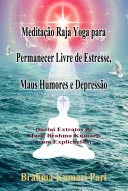
Meditação Raja Yoga para Permanecer Livre de Estresse, Maus Humores e Depressão
 78
78

Meditação Raja Yoga para Permanecer Livre de Estresse, Maus Humores e Depressão
Brahma Kumari Pari's "Meditação Raja Yoga para Permanecer Livre de Estresse, Maus Humores e Depressão" offers a direct, no-nonsense approach to mental well-being through the lens of the Brahma Kumaris spiritual organization. Its strength lies in its clarity and the accessibility of its core message: sustained peace is attainable through conscious connection with the Supreme Soul. The book effectively distills complex spiritual concepts into actionable advice. However, its reliance on the specific theological framework of the Brahma Kumaris might limit its universal appeal to those unfamiliar with or resistant to its particular metaphysical underpinnings. A passage detailing the "removal of defects in the body" hints at a holistic approach, though it remains somewhat underdeveloped in this edition. For adherents or those curious about this specific path, it serves as a practical manual. For others, it's an interesting, if narrowly focused, guide to stress reduction.
📝 Description
78
Published in 2023, Brahma Kumari Pari's book details Raja Yoga for stress relief.
This volume offers practices for mental equilibrium derived from the Brahma Kumaris spiritual teachings. It guides readers toward sustained happiness and peace, presenting a method to remain free from stress, negative moods, and depressive states. The book is suited for individuals seeking practical techniques to manage emotional well-being and mental clarity. It particularly appeals to those interested in spiritual approaches to common psychological challenges, regardless of their prior experience with meditation or the Brahma Kumaris.
The core of the book focuses on "Raja Yoga," a meditation technique involving contemplation of divine knowledge and connection with the "Supreme Soul." This connection is presented as the key to achieving a stable, positive mental state. The practices aim to counteract stress, ill-humors, and depression through spiritual awareness and the removal of personal defects. The book disseminates these teachings in a format accessible to a modern global audience.
The methods described are rooted in the Brahma Kumaris, a spiritual movement founded in 1937 in India. The movement's Raja Yoga meditation emphasizes the soul's connection to the Supreme Soul. This practice is presented as a means to achieve a stable, positive mental state, counteracting negative emotions and psychological challenges through spiritual awareness. This book makes these teachings accessible to contemporary readers.
💡 Why Read This Book?
• You will learn a specific meditation technique, Raja Yoga as taught by the Brahma Kumaris since 1937, to foster inner peace and resilience against stress. • You will gain practical methods for cultivating happiness and emotional stability, directly addressing negative states like ill-humors and depression through spiritual contemplation. • You will understand how connecting with the "Supreme Soul" is presented as a pathway to self-mastery and freedom from psychological burdens, as explained within the Brahma Kumaris' knowledge system.
⭐ Reader Reviews
Honest opinions from readers who have explored this book.
❓ Frequently Asked Questions
What is Raja Yoga as presented in this book?
Raja Yoga, according to Brahma Kumari Pari, is a form of meditation focused on connecting the individual soul with the Supreme Soul through the contemplation of divine knowledge. It is presented as a direct path to inner peace and stress-free living.
How does this book help with stress and depression?
The book teaches that by engaging in Raja Yoga and understanding divine knowledge, one can maintain a happy and peaceful state. This spiritual connection is presented as a means to counteract stress, ill-humors, and depressive tendencies.
Is this book suitable for beginners in meditation?
Yes, the book is designed as a guide for anyone to use, regardless of prior experience. Its explanations are based on the Brahma Kumaris' teachings, aiming to make the practice accessible for achieving freedom from stress and depression.
What is the origin of the Brahma Kumaris' teachings mentioned in the book?
The Brahma Kumaris is a spiritual movement founded in 1937 in India. Its teachings, which form the basis of this book, emphasize spiritual self-awareness and the connection between the individual soul and the Supreme Soul.
Does the book offer solutions for physical defects?
The book mentions explanations on how to remove defects in the body, suggesting a holistic approach. This is likely tied to the spiritual practice of self-purification and the impact of mental states on physical well-being within the Brahma Kumaris philosophy.
What is the 'Supreme Soul' concept in this context?
In the Brahma Kumaris tradition, the "Supreme Soul" refers to God, the formless, ultimate source of consciousness and energy. The practice involves yogic connection and remembrance of this Supreme Soul to achieve spiritual upliftment and peace.
🔮 Key Themes & Symbolism
Raja Yoga Meditation
This theme centers on the specific meditative practice of Raja Yoga as taught by the Brahma Kumaris. It involves a deep, contemplative connection with the Supreme Soul, aiming to instill a state of constant happiness and peace. The book details how this practice serves as a powerful antidote to modern psychological afflictions like stress, negative moods, and depression, grounding the reader in a spiritual awareness that transcends ordinary mental fluctuations.
Spiritual Connection
The core of the book's philosophy lies in the profound benefits derived from connecting with the 'Supreme Soul.' This connection is not merely an intellectual concept but a practice designed to uplift consciousness, purify the mind, and foster a stable, joyful disposition. It posits that this spiritual tether is the foundation for remaining free from internal turmoil and external pressures.
Freedom from Negativity
A primary objective of the practices outlined is achieving liberation from negative emotional states. The book directly addresses stress, ill-humors, and depression, presenting Raja Yoga and divine knowledge as the means to eradicate these conditions. It emphasizes the power of spiritual understanding to dissolve mental impurities and defects, leading to lasting well-being.
Self-Mastery Through Knowledge
The book integrates the contemplation of 'divine knowledge' with the practice of Raja Yoga. This knowledge is presented as essential for self-understanding and the removal of personal flaws or 'defects.' By internalizing this wisdom, readers are guided toward achieving a higher level of consciousness and control over their thoughts, emotions, and reactions.
💬 Memorable Quotes
Direct passages from the work, attributed to the author.
“You will not be able to experience ill humors when you are in yoga with the Supreme Soul.”
— This statement highlights the central thesis: that a conscious, spiritual connection with the Divine actively prevents the onset or recurrence of negative emotional states like anger, frustration, or sadness.
“Any one can use this book as a guide to become free from Stress, Ill Humors and Depression.”
— This emphasizes the book's practical and inclusive nature. It positions the text not as theoretical discourse but as a user-friendly manual for achieving tangible mental and emotional freedom.
“The explanations in this book are based on the knowledge of the Brahma Kumaris.”
— This declaration clearly attributes the source of the teachings, grounding the book within a specific spiritual lineage and providing context for its unique philosophical and practical approach.
“This book helps to keep you in a happy, peaceful state, free from stress, free from depression.”
— This offers a concise summary of the book's intended outcome: the cultivation and maintenance of a positive mental and emotional environment through the application of its spiritual guidance.
“There are also explanations in this book on how to remove defects in the body.”
— This suggests a holistic view where spiritual practices influence not only the mind but also the physical self, indicating that inner purification can extend to addressing bodily imperfections.
🌙 Esoteric Significance
Tradition
The work is firmly rooted in the esoteric tradition of the Brahma Kumaris, a spiritual movement founded in 1937. While it shares some conceptual overlaps with Hindu yogic philosophy and Vedanta, particularly concerning the soul (Atma) and the Supreme Soul (Paramatma), its specific interpretation and practical application are unique. It represents a modern, distinct lineage focused on a disciplined, conscious remembrance of God as the primary means for spiritual elevation and mental purification.
Symbolism
A key symbolic concept is the 'Supreme Soul,' often represented abstractly as a point of light, signifying pure consciousness and the ultimate divine source. The 'soul' (Atma) is also depicted as a point of light, representing the true self distinct from the physical body. The practice of 'yoga' itself symbolizes the union or connection between these two points of light, a cosmic embrace that fosters peace and clarity.
Modern Relevance
Contemporary spiritual seekers and mindfulness practitioners often find resonance with the Brahma Kumaris' emphasis on mental discipline and inner peace. While not always directly citing the movement, modern schools of thought focusing on stress reduction, emotional regulation, and consciousness studies can draw parallels with the core tenets presented in this book. The Brahma Kumaris' global network continues to offer practical guidance for navigating modern life's pressures.
👥 Who Should Read This Book
['• Practitioners of meditation seeking to deepen their practice with a focus on divine connection, particularly those interested in Eastern spiritual philosophies distinct from mainstream Buddhism or Vedanta.', '• Individuals experiencing persistent stress, anxiety, or depressive symptoms who are open to spiritual or faith-based approaches to mental well-being.', '• Students of comparative religion and spirituality interested in understanding the unique teachings and practices of the Brahma Kumaris movement founded in 1937.']
📜 Historical Context
The Brahma Kumaris movement, from which this book draws its teachings, was established in 1937 in Hyderabad, Sindh (now Pakistan) by Dada Lekhraj Kripalani. It emerged during a period of significant social and political upheaval in India, including the lead-up to independence and the partition. The movement's philosophy, which emphasizes a form of Raja Yoga focused on remembering the Supreme Soul and understanding one's true identity as a soul, offered a spiritual anchor during times of uncertainty. This differed from established Hindu traditions by emphasizing a direct, personal connection to God and a structured, daily spiritual discipline. While not facing widespread censorship, its unique teachings and organizational structure sometimes led to scrutiny. The movement gained significant international traction throughout the latter half of the 20th century, particularly after relocating its headquarters to Mount Abu, Rajasthan, India. This 2023 publication reflects the ongoing dissemination of these principles to a global audience seeking spiritual solutions for modern psychological challenges.
📔 Journal Prompts
The connection with the Supreme Soul as a source of peace.
Identifying and removing personal defects through divine knowledge.
Maintaining a happy and peaceful state during stressful situations.
The role of spiritual yoga in preventing ill humors.
Applying Brahma Kumaris' knowledge for stress-free living.
🗂️ Glossary
Raja Yoga
A specific form of meditation taught by the Brahma Kumaris, focusing on the conscious remembrance and connection with the Supreme Soul for spiritual self-realization and peace.
Supreme Soul
In the context of Brahma Kumaris teachings, this refers to God, the incorporeal, supreme consciousness from whom all souls originate and to whom they eventually return.
Soul (Atma)
The true, eternal essence of an individual, understood as a point of consciousness separate from the physical body and mind, possessing inherent virtues.
Yoga
While broadly meaning union, in this text, it specifically refers to the practice of connecting one's consciousness with the Supreme Soul.
Ill Humors
Refers to negative emotional states, moods, or dispositions, such as anger, irritability, or sadness, which are seen as impediments to a peaceful state of mind.
Defects
Negative qualities or impurities of the mind and character, such as ego, lust, anger, greed, and attachment, which hinder spiritual progress and well-being.
Divine Knowledge
Spiritual wisdom imparted through the Brahma Kumaris teachings, believed to facilitate self-understanding, purification, and connection with the Supreme Soul.