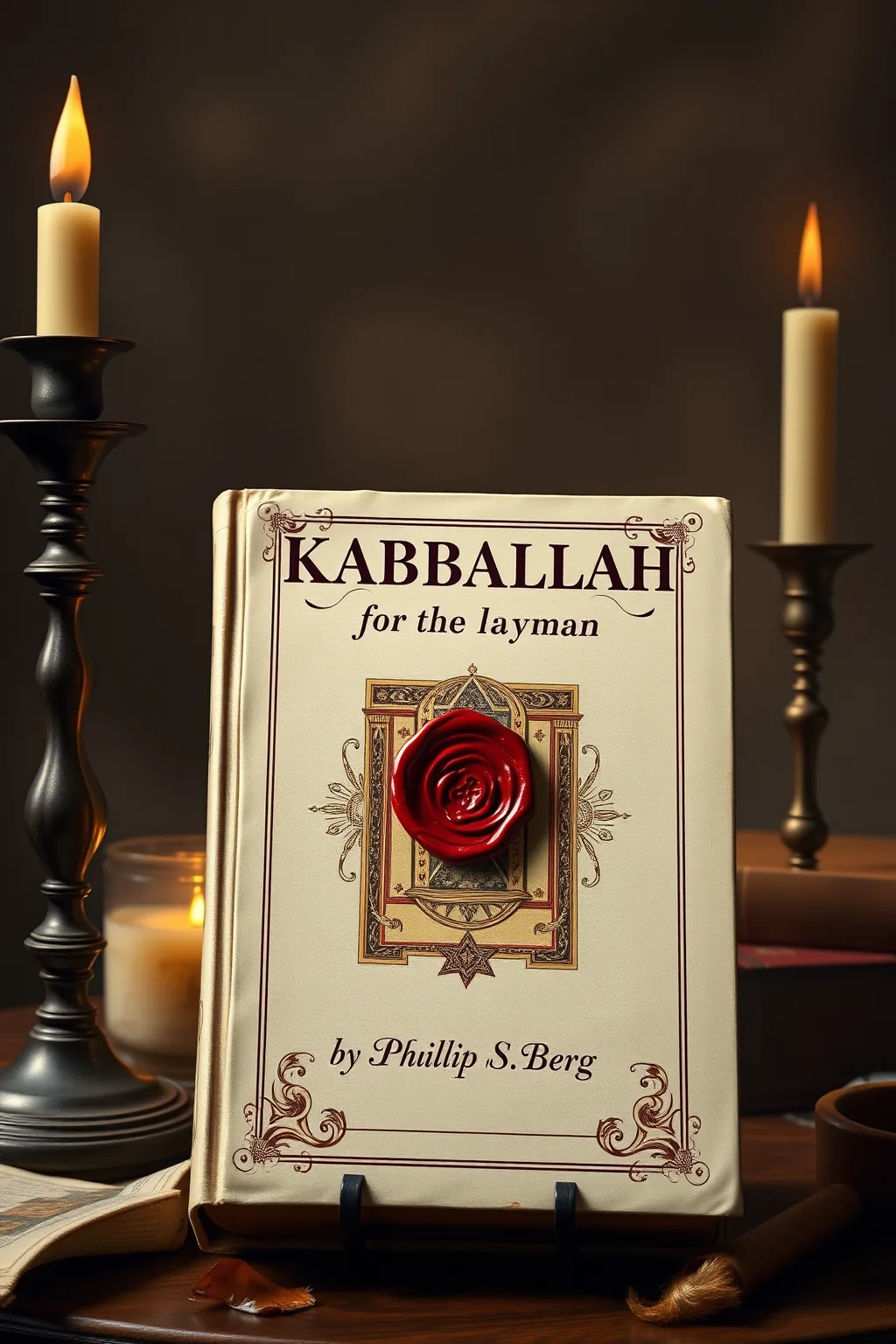
Kabbalah for the Layman
 78
78

Kabbalah for the Layman
Philip S. Berg’s Kabbalah for the Layman, released in 1988, attempts to distill the dense principles of Kabbalistic thought for a general audience. Berg’s strength lies in his commitment to clarity, rendering abstract concepts like the Sefirot and the Tree of Life into more comprehensible terms than many predecessors. He successfully charts a course through the often-intimidating landscape of Jewish mysticism. However, the work occasionally sacrifices depth for accessibility, presenting a simplified view that may leave seasoned practitioners wanting more nuance. A particular passage explaining the Tzimtzum, while clear, feels somewhat abbreviated, leaving the profound implications of divine self-limitation somewhat understated. For newcomers, it’s a functional primer, but its limitations become apparent when contrasted with more scholarly or deeply mystical expositions.
📝 Description
78
Philip S. Berg published Kabbalah for the Layman in 1988 to make Jewish mysticism accessible.
Philip S. Berg's Kabbalah for the Layman, first published in 1988, attempts to make the complex ideas of Kabbalah understandable to a general audience. Berg breaks down the spiritual principles and cosmology of this tradition, making them easier for newcomers to grasp. The book is for individuals curious about Jewish mysticism and looking for an introduction to its deeper spiritual dimensions.
It aims to explain the structure of the universe and the nature of the soul through a Kabbalistic framework. Readers interested in a clear, yet systematic, overview of these concepts will find it useful. Berg's work positions itself as a more direct path into Kabbalah, distinct from purely academic studies or contemporary speculative interpretations.
Published in 1988, this book entered a period of growing interest in Western esoteric traditions. While academic study of Kabbalah was established, popular engagement often leaned towards less traditional interpretations. Berg's book sought to offer a more direct, though simplified, approach to Kabbalistic thought, distinguishing itself from both scholarly works and more modern, speculative adaptations.
💡 Why Read This Book?
• Gain an introductory understanding of the Sefirot, the ten divine emanations that form the core of Kabbalistic cosmology, as explained in Berg's simplified framework. • Explore the concept of the Tree of Life as presented in the book, a central diagram for understanding spiritual realms and their connection to the material world. • Grasp the initial principles of Tzimtzum, the divine act of contraction, as introduced in the 1988 publication, offering a simplified entry into the Kabbalistic concept of creation.
⭐ Reader Reviews
Honest opinions from readers who have explored this book.
❓ Frequently Asked Questions
When was Philip S. Berg's Kabbalah for the Layman first published?
Philip S. Berg's Kabbalah for the Layman was first published in 1988, aiming to make complex Kabbalistic ideas accessible to a wider audience.
What are the main themes covered in Kabbalah for the Layman?
The book covers core Kabbalistic themes such as the Ein Sof, the ten Sefirot, the Tree of Life, and the concept of Tzimtzum, explaining their roles in the structure of reality.
Is Kabbalah for the Layman suitable for beginners?
Yes, the book is specifically designed for beginners, aiming to demystify Kabbalah and provide a foundational understanding without requiring prior esoteric knowledge.
What is the Ein Sof as described in the book?
In Berg's work, the Ein Sof represents the Infinite, the ultimate, unknowable Godhead from which all existence emanates, serving as the primordial source.
How does the book explain the Tree of Life?
The book presents the Tree of Life as a cosmological map, illustrating the ten Sefirot and the pathways connecting them, used to understand divine emanations and creation.
Who was Philip S. Berg?
Philip S. Berg was a prominent Kabbalist and author who founded the Kabbalah Centre. He authored numerous books, including Kabbalah for the Layman (1988), focusing on making Kabbalistic studies accessible.
🔮 Key Themes & Symbolism
The Ten Sefirot
Kabbalah for the Layman elucidates the concept of the ten Sefirot, divine emanations that bridge the infinite Godhead (Ein Sof) and the created universe. Berg presents these as distinct attributes or vessels through which divine light manifests, forming the structure of both spiritual realms and our perceived reality. Understanding the Sefirot, from Keter (Crown) to Malkuth (Kingdom), is presented as crucial for comprehending the mechanics of creation and spiritual ascent.
The Tree of Life
Central to Kabbalistic cosmology, the Tree of Life is explained as a diagrammatic representation of the Sefirot and their interconnections. In Berg's work, it serves as a map of consciousness and creation, illustrating the descent of divine energy and the potential for human spiritual evolution. The pathways connecting the Sefirot are depicted as crucial routes for mystical experience and understanding the divine plan.
Ein Sof and Tzimtzum
The book introduces the concept of Ein Sof, the Infinite and utterly transcendent aspect of God, beyond human comprehension. To allow for creation, the work explains Tzimtzum, the initial divine act of 'contraction' or self-limitation, creating a conceptual 'space' for existence. This paradox of divine immanence arising from divine transcendence is a foundational element discussed.
Spiritual Evolution
Kabbalah for the Layman touches upon the idea that human beings possess a spiritual imperative to ascend and reconnect with the Divine Source. Through understanding the Kabbalistic cosmology and applying its principles, individuals can purportedly work towards correcting spiritual imbalances and achieving a higher state of consciousness, aligning themselves with the divine order.
💬 Memorable Quotes
Direct passages from the work, attributed to the author.
“The ten Sefirot are the vessels through which the Infinite Light is revealed.”
— This statement expresses the core function of the Sefirot in Kabbalistic thought as presented by Berg: they are not merely abstract concepts but active channels that allow the boundless energy of the Ein Sof to manifest in forms understandable and accessible to creation.
“The Tree of Life is the blueprint of creation.”
— This highlights the structural importance of the Tree of Life diagram. It's presented not just as a symbolic image but as a fundamental organizational principle underlying all existence, from the highest spiritual planes down to the material world.
“Creation began with a withdrawal of the Infinite.”
— This refers to the principle of Tzimtzum. It suggests that the very act of making space for a universe required a paradoxical 'emptying' or self-limitation on the part of the Infinite, setting the stage for existence.
“The purpose of life is to return to the Source.”
— This interpretation points to the teleological aspect of Kabbalah discussed in the book, suggesting that human existence has a spiritual trajectory aimed at reunification with the Divine, often achieved through spiritual practice and understanding.
“Understanding the divine attributes is key to spiritual growth.”
— This emphasizes the pedagogical aspect of studying Kabbalah. By learning about the Sefirot, which represent divine attributes, one gains insight into the nature of reality and the path toward spiritual development.
🌙 Esoteric Significance
Tradition
This work belongs to the Western Esoteric tradition, specifically focusing on Kabbalah, a system of Jewish mysticism. While drawing from classical Kabbalistic texts and concepts, Berg's approach aims for a modern, simplified interpretation. It departs from strictly Orthodox Jewish contexts by presenting Kabbalah as a universal spiritual science accessible to all, a common characteristic of esoteric movements seeking to synthesize ancient wisdom for contemporary seekers.
Symbolism
Key symbols explored include the Sefirot, presented as divine emanations forming the structure of reality, and the Tree of Life, a diagram mapping these emanations and their interconnections. The book likely discusses the symbolic meaning of Hebrew letters and divine names, integral to Kabbalistic practice, as tools for understanding the building blocks of creation and facilitating spiritual connection.
Modern Relevance
Berg's accessible presentation of Kabbalistic concepts, particularly through the lens of the Sefirot and the Tree of Life, continues to influence contemporary spiritual seekers and authors. While some academic and traditional Kabbalists critique simplified approaches, Berg's work laid groundwork for organizations like the Kabbalah Centre, impacting how many individuals globally first encounter these mystical ideas.
👥 Who Should Read This Book
• Individuals new to Kabbalah seeking a foundational overview without overwhelming technical jargon. • Students of comparative mysticism interested in understanding Jewish esoteric traditions through a simplified, modern interpretive lens. • Spiritual explorers looking for frameworks to comprehend the structure of reality and the nature of the Divine beyond conventional religious or philosophical approaches.
📜 Historical Context
Published in 1988, Philip S. Berg’s *Kabbalah for the Layman* arrived during a period of burgeoning interest in esoteric subjects, partly fueled by the New Age movement. While academic scholars like Gershom Scholem had been rigorously examining Kabbalistic texts for decades, popular engagement often sought more direct, experiential paths. Berg's work positioned itself within this popular discourse, aiming to simplify the complex theoretical frameworks of Kabbalah, such as the Lurianic system, for a Western audience. It offered an alternative to both the dense academic treatises and the more syncretic, less traditional interpretations prevalent at the time. The book sought to provide a structured introduction to concepts like the Sefirot and the Tree of Life, making them accessible without necessarily studying the deep textual traditions or mystical practices associated with earlier Kabbalists.
📔 Journal Prompts
The structure of the ten Sefirot as presented in the book: how do they map your understanding of divine attributes?
Reflect on the concept of Tzimtzum: what does the idea of divine self-limitation imply for the nature of existence?
Consider the Tree of Life: how does this symbolic map resonate with your perception of interconnectedness in the universe?
The role of man in spiritual ascent: what responsibilities does Berg suggest individuals have in relation to the Divine Source?
Contemplate the Ein Sof: what challenges arise when trying to conceptualize the Infinite?
🗂️ Glossary
Ein Sof
The Kabbalistic concept of the Infinite, the absolute, unknowable Godhead that is beyond all comprehension and description, serving as the ultimate source of all existence.
Sefirot
The ten divine emanations or attributes through which the Infinite (Ein Sof) reveals itself and creates the universe. They form the structure of the Kabbalistic Tree of Life.
Tree of Life
A central diagram in Kabbalah consisting of ten Sefirot and the pathways connecting them, representing the structure of the cosmos, divine emanations, and the path of spiritual development.
Tzimtzum
Literally 'contraction' or 'withdrawal.' The Kabbalistic concept describing the initial divine act of self-limitation, creating a void or space for the existence of the universe.
Kabbalah
A system of Jewish mysticism concerned with the hidden nature of God and the universe. It seeks to understand divine secrets through esoteric interpretations of scripture and mystical practices.
Malkuth
The tenth Sefirah, often translated as 'Kingdom.' It represents the final stage of divine emanation, corresponding to the physical world and the manifest universe.
Keter
The first Sefirah, translated as 'Crown.' It represents the highest aspect of divinity, the divine will, and the closest point of connection to the Infinite (Ein Sof).

















![[Zohar]](/img/thumb/zohar-jerry-winston.webp)
