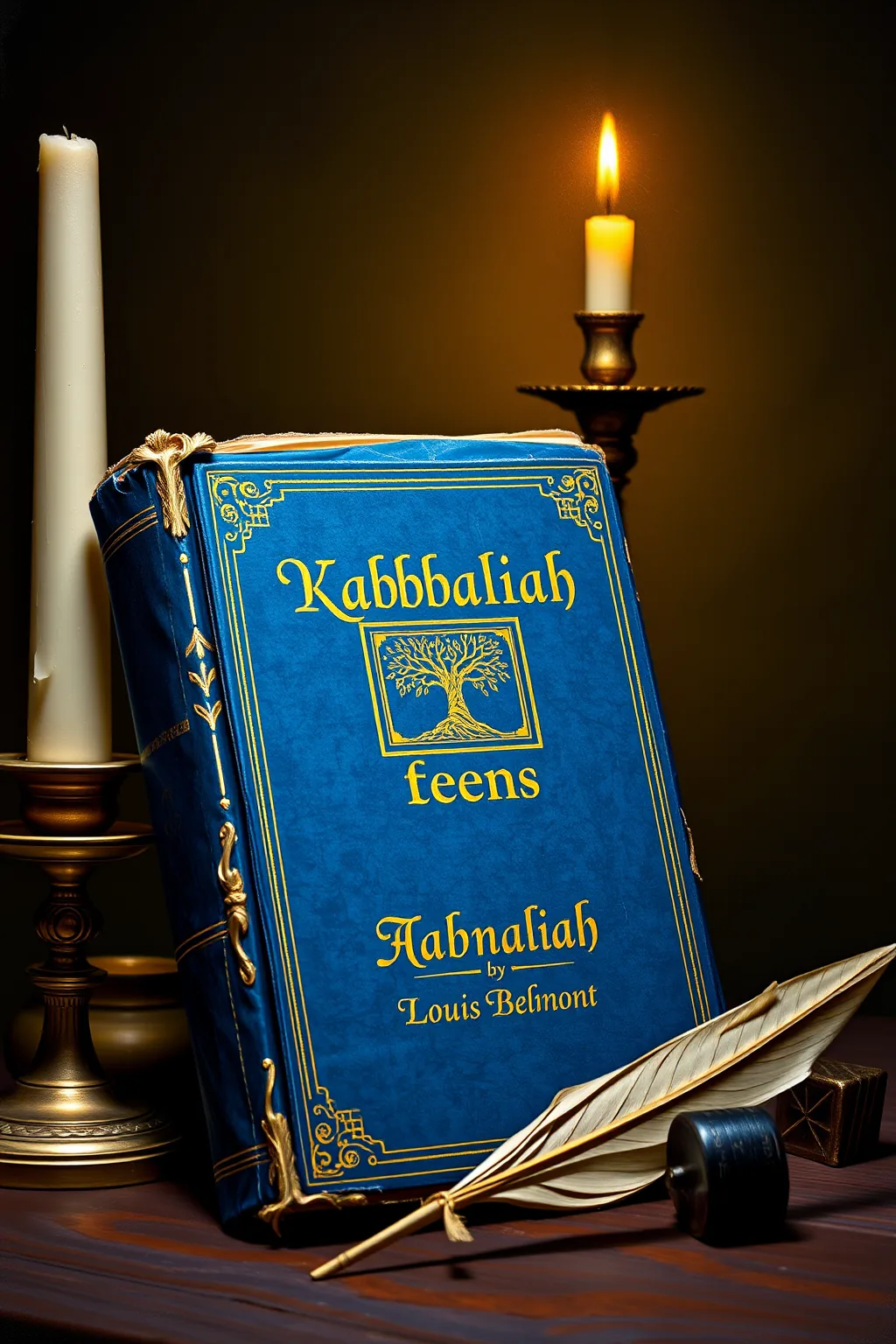
Kabbalah for teens
 61
61

Kabbalah for teens


Aurelia Blackwood (Occult Philosophy Critic) — Louis Belmont's 'Kabbalah for Teens' is a remarkable achievement, demystifying the profound currents of Jewish mysticism for a nascent audience. Belmont navigates the labyrinthine symbolism of the Tree of Life with clarity and reverence, offering genuine esoteric insights without dilution. This work excels in its ability to foster a contemplative mindset, encouraging young seekers to engage directly with ancient wisdom. Its strength lies in its balanced approach, presenting complex ideas in a digestible yet spiritually potent manner, making it an invaluable primer for any adolescent drawn to the hidden dimensions of reality.
📝 Description
61
Louis Belmont's 'Kabbalah for Teens' translates Jewish mysticism for a younger audience.
Published by Louis Belmont, 'Kabbalah for Teens' introduces the core tenets of Jewish mysticism. The book unpacks the Tree of Life, explaining the Sephirot and their symbolic meanings. Belmont aims to make complex ideas understandable for teenagers, focusing on the universe's structure and an individual's role within it. It covers divine emanations and the interconnectedness of creation. The text encourages self-discovery and spiritual exploration, presenting Kabbalistic thought as relevant for contemporary life.
This work simplifies dense philosophical and mystical concepts. It guides readers through the symbolic language of Kabbalah, aiming to foster an understanding of its underlying principles. The goal is to provide a clear entry point into a rich tradition for those new to its study. The book emphasizes personal growth and finding deeper meaning through these ancient teachings.
Kabbalah is a form of Jewish mysticism that originated in the medieval period. It seeks to understand the divine nature and the relationship between God and the created world through symbolic interpretation and meditative practices. Central to Kabbalistic thought is the concept of the Sephirot, ten divine attributes or emanations through which God interacts with the universe. The Tree of Life is a diagram representing these Sephirot and their connections, serving as a map of creation and spiritual ascent. This tradition has influenced various esoteric and spiritual movements throughout history.
💡 Why Read This Book?
Embark on a transformative journey into the heart of Jewish mysticism. 'Kabbalah for Teens' offers a unique opportunity to grasp profound spiritual concepts, understand ancient symbolism, and connect with a rich esoteric heritage. Ideal for young seekers, curious minds, and budding scholars of the occult, this book provides a foundational understanding of Kabbalistic principles, fostering introspection and a deeper connection to the divine.
⭐ Reader Reviews
Honest opinions from readers who have explored this book.
❓ Frequently Asked Questions
What is the Kabbalah?
The Kabbalah is an esoteric tradition within Judaism that explores the mystical nature of God, the creation of the universe, and the relationship between the divine and humanity, often through symbolic texts and practices.
Is this book suitable for beginners?
Absolutely. Louis Belmont has crafted 'Kabbalah for Teens' with young learners and newcomers in mind, simplifying complex ideas for accessible understanding.
What is the Tree of Life?
The Tree of Life is a central diagram in Kabbalistic cosmology, representing the emanations of God and the structure of the universe, often depicted as ten interconnected spheres (Sephirot).
Does this book teach practical Kabbalah?
While it lays a strong theoretical and symbolic foundation, the primary focus is on understanding the core principles and esoteric philosophy of Kabbalah, rather than specific practical applications.
What age group is this book intended for?
The book is specifically tailored for teenagers and young adults, but its clear explanations can benefit anyone interested in an accessible introduction to Kabbalistic thought.
🔮 Key Themes & Symbolism
The Luminous Tree of Life
The central pillar of Kabbalistic thought, the Tree of Life, is explored in its full splendor. This sacred diagram, composed of ten interconnected Sephirot, serves as a map of divine emanation and the structure of existence. Belmont illuminates how each Sephirah represents a unique attribute of the Divine and a stage in the creative process, offering a profound framework for understanding the universe and one's own spiritual journey. Readers will learn to decipher its intricate pathways and grasp its symbolic language, revealing the interconnectedness of all things.
Symbolism and Divine Language
Kabbalah is a tradition rich in symbolism, and this book unlocks its potent lexicon. From the Hebrew alphabet's mystical significance to the archetypal imagery embedded within the Sephirot, Belmont guides readers through the esoteric language of the cosmos. Understanding these symbols is akin to learning the divine tongue, allowing for a deeper apprehension of hidden realities and the underlying principles that govern creation. This exploration fosters an appreciation for the power of metaphor and allegory in spiritual inquiry.
The Journey of the Soul
Beyond cosmology, Kabbalah offers useful insights into the nature of the soul and its evolutionary path. 'Kabbalah for Teens' introduces the concept of the soul's descent into physical existence and its ultimate return to its divine source. It explores the personal spiritual quest, encouraging introspection and self-awareness as essential components of growth. Readers are invited to contemplate their own inner landscape, recognizing the divine spark within and the potential for spiritual realization through understanding and ethical living.
💬 Memorable Quotes
Direct passages from the work, attributed to the author.
“Each Sephirah is a doorway to the Divine.”
— This highlights the Tree of Life's function as a pathway to understanding and experiencing God's attributes, suggesting that by contemplating each sphere, one can gain deeper spiritual insight.
“To know yourself is to begin knowing the Infinite.”
— This points to the introspective nature of Kabbalistic practice, asserting that self-knowledge is intrinsically linked to understanding the divine, as the microcosm reflects the macrocosm.
“The light within mirrors the light above.”
— This emphasizes the concept of divine immanence and the interconnectedness of the human soul with the divine realm, suggesting that the spiritual essence within us is a reflection of the universal divine light.
💡 Key Ideas
Editorial paraphrase of the work's core concepts — not direct quotes.
The universe whispers its secrets through symbols.
This quote emphasizes the Kabbalistic belief that divine truths are not always revealed through direct pronouncements but are often encoded within the symbolic language of creation, waiting to be deciphered.
Wisdom is not found, but cultivated.
This quote underscores the active and participatory nature of spiritual learning in Kabbalah, suggesting that true wisdom requires diligent study, contemplation, and personal growth.
🌙 Esoteric Significance
Tradition
This book looks at the heart of Kabbalah, an ancient and profound esoteric tradition within Judaism. It is concerned with the hidden meanings of scripture, the nature of God's emanation, and the spiritual architecture of the cosmos. Kabbalah offers a mystical pathway to direct experience of the divine and an understanding of humanity's role in the grand cosmic scheme, emphasizing divine immanence and the interconnectedness of all existence.
Symbolism
The primary symbolic system explored is the Tree of Life, a diagram of ten Sephirot representing divine attributes and stages of creation. Other key symbols include the Hebrew letters, which are believed to possess inherent mystical power, and archetypal imagery associated with the divine realms. These symbols serve as keys to unlock deeper spiritual truths and provide a framework for contemplative practice and understanding the universe's hidden order.
Modern Relevance
In an age often characterized by material pursuits and existential questioning, Kabbalah offers a timeless perspective on meaning, purpose, and spiritual connection. 'Kabbalah for Teens' makes these useful insights accessible to a new generation, providing tools for self-reflection, ethical development, and a deeper understanding of the universe. It encourages a holistic worldview, fostering a sense of wonder and an appreciation for the unseen dimensions of life.
👥 Who Should Read This Book
This book is an ideal companion for any adolescent beginning a spiritual quest or harboring a natural curiosity about the deeper mysteries of existence. It's particularly suited for young seekers interested in comparative religion, philosophy, or the occult, offering a clear and engaging entry point into Jewish mysticism. Students of comparative spirituality, budding scholars of esoteric traditions, or anyone seeking a grounded yet profound understanding of metaphysical concepts will find immense value within its pages. Practitioners of other spiritual paths may also find its symbolic language and philosophical depth enriching.
📜 Historical Context
Emerging from the body of medieval Jewish thought, Kabbalah flourished particularly in 13th-century Spain and later in Safed during the 16th century. This period of intense intellectual and spiritual inquiry was marked by a desire to explore the deeper, mystical dimensions of the Torah, seeking to understand God's nature and the mechanics of creation beyond literal interpretation. The expulsion of Jews from Spain and subsequent diasporas, while traumatic, also led to the dissemination of Kabbalistic ideas, influencing various mystical and esoteric movements across the globe. 'Kabbalah for Teens' draws upon this venerable tradition, presenting its core concepts in a way that speaks to contemporary young minds, bridging centuries of spiritual exploration.
📔 Journal Prompts
Reflect on the concept of divine emanation as described by the Sephirot. How might these divine attributes manifest in your own life?
Consider the Hebrew alphabet as a symbolic language. What does it reveal to you about the power of letters and words in shaping reality?
The Tree of Life is often seen as a map of the soul's journey. Where do you see yourself on this map, and what spiritual growth is beckoning you?
Meditate on a personal challenge you are facing. How could understanding a specific Sephirah or Kabbalistic concept offer a new perspective or path forward?
How does the idea of interconnectedness, central to Kabbalah, influence your perception of your relationships with others and the world around you?
🗂️ Glossary
Sephirot
The ten divine emanations or attributes of God, forming the structure of the Kabbalistic Tree of Life, representing stages of creation and divine manifestation.
Tree of Life
A central diagram in Kabbalah depicting the ten Sephirot and their interconnections, serving as a symbolic map of the universe, God, and the human soul's journey.
Ein Sof
The Kabbalistic concept of the 'Infinite' or 'Without End,' representing God in His absolute, unknowable, and transcendent state before any emanation or creation.
Tzimtzum
The Kabbalistic concept of 'contraction' or 'withdrawal,' describing God's self-limitation to create a void in which existence and free will could manifest.
Malkuth
The tenth Sephirah on the Tree of Life, representing the Kingdom or Earthly Realm, the final manifestation of divine energy and the point of contact with the physical world.
This book appears in 1 collection
🔮 Readers Also Liked
Browse all →









From the “Kabbalah” Collection
View all →








More Free Kabbalah & Jewish Mysticism Books
View all →