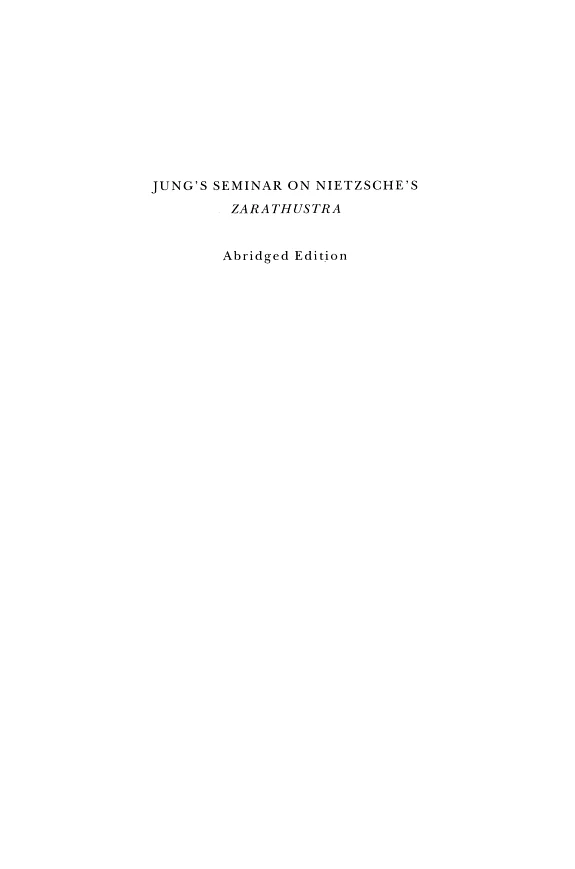
Jung's Seminar on Nietzsche's Zarathustra
 76
76

Jung's Seminar on Nietzsche's Zarathustra
Jung's dissection of Nietzsche's *Zarathustra* is a powerful demonstration of how archetypal psychology can illuminate even the most fiercely anti-religious philosophical texts. His interpretation of Zarathustra as a figure wrestling with the eternal recurrence and the death of God offers a compelling psychological counterpoint to Nietzsche's existential pronouncements. A particular strength lies in Jung's ability to trace the emergence of unconscious material within Nietzsche's prose, viewing it as a projection of the collective unconscious. However, the abridged nature of this edition, while making it more accessible, sometimes sacrifices the granular detail and back-and-forth of the original seminar, leaving the reader wishing for more of Jung's characteristic exploration of nuances. The discussion of the 'last man' as a symbol of psychic stagnation is particularly potent. This seminar is a vital bridge between philosophy and depth psychology.
📝 Description
76
Carl Jung lectured on Nietzsche's *Thus Spoke Zarathustra* in 1934 and 1939.
This abridged paperback presents Carl Gustav Jung's extensive seminar discussions on Friedrich Nietzsche's *Thus Spoke Zarathustra*. Originally published in two volumes, this edition focuses on Jung's psychological interpretations of Nietzsche's challenging text. The seminar serves as a primary source for understanding Jung's theories through the lens of a seminal 19th-century philosophical novel.
This volume is useful for scholars and students of depth psychology, particularly those interested in Jungian analysis and its connection to philosophical and religious thought. Literary critics and philosophers studying Nietzsche's *Zarathustra* will also find value in its psychological interpretations. A familiarity with both Nietzsche's work and Jungian concepts is necessary to fully engage with the material.
Jung's seminar on *Zarathustra* took place during a period of intense intellectual activity in the early to mid-20th century. Psychology, philosophy, and religious studies were increasingly examining the unconscious and the nature of myth. Nietzsche's *Zarathustra*, published in the 1880s, was already a controversial work. Jung's engagement with it continued a broader intellectual dialogue about the crisis of meaning in modernity.
Jung's engagement with Nietzsche's *Zarathustra* occurred during a time when Western esotericism was reinterpreting classical philosophical and religious texts through the lens of depth psychology. The seminar examines Nietzsche's ideas on self-overcoming and the eternal return, concepts that resonated with alchemical and Gnostic traditions Jung frequently referenced. By treating Zarathustra as an archetypal figure and the text as a symbolic map of psychic transformation, Jung placed Nietzsche's philosophy within a lineage of spiritual inquiry, connecting it to the broader human search for meaning and wholeness.
💡 Why Read This Book?
• Gain a unique psychological lens on Nietzsche's *Thus Spoke Zarathustra*, understanding its themes through Jung's concepts of archetypes and the unconscious, as discussed in the context of the book's publication era. • Explore Jung's interpretation of the Übermensch and eternal recurrence, learning how these philosophical ideas can be understood as representations of the individuation process and psychic transformation. • Benefit from Jung's direct engagement with Nietzsche's challenging text, offering insights into the symbolic language and potential unconscious motivations behind Nietzsche's provocative philosophical statements.
⭐ Reader Reviews
Honest opinions from readers who have explored this book.
❓ Frequently Asked Questions
What is the primary focus of Jung's seminar on Nietzsche's Zarathustra?
Jung's seminar interprets Nietzsche's *Thus Spoke Zarathustra* through the lens of analytical psychology, viewing the text as a powerful demonstration of the unconscious at work and a symbolic exploration of the individuation process.
When did Carl Gustav Jung conduct this seminar on Zarathustra?
While the original publication of the seminar is from 1998, Jung's seminars typically took place throughout the mid-20th century, with this specific series likely occurring within that timeframe.
How does Jung's interpretation differ from a purely philosophical reading of Zarathustra?
Jung moves beyond philosophical exegesis to analyze Zarathustra as an archetypal figure and Nietzsche's text as a manifestation of unconscious psychic processes, particularly the individuation journey.
Is this book suitable for beginners in Jungian psychology?
This abridged edition is best suited for those with some familiarity with Jungian concepts and Nietzsche's philosophy, as it assumes a level of prior knowledge and engages directly with complex ideas.
What is the significance of the 'eternal recurrence' in Jung's analysis?
Jung explores the eternal recurrence as a profound psychological challenge, representing the ultimate affirmation of life and the self's integration with its destiny, central to the individuation process.
What does Jung suggest about the 'religiosity' in Nietzsche's anti-religious work?
Jung interprets this paradox as indicative of Zarathustra's confrontation with numinous, archetypal forces and the soul's inherent drive towards meaning, even when challenging traditional religious structures.
🔮 Key Themes & Symbolism
The Unconscious as Creative Force
Jung posits that Nietzsche's *Zarathustra* is a profound proof of the power of the unconscious. He analyzes how Zarathustra's pronouncements and the novel's symbolic landscape emerge from deep psychic layers, acting as a vehicle for the unconscious to express itself. Jung sees this not as mere literary device but as a direct manifestation of psychic energy, driving the philosophical and spiritual quest for meaning and self-overcoming.
Individuation and the Übermensch
The seminar frames Nietzsche's Übermensch as an archetypal representation of the goal of individuation – the process of becoming a whole, integrated self. Jung connects Zarathustra's journey to the arduous path of psychological development, where confronting the shadow, integrating disparate psychic elements, and affirming life's totality, including the eternal recurrence, are essential steps toward achieving psychic maturity and self-realization.
Nietzsche's Zarathustra as Archetypal Figure
Jung interprets Zarathustra not solely as a philosophical mouthpiece but as a potent archetypal figure embodying the prophet or seer who brings a new message. His struggle with the eternal recurrence and the 'death of God' is seen as a universal human drama of confronting existential voids and forging new meaning. This perspective allows Jung to bridge philosophy with the transpersonal dimensions of the human psyche.
The Paradox of Religiosity
Jung grapples with the apparent contradiction of intense religiosity within Nietzsche's critique of traditional religion. He suggests this indicates a confrontation with the numinous, a powerful, often unconscious, drive towards the sacred and the ultimate, even when that 'sacred' is redefined by the individual or through philosophical upheaval. It highlights the psyche's inherent need for meaning beyond the purely rational.
💬 Memorable Quotes
Direct passages from the work, attributed to the author.
“Zarathustra is a demonstration of the unconscious at work.”
— This core assertion frames Jung's entire seminar, viewing Nietzsche's text not just as philosophy but as a living expression of deep psychological forces and archetypal patterns emerging from the unconscious.
“The Übermensch represents the goal of psychic totality.”
— Jung reinterprets Nietzsche's concept, linking the ideal of the Übermensch to the Jungian process of individuation, where wholeness and the integration of all aspects of the self are paramount.
“The eternal recurrence is a test of life affirmation.”
— This highlights Jung's view of Nietzsche's challenging idea as a profound psychological crucible, demanding complete acceptance of one's existence and destiny.
“Nietzsche's work contains a strange sense of religiosity.”
— Jung identifies this paradox as evidence of Zarathustra's engagement with powerful, numinous forces that transcend conventional religious dogma, pointing to the soul's deep-seated search for meaning.
“The seminar explores the symbolic field of the unconscious.”
— This indicates the seminar's focus on decoding the imagery and narrative of Zarathustra as symbolic expressions of universal psychological dynamics and archetypal themes.
🌙 Esoteric Significance
Tradition
Jung's work, including this seminar, fits within the broader stream of modern esoteric thought that seeks to reconcile ancient wisdom with contemporary understanding. While not strictly aligned with a single tradition like Hermeticism or Kabbalah, Jungian psychology draws heavily on Gnostic ideas of self-knowledge and the journey of the soul, as well as alchemical symbolism. This seminar explores Nietzsche's text as a modern myth, a vehicle for archetypal truths that resonate with perennial spiritual quests.
Symbolism
Within Nietzsche's *Zarathustra*, Jung highlights symbols like the 'overman' (Übermensch) as an archetype of self-transcendence and the 'eternal recurrence' as a symbol for confronting and affirming the totality of existence. The serpent and the eagle, often associated with wisdom and spiritual ascent, are also implicitly examined as carriers of profound psychological meaning relevant to the individuation journey.
Modern Relevance
Contemporary depth psychology, transpersonal psychology, and even certain schools of literary criticism continue to draw upon Jung's method of interpreting philosophical and religious texts as symbolic expressions of the psyche. Thinkers exploring consciousness, mythology, and the search for meaning in a secular age find Jung's approach to Zarathustra a valuable tool for understanding the psychological underpinnings of existential thought and spiritual aspiration.
👥 Who Should Read This Book
• Students of Jungian Psychology: Those seeking to understand how Jung applied his analytical framework to complex philosophical texts and how he viewed the unconscious influencing cultural works. • Nietzsche Scholars: Researchers interested in a psychological interpretation of *Thus Spoke Zarathustra* that moves beyond purely philosophical analysis to explore its psychic dimensions. • Seekers of Meaning: Individuals grappling with existential questions and interested in how psychological depth can illuminate philosophical concepts of self-overcoming and life affirmation.
📜 Historical Context
Carl Gustav Jung's seminar on Nietzsche's *Thus Spoke Zarathustra* emerged during a key era for psychology and philosophy in the early to mid-20th century. This period witnessed a profound engagement with the psyche, moving beyond Freud's focus on the personal unconscious to explore deeper, collective layers. Nietzsche's *Zarathustra*, first published in the 1880s, had already sparked intense debate for its concepts like the Übermensch and the eternal recurrence. Jung's interpretation can be seen as a response to, and an expansion upon, the existential and nihilistic currents Nietzsche's work provoked. While existentialists like Jean-Paul Sartre would later grapple with similar themes of meaning and freedom, Jung sought to ground these struggles within a framework of archetypal psychology and the individuation process, offering a psychological counterpoint to purely philosophical or atheistic readings. The seminar became a key text for understanding Jung's method of analyzing cultural and philosophical works as expressions of the collective unconscious.
📔 Journal Prompts
Zarathustra's pronouncements on the Übermensch as a reflection of your own aspirations for self-development.
The concept of eternal recurrence and its implications for valuing individual moments.
Jung's interpretation of the 'religiosity' within Nietzsche's critique of religion: where do you find the numinous?
Analyzing the symbolic field of *Thus Spoke Zarathustra* through a Jungian lens.
The 'last man' as a symbol of psychic stagnation: identifying its manifestations.
🗂️ Glossary
Analytical Psychology
The school of psychology founded by Carl Gustav Jung, emphasizing the importance of the unconscious, archetypes, and the individuation process in understanding the human psyche.
Archetype
Universal, archaic patterns and images that derive from the collective unconscious and are the psychic counterpart of instinct. They manifest in myths, dreams, and symbols.
Collective Unconscious
A layer of the unconscious psyche that is inherited and shared by all humanity, containing archetypes and primal patterns of thought and behavior.
Individuation
The lifelong psychological process of differentiation of the self, by which one integrates one's personality and achieves psychic wholeness.
Übermensch
Nietzsche's concept of a higher type of human being who transcends conventional morality and creates their own values; interpreted by Jung as an archetype of self-realization.
Eternal Recurrence
Nietzsche's thought experiment proposing the infinite repetition of all events; Jung interprets it as a profound psychological test of life affirmation and destiny.
The Shadow
The unconscious, repressed, or unacknowledged aspects of the personality, often perceived as negative but essential for wholeness when integrated.
This book appears in 1 collection
🔮 Readers Also Liked
Browse all →









From the “Jungian Psychology” Collection
View all →





More Free Occult Philosophy Books
View all →