John Dee's Natural Philosophy

 76
76

John Dee's Natural Philosophy
Nicholas Clulee's "John Dee's Natural Philosophy" offers a much-needed scholarly corrective to the popular image of Dee as merely a sorcerer. Clulee meticulously charts Dee's intellectual trajectory, demonstrating the genuine scientific and philosophical rigor underpinning his work. The book excels in situating Dee within the complex scholastic and humanist currents of the 16th century, revealing how his engagement with mathematics, geography, and alchemy was far from idiosyncratic. A particular strength lies in Clulee's detailed analysis of Dee's extensive library and his correspondence networks, which illuminate the breadth of his intellectual curiosity and his standing among European scholars.
However, the book's dense academic prose and focus on detailed scholastic arguments may prove challenging for readers less familiar with Renaissance intellectual history. While it admirably debunks sensationalism, it occasionally risks underselling the profound, almost mystical, drive that animated Dee's quest for knowledge, a drive that informed both his scientific and occult endeavors. The exploration of Dee's alchemical theories, for instance, while accurate, could benefit from a more direct engagement with the symbolic and spiritual dimensions that were integral to alchemical practice. Despite this, Clulee's work stands as an indispensable resource for understanding the scientific mind of John Dee. It is a vital contribution to the field, offering a nuanced portrait of a pivotal Renaissance figure.
📝 Description
76
Nicholas Clulee's 2012 book examines John Dee's scientific and mathematical work, beyond his occult reputation.
Nicholas Clulee's "John Dee's Natural Philosophy" reconstructs the intellectual world of John Dee (1527-1608). The study moves past Dee's more sensational occult interests to analyze his serious engagement with the natural sciences of his time. Clulee traces Dee's development as a natural philosopher, detailing his education, his collaborations with continental scholars, and his contributions to mathematics, astronomy, geography, and alchemy. The book firmly grounds Dee's work within the specific academic and intellectual environment of the 16th century.
This study is intended for academics, postgraduate students, and researchers focused on Renaissance intellectual history, the history of science, and the history of magic. It will also interest those with a deep focus on John Dee, particularly individuals seeking a rigorous, non-sensationalized view of his scientific and philosophical activities. Readers should have a basic understanding of the period and its main figures to fully appreciate the analysis presented.
Nicholas Clulee's "John Dee's Natural Philosophy" situates Dee within the complex intellectual currents of the 16th century. While acknowledging Dee's occult pursuits, the book emphasizes his place within a tradition that sought to understand the natural world through mathematics, Neoplatonism, and Hermetic philosophy. Dee operated at a time when empirical methods were emerging, yet older traditions still held sway. Clulee places Dee's natural philosophy in dialogue with prevailing Aristotelianism and the humanist rediscovery of classical texts, highlighting how these diverse influences shaped Dee's approach to knowledge.
💡 Why Read This Book?
• Gain a nuanced understanding of John Dee's scientific contributions beyond his occult reputation, learning how his mathematical studies, referenced in the 'Mathematical Preface' to Euclid, informed his worldview. • Appreciate the intellectual milieu of the 16th century by examining Dee's engagement with prevailing Aristotelianism and humanist revivals, understanding his place among contemporaries like Tycho Brahe. • Explore the practical applications of Dee's knowledge, from navigation to alchemy, understanding how his diverse interests were interconnected and influenced by his extensive library.
⭐ Reader Reviews
Honest opinions from readers who have explored this book.
❓ Frequently Asked Questions
What was John Dee's primary contribution to mathematics?
John Dee is credited with writing a "Mathematical Preface" to his 1570 English translation of Euclid's Elements. This preface aimed to introduce and promote the importance of mathematics as a foundational science for all other disciplines during the Renaissance.
How does Nicholas Clulee's book differentiate John Dee's natural philosophy from his occult practices?
Clulee's "John Dee's Natural Philosophy" meticulously separates Dee's serious scientific and philosophical inquiries from his more esoteric pursuits. It analyzes his engagement with mathematics, geography, and alchemy as distinct intellectual endeavors rooted in 16th-century scholarship, rather than solely viewing them through the lens of magic.
What role did John Dee's library play in his intellectual development?
Dee's vast library, reputedly one of the largest in London at the time, served as a crucial resource for his studies. Clulee highlights it as a physical manifestation of Dee's wide-ranging intellectual interests, housing texts on mathematics, alchemy, astronomy, and more, which fueled his research and writings.
How does the book contextualize Dee's work within the broader intellectual currents of the 16th century?
The book places Dee's natural philosophy within the context of the Renaissance, the Reformation, and the early stirrings of the Scientific Revolution. It examines his interactions with both prevailing Aristotelian thought and the humanist emphasis on classical texts, as well as his correspondence with continental scholars.
Does the book cover Dee's alchemical theories?
Yes, "John Dee's Natural Philosophy" examines Dee's alchemical theories as part of his broader natural philosophy. It analyzes his understanding of transmutation and the philosophical underpinnings of his alchemical research within the scientific framework of the 16th century.
When was Nicholas Clulee's book on John Dee first published?
Nicholas Clulee's "John Dee's Natural Philosophy" was first published in 2012. This scholarly work provides a comprehensive analysis of Dee's scientific and philosophical contributions during the Elizabethan era.
🔮 Key Themes & Symbolism
Mathematical Foundations
This theme explores John Dee's profound belief in the foundational role of mathematics for understanding the natural world. Nicholas Clulee details how Dee championed mathematics not just as a tool for calculation, but as a key to unlocking the secrets of the cosmos and the divine order. His "Mathematical Preface" to Euclid's Elements (1570) is a prime example, intended to elevate the status of mathematics within English intellectual life and demonstrate its applicability across various disciplines, from geography to music and astronomy.
Alchemy and Natural Philosophy
The work examines Dee's serious engagement with alchemy, positioning it not as mere charlatanism but as an integral part of his natural philosophy. Clulee elucidates how Dee viewed alchemical processes as a means to understand the fundamental principles of nature and matter, often intertwined with Neoplatonic and Hermetic concepts. The book analyzes Dee's theoretical frameworks for transmutation and his practical experiments, connecting them to the broader alchemical traditions and scientific inquiries of the 16th century.
Dee's Intellectual Networks
This theme focuses on the extensive web of scholars and thinkers with whom John Dee interacted. Clulee highlights Dee's role as a central node in European intellectual exchange, evidenced through his vast correspondence and his renowned library. By detailing his relationships with figures like Gerardus Mercator and Abraham Ortelius, the book illustrates how Dee's natural philosophy was shaped by, and contributed to, a wider transatlantic discourse on science, exploration, and the arcane arts.
The Elizabethan Scientific Milieu
Clulee meticulously reconstructs the scientific and intellectual environment of Elizabethan England in which Dee operated. The book contrasts Dee's natural philosophy with prevailing Aristotelianism and explores its place alongside emerging empirical approaches. It underscores the challenges and opportunities faced by scholars of the era, particularly those whose interests spanned both conventional science and more esoteric subjects, demonstrating the complex field of knowledge production in the 16th century.
💬 Memorable Quotes
Direct passages from the work, attributed to the author.
“Dee saw mathematics as the key to unlocking the secrets of the universe.”
— This interpretation highlights Dee's fundamental conviction that mathematical principles were not merely abstract tools but held the very blueprint of creation, essential for understanding both the physical and metaphysical realms.
“The book analyzes Dee's alchemical theories within the context of 16th-century scientific thought.”
— This emphasizes that Clulee's work treats Dee's alchemy not as fringe magic, but as a serious intellectual pursuit connected to the broader scientific questions and experimental practices of his time.
“Dee's extensive library was a evidence of his wide-ranging intellectual curiosity.”
— This points to the sheer volume and diversity of texts in Dee's collection as concrete evidence of his deep engagement with numerous fields, from mathematics and astronomy to geography and occult philosophy.
“Clulee situates Dee's natural philosophy amidst the scholastic and humanist currents of the Renaissance.”
— This suggests the book meticulously places Dee's ideas within the specific academic and philosophical debates of his era, showing how he engaged with both established traditions and new intellectual movements.
“The work details Dee's practical applications of knowledge in navigation and statecraft.”
— This indicates that the book goes beyond theory to explore how Dee's intellectual pursuits had real-world implications, demonstrating the practical utility he found and offered in fields vital to Elizabethan England.
🌙 Esoteric Significance
Tradition
This work primarily engages with the Hermetic and Neoplatonic traditions that influenced Renaissance natural philosophy. John Dee, a devoted student of these ancient streams of thought, saw a profound unity between the celestial mechanics, alchemical processes, and divine principles. Clulee's analysis positions Dee's scientific endeavors not as separate from, but as deeply intertwined with, his esoteric studies, reflecting a worldview where the microcosm (human) mirrored the macrocosm (universe) and all knowledge sought to understand God's creation.
Symbolism
Key symbols explored include the mathematical figures and geometric forms that Dee believed represented divine order and cosmic harmony. Alchemy, with its rich lexicon of symbolic metals, celestial influences, and transformative processes (like the Philosopher's Stone), represents the practical application of Hermetic principles for Dee, aiming at both material and spiritual perfection. The celestial spheres themselves, central to his astronomical work, symbolized a divinely ordained, interconnected cosmos governed by mathematical laws.
Modern Relevance
Contemporary thinkers exploring the history of science and esoteric traditions find Dee's integrated approach highly relevant. Modern Hermeticists and practitioners of Western esotericism draw inspiration from Dee's holistic view of knowledge, seeking to bridge the perceived gap between science and spirituality. Researchers of Renaissance studies continue to analyze his methodologies for understanding how early modern scholars synthesized empirical observation with metaphysical frameworks, offering a counterpoint to purely materialistic scientific paradigms.
👥 Who Should Read This Book
• Students of Renaissance intellectual history seeking a rigorous academic analysis of John Dee's scientific contributions beyond sensationalized accounts. • Scholars of the history of science interested in the transition from medieval to early modern scientific thought and the role of mathematics and alchemy. • Practitioners and scholars of Western Esotericism looking to understand the historical roots of Hermeticism and its influence on key historical figures like Dee.
📜 Historical Context
Nicholas Clulee's "John Dee's Natural Philosophy" studies the intellectually vibrant yet often contentious 16th century, a period defined by the Reformation's religious upheaval and the burgeoning Scientific Revolution. John Dee (1527-1608) navigated this landscape, a figure whose interests spanned mathematics, geography, astronomy, and alchemy. Clulee places Dee's work in dialogue with prevailing Aristotelian natural philosophy and the humanist revival of classical learning. Dee’s own "Mathematical Preface" to Euclid’s Elements in 1570 championed mathematics as a foundational science. Contemporaries like Tycho Brahe were also pushing the boundaries of observational astronomy, though Dee’s approach often integrated more esoteric elements. The book highlights Dee's extensive library and correspondence, showcasing his connection to European scholars like Gerardus Mercator, underscoring his significance in the transmission of knowledge across the continent during a time of significant intellectual flux and religious division.
📔 Journal Prompts
John Dee's "Mathematical Preface" to Euclid's Elements: How does mathematics serve as a bridge between the empirical and the conceptual in your own understanding?
Analyze Dee's alchemical theories: What symbolic meanings can be extracted from the transformation of base metals into gold?
Reflect on Dee's extensive library: What is the relationship between a scholar's collection of books and the breadth of their intellectual pursuits?
Consider Dee's work as a navigational consultant: How can abstract knowledge be practically applied to concrete challenges?
Explore the intersection of natural philosophy and esoteric beliefs in Dee's era: Where do you see similar integrations in contemporary thought?
🗂️ Glossary
Natural Philosophy
The historical term for the study of nature and the physical universe, encompassing what we now understand as physics, chemistry, biology, astronomy, and geology. In Dee's time, it was deeply intertwined with metaphysics and theology.
Hermeticism
A religious, philosophical, and esoteric tradition based primarily upon writings attributed to Hermes Trismegistus. It emphasizes divine knowledge, the interconnectedness of all things, and the potential for human spiritual ascent.
Neoplatonism
A philosophical system originating in the Roman Empire, based on the teachings of Plato, particularly his concept of the One. It influenced Christian, Jewish, and Islamic thought, emphasizing mystical contemplation and the hierarchy of being.
Alchemy
An ancient tradition focused on the transmutation of matter, often involving the search for the Philosopher's Stone to turn base metals into gold. It also encompassed spiritual purification and the understanding of fundamental natural principles.
Mathematical Preface
The introductory essay written by John Dee for his 1570 English translation of Euclid's Elements. It argued for the vital importance and wide-ranging applicability of mathematics across all fields of knowledge.
Aristotelianism
The philosophical system derived from the works of Aristotle. In the Renaissance, it was the dominant framework for understanding logic, ethics, metaphysics, and natural philosophy, though increasingly challenged by new ideas.
Humanism (Renaissance)
An intellectual movement during the Renaissance that emphasized the study of classical antiquity (Greek and Roman literature, history, and philosophy) and human potential, focusing on secular subjects alongside religious ones.
🔮 Readers Also Liked
Browse all →







More by Nicholas Clulee
All books →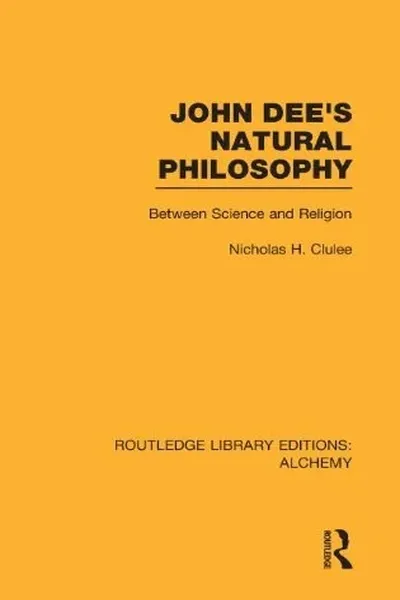
More Free Alchemy & Hermeticism Books
View all →