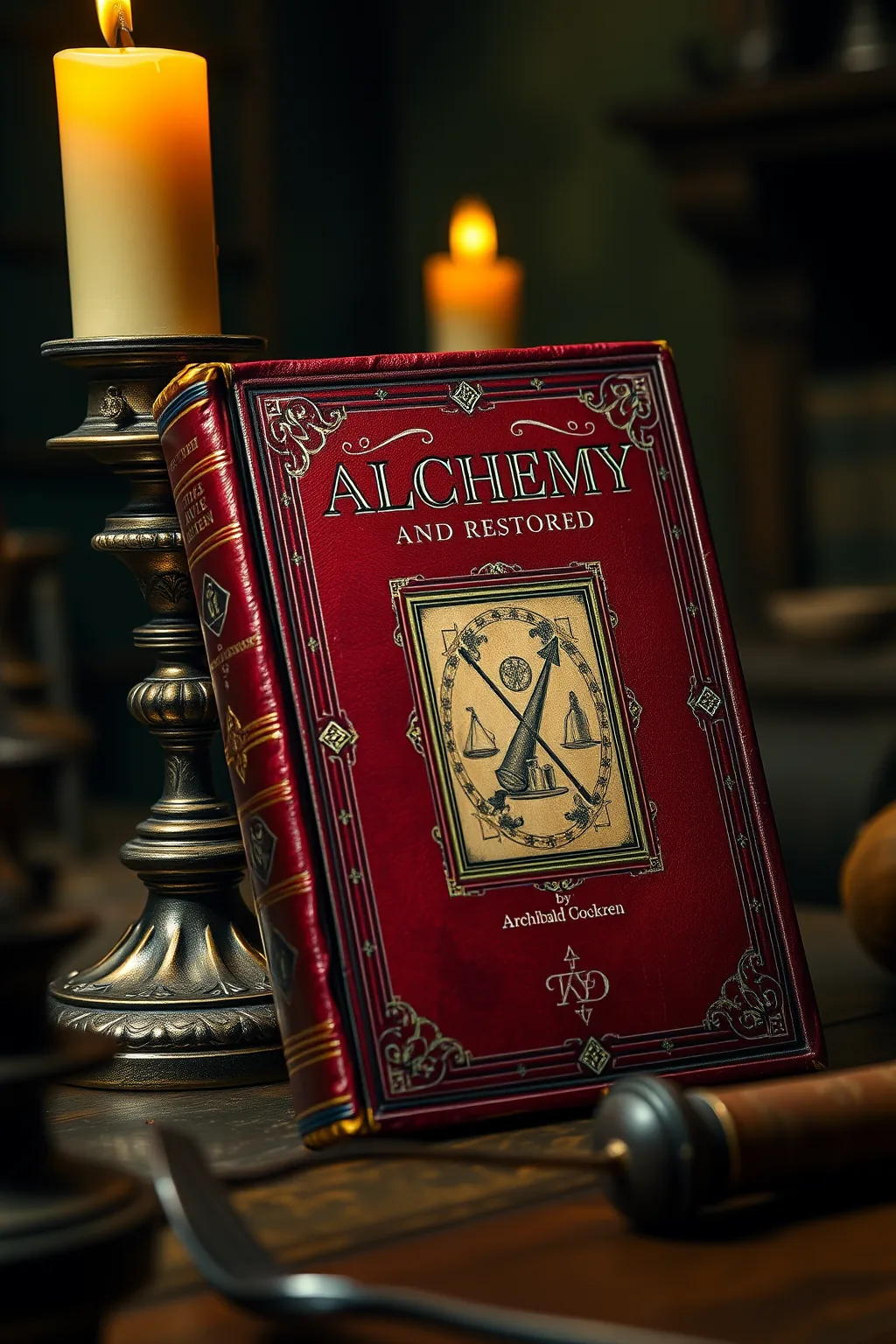
Alchemy Rediscovered and Restored
 75
75

Alchemy Rediscovered and Restored
Archibald Cockren's Alchemy Rediscovered and Restored presents a commendable effort to synthesize the labyrinthine subject of alchemy. Cockren’s strength lies in his methodical approach, carefully dissecting alchemical texts and practices into digestible components. He avoids the common pitfall of presenting alchemy as a purely mystical pursuit, instead grounding it in what he posits as a comprehensible, albeit complex, science of transformation. One particularly effective passage details the symbolic significance of the Philosopher's Stone, moving beyond simplistic notions of material gold-making to its role as a catalyst for spiritual perfection. However, the book occasionally suffers from a degree of academic dryness; while thorough, some sections could benefit from more vivid illustrative examples to fully convey the transformative potential it describes. The work’s emphasis on restoring alchemical understanding is clear, but its accessibility might be limited for absolute beginners. It is a valuable resource for those committed to a rigorous study of the alchemical arts.
📝 Description
75
Archibald Cockren's Alchemy Rediscovered and Restored first appeared in 2016.
This book presents alchemy not as a historical curiosity, but as a living system of spiritual and material transformation. Cockren moves beyond recounting past experiments to detail a practical and philosophical framework for pursuing the Great Work. He aims to clarify alchemical processes, showing them as a sophisticated method for inner and outer change. The text is intended for serious students of esoteric traditions, particularly those focused on Hermeticism and its applications. Readers seeking a deeper grasp of alchemical symbolism and a connection between historical practice and modern metaphysics will find value here. A basic familiarity with occult philosophy is beneficial for a full appreciation of its contents.
Cockren systematically breaks down alchemical operations and symbolism. He covers the classical elements, the Prima Materia, and the stages of the alchemical process: Nigredo, Albedo, Citrinitas, and Rubedo. The author highlights the philosophical core of alchemy, viewing it as a path of inner purification and realization that aligns with spiritual alchemy's goals.
Published in 2016, Cockren's work engages with a long lineage of alchemical thought, tracing back to Hermes Trismegistus and the Hermetic tradition. It situates itself within Western esoteric philosophy, a field that has seen a resurgence in recent times. The book addresses contemporary interpretations of alchemical practices by examining their historical roots and philosophical underpinnings. It connects these historical practices with modern metaphysical ideas, distinguishing them from earlier occult revivals.
💡 Why Read This Book?
• Understand the alchemical stages of Nigredo, Albedo, Citrinitas, and Rubedo, learning how these symbolic colour changes map onto processes of both material and spiritual refinement, as detailed by Cockren. • Explore the concept of the Prima Materia not just as a theoretical substance but as a foundational element for transformation, gaining insight into its role in alchemical operations as presented in the text. • Grasp the philosophical underpinnings of alchemy, moving beyond simplistic views of gold transmutation to appreciate its function as a system for inner purification and self-realization, as elucidated by Cockren's analysis.
⭐ Reader Reviews
Honest opinions from readers who have explored this book.
❓ Frequently Asked Questions
What is the primary goal of alchemy as presented in Alchemy Rediscovered and Restored?
The book posits that alchemy's primary goal is not literal gold-making, but rather a profound transformation of both the practitioner and the base materials, leading to spiritual perfection and material transmutation.
Does Cockren discuss the historical figures involved in alchemy?
Yes, Archibald Cockren's work references a lineage of alchemical thought, implicitly connecting to historical figures and traditions that have shaped the field over centuries.
What are the four main stages of the alchemical process mentioned in the book?
The book details the four primary stages: Nigredo (blackening), Albedo (whitening), Citrinitas (yellowing), and Rubedo (reddening), each representing distinct phases of transformation.
Is Alchemy Rediscovered and Restored suitable for someone new to alchemy?
While comprehensive, the book assumes some foundational knowledge of esoteric philosophy. Newcomers might find it more beneficial after exploring introductory texts on Hermeticism or occultism.
What is the 'Prima Materia' according to Cockren's interpretation?
Cockren interprets the Prima Materia as the primordial, undifferentiated substance from which all things are created, serving as the essential starting point for alchemical operations.
How does this book differ from popular modern interpretations of alchemy?
This work distinguishes itself by focusing on a more systematic, philosophical, and arguably practical restoration of alchemical principles, moving beyond New Age interpretations to engage with historical substance.
🔮 Key Themes & Symbolism
The Great Work
Cockren frames Alchemy Rediscovered and Restored around the concept of the Great Work, which he defines as the ultimate process of spiritual and material perfection. This involves not just the transmutation of base metals into gold, but a profound inner transformation of the alchemist. The book meticulously outlines the theoretical and symbolic pathways to achieving this, emphasizing the interconnectedness of the microcosm (the human being) and the macrocosm (the universe). It presents the alchemical journey as a path of purification, dissolution, and reintegration, aiming for a state of wholeness and enlightenment.
Symbolism of Alchemical Stages
A core theme is the detailed exploration of the symbolic colour stages of alchemical transformation: Nigredo (blackening), Albedo (whitening), Citrinitas (yellowing), and Rubedo (reddening). Cockren interprets these not merely as descriptive phases but as crucial allegories for psychological and spiritual development. The Nigredo represents chaos and dissolution, Albedo signifies purification, Citrinitas introduces dawning understanding, and Rubedo culminates in spiritual realization and the attainment of the Philosopher's Stone. Each stage is presented as a necessary step in the arduous but rewarding process of the Great Work.
The Prima Materia
The book places significant emphasis on the Prima Materia, the fundamental, undifferentiated substance from which all creation arises. Cockren moves beyond simplistic definitions, presenting it as the underlying potentiality and chaotic essence that alchemists sought to work with. Understanding and manipulating the Prima Materia is depicted as the essential first step in the alchemical process, requiring great insight and skill. The text explores its properties and the challenges associated with its isolation and preparation, highlighting its critical role in initiating the transformative journey.
Spiritual Alchemy
Alchemy Rediscovered and Restored strongly advocates for alchemy as a spiritual discipline rather than solely a protoscience or metallurgy. Cockren argues that the true 'gold' sought by alchemists is spiritual enlightenment and perfected consciousness. The alchemical laboratory becomes a metaphor for the inner self, and the processes of distillation, calcination, and conjunction are seen as corresponding to stages of inner purification and integration. This spiritual dimension is woven throughout the book, positioning alchemy as a rigorous path to self-knowledge and divine union.
💬 Memorable Quotes
Direct passages from the work, attributed to the author.
“The Art of Alchemy is a science of the soul as well as of the matter.”
— This interpretation highlights the dual nature of alchemy as described by Cockren, emphasizing that its principles apply equally to the inner spiritual development of the practitioner and the transformation of physical substances.
“Understanding the Prima Materia is the first key to unlocking the alchemical process.”
— This captures the foundational importance Cockren places on the concept of the Prima Materia, suggesting that comprehending this primordial substance is essential before any meaningful alchemical work can commence.
“The colours Nigredo, Albedo, and Rubedo mark the essential progression of the Great Work.”
— This highlights the significance of the symbolic colour stages as markers of progress within the alchemical journey, as detailed systematically throughout the book's exploration of the Great Work.
“Alchemy restores a lost connection between the material and the spiritual realms.”
— This interpretation suggests that Cockren views alchemy as a means to bridge the perceived gap between the physical world and the spiritual, offering a unified perspective on existence.
💡 Key Ideas
Editorial paraphrase of the work's core concepts — not direct quotes.
The Philosopher's Stone is not merely for transmuting lead into gold, but for perfecting the human spirit.
This paraphrased concept underscores the book's focus on spiritual alchemy, presenting the Stone as a symbol of ultimate realization and inner perfection rather than just material wealth or immortality.
🌙 Esoteric Significance
Tradition
This work firmly situates itself within the Western Esoteric Tradition, specifically drawing from Hermeticism and the lineage of operative and spiritual alchemy. It seeks to restore an understanding of alchemical principles that aligns with the Hermetic axiom 'As Above, So Below,' viewing the macrocosm and microcosm as interconnected. Cockren’s approach attempts to bridge the gap between historical alchemical practice and its philosophical and spiritual implications, offering a coherent framework that departs from purely symbolic interpretations by stressing a methodical, restored understanding of the Art.
Symbolism
Central symbols explored include the four alchemical stages—Nigredo (blackening), Albedo (whitening), Citrinitas (yellowing), and Rubedo (reddening)—representing phases of purification and spiritual maturation. The Prima Materia, the chaotic, undifferentiated substance, is another key motif, symbolizing the potential from which all is formed and must be worked upon. The Philosopher's Stone, often misunderstood, is presented not just as a material agent but as the ultimate principle of perfection and transformation, both physical and spiritual.
Modern Relevance
Alchemy Rediscovered and Restored offers a valuable resource for contemporary practitioners and scholars of Hermeticism, Western esotericism, and comparative religion. Its methodical approach appeals to those seeking a structured understanding of alchemical philosophy beyond speculative interpretations. Thinkers and groups focused on integral spirituality, psychological alchemy (drawing parallels with Jungian analysis), and the restoration of ancient wisdom traditions find Cockren's work relevant for its attempt to present a coherent, restored system of transformation for the modern age.
👥 Who Should Read This Book
• Students of Hermeticism and Western Esotericism: Those seeking a structured, philosophical exploration of alchemy that connects historical practices to deeper spiritual and material principles. • Practitioners of Inner Transformation: Individuals interested in alchemy as a path of self-purification and spiritual development, looking for a systematic framework to understand the stages and symbolism involved. • Comparative Religion and Philosophy Scholars: Researchers interested in the historical development and symbolic language of esoteric traditions, particularly alchemy's role within Western philosophical thought.
📜 Historical Context
Archibald Cockren’s Alchemy Rediscovered and Restored, first published in 2016, emerges in an era distinct from the 19th-century occult revival that saw figures like Eliphas Lévi popularize esoteric traditions. While building on the Hermetic lineage, Cockren’s work reflects a contemporary scholarly and practitioner interest in clarifying alchemical texts, seeking to restore a perceived original intent obscured by centuries of allegorical language and misinterpretation. It engages with a long tradition dating back to Hermes Trismegistus, whose Corpus Hermeticum influenced Western esotericism for millennia. Unlike purely mystical or spiritual interpretations that dominated certain periods, Cockren’s approach aims for a more systematic and philosophical explication, implicitly challenging less rigorous modern adaptations. His work contributes to a broader academic and popular resurgence in alchemy studies, seeking to present it as a coherent system of transformation.
📔 Journal Prompts
The initial state of the Prima Materia, as discussed in the text, invites contemplation on the nature of potentiality.
Reflect on the symbolic meaning of the Nigredo stage and its relation to personal dissolution and renewal.
Consider the practical application of the Albedo stage in one's own life, focusing on purification.
Explore the metaphorical significance of the Rubedo and its connection to ultimate spiritual attainment.
Analyze the 'As Above, So Below' principle as it relates to the alchemical processes described by Cockren.
🗂️ Glossary
Great Work
The ultimate goal of alchemy, encompassing both the spiritual perfection of the alchemist and the transmutation of base materials into higher forms, often symbolized by the Philosopher's Stone.
Prima Materia
The fundamental, undifferentiated substance from which all things are created; the chaotic, primordial matter that is the starting point for alchemical operations.
Nigredo
The first stage of the alchemical process, symbolized by blackness, representing dissolution, putrefaction, and the breaking down of the old form.
Albedo
The second stage, symbolized by whiteness, representing purification, washing, and the illumination that follows dissolution.
Citrinitas
The third stage, symbolized by yellowing, representing the dawning of the solar light and the beginning of the transformation towards the final stage.
Rubedo
The final stage, symbolized by redness, representing the culmination of the Great Work, the attainment of the Philosopher's Stone, and spiritual perfection.
Hermeticism
A philosophical and religious tradition based on the writings attributed to Hermes Trismegistus, emphasizing a holistic understanding of the cosmos and humanity's place within it.
🔮 Readers Also Liked
Browse all →








More by Archibald Cockren
All books →


More Free Alchemy & Hermeticism Books
View all →