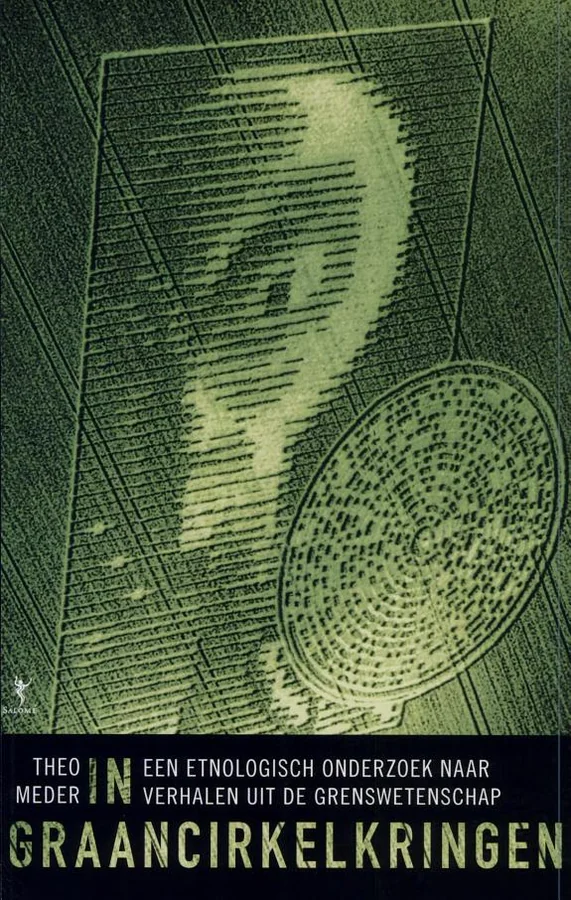
In graancirkelkringen
 72
72

In graancirkelkringen
Theo Meder’s 'In graancirkelkringen' offers a refreshingly grounded perspective on the crop circle phenomenon, treating it less as a mystery to be solved and more as a case study in belief formation. Meder, drawing on his background in folklore, meticulously dissects how circulating narratives can solidify into accepted truths, influencing how individuals perceive the world. His examination of how stories grow, gain authority, and shape conduct is particularly sharp. For instance, his analysis of media roles—how journalists position themselves and frame the crop circle debate—provides a concrete illustration of narrative construction in action. A limitation, however, is that the book's focus on the sociology of belief, while insightful, can sometimes feel detached from the visceral wonder many experience when encountering these formations. The work provides a compelling argument for understanding the *process* of belief, even if it doesn't fully capture the *experience* of mystery. It stands as a valuable contribution to understanding how collective meaning is made.
📝 Description
72
Theo Meder's 2006 book 'In graancirkelkringen' analyzes crop circles as a case study in how stories shape belief.
Published in 2006, Theo Meder's 'In graancirkelkringen' examines the crop circle phenomenon. Meder, a scholar of folklore and cultural history, treats crop circles not as evidence of aliens or geological quirks, but as a potent illustration of how shared narratives influence collective understanding. He approaches the subject from sociological and semiotic viewpoints. The book scrutinizes how anecdotal accounts and speculative ideas can solidify into accepted truths, thereby affecting public perception and individual outlooks.
The work is for readers interested in the sociology of belief, the construction of phenomena through culture, and the impact of narrative. It will appeal to those who question how certain ideas gain widespread acceptance, especially when empirical support is lacking. Students of folklore, media studies, anthropology, and anyone curious about the psychology of belief systems will find Meder's analysis relevant. It offers insight into the processes that form and sustain collective myths.
While crop circles often attract attention from ufological and paranormal circles, Meder's 'In graancirkelkringen' situates the phenomenon within broader patterns of folklore and social psychology. This approach counters interpretations that seek extraterrestrial or supernatural explanations. Instead, Meder's work engages with the human propensity to create and propagate stories, especially in contexts where mystery and wonder are present. It examines how these narratives, regardless of their factual basis, become powerful cultural forces, shaping how groups understand and interact with the world around them.
💡 Why Read This Book?
• Understand the sociological mechanisms behind the acceptance of unusual phenomena, illustrated by Meder's analysis of how crop circle stories evolve into belief systems. • Learn how media framing impacts public perception, a concept explored through Meder's examination of journalistic positions on crop circles. • Gain insight into the concept of 'exempla' as a driver of belief, using the crop circle phenomenon as a modern case study of narrative authority.
⭐ Reader Reviews
Honest opinions from readers who have explored this book.
❓ Frequently Asked Questions
What is the primary focus of Theo Meder's 'In graancirkelkringen'?
The book's primary focus is on analyzing how stories, particularly those surrounding crop circles, can develop into widely accepted beliefs and influence people's worldviews and actions, rather than on proving or disproving the existence of extraterrestrial involvement.
Who is Theo Meder?
Theo Meder is a scholar whose work often draws from folklore and cultural history. His analysis in 'In graancirkelkringen' applies these academic disciplines to understand the social and psychological processes behind belief formation, using crop circles as a central example.
When was 'In graancirkelkringen' first published?
The book 'In graancirkelkringen' was first published in 2006, a period when digital communication was beginning to significantly impact the spread of information and cultural narratives.
Does the book explore the purpose of crop circles?
Yes, the book addresses the purpose of crop circles by examining the various interpretations and beliefs that have emerged around them, focusing on the 'why' from a sociological and narrative perspective rather than asserting a single definitive purpose.
What perspective does Meder take on the creation of crop circles?
Meder approaches the creation of crop circles from the perspective of how narratives about their origin and meaning are constructed and disseminated, rather than focusing on the physical methods of their creation or specific perpetrators.
How does the book discuss the role of journalists regarding crop circles?
The book analyzes the positions journalists take when reporting on crop circles, exploring how their framing and reporting can contribute to or challenge the prevailing narratives and belief systems surrounding the phenomenon.
🔮 Key Themes & Symbolism
Narrative Authority
The work meticulously unpacks how narratives, even those lacking empirical validation, can accrue authority and become accepted as truth within a community. Meder uses the crop circle phenomenon as a prime example, demonstrating how repeated stories, media attention, and the inherent human desire for meaning can elevate speculative accounts to the status of established fact. This exploration is crucial for understanding how belief systems are constructed and maintained outside of traditional scientific or evidentiary frameworks.
Sociology of Belief
Meder studies the social dynamics that underpin belief formation, particularly concerning unexplained phenomena. He examines how collective acceptance of a story—in this case, about crop circles—is not solely dependent on its factual basis but on its resonance with existing cultural narratives, psychological needs, and social consensus. The book provides a lens through which to view how groups coalesce around shared interpretations, shaping their collective worldview and individual conduct.
Media and Perception
The role of media in shaping public perception is a significant thread throughout the book. Meder analyzes how journalistic approaches to phenomena like crop circles can either reinforce or challenge dominant narratives. By dissecting the stances taken by journalists and the way information is presented, the work highlights media's power in constructing the 'believability' of a phenomenon and influencing how it is understood by a wider audience.
The Exemplum in Modern Culture
Drawing on the historical concept of the 'exemplum'—an illustrative story used to convey a moral or establish a point—Meder argues that modern phenomena like crop circles function similarly. These contemporary 'exempla' serve to solidify belief systems and guide behavior, often bypassing rigorous scrutiny. The book re-contextualizes this age-old narrative device within the framework of contemporary culture and media consumption.
💬 Memorable Quotes
Direct passages from the work, attributed to the author.
“Stories can grow into irrefutable exempla of truth.”
— This core idea suggests that narratives, through their repetition and cultural adoption, can achieve a status of unquestionable fact, functioning as powerful examples that shape understanding and behavior.
“They can become the building blocks of a belief system.”
— This highlights how seemingly simple stories or accounts, when accumulated and accepted, form the foundational elements upon which complex worldviews and belief structures are erected.
“What positions do journalists take?”
— This question points to the book's critical examination of media's role in the phenomenon, analyzing how journalistic framing and editorial choices influence public perception and the narrative's trajectory.
“How are the crop circles made and to what purpose?”
— This question represents the fundamental inquiries the book addresses not by providing definitive answers, but by analyzing the *discourse* and *belief systems* that have arisen around these questions.
“All the elementary questions are dealt with from different perspectives.”
— This indicates the book's comprehensive approach, ensuring that the analysis of crop circles considers multiple viewpoints, including those of farmers, journalists, and the public, rather than adhering to a single theory.
🌙 Esoteric Significance
Tradition
While not explicitly tied to a single esoteric lineage, Meder's work engages with the broader Hermetic principle of 'As Above, So Below' by demonstrating how macro-level belief systems are constructed from micro-level narratives. It aligns with Gnostic concerns about the nature of perception and the potential for deception in worldly phenomena, encouraging a critical examination of what is accepted as truth. The book's focus on hidden patterns and emergent meanings within human culture echoes Theosophical inquiries into universal symbolism and the evolution of consciousness.
Symbolism
The primary 'symbol' explored is the crop circle itself, which functions as a modern hieroglyph or sigil for a multitude of interpretations—from extraterrestrial communication to geophysical anomalies. Meder analyzes how the *meaning* attributed to these formations, rather than their physical manifestation, becomes the potent symbolic element. The book also implicitly examines the symbolism of 'the unknown' and 'the mysterious,' and how these abstract concepts are projected onto tangible, observable phenomena.
Modern Relevance
Contemporary thinkers in fields like critical thinking, media studies, and the sociology of religion continue to draw upon Meder's analytical framework. His exploration of narrative construction is relevant to understanding the spread of 'fake news' and conspiracy theories in the digital age. Scholars examining belief in pseudoscience, paranormal claims, and the impact of social media on collective psychology find Meder's analysis of how stories become unquestioned exempla particularly pertinent to modern digital culture.
👥 Who Should Read This Book
• Students of folklore and cultural studies seeking case studies on narrative formation and belief systems. • Skeptics and critical thinkers interested in understanding the psychological and sociological drivers behind acceptance of extraordinary claims. • Researchers of media influence and the construction of public opinion, particularly concerning unexplained phenomena.
📜 Historical Context
Published in 2006, Theo Meder's 'In graancirkelkringen' emerged during a period of increasing internet penetration, which significantly amplified the dissemination of information and speculative theories. The crop circle phenomenon, which had captivated public imagination since the late 1970s, was a fertile ground for exploring how collective beliefs are formed and sustained. Meder’s work stood in contrast to the prevalent ufological and paranormal interpretations championed by figures like Colin Andrews, who had been documenting crop circles extensively since the 1980s. Meder applied a sociological and folkloristic lens, treating the phenomenon as a cultural construct rather than an extraterrestrial event. While not a widely debated topic in academic circles at the time, Meder's approach offered a counter-narrative to the burgeoning pseudoscientific literature, situating the crop circle stories within established patterns of folklore and belief formation.
📔 Journal Prompts
The construction of belief systems from narrative exempla.
How media positions influence the perceived truth of phenomena.
The evolution of stories into accepted 'facts'.
Personal experiences with phenomena that challenge conventional understanding.
The role of collective interpretation in shaping worldview.
🗂️ Glossary
Exemplum
An illustrative story or example used in medieval times to teach a moral lesson or establish a point; in Meder's context, a narrative that serves as proof or foundation for a belief system.
Belief System
A set of mutually supportive beliefs that together provide a comprehensive understanding of the world or an aspect of it.
Narrative Construction
The process by which stories are created, shaped, and disseminated, influencing how events or phenomena are understood and perceived by an audience.
Sociology of Belief
The study of how beliefs are formed, maintained, and changed within social groups and institutions.
Cultural Resonance
The extent to which a story, idea, or symbol connects with the values, beliefs, and experiences of a particular culture or society.
Media Framing
The way in which journalists and media outlets present information, influencing how audiences interpret issues and events.
Phenomenon
An observable fact or event; in this context, often referring to unexplained or extraordinary occurrences like crop circles.
This book appears in 1 collection
🔮 Readers Also Liked
Browse all →








From the “Crop Circles” Collection
View all →






More Free Occult Philosophy Books
View all →