Crop circles
 81
81

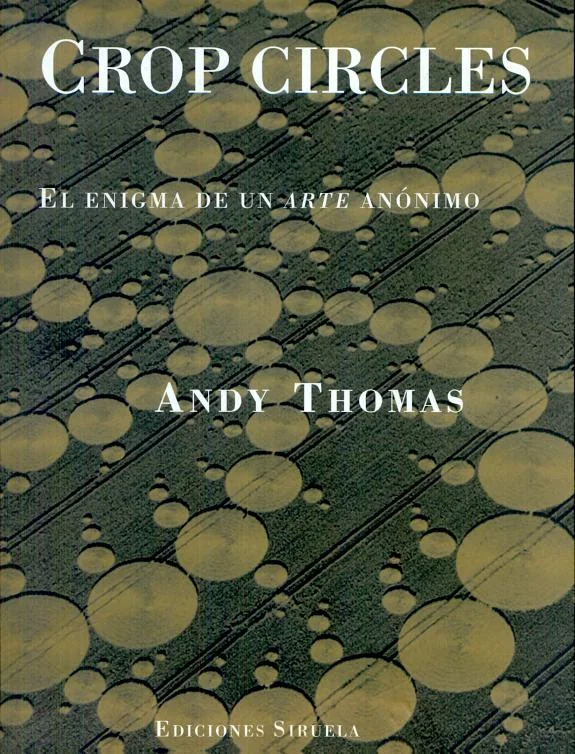
Crop circles
Andy Thomas's "Crop Circles" grapples with a subject that has confounded observers for decades. The strength of this book lies in its meticulous cataloging of formations and the sheer breadth of unexplained aspects it presents. Thomas avoids easy answers, instead laying out the evidence with a reporter's eye. One particularly effective section details the formation at Barbury Castle in 1991, highlighting its intricate design and the debate it ignited. However, the work occasionally feels bogged down by the sheer volume of anecdotal evidence without always providing a robust framework for analysis. While the 2003 publication date means it predates some later developments, its core examination of the phenomenon's core mysteries remains compelling. It is a solid primer for understanding the arguments surrounding these enigmatic field designs.
📝 Description
81
Andy Thomas's 2003 book examines crop circles from their modern resurgence.
This 2003 book by Andy Thomas investigates the phenomenon of crop circles, focusing on their modern resurgence in the late 20th century. The author details the complex geometric patterns that appear in agricultural fields, noting their rapid and unexplained manifestation and the absence of physical evidence from their creators. The work considers the scale and precision of these designs, which became a global point of discussion. It is written for those interested in aerial anomalies, geometric art, and the intersection of folklore with modern mysteries. The book also appeals to readers questioning established narratives and seeking deeper understanding of enduring enigmas.
The phenomenon gained significant public attention in the 1980s and 1990s, especially in England, with a rise in formation complexity and number. This period fueled debate about their origins, with explanations ranging from natural causes and hoaxes to more extraordinary theories. Thomas's book situates itself within this historical context, critically examining evidence and arguments from researchers and commentators of that time. It contrasts these with earlier, simpler accounts of similar field markings.
Andy Thomas's work on crop circles engages with a tradition of investigating unexplained phenomena that lie outside mainstream scientific or historical consensus. This tradition often looks for non-human or unconventional explanations for events that challenge conventional understanding. The book's focus on the unexplained appearance, precision, and alleged anomalous effects associated with crop circles aligns with an esoteric interest in patterns and messages perceived to be beyond ordinary human agency or natural processes. It contributes to a discourse that seeks meaning in mysteries, often connecting them to broader questions about consciousness, Earth energies, or unknown intelligences.
💡 Why Read This Book?
• Learn about the specific geometric principles and scale of crop circle formations, such as those documented in the early 1990s, which challenge conventional explanations for their creation. • Understand the development of 'cereology' as a field of study, exploring the various scientific and speculative theories proposed to explain crop circles since their modern emergence. • Gain insight into the lack of physical evidence typically left behind by crop circle creators, a recurring puzzle that fuels debate and research into the phenomenon's origins.
⭐ Reader Reviews
Honest opinions from readers who have explored this book.
❓ Frequently Asked Questions
When did the modern crop circle phenomenon become widely recognized?
The modern era of crop circles, characterized by complex geometric designs, gained significant public and media attention starting in the late 1970s and escalating through the 1980s and 1990s, particularly in the United Kingdom.
Are crop circles exclusively found in England?
While England, especially the Marlborough Downs region, is a well-known hotspot, crop circles have been reported in numerous countries across the globe, appearing in fields of various crops.
What is the primary argument against human hoaxes for crop circles?
A primary argument against simple hoaxes is the speed at which some complex formations appear (often overnight), the scale and precision involved, and the alleged lack of any footprints or mechanical traces from their creators.
What does 'cereology' refer to?
Cereology is the informal term for the study of crop circles. It encompasses the investigation, documentation, and theorizing about the origins and nature of these formations.
Did Andy Thomas propose a definitive explanation for crop circles in his 2003 book?
Andy Thomas's 2003 book "Crop Circles" primarily focuses on presenting the phenomenon, documenting its history, and examining various theories and evidence rather than offering a single, definitive explanation.
What types of crops are typically affected by crop circles?
While most famously documented in cereal crops like wheat, barley, and rye, crop circles have also appeared in other plants, including corn, rapeseed, and even flax.
🔮 Key Themes & Symbolism
The Enigma of Creation
This theme centers on the perplexing question of how crop circles are made. The book details formations appearing rapidly, often overnight, with remarkable geometric precision and complexity. It highlights the lack of evidence, such as footprints or machinery marks, that would point to human intervention, prompting deeper investigation into alternative explanations for their origin.
Geometric Precision and Symbolism
The intricate geometric designs found in crop circles are a key focus. These patterns, ranging from simple circles to elaborate fractals and symbolic representations, suggest intelligence and purpose. The book explores the mathematical and aesthetic qualities of these designs, inviting contemplation on their potential meaning or communicative intent.
Cereology and Scientific Inquiry
The emergence of 'cereology' as a field dedicated to studying crop circles is examined. This theme explores the various scientific and pseudoscientific hypotheses proposed to explain the phenomenon, including atmospheric anomalies, unusual energy fields, and biological effects on the crops themselves, alongside the persistent debate about hoaxes.
Global Phenomenon and Cultural Impact
Beyond their appearance in English fields, the book acknowledges the global spread of crop circles. It touches upon how these formations have captured public imagination, inspired art and media, and become a subject of intense speculation and research worldwide, reflecting a human fascination with the unknown.
💬 Memorable Quotes
Direct passages from the work, attributed to the author.
“No definitive proof of human agency has ever been presented for many of the more complex formations.”
— This highlights a central argument in the crop circle debate – the persistent lack of concrete evidence for human creators, particularly for elaborate designs.
“Researchers have documented anomalous electromagnetic readings in and around some crop circle sites.”
— This refers to a recurring anecdotal claim within crop circle studies: the detection of unusual energy fields, suggesting non-conventional forces at play.
“The phenomenon has spread globally, appearing in diverse landscapes and agricultural settings.”
— This emphasizes that crop circles are not confined to one region but represent a worldwide occurrence, broadening the scope of inquiry beyond local explanations.
“Skeptics often point to elaborate hoaxes, yet the speed and precision remain points of contention.”
— This reflects the ongoing tension between debunking efforts and the persistent questions raised by the characteristics of many crop circle formations.
💡 Key Ideas
Editorial paraphrase of the work's core concepts — not direct quotes.
The formations have appeared with an astonishing regularity and complexity that seems to defy simple explanation.
This paraphrased concept captures the core mystery: the sheer scale and intricate nature of crop circles, which challenge easy dismissal as mere pranks.
🌙 Esoteric Significance
Tradition
While not strictly tied to a single esoteric lineage, "Crop Circles" engages with themes common in modern esoteric thought, particularly those influenced by Theosophy and New Age beliefs. It explores ideas of non-human intelligence, subtle energies, and the possibility of symbolic communication from unknown sources, aligning with a general interest in cosmic consciousness and unexplained phenomena found in these traditions.
Symbolism
The geometric patterns themselves are central symbols. Circles often represent wholeness, eternity, or celestial bodies. More complex designs can be interpreted as mandalas, fractals, or even representations of astronomical events or mathematical constants, suggesting a form of cosmic language or planetary consciousness expressing itself through the land.
Modern Relevance
The work remains relevant for contemporary researchers in fields like consciousness studies, ufology, and anomalous phenomena. It provides a historical overview and critical analysis that informs discussions on intentionality in nature, the limits of conventional science, and the human drive to find meaning in unexplained patterns, resonating with those exploring earth mysteries and alternative cosmologies.
👥 Who Should Read This Book
• Aspiring investigators of unexplained aerial phenomena seeking a structured overview of the crop circle mystery and its historical context. • Skeptics interested in a critical examination of evidence and arguments surrounding crop circles, including documented hoaxes and unexplained aspects. • Students of modern folklore and rural mysteries who want to understand a significant cultural phenomenon of the late 20th century.
📜 Historical Context
Published in 2003, Andy Thomas's "Crop Circles" emerged during a period of intense public fascination and academic skepticism surrounding the phenomenon. The late 20th century, particularly the 1980s and 1990s, saw an explosion in the complexity and frequency of crop circle appearances, largely concentrated in the English countryside. This era was characterized by a vibrant subculture of researchers, often referred to as 'cereologists', who documented formations and proposed theories ranging from atmospheric vortices to extraterrestrial intervention. Thomas's work engaged with this burgeoning field, critically examining the evidence presented by contemporaries like Colin Andrews and the arguments of skeptics. It also implicitly contrasted with earlier, more folkloric accounts of strange markings in fields, positioning itself within a modern, scientifically-tinged investigation.
📔 Journal Prompts
The geometric precision of formations like the Barbury Castle 1991 design.
The concept of 'cereology' and its place in understanding anomalies.
The argument for non-human agency in crop circle creation.
The significance of the lack of physical evidence in field formations.
How the global spread of crop circles impacts interpretations of their origin.
🗂️ Glossary
Cereology
The informal study and investigation of crop circles, encompassing documentation, analysis of formations, and theorizing about their origins.
Formation
A specific pattern or design created within a crop field, referring to the crop circle itself.
Hoax
An act intended to deceive, in this context referring to deliberate human creation of crop circles to mislead observers.
Geometric Precision
The accuracy and complexity of mathematical shapes and patterns found within crop circles, often cited as a challenge to simple explanations.
Anomalous Phenomena
Events or occurrences that deviate from what is understood as normal or expected, often studied in fields like ufology and parapsychology.
Marlborough Downs
A chalk downland region in Wiltshire, England, famous as a major center for crop circle appearances during the late 20th century.
Cereal Crops
Grains such as wheat, barley, oats, and rye, which are the most common types of vegetation found in documented crop circle formations.
This book appears in 1 collection
🔮 Readers Also Liked
Browse all →









From the “Crop Circles” Collection
View all →




More Free Occult Philosophy Books
View all →