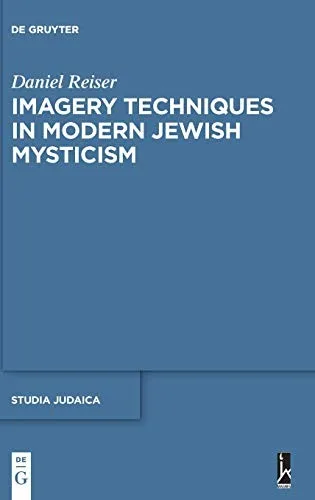
Imagery Techniques in Modern Jewish Mysticism
 62
62

Imagery Techniques in Modern Jewish Mysticism


Daniel Reiser's 'Imagery Techniques in Modern Jewish Mysticism' is a revelatory exploration of a vital, yet often under-examined, facet of esoteric practice. Reiser masterfully deciphers the shift from the symbolic language of medieval Kabbalah to the sophisticated, almost cinematic, visualization methods of contemporary Jewish mystics. This work offers profound insights into the psychology of spiritual experience, demonstrating how cultivated imagination can serve as a direct pathway to divine encounter. Its strength lies in its lucid analysis and its ability to bridge historical scholarship with practical application. Essential reading for anyone seeking to deepen their understanding of Jewish mysticism, or indeed, the universal principles of inner work and contemplative technique.
📝 Description
62
Daniel Reiser's 2010 book details how twentieth-century Jewish mystics used internal imagery.
Daniel Reiser’s 'Imagery Techniques in Modern Jewish Mysticism' examines the shift from textual contemplation to visual methods in Jewish mysticism. The book contrasts medieval Kabbalah, which relied heavily on linguistic and symbolic interpretation, with the development of immersive visualization techniques that emerged in the twentieth century. Reiser argues that these later methods allow for a more direct, experiential approach to mystical states. He illustrates how the imagination became a central tool for accessing divine connection, moving beyond traditional prayer and study.
The work provides a detailed look at how this transformation occurred, linking it to broader changes in consciousness and spiritual practice. It is written for those interested in the practical application of esoteric Jewish traditions. The book shows how internal visualization became a significant pathway for achieving altered states of awareness within this lineage.
This book situates modern Jewish mysticism within a long history of contemplative and ecstatic practices. It specifically addresses the evolution of techniques used to achieve direct experience of the divine. By focusing on the twentieth century, Reiser highlights a significant development where internal imagery became a primary method, distinct from earlier, more textually focused approaches like medieval Kabbalah. This shift reflects broader trends in esoteric thought that emphasize subjective experience and the power of the mind to shape spiritual reality.
💡 Why Read This Book?
Uncover the transformative power of visualization within Jewish mysticism. This book illuminates the evolution of esoteric techniques, revealing how modern practitioners engage with the divine through rich, internalized imagery. Ideal for seekers of deeper spiritual connection, scholars of comparative mysticism, and practitioners looking to enhance their contemplative practices with potent psychological tools.
⭐ Reader Reviews
Honest opinions from readers who have explored this book.
❓ Frequently Asked Questions
What is the primary focus of this book?
The book's primary focus is the analysis and description of imagery techniques, a crucial method for achieving mystical experiences, within the context of Jewish mysticism, particularly its modern manifestations.
How do modern Jewish imagery techniques differ from medieval Kabbalah?
Modern techniques are likened to 'screenplays' or 'feature films'—highly immersive and visual—whereas medieval Kabbalah relied more on linguistic symbolism and textual interpretation.
Who is the intended audience for this book?
The book is intended for scholars of mysticism, students of Kabbalah, practitioners of Jewish meditation, and anyone interested in the psychology of spiritual experience and the use of imagination in spiritual development.
Does the book offer practical guidance on using imagery techniques?
While primarily analytical, the book provides a deep understanding of the principles and historical development, which can inform and enhance a practitioner's personal use of imagery techniques in their spiritual journey.
What broader trends does the book connect Jewish mysticism to?
Reiser contextualizes the development of Jewish imagery techniques within broader trends of both Western and Eastern imagery techniques, highlighting universal aspects of human spiritual exploration.
🔮 Key Themes & Symbolism
The Cinematic Nature of Modern Mystical Visualization
This theme studies the striking comparison of twentieth-century Jewish mystical imagery to cinematic narratives. Reiser posits that modern practitioners construct complex, multi-sensory internal worlds, akin to film scripts, which serve as potent vehicles for spiritual ascent. This contrasts sharply with the more abstract, language-based approaches of earlier Kabbalistic traditions, suggesting a profound evolution in how the human mind engages with the transcendent through cultivated imagination and visualization.
Bridging East and West in Contemplative Practices
Reiser masterfully situates the development of Jewish imagery techniques within a global collection of contemplative traditions. The book explores how these uniquely Jewish methods resonate with and can be fruitfully understood in relation to similar practices found in both Eastern and Western esoteric lineages. This comparative approach highlights universal principles of mind-training and spiritual development, revealing the interconnectedness of human quests for higher consciousness across diverse cultural and historical landscapes.
The Psychology and Methodology of Inner Vision
Fundamentally, this theme examines the psychological underpinnings and practical methodologies of using imagery in Jewish mysticism. Reiser analyzes how specific visualization techniques are designed to evoke altered states of consciousness, facilitate communion with divine emanations, and unlock deeper levels of spiritual insight. It’s a deep dive into the 'how-to' of mystical experience, clarifying the process and offering a framework for understanding the efficacy of internal mental constructs in spiritual attainment.
💬 Memorable Quotes
Direct passages from the work, attributed to the author.
“From etched letters to unfolding vistas.”
— This highlights the transition from the textual and linguistic focus of older Kabbalah to the expansive, visual, and experiential nature of modern mystical imagery.
“Visualization: the blueprint of the soul's ascent.”
— This aphorism emphasizes the crucial role of internal imagery as a foundational guide or map for the journey of spiritual growth and transcendence.
“The screen of consciousness, where divine dramas play.”
— This evocative phrase compares the mind to a cinematic screen, capable of projecting and experiencing profound spiritual events and divine interactions.
“Imagination, the bridge to the Unseen.”
— This succinctly captures the idea that our faculty of imagination is not merely a passive faculty but an active tool that allows us to connect with and perceive realities beyond the physical senses.
💡 Key Ideas
Editorial paraphrase of the work's core concepts — not direct quotes.
The mind, when trained, becomes a celestial theatre.
This quote suggests that through disciplined practice, the human imagination can be transformed into a sacred space where divine encounters and spiritual insights unfold.
🌙 Esoteric Significance
Tradition
This work is deeply rooted in the esoteric tradition of Kabbalah, a mystical interpretation of Judaism that seeks to understand the divine nature and the relationship between God and the created world. It specifically focuses on the evolution within modern Kabbalistic thought, highlighting how its practitioners utilize internal visualization as a primary means to achieve gnosis, divine communion, and profound spiritual transformation, moving beyond purely intellectual or textual engagement.
Symbolism
The symbolism central to this book lies in the very act of visualization itself. Reiser unpacks how specific internal images, often drawn from traditional Kabbalistic cosmology and divine names, function as symbolic keys. These are not mere mental pictures, but active, potent symbols designed to unlock specific spiritual states, facilitate encounters with divine emanations (Sefirot), and guide the mystic through the celestial realms, acting as a sacred language of the soul.
Modern Relevance
The esoteric significance of 'Imagery Techniques in Modern Jewish Mysticism' lies in its profound relevance to contemporary spiritual seekers and practitioners. In an age often characterized by distraction and superficiality, Reiser demonstrates how ancient mystical traditions offer powerful, accessible methods for cultivating inner depth, focus, and direct experience of the sacred. The book provides a vital framework for understanding how to harness the power of imagination for personal growth, spiritual insight, and a more profound connection to the divine in the modern world.
👥 Who Should Read This Book
This book is important for a diverse readership. **Scholars** of comparative mysticism and Jewish studies will find a rigorous analysis of historical and methodological shifts. **Spiritual seekers** yearning for deeper connection will discover potent techniques for cultivating inner awareness and accessing transcendent states through visualization. **Practitioners** of Kabbalah and other contemplative traditions will gain new insights into enhancing their existing practices. Even **beginners** curious about the intersection of psychology, imagination, and spirituality will find a compelling and accessible entry point into the rich world of Jewish mysticism's inner technologies.
📜 Historical Context
Daniel Reiser's exploration unfolds against the backdrop of a burgeoning interest in psychology and contemplative practices in the 20th century, a period marked by both secularization and a resurgence of spiritual seeking. The shift from the scholastic, text-bound approaches of medieval Kabbalah to the more experiential, visualization-centric methods of modern Jewish mysticism mirrors broader intellectual currents. As Western thought grappled with the subconscious and the power of the mind, esoteric traditions, including Jewish mysticism, began to articulate their practices in ways that resonated with these new understandings. This era saw thinkers and practitioners seeking to integrate ancient wisdom with contemporary psychological insights, leading to the development of sophisticated techniques for inner exploration and direct mystical experience, often drawing parallels with Eastern contemplative traditions that were gaining wider recognition in the West.
📔 Journal Prompts
Reflect on a recurring image or symbol in your dreams. How might this image connect to your inner spiritual landscape?
Describe a vivid memory. Now, try to imbue that memory with a sense of divine presence. What shifts occur?
If your spiritual journey were a film, what would be its opening scene, its central conflict, and its ultimate resolution? Visualize it.
Consider a challenging aspect of your life. Can you visualize a symbolic representation of this challenge, and then visualize yourself transforming or overcoming it?
Explore the concept of 'sacred space' within your own mind. What elements define this space, and how can you consciously cultivate it?
🗂️ Glossary
Kabbalah
A system of Jewish mysticism that seeks to understand the nature of God and the universe through esoteric interpretation of scripture and divine emanations (Sefirot).
Sefirot
The ten divine emanations or attributes through which God reveals Himself and interacts with the created world in Kabbalistic cosmology. They are often visualized as a tree.
Visualization
The practice of forming mental images, often detailed and multi-sensory, used in meditation and mystical disciplines to achieve altered states of consciousness or spiritual insight.
Gnosis
Spiritual knowledge or insight, often attained through direct experience or intuition, particularly in esoteric traditions, leading to a deeper understanding of divine truths.
Contemplation
A form of deep, reflective prayer or meditation focused on achieving communion with the divine, often involving sustained focus on a specific idea, image, or divine presence.
This book appears in 1 collection
🔮 Readers Also Liked
Browse all →









More by Daniel Reiser
All books →
From the “Kabbalah” Collection
View all →








More Free Kabbalah & Jewish Mysticism Books
View all →