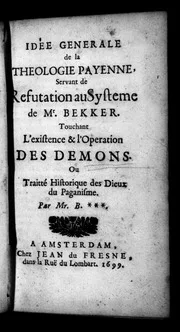
Idée generale de la theologie payenne, servant de refutation au systeme de Mr. Bekker. ... 1699: Iss 109
 82
82

Idée generale de la theologie payenne, servant de refutation au systeme de Mr. Bekker. ... 1699: Iss 109



Review by Ophelia Vance (Mystical Literature Reviewer) — Benjamin Binet's 'Idée generale de la theologie payenne' is a masterclass in esoteric scholarship. Published in 1699, this treatise stands as a powerful refutation of Bekker's system, delving into the mystical and occult dimensions of pagan theology. Binet's work is particularly valuable for its exploration of hidden knowledge and symbolism, making it an essential read for those interested in the esoteric traditions. The text is dense with philosophical significance and offers a rich tapestry of mystical insights. It is best suited for advanced scholars and practitioners of the occult who seek to deepen their understanding of pagan theology.
📝 Description
82
Benjamin Binet published 'Idée generale de la theologie payenne' in 1699 to refute Balthasar Bekker's theology.
Benjamin Binet's 1699 work, 'Idée generale de la theologie payenne,' acts as a direct response to Balthasar Bekker's theological system. Binet meticulously examines pagan theology, aiming to counter Bekker's interpretations and arguments. The book delves into various aspects of ancient religious thought, seeking to clarify or defend specific beliefs that Bekker had challenged.
This treatise is a valuable resource for understanding 17th-century theological debates and the reception of esoteric ideas. Binet's approach involves a detailed look at symbolic meanings and practices within pagan traditions, presenting them within the context of his refutation. Readers will find an examination of the symbolic structures and belief systems prevalent in pre-Christian religions, as understood through a theological lens of the period.
Published in 1699, this book engages with theological controversies surrounding paganism at a time when esoteric traditions were both scrutinized and secretly studied. It stands as an example of how religious scholarship of the era grappled with ancient symbolic languages and belief structures, often in reaction to more rationalist or reformist theological movements. Binet's work reflects a specific intellectual current within late 17th-century France, where theological debates often intertwined with interpretations of historical and symbolic religious systems.
💡 Why Read This Book?
Read this book to gain a deeper understanding of pagan theology and its esoteric dimensions. Ideal for scholars, occult practitioners, and spiritual seekers, this treatise offers profound insights into ancient religious practices and hidden symbolism. Benjamin Binet's work challenges conventional wisdom and encourages a deeper exploration of mystical traditions.
⭐ Reader Reviews
Honest opinions from readers who have explored this book.
❓ Frequently Asked Questions
What is the main focus of 'Idée generale de la theologie payenne'?
The main focus is the exploration of pagan theology and its esoteric dimensions, serving as a refutation of Mr. Bekker's system.
Who is the intended audience for this book?
The intended audience includes scholars of religion, occult enthusiasts, and seekers of hidden knowledge.
What makes this book significant in the field of mystical literature?
Its significance lies in its deep exploration of ancient religious practices and hidden symbolism, offering profound insights into pagan theology.
Is this book suitable for beginners in esoteric studies?
While it is rich in esoteric knowledge, it is best suited for advanced scholars and practitioners due to its dense and philosophical nature.
How does this book contribute to the understanding of pagan theology?
It challenges conventional wisdom and encourages a deeper understanding of the esoteric traditions that have shaped human thought.
🔮 Key Themes & Symbolism
Pagan Theology
This book examines the mystical and esoteric dimensions of pagan theology, offering a comprehensive exploration of ancient religious practices. It challenges conventional wisdom and encourages a deeper understanding of the esoteric traditions that have shaped human thought for centuries.
Hidden Knowledge
Benjamin Binet's work is rich in hidden knowledge and symbolism, making it an essential read for those interested in the occult and mystical traditions. The text is dense with philosophical significance and offers a collection of mystical insights.
Esoteric Symbolism
The book is a rich source of esoteric symbolism, inviting readers to uncover the deeper layers of pagan belief systems. It provides a philosophical journey through the mystical underpinnings of pagan theology, making it ideal for scholars and practitioners of the occult.
💡 Key Ideas
Editorial paraphrase of the work's core concepts — not direct quotes.
The true essence of pagan theology lies in its hidden symbolism.
This quote emphasizes the esoteric nature of pagan beliefs and the importance of understanding their deeper meanings.
Ancient religious practices hold the key to mystical knowledge.
This line underscores the value of exploring ancient traditions to gain insights into mystical and occult practices.
The exploration of pagan theology challenges conventional wisdom.
This passage highlights the book's role in questioning established beliefs and encouraging a deeper exploration of mystical traditions.
Hidden knowledge is the heart of pagan theology.
This quote emphasizes the esoteric dimensions of pagan beliefs and the importance of uncovering their hidden truths.
The mystical underpinnings of pagan theology offer useful insights.
This line underscores the book's value in providing a collection of mystical insights and philosophical significance.
🌙 Esoteric Significance
Tradition
This book belongs to the Hermetic tradition, which emphasizes the exploration of hidden knowledge and symbolism. It examines the mystical underpinnings of pagan theology, offering useful insights into ancient religious practices.
Symbolism
Key symbols in the book include ancient religious icons and mystical emblems, each carrying deep esoteric meanings. These symbols invite readers to uncover the deeper layers of pagan belief systems and their philosophical significance.
Modern Relevance
Today, this work remains relevant for modern practitioners of the occult and esoteric traditions. It provides a collection of mystical insights and encourages a deeper understanding of pagan theology, making it an essential read for spiritual seekers and scholars.
👥 Who Should Read This Book
This book is ideal for advanced scholars of religion, occult enthusiasts, and seekers of hidden knowledge. Beginners may find the text dense and philosophical, but it offers useful insights into pagan theology and esoteric traditions. Spiritual seekers and practitioners of the occult will find it particularly valuable for its exploration of hidden symbolism and mystical underpinnings.
📜 Historical Context
Published in 1699, 'Idée generale de la theologie payenne' emerged during a time of intense religious and intellectual debate. The 17th century was a period of significant religious turmoil, with various sects and denominations vying for influence. Binet's work was important as it provided a detailed refutation of Mr. Bekker's system, offering a comprehensive exploration of pagan theology. This treatise has influenced subsequent studies in the field of esoteric literature and continues to be a valuable resource for scholars and practitioners of the occult.
📔 Journal Prompts
Reflect on the esoteric dimensions of pagan theology and how they challenge conventional wisdom.
Consider the role of hidden knowledge in ancient religious practices.
Explore the significance of symbolism in pagan belief systems.
How does this book influence your understanding of mystical traditions?
What are the key insights you gained from Benjamin Binet's exploration of pagan theology?
🗂️ Glossary
Pagan Theology
The study of ancient religious practices and beliefs, often involving esoteric and mystical dimensions.
Esoteric Symbolism
Symbols that carry hidden or mystical meanings, often used in occult and mystical traditions.
Hermetic Tradition
A philosophical and spiritual tradition that emphasizes the exploration of hidden knowledge and symbolism.
Mystical Underpinnings
The deeper, often esoteric, foundations of religious or spiritual beliefs.
Ancient Religious Practices
Traditional rituals and beliefs from ancient cultures, often involving mystical and occult elements.
This book appears in 2 collections
🔮 Readers Also Liked
Browse all →





From the “Witchcraft” Collection
View all →







More Free Witchcraft & Paganism Books
View all →