I ging

 81
81

I ging
Richard Wilhelm's translation of the I Ching, first published in 1956, remains a significant entry point for Western engagement with this seminal Chinese text. Wilhelm, a German sinologist deeply immersed in Chinese culture, brings a scholar's rigor and a mystic's appreciation to the work. The strength of this edition lies in its thoroughness, incorporating not only the primary text but also the extensive commentaries that have accumulated over centuries, particularly the Ten Wings attributed to Confucius' school. These layers provide crucial context for understanding the philosophical depth beyond mere divination. A limitation, however, is the inherent challenge of translating such a nuanced and culturally specific text; some of the subtle wordplay and philosophical allusions may inevitably be softened in cross-cultural transmission.
Wilhelm's handling of the hexagrams, particularly the concept of "The Creative" (Hexagram 1, Qian), offers a powerful glimpse into the text's cosmology. He elucidates its representation of pure potentiality and the ceaseless drive of yang energy. While no translation can fully capture the I Ching's multi-layered resonance, Wilhelm's effort provides a solid foundation for study.
Read more ↓
This translation serves as an authoritative, albeit dense, introduction to a foundational Eastern philosophical and divinatory system.
📝 Description
81
Richard Wilhelm's 1924 translation brought the I Ching, a Chinese divination text from the 11th century BCE, to a global audience.
The I Ching, or Book of Changes, is an ancient Chinese text originating around the 11th century BCE during the Zhou Dynasty. It is structured around 64 hexagrams, each formed by six solid (yang) or broken (yin) lines. These hexagrams serve as a system for interpreting specific situations and broader life questions, offering guidance through a complex symbolic language.
This translation by Richard Wilhelm makes the text accessible to those interested in introspection, decision-making, comparative philosophy, and ancient Chinese thought. It is particularly valuable for students of divination, scholars of Chinese culture, and anyone seeking a method to gain perspective on complex issues. Readers who value scholarly research and historical background will find this edition beneficial.
The philosophical underpinnings of the I Ching developed significantly during China's Spring and Autumn and Warring States periods, with later commentaries attributed to Confucius and his followers. Its ideas shaped Chinese governance, ethics, and cosmology for centuries. Wilhelm's work bridges cultural divides, introducing the text's depth to Western readers.
The I Ching is a central text in Chinese divination and philosophy, rooted in Taoist principles of balance and transformation. Its system of hexagrams, derived from combinations of solid and broken lines, represents the dynamic interplay of cosmic forces. The text suggests that understanding these patterns allows individuals to align with the natural flow of events and make decisions that harmonize with the Tao. Its influence extends beyond mere fortune telling, shaping ethical thought and providing a framework for comprehending the cyclical nature of existence.
💡 Why Read This Book?
• Gain insight into the ancient Chinese philosophy of change, understanding the dynamic interplay of yin and yang as described in the text's foundational hexagrams. • Explore the philosophical commentaries, such as the Ten Wings attributed to Confucius' school, offering historical and ethical perspectives beyond simple divination. • Develop a method for introspective inquiry by learning to consult the 64 hexagrams, providing a structured framework for decision-making and self-reflection.
⭐ Reader Reviews
Honest opinions from readers who have explored this book.
❓ Frequently Asked Questions
What is the I Ching and how does it work?
The I Ching, or Book of Changes, is an ancient Chinese divination text composed of 64 hexagrams. Each hexagram is formed from six lines, either solid (yang) or broken (yin), representing fundamental states of being and change. Consulting it involves casting lots to generate a hexagram, which is then interpreted for guidance.
Who was Richard Wilhelm and why is his translation important?
Richard Wilhelm was a German sinologist who lived in China for many years. His translation, first published in 1956, is highly regarded for its scholarly depth and inclusion of traditional commentaries, making the I Ching accessible to a Western audience.
What are the main philosophical concepts in the I Ching?
Key concepts include the constant state of flux and change, the balance of opposing forces (yin and yang), and the importance of aligning oneself with the natural order or Tao. Each hexagram represents a specific phase or situation within this cosmic flow.
Is the I Ching only for divination, or does it have other uses?
While used for divination, the I Ching is also a profound philosophical and ethical text. It explores cosmology, human nature, and the principles of wise governance, offering guidance for personal development and understanding the world.
When was the I Ching first written?
The earliest components of the I Ching are believed to date back to the Western Zhou Dynasty in China, around the 11th century BCE. Its philosophical development continued for centuries afterward.
What is a hexagram in the I Ching?
A hexagram is the fundamental symbol of the I Ching, consisting of six stacked lines. Each line is either solid (yang) or broken (yin), and the combination of 64 unique hexagrams represents a vast spectrum of situations and transformations.
🔮 Key Themes & Symbolism
The Dynamic Nature of Change
Central to the I Ching is the understanding that reality is in perpetual flux. The text illustrates this through the transformations of hexagrams, demonstrating how situations evolve and shift. It encourages acceptance of change rather than resistance, promoting adaptability. Wilhelm's commentary often highlights the cyclical nature of events, showing how periods of growth are followed by decline, and vice versa, mirroring natural processes observed since the Zhou Dynasty.
Yin and Yang Polarity
The interplay between yin (passive, dark, feminine) and yang (active, light, masculine) is the fundamental building block of the I Ching's cosmology. These forces are not seen as good or evil, but as complementary energies whose dynamic balance governs all phenomena. The solid lines represent yang, and the broken lines represent yin, forming the basis of the 64 hexagrams and their interpretations.
Ethical and Philosophical Guidance
Beyond its divinatory function, the I Ching functions as a profound ethical and philosophical guide. The commentaries, particularly the Ten Wings, elaborate on the moral implications of different hexagrammatic situations. They stress the importance of acting in accordance with the Tao, cultivating virtue, and maintaining inner harmony amidst external circumstances, reflecting influences from Confucian thought.
The Art of Interpretation
Consulting the I Ching requires more than just mechanical interpretation of hexagrams; it demands introspection and wisdom. The text presents archetypal situations, and the reader must apply these to their specific context. Wilhelm's translation aids this process by providing extensive explanations and commentaries that illuminate the nuances of each hexagram and its potential meanings.
💬 Memorable Quotes
Direct passages from the work, attributed to the author.
“The Creative works in the same way as the general laws of creation.”
— This interpretation of Hexagram 1, Qian, emphasizes the I Ching's view of the universe as governed by consistent, discernible principles. It suggests that the forces driving creation are not arbitrary but follow a grand, understandable order.
“When a man has completed a great work, he returns to the beginning.”
— This concept, often associated with the cyclical nature depicted in the I Ching, suggests that the culmination of a significant endeavor naturally leads to a point of renewal or a new starting phase.
“In diversity there is unity.”
— This aphorism reflects the I Ching's understanding of how distinct phenomena (represented by different hexagrams or lines) ultimately arise from and contribute to a unified cosmic whole or Tao.
“The Book of Changes is a book of wisdom.”
— This statement underscores the I Ching's dual role as a tool for divination and a repository of profound philosophical and ethical teachings developed over millennia of Chinese intellectual history.
💡 Key Ideas
Editorial paraphrase of the work's core concepts — not direct quotes.
The superior man, in his energetic advance, is not diverted from his aim.
This paraphrase, likely reflecting commentary on Hexagram 1, highlights the virtue of perseverance and focused determination. It speaks to the ideal character trait of relentlessly pursuing one's objectives without succumbing to distractions or obstacles.
🌙 Esoteric Significance
Tradition
The I Ching is a foundational text within the broader tradition of Chinese Taoism and Confucianism, with significant cross-pollination into esoteric practices throughout East Asia. It predates many formalized esoteric systems but shares core principles with Hermeticism and other Western traditions concerning cosmic order, balance, and the interconnectedness of macrocosm and microcosm. Wilhelm's translation bridges these traditions, presenting the I Ching as a universal source of wisdom.
Symbolism
The primary symbolism revolves around the hexagrams, composed of yin (broken lines) and yang (solid lines). These represent the fundamental dualities of existence – passive/active, dark/light, feminine/masculine – and their dynamic interplay. Specific hexagrams, like 'The Creative' (Qian) symbolizing pure yang energy and potential, or 'The Receptive' (Kun) symbolizing earth and responsiveness, offer archetypal representations of cosmic and human situations.
Modern Relevance
Contemporary thinkers in psychology, philosophy, and even systems theory continue to draw from the I Ching's principles of change and interconnectedness. Its emphasis on cyclical patterns and synchronicity appeals to modern understandings of complex systems. Practices like Jungian psychology and various forms of meditative inquiry often reference its wisdom for understanding psychological states and life transitions.
👥 Who Should Read This Book
• Students of comparative philosophy and religion: Gain a foundational understanding of a text that has shaped East Asian thought for millennia, bridging philosophical traditions. • Seekers of introspective tools: Learn a structured method for self-reflection and decision-making, using the 64 hexagrams to gain perspective on life's challenges. • Scholars of Chinese culture and history: Access a rigorously translated and annotated version of a key work, enriched by traditional commentaries dating back to the time of Confucius.
📜 Historical Context
Richard Wilhelm's translation of the I Ching, first published in German in 1943 and later in English in 1956, emerged during a period of intense Western interest in Eastern philosophies. Wilhelm, a scholar who spent decades in China and was deeply influenced by Taoism and Confucianism, presented the text not merely as a divination manual but as a profound philosophical work. His approach integrated the core text with the Ten Wings, the extensive commentaries traditionally attributed to Confucius and his disciples, which imbue the I Ching with a strong ethical and cosmological framework. This era also saw the rise of figures like Carl Jung, who famously wrote a foreword to the English edition, finding the I Ching's concept of synchronicity aligned with his own psychological theories. Wilhelm's work offered a more comprehensive and philosophically grounded understanding than earlier, more simplistic interpretations, positioning the I Ching as a core part of Chinese thought alongside the Analects of Confucius.
📔 Journal Prompts
The transformation of Hexagram 1, Qian, into Hexagram 2, Kun.
The concept of 'The Superior Man' as depicted in Hexagram 1.
The balance of yin and yang in a current personal challenge.
The cyclical nature of change illustrated by a specific hexagram's progression.
Applying the principle of 'The Receptive' (Kun) to a passive situation.
🗂️ Glossary
Hexagram
A symbol composed of six stacked lines, either solid (yang) or broken (yin). There are 64 unique hexagrams, each representing a specific situation, phase, or archetype within the I Ching's system.
Yin
The passive, dark, feminine, or receptive principle in Chinese philosophy, represented by a broken line (--) in the I Ching.
Yang
The active, light, masculine, or creative principle in Chinese philosophy, represented by a solid line (—) in the I Ching.
Tao (or Dao)
The fundamental principle of the universe in Taoism; the 'Way.' It represents the natural order, the source, and the underlying reality that governs all existence.
Ten Wings
A collection of ten traditional commentaries attributed to the school of Confucius, which significantly expanded upon the philosophical and ethical dimensions of the I Ching.
Qian (乾)
The first hexagram, consisting of six solid yang lines. It symbolizes Heaven, the Creative, pure potentiality, and relentless forward movement.
Kun (坤)
The second hexagram, consisting of six broken yin lines. It symbolizes Earth, the Receptive, devotion, and the power of yielding.
🔮 Readers Also Liked
Browse all →







More by Richard Wilhelm
All books →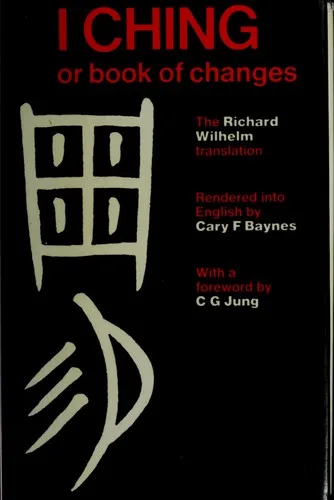





More Free Occult Philosophy Books
View all →