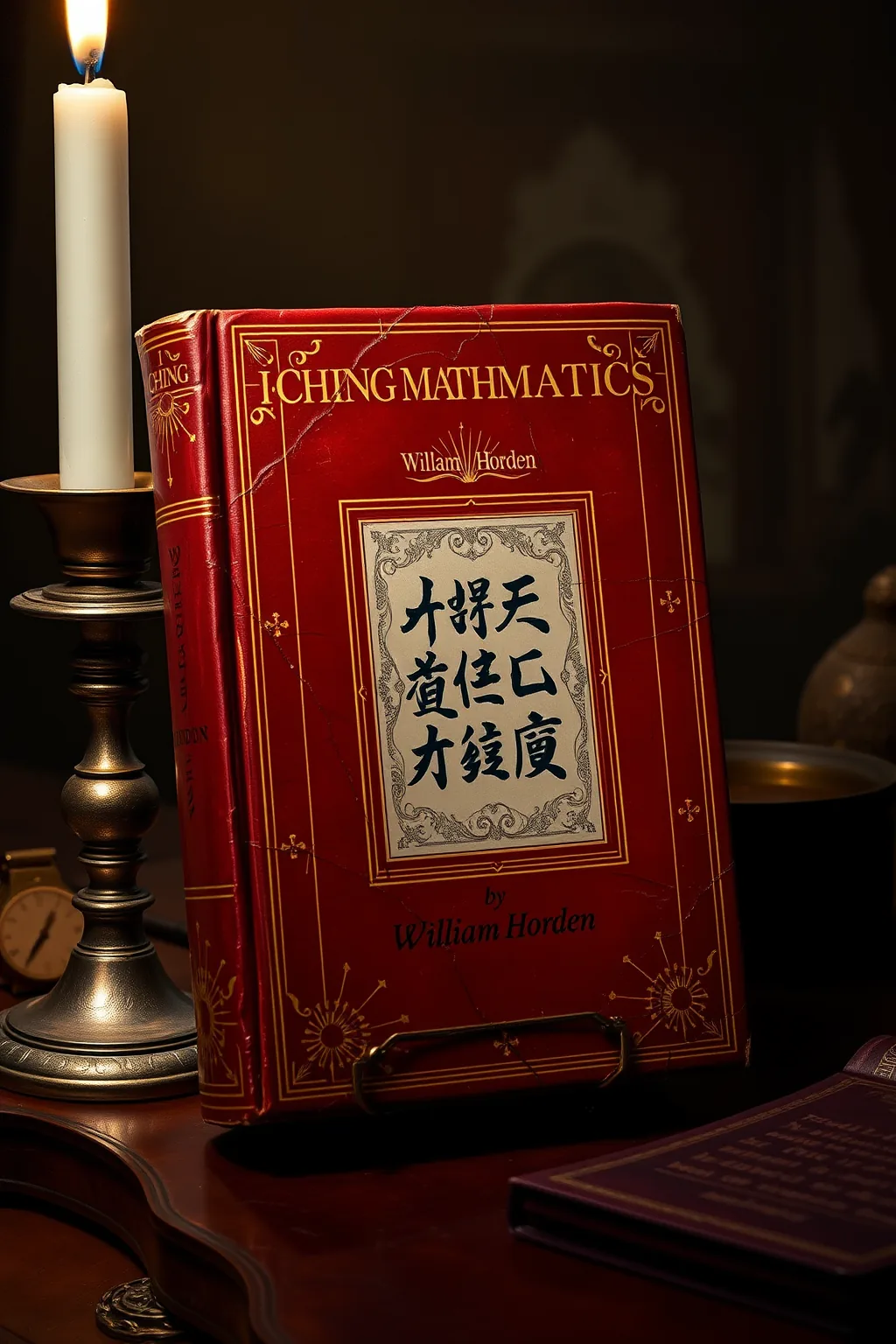
I Ching Mathematics
 61
61

I Ching Mathematics



Evander Ashcroft (Alchemy & Hermeticism Editor) — William Horden's 'I Ching Mathematics' is a revelation, bridging the seemingly disparate worlds of ancient divination and empirical science. Horden masterfully illuminates the sophisticated numerical systems embedded within the I Ching, revealing its profound mathematical underpinnings. This work offers an unprecedented clarity for those seeking to understand the I Ching beyond mere symbolic interpretation, presenting it as a rigorously structured system. Its strength lies in its ability to satisfy both the intellectual curiosity of scholars and the intuitive hunger of spiritual seekers. For anyone dedicated to the esoteric arts, or simply fascinated by the hidden order of the cosmos, this book is an indispensable guide.
📝 Description
61
William Horden's 'I Ching Mathematics' (2000) claims the ancient Chinese oracle operates on a hidden mathematical system.
William Horden's 'I Ching Mathematics' examines the numerical structures within the Chinese oracle. Published in 2000, the book investigates how the hexagrams and their changing lines might correspond to specific mathematical principles. Horden suggests that the I Ching is not just a system of divination but also a model that reflects underlying order through number and pattern.
The author breaks down the components of the I Ching, such as the trigrams and hexagrams, to show their mathematical relationships. He explores concepts like binary coding and cyclical sequences, arguing that these reveal a logical framework behind the oracle's workings. The text aims to provide a more analytical perspective on the I Ching, moving beyond its traditional interpretation.
This work enters the tradition of numerology and symbolic interpretation within esoteric studies. It follows scholars who seek underlying mathematical or geometric principles in ancient texts and systems, viewing them not merely as religious or philosophical documents but as expressions of universal laws. The book connects the I Ching to broader esoteric interests in cosmic order, pattern recognition, and the idea that reality itself can be understood through structured, quantifiable relationships. It positions the I Ching within a lineage of thought that finds order and meaning in numerical correspondence.
💡 Why Read This Book?
Uncover the hidden mathematical architecture of the I Ching, revealing its profound logical structure. Understand the universe through the lens of ancient Chinese wisdom and numerical patterns. Ideal for seekers of esoteric knowledge, scholars of comparative philosophy, and practitioners desiring a deeper, more rational connection to the oracle. Experience the I Ching as a cosmic blueprint, illuminated by mathematical elegance.
⭐ Reader Reviews
Honest opinions from readers who have explored this book.
❓ Frequently Asked Questions
What is the primary focus of 'I Ching Mathematics'?
The book focuses on revealing the intricate mathematical principles and numerical structures that form the foundation of the I Ching, demonstrating its inherent logical and systemic nature beyond symbolic interpretation.
Is prior knowledge of mathematics or the I Ching required?
While a basic appreciation for logical systems is beneficial, the book is structured to guide readers through its concepts. It aims to illuminate the I Ching's mathematical aspects, making them accessible.
How does this book enhance the practice of I Ching divination?
By understanding the mathematical underpinnings, practitioners can gain a deeper, more rational insight into the hexagrams and their transformations, leading to more nuanced and informed interpretations.
What kind of reader would benefit most from this book?
This book is ideal for students of esoteric traditions, mathematicians interested in ancient systems, philosophers, and anyone seeking a more profound, structured understanding of the I Ching and its cosmic implications.
Can this book be considered a scholarly work?
Yes, 'I Ching Mathematics' presents a rigorous, analytical approach to the I Ching, making it a valuable resource for academic study as well as personal exploration of its esoteric dimensions.
🔮 Key Themes & Symbolism
The Mathematical Architecture of the I Ching
This theme explores the foundational numerical systems that govern the I Ching's structure, from the Yin and Yang lines to the generation of hexagrams. It examines the elegant logic and cyclical patterns that reveal the oracle as a sophisticated mathematical model of reality. Understanding these principles offers a clear insights into the inherent order and interconnectedness of the universe as perceived by ancient Chinese sages, transforming the I Ching from a mere divinatory tool into a cosmic blueprint governed by quantifiable laws.
Numerology and Cosmic Harmony
The book investigates the deep symbiotic relationship between numerology and the pursuit of cosmic harmony within the I Ching. It examines how specific numbers and their relationships within the hexagrammatic system reflect universal principles and divine order. This exploration suggests that by comprehending these numerical correspondences, one can align oneself with the natural rhythms of existence, fostering balance and understanding. It posits that mathematics is not merely a human construct but a fundamental language of the cosmos, through which we can perceive and interact with universal energies.
The Esoteric Significance of Binary Systems
Central to 'I Ching Mathematics' is the exploration of the I Ching's inherent binary nature, mirroring ancient philosophies of duality and transformation. This theme unpacks the profound esoteric implications of representing reality through opposing forces, such as Yin and Yang. It highlights how this binary foundation generates complexity and infinite potential, serving as a metaphor for creation and change. The book invites readers to contemplate how this fundamental principle, expressed mathematically, offers a pathway to understanding the dynamic interplay of forces that shape our existence and consciousness.
💬 Memorable Quotes
Direct passages from the work, attributed to the author.
“Within the lines, a universe unfolds.”
— This highlights the profound depth and complexity contained within the seemingly simple structure of the I Ching's lines, symbolizing the vastness of existence.
“Order is the breath of chaos.”
— This paradoxical statement points to the dynamic interplay between structure and flux, suggesting that order emerges from and is sustained by the inherent dynamism of chaos.
“The oracle speaks in the language of form.”
— This emphasizes that the I Ching's wisdom is conveyed through its geometrical and structural patterns, which are inherently mathematical and symbolic.
“Seek the ratio, find the truth.”
— This encourages a rational, analytical approach to understanding the oracle, suggesting that discerning the underlying mathematical relationships reveals useful insights.
💡 Key Ideas
Editorial paraphrase of the work's core concepts — not direct quotes.
The numbers sing the song of creation.
This quote suggests that mathematical principles are not abstract but are intrinsic to the very act of cosmic generation and existence, embodying a divine harmony.
🌙 Esoteric Significance
Tradition
This work deeply engages with the esoteric dimensions of Taoism and Confucianism, specifically through its rigorous examination of the I Ching. It positions the I Ching not just as a divinatory text but as a profound cosmological map, rooted in principles that resonate with Hermeticism and Pythagorean thought, emphasizing the universe's inherent mathematical and harmonic order.
Symbolism
The hexagrams and their constituent trigrams are explored as potent symbolic representations of universal forces and archetypes. Horden reveals how the mathematical relationships between these symbols encode profound truths about change, balance, and the cyclical nature of existence, transforming abstract numbers into potent carriers of cosmic wisdom.
Modern Relevance
In an age increasingly reliant on data and algorithms, 'I Ching Mathematics' offers a profound counterpoint, demonstrating that ancient systems intuitively grasped complex patterns and relationships. It provides a framework for understanding the inherent order within seemingly chaotic systems, offering timeless wisdom applicable to personal growth, decision-making, and a deeper appreciation of universal interconnectedness.
👥 Who Should Read This Book
This book is a treasure for several distinct seekers. For the **beginner** to the I Ching, it offers a foundational understanding of its structure, clarifying its complexities. **Scholars** of comparative religion, philosophy, and mathematics will find Horden's analytical approach useful for academic study and interdisciplinary exploration. **Spiritual practitioners** and **seekers of esoteric knowledge** will discover a profound deepening of their connection to the oracle, revealing its rational underpinnings. **Mathematicians** and **logicians** may find a fascinating historical and philosophical application of numerical principles in an ancient wisdom tradition.
📜 Historical Context
Written during a period of burgeoning interest in Eastern philosophies and esoteric systems in the West, William Horden's 'I Ching Mathematics' emerged as a unique contribution. The mid-to-late 20th century saw a significant cross-pollination of ideas, where scholars and mystics alike sought to find universal truths connecting diverse traditions. Horden's work tapped into this intellectual current, offering a bridge between the ancient Chinese Zhouyi and Western analytical thought. It resonated with those disillusioned by purely materialistic paradigms, seeking a more holistic understanding of reality that incorporated both spiritual insight and logical structure. The book can be seen as a product of this era's fascination with hidden patterns and the potential for ancient wisdom to inform modern understanding.
📔 Journal Prompts
Reflect on a time you experienced a profound sense of order emerging from chaos. How might the mathematical principles discussed in this book relate to that experience?
Consider the binary nature of Yin and Yang. How does this duality manifest in your own life, and what are its mathematical implications?
If the numbers sing the song of creation, what 'melody' do you perceive in the I Ching's structure as described by Horden?
Explore the idea of 'cosmic harmony' through numerical ratios. How can understanding these ratios inform your pursuit of balance in your daily life?
How does Horden's mathematical interpretation of the I Ching challenge or expand your previous understanding of divination and ancient wisdom?
🗂️ Glossary
Hexagram
A symbol in the I Ching composed of six stacked horizontal lines, each representing either a broken (Yin) or solid (Yang) state. It forms the primary unit of divination and symbolic representation.
Trigram
A fundamental component of a hexagram, consisting of three stacked lines (Yin or Yang). There are eight unique trigrams, each associated with specific meanings and natural elements.
Yin
The feminine, passive, dark, and receptive principle in Taoist philosophy, often represented by a broken line in the I Ching.
Yang
The masculine, active, light, and assertive principle in Taoist philosophy, often represented by a solid line in the I Ching.
Binary System
A system of representation or logic based on two mutually exclusive states, such as Yin and Yang, or 0 and 1, which forms the fundamental structure of the I Ching.
This book appears in 3 collections
🔮 Readers Also Liked
Browse all →









More by William Horden
All books →



From the “Tarot” Collection
View all →









More Free Divination & Tarot Books
View all →