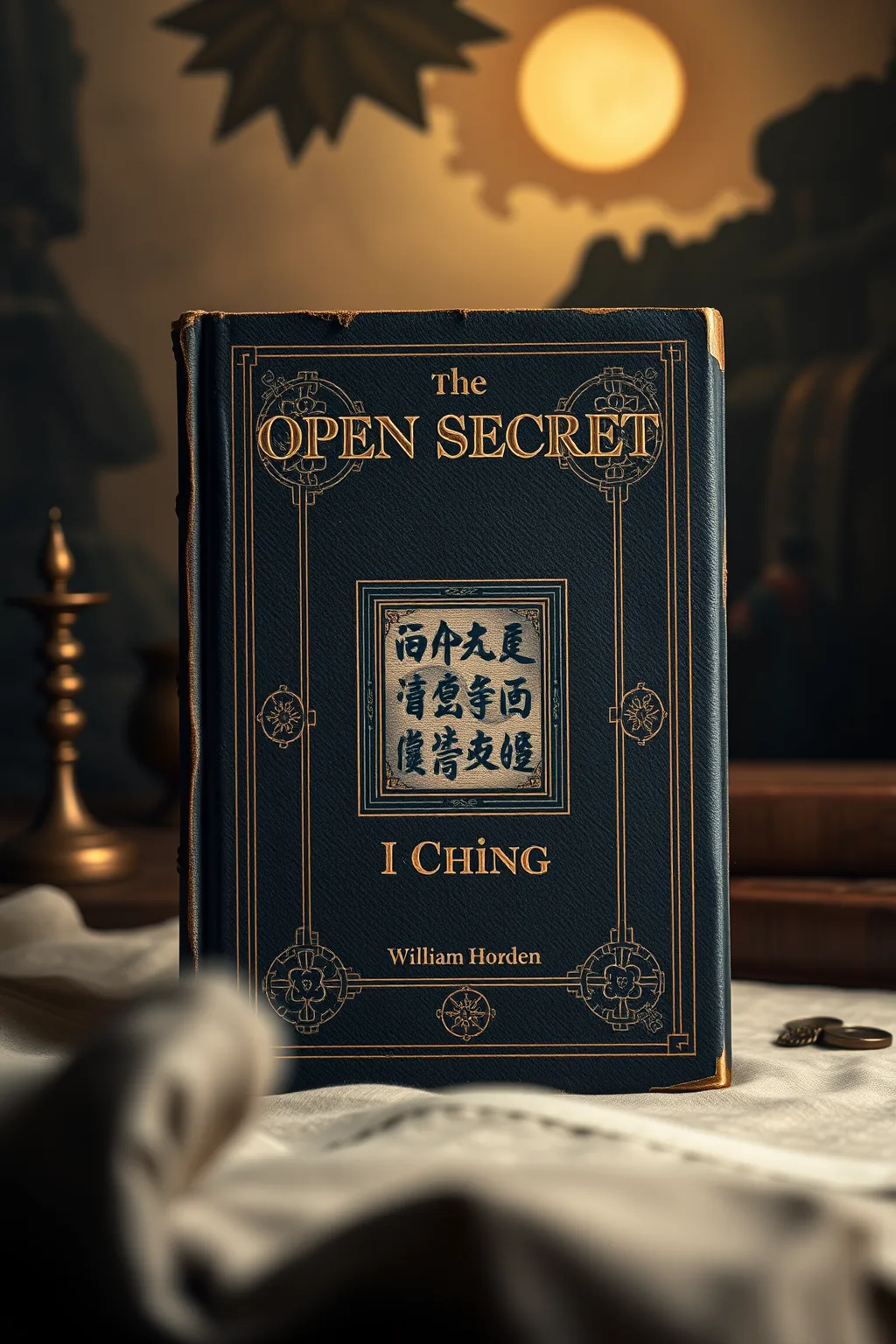
Open Secret I Ching
 61
61

Open Secret I Ching



Review by Marcus Thorne (Esoteric Sciences Reviewer) — William Horden's 'Open Secret I Ching' stands as a beacon for those seeking more than superficial divination. Horden masterfully elucidates the I Ching's intricate symbolic language, revealing its profound philosophical and cosmological dimensions. His translation avoids common pitfalls, offering clarity and depth that resonates with esoteric traditions. This work is particularly potent for its ability to connect the ancient wisdom to contemporary spiritual inquiry, making it an invaluable resource for seasoned practitioners and serious students of the occult. Its strength lies in its comprehensive yet accessible approach, fostering a genuine understanding of the oracle's transformative potential.
📝 Description
61
William Horden's 'Open Secret I Ching' (1991) offers a unique translation and commentary on the ancient Chinese oracle.
This translation and commentary on the I Ching, by William Horden, moves beyond simple divination. It seeks to illuminate the philosophical and symbolic dimensions of the hexagrams, presenting them as a system for understanding change and interconnectedness. Horden's approach focuses on the layered meanings within each character and line, aiming to provide deeper insight into a tradition that has influenced thought for centuries.
The book is structured to guide readers toward introspection and the discovery of underlying truths. It presents a philosophical framework intended to help individuals grapple with life's complexities by examining the universal principles that Horden believes govern existence. The work engages with ancient Chinese cosmology, using symbolic language to explore the human condition.
The 'Open Secret I Ching' situates itself within the broader tradition of Western engagement with Chinese esoteric thought. While many translations focus on the divinatory aspect, Horden's work emphasizes the philosophical and cosmological underpinnings. It connects the I Ching to a lineage of texts that interpret cosmic patterns and human destiny through symbolic systems, aligning with practices that seek spiritual or philosophical understanding through ancient texts.
💡 Why Read This Book?
Unlock the ancient secrets of destiny and personal transformation. 'Open Secret I Ching' offers profound insights into life's challenges and opportunities, guided by timeless wisdom. Ideal for spiritual seekers, scholars of esoteric traditions, and anyone yearning to understand the deeper patterns of existence and harness their inner power.
⭐ Reader Reviews
Honest opinions from readers who have explored this book.
❓ Frequently Asked Questions
What is the I Ching?
The I Ching, or 'Book of Changes,' is an ancient Chinese divination text and philosophical classic, revered for its profound wisdom on the nature of change and the patterns of the universe.
Who was William Horden?
William Horden was a dedicated scholar and practitioner who devoted himself to translating and interpreting esoteric texts, aiming to make their profound wisdom accessible to a modern audience.
Is this book only for divination?
While it can be used for divination, 'Open Secret I Ching' transcends simple fortune-telling, offering deep philosophical insights and a framework for understanding cosmic principles and personal growth.
What makes this translation unique?
Horden's translation is lauded for its clarity, its deep respect for the original text's esoteric nuances, and its insightful commentary that bridges ancient wisdom with modern understanding.
Do I need prior knowledge of Chinese philosophy?
No prior knowledge is strictly necessary, though an open mind and a willingness to explore symbolic language will greatly enhance the reader's experience and understanding.
🔮 Key Themes & Symbolism
The Philosophy of Change
This work looks at the core tenet of the I Ching: the ceaseless nature of change. It explores how understanding and harmonizing with these universal shifts is key to navigating life's currents. The book illuminates the dynamic interplay of Yin and Yang, the fundamental forces that drive all transformation, offering a profound perspective on impermanence and the art of adapting to evolving circumstances with wisdom and grace. It teaches that true power lies not in resisting change, but in flowing with its inevitable tides.
Symbolic Language of the Cosmos
The I Ching's hexagrams and lines are presented not as mere symbols, but as a cosmic language that mirrors the patterns of existence. Horden's commentary unveils the collection of meaning woven into each elemental trigram and their combinations. Readers will discover how these ancient symbols encapsulate universal archetypes, psychological states, and the dynamics of human experience, providing a profound means of self-reflection and a roadmap to understanding the interconnectedness of the universe.
Inner Alchemy and Self-Mastery
Beyond mere prediction, 'Open Secret I Ching' serves as a guide to inner transformation and self-mastery. By engaging with the oracle, individuals are prompted to examine their own motivations, biases, and potential. The book encourages a process of 'inner alchemy,' where understanding the external forces at play leads to the refinement of one's inner landscape. It offers a path toward greater self-awareness, emotional equilibrium, and the cultivation of virtues necessary for a balanced and meaningful life.
💬 Memorable Quotes
Direct passages from the work, attributed to the author.
“Within each hexagram, a universe of meaning awaits discovery.”
— This highlights the profound depth and complexity of the I Ching's symbolic system. Each of the 64 hexagrams is not a simple omen but a rich, complex metaphor capable of revealing useful insights into life's situations.
“To know the self is to know the world.”
— This aphorism underscores the introspective power of the I Ching. By studying the oracle's wisdom, one gains a clearer understanding of their own inner workings, which in turn illuminates their perception of and interaction with the external world.
“Harmony is found not in stillness, but in balanced movement.”
— This profound statement challenges the common perception of harmony as static. It suggests that true equilibrium is achieved through a dynamic and responsive engagement with life's ever-changing circumstances, much like the flow of water.
💡 Key Ideas
Editorial paraphrase of the work's core concepts — not direct quotes.
The universe is in constant flux; wisdom lies in understanding its rhythm.
This quote captures the fundamental principle of the I Ching – that change is the only constant. True wisdom, therefore, is not about resisting change, but about learning to perceive and align oneself with its natural flow and patterns.
The past informs, the present guides, the future unfolds.
This quote speaks to the temporal aspect of the I Ching's wisdom. It acknowledges the influence of past experiences, emphasizes the importance of present actions and awareness, and offers guidance on how to work through the unfolding possibilities of the future.
🌙 Esoteric Significance
Tradition
The 'Open Secret I Ching' is deeply rooted in the esoteric traditions of ancient Chinese cosmology and philosophy, particularly within the framework of Taoism and later developments influenced by Confucianism. It is a central to Chinese metaphysical thought, offering insights into the principles of universal balance, cyclical change, and the interconnectedness of all phenomena. Its esoteric significance lies in its ability to serve as a map of consciousness, revealing the archetypal forces at play within the individual and the cosmos.
Symbolism
The core symbolism of the I Ching lies in its 64 hexagrams, each formed by the combination of two trigrams. These trigrams, in turn, are composed of three broken (Yin) or unbroken (Yang) lines, representing fundamental cosmic dualities and elemental forces. Horden's commentary elucidates the rich symbolic layers of each hexagram, revealing how they represent specific archetypal situations, psychological states, and energetic configurations. The symbolism serves as a universal language, capable of useful the unseen dynamics of life and guiding individuals towards greater understanding and harmony.
Modern Relevance
In an age of rapid change and information overload, the I Ching's emphasis on adaptation, balance, and understanding fundamental patterns is more relevant than ever. 'Open Secret I Ching' provides a timeless framework for navigating uncertainty, fostering resilience, and cultivating inner peace. Its philosophical depth offers a counterpoint to superficial materialism, encouraging introspection and a deeper connection to universal principles. For modern seekers, it remains a powerful tool for self-discovery, decision-making, and aligning one's life with the natural order of existence.
👥 Who Should Read This Book
This profound work is an indispensable resource for a diverse range of readers. For the nascent spiritual seeker, it offers a gentle yet powerful introduction to ancient wisdom and self-inquiry. Scholars of comparative religion and Eastern philosophy will find Horden's translation and commentary a valuable addition to their studies, providing nuanced interpretations. Dedicated practitioners of divination and esoteric arts will discover a deeper, more philosophical engagement with the I Ching's transformative potential. Ultimately, anyone yearning for a richer understanding of life's complexities, seeking guidance on personal growth, or wishing to connect with timeless cosmic principles will find profound value within its pages.
📜 Historical Context
The I Ching, or 'Book of Changes,' emerged from ancient Chinese culture, with its origins stretching back to the Shang Dynasty (c. 1600-1046 BCE) and solidifying in its current form during the Zhou Dynasty (c. 1046-256 BCE). It is one of the oldest and most influential of the Chinese Classics, deeply intertwined with Confucianism and Taoism. Throughout centuries, it has served not only as a divinatory text but also as a profound philosophical treatise, influencing Chinese art, politics, medicine, and military strategy. The intellectual ferment of its era, marked by the Hundred Schools of Thought, provided fertile ground for the development of such sophisticated systems of wisdom. William Horden's work, appearing in the modern era, bridges this vast historical chasm, presenting the I Ching's timeless insights to a contemporary audience grappling with similar existential questions.
📔 Journal Prompts
Reflect on a recent situation where you felt in harmony with the flow of events. What elements contributed to this feeling?
Consider a time you resisted change. What were the consequences, and what might a more adaptable approach have yielded?
How do the principles of Yin and Yang manifest in your daily life and relationships?
When you consult the I Ching, what underlying questions are you truly seeking to explore about yourself or your circumstances?
How can the wisdom of the I Ching be integrated into your decision-making process to foster greater clarity and alignment?
🗂️ Glossary
Hexagram
A figure composed of six stacked horizontal lines, each line being either solid (Yang) or broken (Yin). There are 64 unique hexagrams in the I Ching, each representing a specific situation or principle.
Trigram
A figure composed of three stacked horizontal lines, either solid (Yang) or broken (Yin). The eight trigrams represent fundamental elements and forces of nature and human experience.
Yin
Represented by broken lines (--) in the I Ching, Yin symbolizes passive, receptive, dark, feminine, and intuitive qualities. It is the complementary force to Yang.
Yang
Represented by solid lines (—) in the I Ching, Yang symbolizes active, assertive, light, masculine, and logical qualities. It is the complementary force to Yin.
Tao (Dao)
The fundamental principle of the universe in Taoism; the natural order, the Way. It represents the ineffable, underlying force that governs all existence.
This book appears in 4 collections
🔮 Readers Also Liked
Browse all →







More by William Horden
All books →



From the “Remote Viewing” Collection
View all →




More Free Divination & Tarot Books
View all →