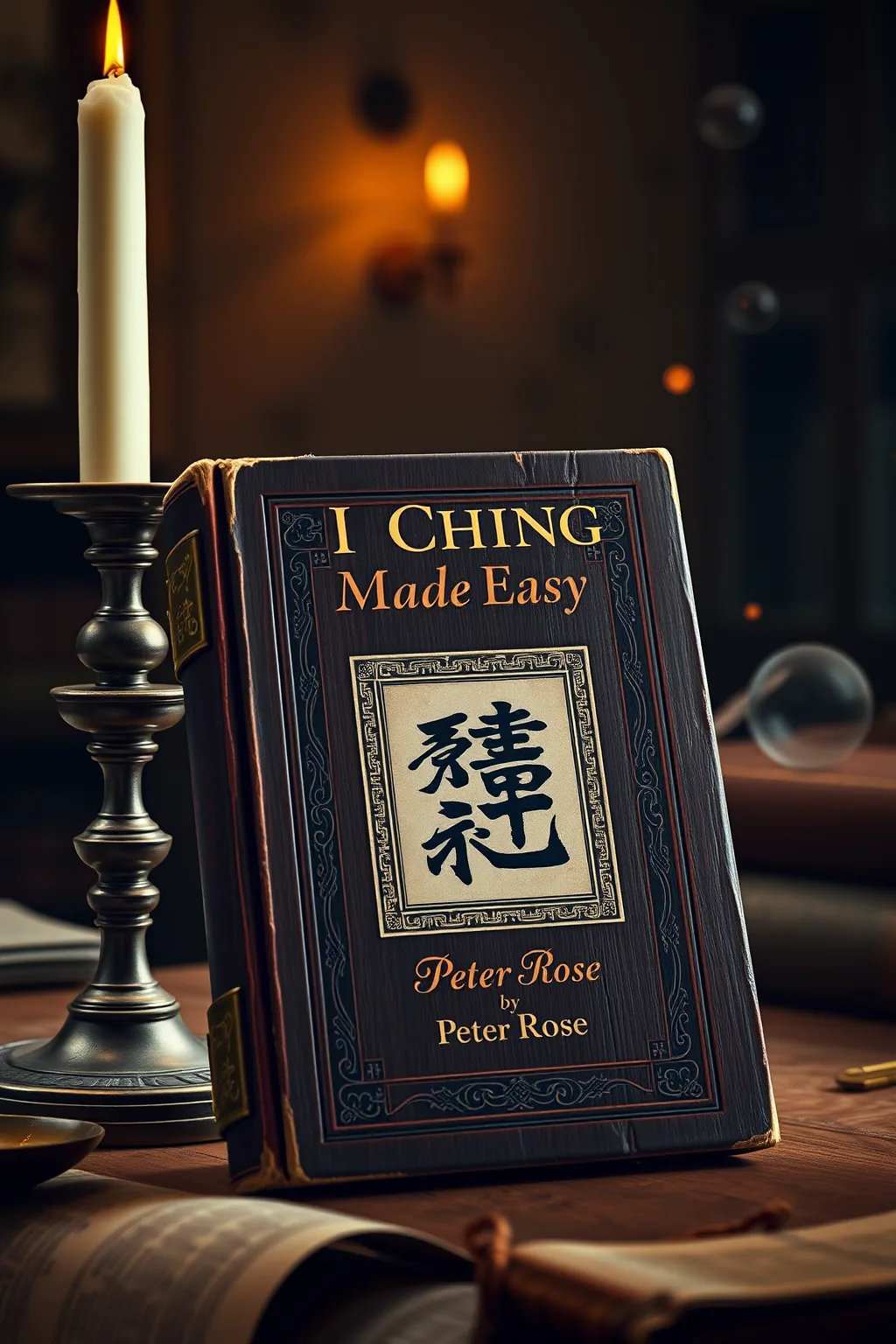
I Ching Made Easy
 61
61

I Ching Made Easy



Ophelia Vance, Mystical Literature Reviewer: Peter Rose's 'I Ching Made Easy' is a revelation for anyone drawn to the depths of esoteric wisdom. Rose doesn't just explain the I Ching; he breathes life into its ancient symbols, making its profound philosophical underpinnings accessible without sacrificing its mystical essence. His approach is both scholarly and deeply intuitive, offering a clear pathway into this complex divination system. The book serves as an invaluable guide for practitioners seeking to deepen their connection to the oracle and for seekers eager to understand the universal laws of change. It's a beautifully crafted text that empowers readers to engage with the I Ching on a truly transformative level.
📝 Description
61
Peter Rose's 'I Ching Made Easy' (1997) deciphers the Book of Changes for the modern reader.
Published in 1997, Peter Rose's 'I Ching Made Easy' aims to make the ancient Chinese text accessible. The book breaks down the 64 hexagrams and their meanings, moving beyond simple divination. Rose focuses on the philosophical underpinnings of the I Ching, explaining its concepts of change, balance, and the interplay of Yin and Yang.
The author provides explanations for the symbolic language within the hexagrams and discusses how these principles can be applied to everyday life. This approach seeks to offer practical insights for those looking to understand the text's deeper messages. The book is structured to guide readers through the complexities of the oracle, fostering a greater understanding of its enduring significance.
The I Ching, or Book of Changes, is a foundational text in Chinese philosophy and divination, dating back to the Western Zhou dynasty. It is considered one of the oldest Chinese classics. Within esoteric traditions, it is viewed not just as a predictive tool but as a map of cosmic principles and human experience. The text's structure, with its 64 hexagrams formed from combinations of six lines, is seen as a representation of all possible situations and transformations. Rose's work places itself within this context, seeking to bridge the gap between the I Ching's ancient wisdom and contemporary understanding.
💡 Why Read This Book?
Unlock the secrets of the ancient Chinese oracle. 'I Ching Made Easy' provides clear, insightful guidance for understanding the Book of Changes, transforming a complex system into an accessible tool for self-discovery and decision-making. Ideal for spiritual seekers, students of metaphysics, and anyone seeking profound wisdom to navigate life's ever-present flux.
⭐ Reader Reviews
Honest opinions from readers who have explored this book.
❓ Frequently Asked Questions
What is the I Ching?
The I Ching, or Book of Changes, is an ancient Chinese divination text and philosophical classic. It offers a system of hexagrams, each representing a specific state of being or change, providing insights into the past, present, and future.
Who is Peter Rose?
Peter Rose is a respected author and scholar specializing in Eastern philosophies and esoteric traditions. His work aims to demystify complex spiritual and philosophical texts for a modern audience.
Is this book suitable for beginners?
Absolutely. 'I Ching Made Easy' is specifically designed to make the I Ching accessible to those new to its concepts, offering clear explanations and practical guidance without overwhelming the reader.
Can the I Ching predict the future?
The I Ching is not typically viewed as a deterministic predictor of the future. Instead, it offers insights into the forces at play and potential outcomes, guiding the user toward wiser choices and greater self-awareness.
What are hexagrams?
Hexagrams are the core symbolic units of the I Ching. Each hexagram is composed of six stacked lines, which can be either solid (Yang) or broken (Yin), representing fundamental cosmic energies and situations.
🔮 Key Themes & Symbolism
The Philosophy of Change
At its heart, the I Ching is a profound exploration of the universal principle of change. Rose looks at how the constant flux of Yin and Yang drives all phenomena, offering a cosmic perspective on the impermanence of all things. Understanding this fundamental concept is key to harmonizing with the natural order and navigating life's inevitable transformations with grace and wisdom.
Symbolic Language of Hexagrams
The sixty-four hexagrams of the I Ching are not mere symbols; they are potent archetypes representing the myriad situations and energies encountered in human experience. Rose meticulously deciphers the rich symbolic language embedded within each hexagram, revealing their layered meanings and their interconnectedness as a comprehensive map of existence. This allows practitioners to interpret the oracle's guidance with clarity and depth.
Divination as Self-Reflection
Beyond simple fortune-telling, the I Ching serves as a powerful tool for introspection and self-discovery. 'I Ching Made Easy' guides readers to view the oracle's responses not as fixed prophecies, but as reflections of their inner state and the energetic currents surrounding them. This approach fosters a deeper understanding of personal motivations and empowers individuals to make conscious, informed decisions that align with their true path.
💬 Memorable Quotes
Direct passages from the work, attributed to the author.
“Embrace the flow of becoming.”
— This emphasizes the core philosophy of the I Ching: accepting and working with the constant nature of change rather than resisting it.
“Wisdom lies in observing the subtle signs.”
— This points to the I Ching's ability to reveal hidden influences and subtle shifts, encouraging mindfulness and attentiveness to life's nuances.
“Each hexagram whispers ancient truths.”
— This evokes the profound knowledge contained within the I Ching's structure, suggesting that each symbolic combination holds profound, timeless wisdom.
“Destiny is a dance with the present.”
— This suggests that rather than being predetermined, our future is shaped by our present actions and our ability to respond wisely to the unfolding circumstances.
💡 Key Ideas
Editorial paraphrase of the work's core concepts — not direct quotes.
The Book of Changes is a mirror to the soul.
This quote highlights the I Ching's function as a reflective tool, revealing inner truths and patterns to the user through its symbolic language.
🌙 Esoteric Significance
Tradition
The I Ching is a core part of Taoist and Confucian philosophical traditions, deeply entwined with ancient Chinese cosmology and metaphysics. It represents a sophisticated system for understanding the fundamental forces of the universe, particularly the interplay of Yin and Yang, and their manifestation in all aspects of existence. Its esoteric significance lies in its ability to act as a map of spiritual and psychological states, offering guidance on aligning oneself with the Tao, the fundamental principle of the universe.
Symbolism
The core symbolism of the I Ching resides in its sixty-four hexagrams, each constructed from six lines (solid Yang, broken Yin). These lines and their combinations represent archetypal situations, natural phenomena, and human relationships. The trigrams (three-line combinations) are foundational, representing Heaven, Earth, Water, Fire, Lake, Mountain, Wind, and Thunder. The dynamic interplay between these elements and their transformations within the hexagrams forms a rich symbolic language for understanding the cyclical nature of change and the forces that shape destiny.
Modern Relevance
In contemporary times, the I Ching remains remarkably relevant as a tool for introspection, ethical guidance, and psychological insight. Its emphasis on adaptability, understanding cyclical patterns, and making conscious choices resonates deeply in our rapidly changing world. Modern practitioners utilize the I Ching not just for divination, but as a profound philosophical text that offers wisdom for personal growth, decision-making, and cultivating a sense of harmony with the universe, bridging the gap between ancient wisdom and modern challenges.
👥 Who Should Read This Book
This book is an essential companion for a diverse array of seekers. For **beginners**, it offers a gentle and accessible entry point into the complex world of the I Ching, explaining its core concepts and practical application. **Scholars** of Eastern philosophy and comparative religion will find Rose's insightful interpretations and historical context useful for a deeper academic understanding. **Spiritual seekers** and **practitioners** of divination will appreciate the clear guidance on using the I Ching for personal growth, ethical reflection, and navigating life's myriad challenges with wisdom and clarity.
📜 Historical Context
The I Ching, or Book of Changes, boasts a lineage stretching back over three millennia, making it one of the world's oldest and most influential texts. Its origins are shrouded in legend, attributed to ancient Chinese sages like Fu Xi, King Wen, and Confucius, who are credited with shaping its philosophical and divinatory aspects. During the Han Dynasty (206 BCE – 220 CE), the I Ching solidified its place as one of the Five Classics of Confucianism, imbuing it with immense cultural and intellectual authority. Throughout subsequent dynasties, scholars and mystics continued to interpret and expand upon its teachings, integrating it with Taoist and Buddhist philosophies. Its influence extended far beyond China, impacting philosophical thought, divination practices, and even scientific inquiry in East Asia and, in more recent centuries, the West, where it has been embraced by psychologists, philosophers, and spiritual seekers alike.
📔 Journal Prompts
Reflect on a recent situation where change was a significant factor. How did you respond, and what might the I Ching suggest for a more harmonious approach?
Consider a persistent challenge in your life. Which hexagram's symbolism or advice seems most relevant to your current circumstances?
Meditate on the balance of Yin and Yang in your daily life. Where do you see excess or deficiency, and how can you cultivate greater equilibrium?
If the I Ching were to offer you guidance on your spiritual path today, what question would you ask, and what core energies (trigrams) do you believe would be most significant in its response?
How can the principles of the I Ching be applied to foster better communication and understanding in your relationships?
🗂️ Glossary
Hexagram
A symbol in the I Ching composed of six stacked lines, representing a specific situation or state of being. Each hexagram is formed from two trigrams.
Trigram
A basic symbol in the I Ching consisting of three lines, either solid (Yang) or broken (Yin). There are eight fundamental trigrams, representing natural forces and concepts.
Yang
In I Ching symbolism, Yang represents the active, masculine, light, and creative principle. It is depicted by a solid line (—).
Yin
In I Ching symbolism, Yin represents the receptive, feminine, dark, and yielding principle. It is depicted by a broken line (- -).
Tao
The fundamental principle of the universe in Taoist philosophy; the natural order, the Way. The I Ching is seen as a reflection of the Tao's processes.
This book appears in 3 collections
🔮 Readers Also Liked
Browse all →








From the “Tarot” Collection
View all →









More Free Divination & Tarot Books
View all →