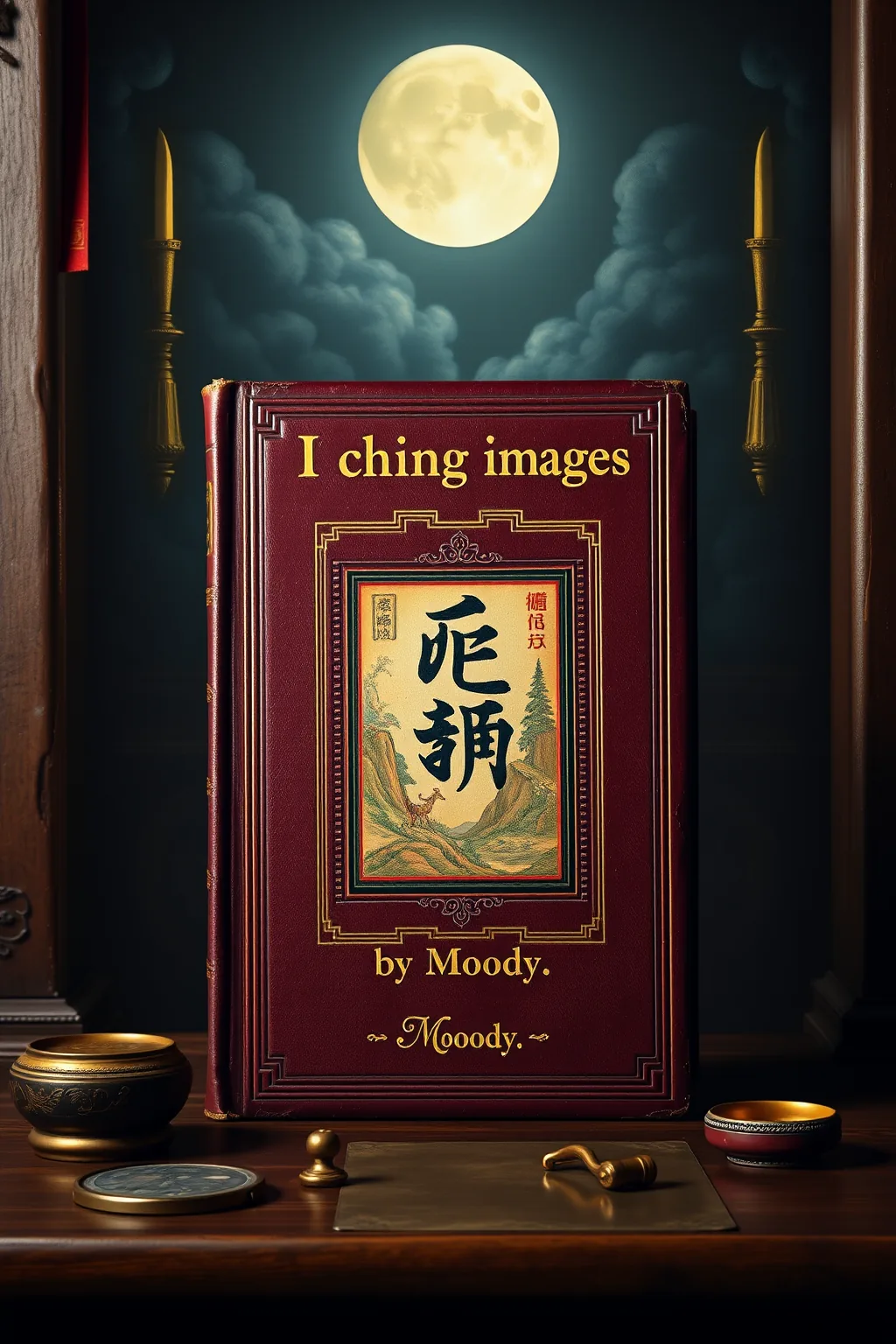
I ching images
 61
61

I ching images



Aurelia Blackwood (Occult Philosophy Critic) — Moody's 'I Ching Images' is a revelation for anyone serious about understanding the visual lexicon of the Oracle. Moving beyond simplistic interpretations, Moody unveils the profound symbolic depth embedded within each hexagram. This isn't just a guide to divination; it's an exploration of cosmic principles rendered in elegant, evocative imagery. The author's insightful prose demystifies complex concepts, making the wisdom of the I Ching accessible without sacrificing its esoteric integrity. Essential for practitioners seeking a deeper connection to the Oracle's profound insights, and for scholars examining the intersection of art, philosophy, and divination.
📝 Description
61
Moody's 'I Ching Images' (1999) decodes the visual symbolism of the I Ching's hexagrams.
Published in 1999, 'I Ching Images' by Moody examines the visual language inherent in the I Ching's sixty-four hexagrams. The book treats these figures not solely as tools for divination but as complex symbolic systems that reflect ancient Chinese cosmology. Moody details how each hexagram's design conveys layers of meaning concerning the relationships between heaven, earth, and humanity. The author maps the symbolic structure of the hexagrams, presenting them as philosophical archetypes that illustrate the constant flux of existence.
This work aims to foster a deeper, intuitive grasp of the I Ching's principles. It encourages readers to engage with the text's visual components to understand the underlying patterns of Taoist philosophy. The book supports personal contemplation and spiritual development by connecting these cosmic patterns to the individual's search for self-understanding. It offers a way to perceive universal truths through the visual framework of the I Ching.
Moody's 'I Ching Images' situates itself within the long tradition of interpreting the I Ching, a foundational text of Chinese philosophy and divination. While many commentaries focus on the textual or mathematical aspects of the hexagrams, this book emphasizes their visual representations. It connects these images to broader concepts in esoteric thought, such as subtle energies and cosmic patterns. The work draws on Taoist principles to explain the I Ching's relevance to understanding the dynamics of change and human existence.
💡 Why Read This Book?
Unlock the ancient wisdom of the I Ching through its powerful visual metaphors. 'I Ching Images' offers a unique perspective, revealing the profound philosophical and spiritual insights encoded within each hexagram. Ideal for those seeking a deeper, intuitive understanding of change, destiny, and the universe's intricate patterns. Whether you are a seasoned practitioner, a curious scholar, or a spiritual seeker, this book provides a rich tapestry for contemplation and personal transformation.
⭐ Reader Reviews
Honest opinions from readers who have explored this book.
❓ Frequently Asked Questions
What is the primary focus of 'I Ching Images'?
The book focuses on the visual symbolism of the I Ching hexagrams, exploring their deeper philosophical and esoteric meanings beyond simple predictive divination.
Who is the intended audience for this book?
It is intended for practitioners of the I Ching, students of esoteric traditions, scholars of Eastern philosophy, and anyone interested in self-discovery and the wisdom of ancient Chinese cosmology.
Does this book provide methods for casting the I Ching?
While it delves deeply into the meaning of the hexagrams, the primary emphasis is on understanding the visual and symbolic language, rather than detailed casting methodologies.
How does this book differ from other I Ching guides?
'I Ching Images' prioritizes the visual and metaphorical interpretation of the hexagrams, offering a more intuitive and philosophical approach compared to purely technical or predictive guides.
Can this book help with personal growth?
Yes, by understanding the archetypal patterns and cycles depicted in the images, readers can gain profound insights into their own lives, facilitating personal growth and transformation.
🔮 Key Themes & Symbolism
The Language of Glyphs
This theme explores the I Ching hexagrams as a profound visual language, a symbolic lexicon that predates written alphabets. Moody elucidates how each line and combination of lines acts as a potent glyph, carrying layers of meaning that speak to the fundamental forces of the cosmos. It's about understanding the universe not just through words, but through archetypal images that resonate with the soul, revealing the interconnectedness of all phenomena and the subtle interplay of yin and yang.
Cosmic Cycles and Transformation
Fundamentally, the I Ching is a system of understanding change. This theme studies how the hexagrams map the cyclical nature of existence, from the nascent stages of growth to the zenith of achievement and the inevitable descent into decline, followed by renewal. Moody guides the reader to perceive these cycles not as fixed fates, but as dynamic processes that can be navigated with wisdom and adaptability, fostering an understanding of transformation as a continuous, natural flow.
The Mirror of the Self
Beyond its divinatory applications, the I Ching serves as a profound mirror for the self. This theme highlights how the archetypal situations presented in the hexagrams reflect our own inner landscapes, challenges, and potential. By contemplating these images, readers are invited to engage in introspection, identifying patterns in their thoughts, emotions, and actions, and ultimately achieving a deeper self-awareness and alignment with the universal Tao.
💬 Memorable Quotes
Direct passages from the work, attributed to the author.
“Change is the only constant, and the I Ching its truest map.”
— This highlights the I Ching's central theme of flux and transformation, positioning it as an authoritative guide for understanding and navigating life's inevitable shifts.
“Within the stillness of the image lies the echo of all movement.”
— This points to the paradoxical nature of the I Ching, where static visual symbols contain the essence of dynamic processes and the underlying rhythm of existence.
“To read the I Ching is to converse with the ancient mind of heaven.”
— This evokes a sense of deep connection and reverence, suggesting that engaging with the Oracle allows one to tap into a timeless, universal consciousness and wisdom.
💡 Key Ideas
Editorial paraphrase of the work's core concepts — not direct quotes.
The hexagrams are but windows into the soul of the cosmos.
This quote emphasizes the I Ching's symbolic nature, suggesting that the visual representations are not mere diagrams but profound portals offering glimpses into the fundamental truths and workings of the universe.
The patterns revealed are not destiny, but the threads of possibility.
This quote reframes the I Ching's predictive aspect, emphasizing that it shows potential pathways and influences rather than immutable outcomes, empowering the reader to shape their future.
🌙 Esoteric Significance
Tradition
The I Ching is deeply embedded within the Taoist tradition, serving as a practical embodiment of its core principles, particularly the concept of Tao (the Way) and the dynamic interplay of Yin and Yang. It also holds significant importance within Confucianism, influencing its ethical and social philosophy, and has been a subject of study for various schools of Chinese mysticism and alchemy, integrating its symbolic language into their practices for understanding cosmic energies and transformation.
Symbolism
The foundational symbolism of the I Ching revolves around the eight trigrams (Bagua) and the sixty-four hexagrams, each representing fundamental forces, states of being, and archetypal situations. Yin (dark, receptive, feminine) and Yang (light, active, masculine) are the primal forces, visualized as solid (Yang) and broken (Yin) lines. These lines combine to form trigrams, which then combine to form hexagrams, each a unique symbolic representation of cosmic phenomena, natural processes, and human experiences, offering a visual map of the universe's ever-changing dynamics.
Modern Relevance
In the modern era, the I Ching continues to offer profound relevance as a tool for self-discovery, ethical guidance, and understanding complex systems. Its emphasis on adaptability, balance, and the acceptance of change resonates deeply in a world characterized by rapid flux. Scholars and practitioners alike find value in its sophisticated symbolic language for navigating personal challenges, fostering intuition, and gaining a holistic perspective on life, bridging ancient wisdom with contemporary existential concerns.
👥 Who Should Read This Book
This volume is essential for the dedicated student of esoteric knowledge, offering a visual and philosophical deep dive into one of the world's most ancient wisdom systems. Beginners will find Moody's approach informative, providing a gentle yet profound introduction to the I Ching's symbolic language. Scholars of comparative religion, philosophy, and Eastern studies will appreciate the nuanced exploration of its cosmological underpinnings. Spiritual seekers and practitioners of divination will discover a richer, more intuitive connection to the Oracle, enhancing their ability to interpret its timeless counsel for personal growth and understanding.
📜 Historical Context
The I Ching, or 'Book of Changes,' boasts a lineage stretching back over three millennia, originating in ancient China. Its earliest forms likely emerged from shamanic practices and early cosmological theories, evolving through the Zhou Dynasty (c. 1046–256 BCE) where it solidified its philosophical and divinatory framework. Confucius and his disciples are traditionally credited with compiling and commenting on its texts, imbuing it with ethical and social dimensions. Throughout Chinese history, the I Ching has been a core part of scholarly, political, and spiritual life, influencing everything from military strategy and medicine to art and personal philosophy. Its enduring appeal lies in its ability to address fundamental questions about human existence, cosmic order, and the ceaseless flow of change, making it a timeless repository of wisdom.
📔 Journal Prompts
Reflect on a recent significant change in your life. How might the imagery of a specific hexagram relate to this experience?
Consider the balance of Yin and Yang in your daily routine. Which energies are dominant, and where could greater harmony be found?
What archetypal situation from the I Ching images do you feel most drawn to or repelled by, and why?
How can the concept of 'constant change' be applied to a current challenge you are facing?
Meditate on the visual symbolism of a hexagram that speaks to you. What deeper meanings or insights does it reveal about your inner world?
🗂️ Glossary
Hexagram
A symbol composed of six stacked lines, each representing either Yin (broken line) or Yang (solid line). It forms the basic unit of the I Ching's divinatory system, symbolizing a specific situation or principle.
Trigram
A symbol composed of three stacked lines, forming the building blocks of hexagrams. There are eight trigrams, each representing fundamental natural forces (e.g., Heaven, Earth, Water, Fire).
Yin
In I Ching symbolism, Yin represents the passive, dark, receptive, feminine, and yielding aspect of reality. It is depicted by a broken line (--) in the hexagrams.
Yang
In I Ching symbolism, Yang represents the active, light, creative, masculine, and assertive aspect of reality. It is depicted by a solid line (—) in the hexagrams.
Tao
The fundamental, ineffable principle underlying all reality in Taoist philosophy. It represents the natural order, the 'Way' of the universe, and is often understood as the source and sustainer of all existence.
This book appears in 3 collections
🔮 Readers Also Liked
Browse all →









From the “Tarot” Collection
View all →







More Free Divination & Tarot Books
View all →