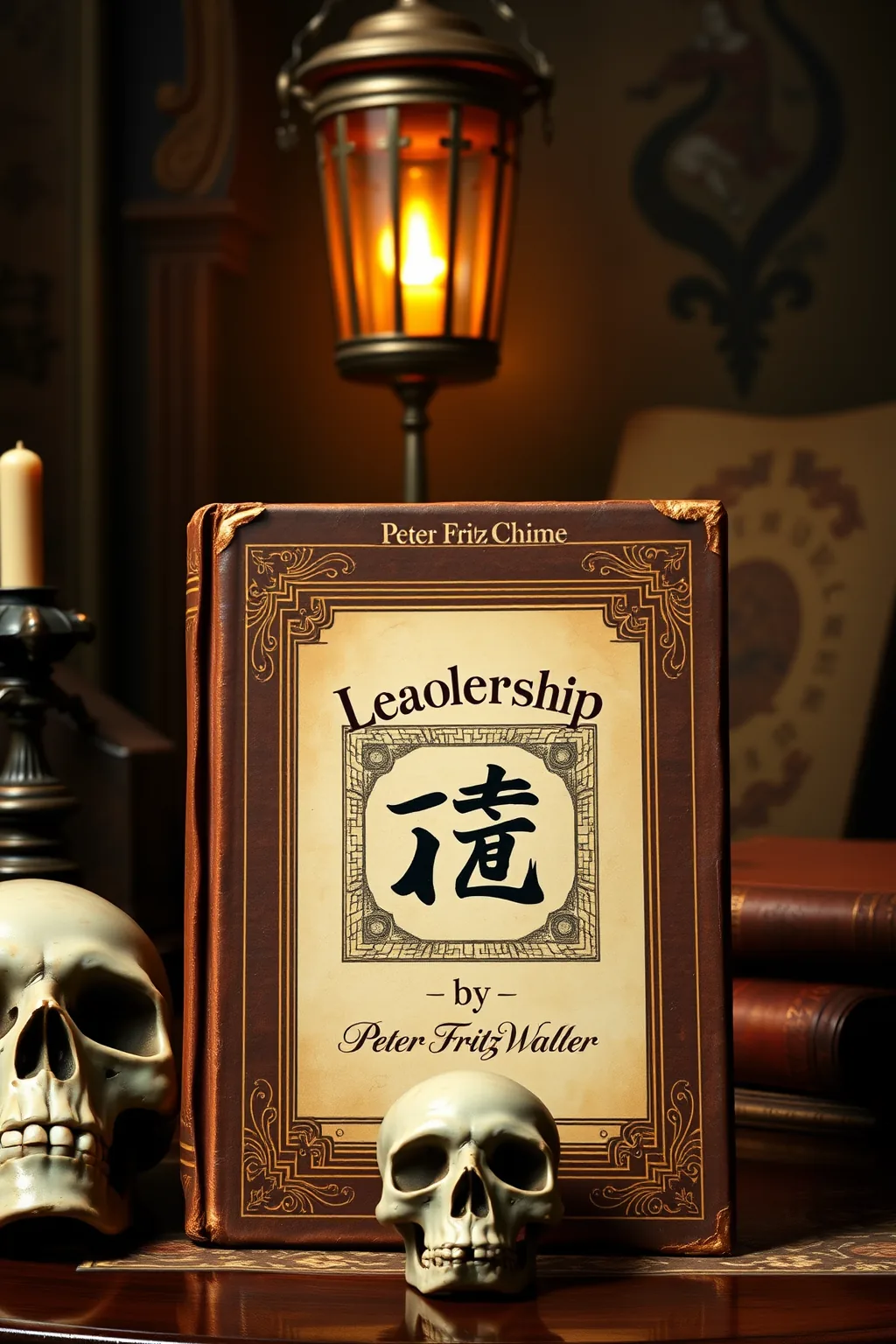
Leadership I Ching
 61
61

Leadership I Ching



Peter Fritz Walter's "Leadership I Ching" is a luminous testament to the enduring power of the Book of Changes as a guide for those who wield influence. Walter transcends a simple translation, delving into the profound esoteric currents that imbue each hexagram with leadership potential. His insights are particularly potent in revealing the subtle interplay of Yin and Yang within decision-making and the unfolding of organizational destiny. This work offers a rare blend of scholarly rigor and mystical intuition, making it an invaluable resource for serious practitioners and students of Hermetic philosophy. It's a compelling invitation to lead not just with intellect, but with the deep wellspring of archetypal wisdom.
📝 Description
61
Peter Fritz Walter's 2017 book, "Leadership I Ching," recasts the ancient Chinese oracle for modern management.
This book applies the principles of the I Ching to the practice of leadership. Walter interprets the sixty-four hexagrams not as mere fortune-telling tools, but as archetypal patterns that describe situations leaders encounter. He connects these patterns to concepts of influence, power, and decision-making.
The text suggests that understanding the I Ching's symbolic language can help individuals develop a more authentic and effective leadership style. It moves beyond simple strategy, aiming to reveal a deeper connection between universal order and human endeavor. The author draws on esoteric traditions to frame leadership as a practice that mirrors the natural flow of the universe.
Walter's approach encourages a contemplative engagement with the material, inviting readers to find practical wisdom in the oracle's ancient pronouncements. The goal is to cultivate a leadership approach that is both insightful and enduring.
The "Leadership I Ching" situates itself within the broader tradition of applying ancient Chinese divination systems to contemporary life. It follows a lineage that views the I Ching not solely as a method for prediction, but as a source of philosophical insight and a map of human experience. This perspective aligns with esoteric interpretations that see universal principles reflected in symbolic systems. Walter connects the oracle's patterns to concepts of "Celestial Mandate," linking governance to a perceived cosmic structure. This echoes similar efforts in esoteric thought to find correspondences between the macrocosm and human institutions.
💡 Why Read This Book?
Uncover the ancient, mystical secrets of effective leadership through the timeless wisdom of the I Ching. This book offers a profound, esoteric perspective, transforming hexagrams into powerful archetypes for personal and collective guidance. Ideal for seekers of hidden knowledge, scholars of ancient divination, and practitioners aiming to cultivate a more authentic and divinely aligned leadership presence.
⭐ Reader Reviews
Honest opinions from readers who have explored this book.
❓ Frequently Asked Questions
What is the I Ching's connection to leadership?
The I Ching, through its 64 hexagrams, offers symbolic representations of universal patterns and archetypal situations, many of which directly correspond to the challenges and dynamics inherent in leadership roles and decision-making.
Is prior knowledge of the I Ching required?
No, this book is designed to be accessible to newcomers while offering depth for seasoned practitioners. Walter introduces core concepts with clarity and rich metaphorical language.
How does this book differ from standard leadership guides?
Unlike pragmatic business books, 'Leadership I Ching' delves into the spiritual and energetic dimensions of leadership, drawing on ancient esoteric principles for profound self-awareness and guidance.
What kind of insights can one expect to gain?
Readers can expect to gain insights into aligning their actions with cosmic flow, understanding the subtle forces influencing their decisions, and cultivating a leadership style rooted in wisdom and integrity.
Can this book be used for personal development?
Absolutely. The principles of leadership discussed are deeply intertwined with self-mastery and personal growth, making it a powerful tool for introspection and understanding one's own path.
🔮 Key Themes & Symbolism
Archetypal Leadership Dynamics
This book posits that the hexagrams of the I Ching are not merely random permutations of lines, but profound archetypal maps of human experience, particularly those related to influence, authority, and the flow of power. Walter illuminates how specific hexagrams embody universal patterns of leadership, from the foundational stability of 'The Creator' to the transformative chaos of 'The Great)--(The Powerful'. By understanding these archetypes, leaders can gain a deeper, more intuitive grasp of the forces at play in their own lives and organizations, learning to navigate challenges with wisdom and foresight.
The Tao of Governance
Central to Walter's thesis is the concept of leading in accordance with the Tao, the fundamental, ineffable principle that governs the cosmos. 'Leadership I Ching' reveals how the ancient Chinese oracle offers a framework for aligning one's actions with this natural order, promoting harmonious governance that arises organically rather than through forceful imposition. It explores the subtle art of 'wu wei' (non-action that achieves) within leadership, demonstrating how true power often lies in yielding to the natural momentum of situations, allowing circumstances to unfold with grace and efficacy.
Inner Alchemy and Outer Influence
The book emphasizes that effective external leadership is inextricably linked to internal transformation. Walter draws parallels between the alchemical process of refining base metals into gold and the spiritual work of transforming the self into a vessel of wisdom and integrity. He suggests that by applying the I Ching's principles to one's inner landscape—understanding one's own shadow, cultivating virtues, and achieving inner balance—one can profoundly enhance their capacity to influence and guide others ethically and effectively, mirroring the cosmic creation and dissolution.
💬 Memorable Quotes
Direct passages from the work, attributed to the author.
“True leadership flows from the stillness within.”
— Emphasizes the esoteric principle that authentic authority and effective guidance stem from inner balance, self-awareness, and a connection to a deeper, contemplative source.
“To lead is to dance with the cosmic currents.”
— This poetic phrase expresses the idea that leadership success lies in harmonizing with universal energies and natural patterns, rather than struggling against them.
“The oracle whispers the secrets of effective action.”
— Suggests that the I Ching offers subtle, intuitive guidance on how to act appropriately and strategically in any given situation, revealing hidden wisdom.
“Enlightened leadership is a reflection of universal order.”
— Connects the practice of leadership to a higher, metaphysical principle, implying that the most profound leaders embody and manifest the inherent harmony of existence.
💡 Key Ideas
Editorial paraphrase of the work's core concepts — not direct quotes.
The hexagrams are not mere predictions, but maps of potential.
This quote highlights the active, generative nature of the I Ching's wisdom, suggesting it provides frameworks for understanding and influencing circumstances rather than passively foretelling them.
🌙 Esoteric Significance
Tradition
This work is deeply rooted in the esoteric traditions of Chinese Taoism and the I Ching's own mystical interpretations. It draws parallels with Hermeticism and Jungian psychology, viewing the hexagrams as archetypal symbols that mirror the unconscious mind and the subtle energetic flows of the universe. The emphasis on aligning with natural forces and cultivating inner transformation places it within the broader Neoplatonic and Hermetic quest for understanding divine order and human potential.
Symbolism
The primary symbolism lies within the 64 hexagrams, each composed of six lines (solid for Yang, broken for Yin) representing fundamental forces and archetypal situations. Walter deciphers these visual symbols, revealing their encoded meanings related to power dynamics, strategic action, cyclical change, and the balance of opposites. Concepts like the 'Dragon' (representing the dynamic force of Yang) and the 'Field' (representing receptivity and the Yin principle) are explored as potent metaphors for leadership qualities and organizational environments.
Modern Relevance
In an era often characterized by rapid change, uncertainty, and complex ethical dilemmas, the I Ching's cyclical wisdom offers a profound anchor. 'Leadership I Ching' provides a framework for navigating these challenges with greater intuition, adaptability, and integrity. It moves beyond superficial management techniques, offering leaders the tools for deep self-reflection, strategic foresight, and the cultivation of authentic influence, aligning personal growth with cosmic principles for sustainable success and inner peace.
👥 Who Should Read This Book
This clear text is a rich source for a diverse audience. **Beginners** seeking an esoteric introduction to leadership will find Walter's accessible yet profound approach highly rewarding. **Scholars** of comparative religion, philosophy, and ancient divination will appreciate the depth of his synthesis and original interpretations. **Seekers** of spiritual growth and deeper meaning in their professional lives will discover powerful tools for self-mastery and authentic influence. **Practitioners** of any leadership role, from corporate executives to community organizers, will find practical, archetypal guidance for navigating complex situations with wisdom and grace.
📜 Historical Context
Peter Fritz Walter's "Leadership I Ching" emerges from a body of Eastern philosophical thought, specifically the I Ching, which dates back to ancient China, possibly as early as the 11th century BCE. Its compilation and commentary over millennia, notably by Confucius and his disciples, transformed it from a divinatory tool into a profound philosophical text exploring ethics, governance, and the natural order. Walter's work stands on the shoulders of this vast tradition, interpreting its core principles through a lens that appeals to modern esoteric thought, which often seeks to integrate ancient wisdom with contemporary challenges. The book's emphasis on symbolic archetypes and universal patterns aligns with the resurgence of interest in mystical traditions and their application to practical life, bridging the ancient world with the modern seeker's quest for meaning and effective action.
📔 Journal Prompts
Reflect on a recent leadership challenge. Which I Ching hexagram, if any, appeals to its dynamics, and why?
Consider the concept of 'wu wei' in your current leadership role. Where can you practice non-forceful action to achieve better results?
What inner 'alchemy' do you need to undertake to embody the leadership qualities you aspire to?
How can you better align your actions with the natural 'cosmic currents' in your professional life?
Identify a 'Dragon' (active Yang) and 'Field' (receptive Yin) archetype within your current team or project. How can you foster their harmonious interplay?
🗂️ Glossary
Hexagram
A symbol composed of six stacked lines, each either solid (Yang) or broken (Yin), representing a fundamental archetypal situation or force within the I Ching system.
Yang
In I Ching symbolism, representing the active, masculine, creative, light, and assertive principle. Symbolized by a solid line (—).
Yin
In I Ching symbolism, representing the receptive, feminine, passive, dark, and yielding principle. Symbolized by a broken line (--).
Wu Wei
A Taoist concept meaning 'non-action' or 'effortless action.' It signifies acting in harmony with the natural flow of things, achieving results without striving or forcing.
Archetype
In Jungian psychology and esoteric philosophy, a universal, archaic pattern or image that derives from the collective unconscious and is believed to influence behavior and experience.
This book appears in 3 collections
🔮 Readers Also Liked
Browse all →









From the “Tarot” Collection
View all →







More Free Divination & Tarot Books
View all →