I Ching
 62
62

I Ching



Sophia Crane (Associate Editor) — Hua Ching Ni's I Ching is an indispensable treasure for any serious student of esoteric philosophy and divination. Ni's profound understanding of Taoist principles illuminates the ancient text with unparalleled clarity, moving beyond mere fortune-telling to reveal deep metaphysical truths. The rich, evocative language invites contemplation, making the complex symbolism of the hexagrams accessible to both neophytes and seasoned practitioners. This edition serves as a powerful guide for self-discovery, ethical reflection, and aligning one's life with the cosmic dance. It is an essential companion for those seeking profound wisdom and practical guidance in the art of living.
📝 Description
62
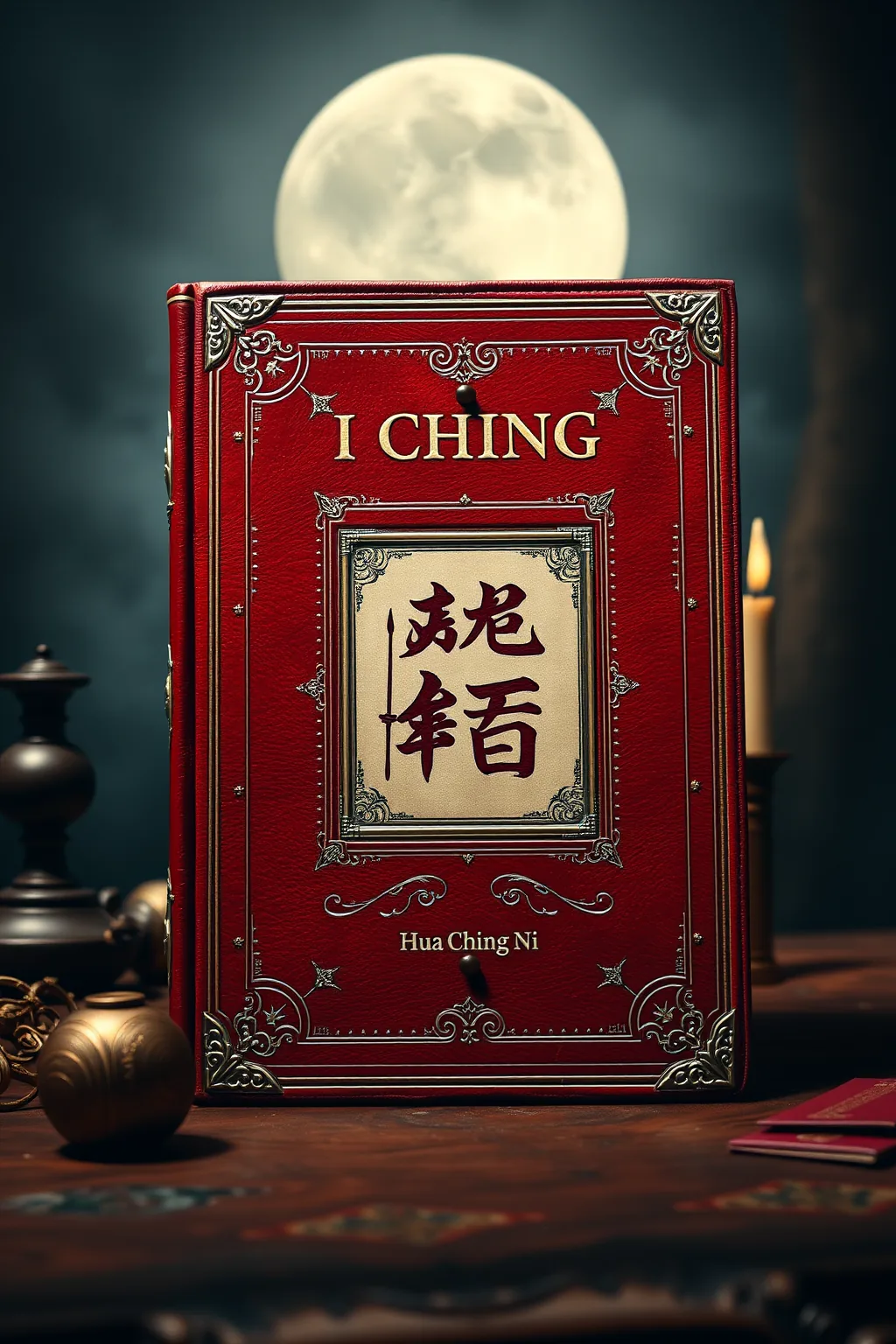
Hua Ching Ni's 1990 translation of the I Ching makes the ancient Chinese oracle accessible.
Hua Ching Ni's 1990 rendition of the I Ching, or 'Book of Changes,' presents this classical Chinese text as more than a simple fortune-telling device. The book details how the hexagrams represent cosmic patterns that influence life's circumstances and the relationships between all phenomena. Ni’s translation works to clarify the complex symbolism and philosophical underpinnings of the hexagrams, aiming to guide readers through concepts of fate, personal development, and spiritual understanding.
This edition aims to illuminate the core principles of the universe as understood through Taoist thought. It positions the I Ching as a guide for individuals seeking to approach life's challenges with greater insight and a connection to the Tao. The text encourages readers to align their decisions with the natural order of the cosmos.
The I Ching is a foundational text in Chinese esoteric traditions, particularly Taoism and Confucianism. Its origins date back thousands of years, and it has been interpreted as a system for understanding the dynamics of change in the universe and human affairs. The text comprises 64 hexagrams, each formed by six lines, representing fundamental archetypes and situations. These are used to gain insight into present circumstances and potential future developments, often interpreted through a lens of cosmic balance and the flow of the Tao.
💡 Why Read This Book?
Uncover the secrets of universal harmony and personal destiny. This edition of the I Ching offers profound philosophical insights and practical guidance for navigating life's challenges. Ideal for seekers of ancient wisdom, students of Eastern philosophy, and practitioners of divination who wish to deepen their understanding of cyclical change and cosmic order.
⭐ Reader Reviews
Honest opinions from readers who have explored this book.
❓ Frequently Asked Questions
What is the I Ching?
The I Ching, or 'Book of Changes,' is an ancient Chinese text used for divination and as a source of philosophical wisdom. It comprises 64 hexagrams, each representing a fundamental situation or archetype, accompanied by explanations and advice.
Who was Hua Ching Ni?
Hua Ching Ni was a renowned Taoist master, philosopher, and author who dedicated his life to disseminating Taoist teachings. His translations are celebrated for their authenticity and profound spiritual depth.
How is the I Ching used for divination?
Divination with the I Ching typically involves casting coins or yarrow stalks to generate a hexagram, which then provides guidance based on its imagery and text. It's a reflective process, not a deterministic prediction.
What philosophical concepts does the I Ching explore?
The I Ching explores core Taoist concepts such as Yin and Yang, the cyclical nature of change, balance, harmony, the Tao (the Way), and the importance of adapting to circumstances.
Is this translation suitable for beginners?
Yes, Hua Ching Ni's translation is often praised for its clarity and depth, making it accessible to beginners while still offering rich insights for advanced practitioners and scholars.
🔮 Key Themes & Symbolism
The Dance of Yin and Yang
The I Ching is a profound exploration of the dualistic forces of Yin (feminine, passive, dark) and Yang (masculine, active, light) that permeate the universe. It illustrates how these seemingly opposing energies are interdependent, constantly interacting, transforming, and giving rise to all phenomena. Understanding this dynamic interplay is crucial for comprehending the ebb and flow of events, achieving balance in one's life, and recognizing the interconnectedness of all existence. The hexagrams themselves are built from these fundamental lines, symbolizing the continuous flux and evolution driven by the balance and tension between Yin and Yang.
The Nature of Change and Transformation
Fundamentally, the I Ching teaches that change is the only constant in the universe. It provides a sophisticated framework for understanding the cyclical patterns of transformation, from the subtle shifts in personal fortune to the grand cycles of cosmic evolution. The 64 hexagrams represent archetypal situations and the inevitable transitions between them, offering wisdom on how to navigate these changes with awareness and adaptability. By studying the I Ching, one learns to embrace impermanence, recognize the opportune moments for action or stillness, and cultivate resilience in the face of life's ever-shifting tides.
The Art of Wise Decision-Making
Beyond its divinatory function, the I Ching serves as a profound guide for ethical living and wise decision-making. Each hexagram offers insights into the dynamics of a particular situation and suggests principles for acting in accordance with the Tao. It encourages introspection, mindfulness, and a deep understanding of consequences. The oracle prompts the user to align their intentions and actions with the natural order, fostering a life of harmony, integrity, and fulfillment. It is a tool for self-cultivation, helping one to discern the right course of action and to develop the inner strength needed to face any circumstance.
💬 Memorable Quotes
Direct passages from the work, attributed to the author.
“The superior man acts as if he were in want of nothing, and as if he were in fear of nothing.”
— This highlights the virtue of inner contentment and fearlessness, achieved by acting with integrity and detachment from material desires or external threats.
“To know that one does not know is the highest wisdom.”
— This emphasizes humility and the recognition of one's limitations as the true path to genuine understanding and intellectual growth.
“When you are in doubt, be still.”
— This advises patience and inner stillness when faced with uncertainty, suggesting that clarity often emerges from quiet contemplation rather than hasty action.
“The superior man understands the decrees of Heaven.”
— This speaks to aligning one's will and actions with a higher cosmic order or destiny, recognizing the subtle influences that guide events.
“The strength of a man is in his gentleness.”
— This paradox suggests that true power and resilience are found not in aggression, but in compassion, adaptability, and a gentle, yielding approach.
🌙 Esoteric Significance
Tradition
The I Ching is a core part of Taoist esoteric philosophy. It embodies the Taoist principles of cyclical change, the interplay of Yin and Yang, and the concept of 'Wu Wei' (non-action or effortless action). Within this tradition, it serves as a sacred oracle, a guide to understanding the natural order of the universe and aligning one's life with the Tao. Its wisdom is sought for spiritual cultivation, ethical guidance, and achieving harmony with the cosmic flow.
Symbolism
The hexagrams, composed of six lines (broken for Yin, solid for Yang), are rich with symbolic meaning. Each combination represents a specific situation or archetypal force. The trigrams (three-line figures) within the hexagrams further elaborate on elemental forces (Heaven, Earth, Thunder, Water, Mountain, Wind, Fire, Lake). The imagery and associated texts provide layered interpretations, offering insights into causality, potential outcomes, and the appropriate course of action, all rooted in a profound symbolic language.
Modern Relevance
In the modern era, the I Ching continues to offer profound relevance. It provides a powerful framework for understanding complex systems, the interconnectedness of global events, and the psychological dynamics of human behavior. Its emphasis on adaptability, mindfulness, and ethical decision-making offers a vital counterpoint to the often chaotic and fragmented nature of contemporary life. For seekers and practitioners, it remains an invaluable tool for personal growth, self-awareness, and reading through the challenges of the 21st century with wisdom and insight.
👥 Who Should Read This Book
This edition of the I Ching is a profound resource for a diverse audience. For the **beginner**, it offers a clear and accessible entry into the world of ancient Chinese philosophy and divination. **Scholars** of Eastern thought will find Hua Ching Ni's translation to be an authoritative and deeply insightful study. **Spiritual seekers** will discover a powerful oracle for self-reflection, guidance, and understanding the subtle currents of life. **Practitioners** of divination and contemplative arts will appreciate its depth and the nuanced interpretations it provides for deepening their practice and connection to universal wisdom.
📜 Historical Context
The I Ching, or 'Book of Changes,' traces its origins back to ancient China, with roots believed to extend over 3,000 years. Initially used for divination by shamans and rulers, it gradually evolved into a profound philosophical and ethical text, deeply influencing Taoism, Confucianism, and Chinese thought. Its compilation involved the work of many scholars and sages over centuries, culminating in the Han Dynasty (206 BCE – 220 CE) where its interpretation and application became highly systematized. The I Ching's enduring appeal lies in its ability to address fundamental questions about human existence, the nature of reality, and the principles of governance and personal conduct, resonating across vastly different historical periods and cultural contexts.
📔 Journal Prompts
Reflect on a recent situation where the balance of Yin and Yang felt particularly pronounced. How did this imbalance affect the outcome?
Consider a significant change you have navigated. How did the principles of the I Ching apply to your experience?
What does 'acting in accordance with the Tao' mean to you in your daily life? Provide specific examples.
If you were to ask the I Ching for guidance on a current challenge, what would be your question, and what hexagram might best represent your situation?
How can embracing impermanence lead to greater peace and resilience in your life?
🗂️ Glossary
Hexagram
A figure composed of six stacked horizontal lines, either solid (Yang) or broken (Yin). Each of the 64 hexagrams represents a fundamental situation or archetype in the I Ching.
Trigram
A figure composed of three stacked horizontal lines, representing one of the eight fundamental elements or forces (e.g., Heaven, Earth, Water). Trigrams are the building blocks of hexagrams.
Tao
The fundamental principle of the universe in Taoist philosophy; the 'Way' or the natural order of things. It is often described as ineffable and beyond conceptualization.
Yin
The feminine, passive, dark, and receptive principle in Taoist philosophy, often associated with the moon, earth, and water.
Yang
The masculine, active, light, and creative principle in Taoist philosophy, often associated with the sun, heaven, and fire.
This book appears in 3 collections
🔮 Readers Also Liked
Browse all →








More by Hua Ching Ni
All books →

From the “Tarot” Collection
View all →








More Free Divination & Tarot Books
View all →