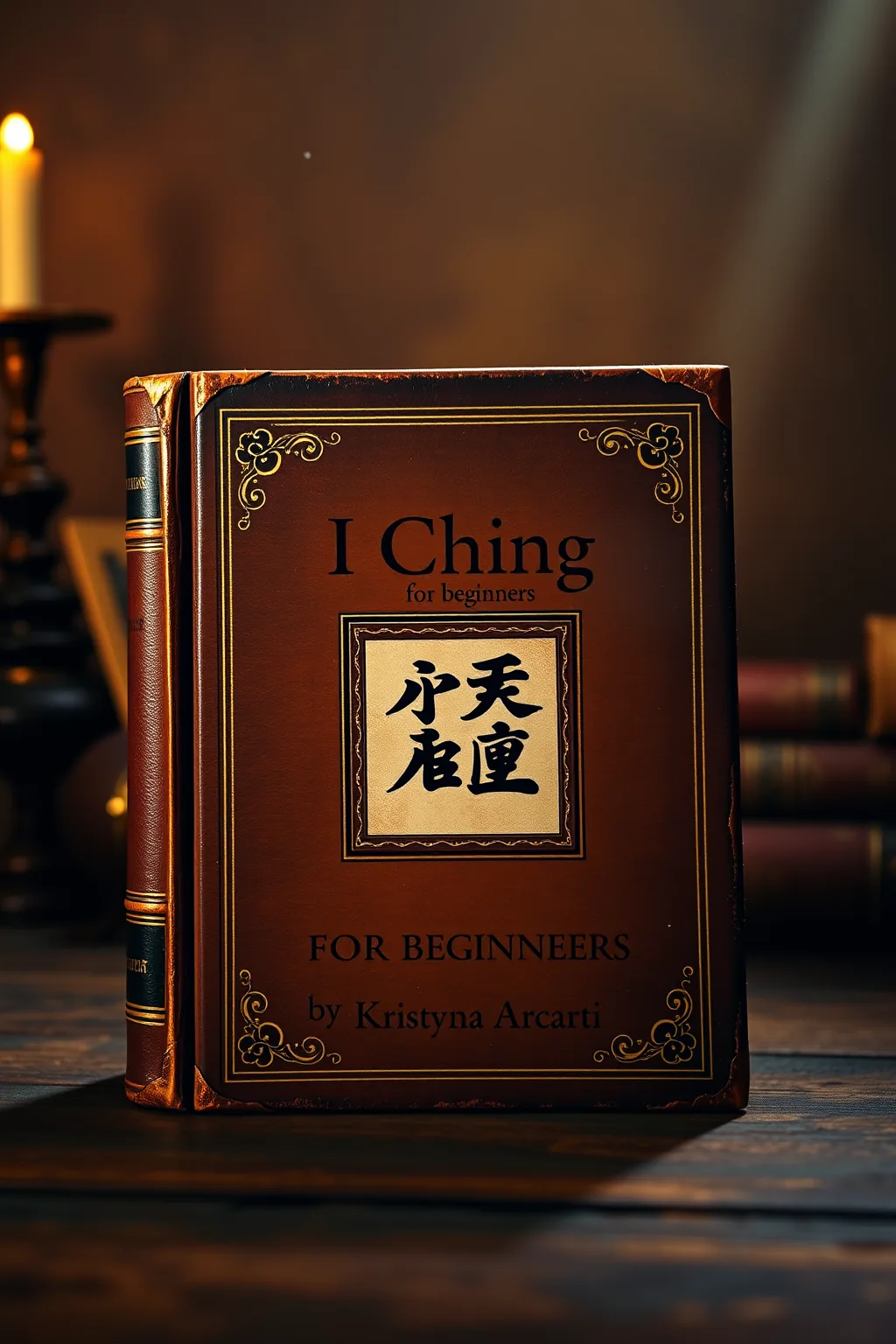
I Ching for beginners
 61
61

I Ching for beginners



Aurelia Blackwood, Occult Philosophy Critic: Kristyna Arcarti's "I Ching for Beginners" is a luminous exposition of a truly profound divinatory system. Arcarti masterfully demystifies the complex symbolism of the I Ching, presenting its esoteric insights with accessible grace. This work transcends mere instruction, offering a contemplative experience that fosters deep introspection and spiritual growth. It is an indispensable companion for neophytes eager to grasp the philosophical underpinnings and practical application of this ancient Chinese oracle. For those seeking to weave the wisdom of the I Ching into their personal journey, this book is an illuminating beacon.
📝 Description
61
Kristyna Arcarti's "I Ching for Beginners" explains the ancient Chinese oracle for new practitioners.
This guide introduces the I Ching, a system of divination and philosophy originating in ancient China. Arcarti breaks down the 64 hexagrams and their changing lines, showing how they can be used for insight into life's situations. The book explains the symbolic language of the I Ching and its connection to the natural world and personal destiny.
Readers will learn the basic methods for consulting the oracle and interpreting its responses. The text focuses on understanding the hexagrams not just as predictions, but as reflections of underlying patterns and influences. It aims to equip beginners with the knowledge to use the I Ching for self-reflection and to gain a clearer perspective on challenges.
The book is written for individuals interested in esoteric traditions and seeking a deeper understanding of themselves and the universe. It presents the I Ching as a tool for personal growth and a way to connect with a tradition of wisdom.
The I Ching, or 'Book of Changes,' is one of the oldest Chinese classics, central to Taoism and Confucianism. For centuries, it has been used as a method of divination and a source of philosophical insight. Its cosmology is based on the interplay of yin and yang, represented by broken and unbroken lines, which combine to form 64 hexagrams. These hexagrams are seen as archetypal situations or forces that describe the dynamics of change in the universe and human affairs. Arcarti’s work places this ancient system within the broader context of esoteric thought, making its principles accessible to modern readers.
💡 Why Read This Book?
Discover the timeless wisdom of the I Ching, a profound oracle of change and cosmic order. This beginner-friendly guide unlocks the secrets of its ancient symbolism, offering practical tools for self-discovery and guidance. Ideal for spiritual seekers, practitioners of divination, and anyone yearning for deeper insight into life's unfolding patterns. Learn to consult the oracle for clarity, wisdom, and a more harmonious connection with the universe.
⭐ Reader Reviews
Honest opinions from readers who have explored this book.
❓ Frequently Asked Questions
What is the I Ching?
The I Ching, or 'Book of Changes,' is an ancient Chinese divination text and philosophical classic. It uses a system of hexagrams, formed by six stacked lines, to provide insights into the present and potential future, guiding decisions and fostering understanding of life's transformations.
How do I use the I Ching for divination?
Typically, you formulate a question and then use a method (like coin tossing or yarrow stalks) to generate a hexagram. The book then offers interpretations of the hexagram and its changing lines to provide guidance.
Is prior knowledge of Chinese philosophy required?
No, this book is specifically designed for beginners. Arcarti breaks down complex concepts into understandable terms, making the I Ching accessible without requiring prior philosophical background.
What are hexagrams?
Hexagrams are the core symbols of the I Ching, composed of six stacked lines, each of which can be either 'yin' (broken) or 'yang' (unbroken). There are 64 unique hexagrams, representing archetypal situations and forces.
Can the I Ching predict the future?
The I Ching is not typically viewed as a deterministic predictor of the future. Instead, it offers insights into the energetic patterns and potential outcomes of a situation, empowering the user to make informed choices.
🔮 Key Themes & Symbolism
The Philosophy of Change
At its heart, the I Ching is a profound exploration of the immutable principle of change that governs all existence. It teaches that nothing is static, and understanding the ebb and flow of transformation is key to navigating life with wisdom. This theme emphasizes the dynamic nature of reality, encouraging acceptance and adaptability rather than resistance to the inevitable shifts and cycles we encounter on our personal and collective journeys.
Symbolic Language of the Hexagrams
The 64 hexagrams of the I Ching are not mere abstract symbols; they are a collection of archetypal imagery that expresses the myriad situations and energies of human experience. Each hexagram, composed of yin and yang lines, acts as a coded message from the universe, offering unique perspectives on challenges, opportunities, and the underlying dynamics at play. Deciphering this symbolic language unlocks clear insights into the interconnectedness of all things.
Divination as a Tool for Self-Reflection
Beyond its philosophical depth, the I Ching serves as a powerful oracle, a sacred mirror reflecting our inner state and external circumstances. This book guides readers in utilizing the I Ching not just for prediction, but as a profound tool for self-reflection, introspection, and spiritual growth. By engaging with its wisdom, individuals can gain clarity, make more conscious decisions, and align themselves with the greater cosmic flow, fostering personal transformation.
💬 Memorable Quotes
Direct passages from the work, attributed to the author.
“In every ending, a new beginning is sown.”
— This speaks to the cyclical nature of life as taught by the I Ching, emphasizing that perceived conclusions are merely transitions, fertile ground for future growth and development.
“The lines shift, revealing the dance of destiny.”
— This emphasizes the dynamic aspect of the I Ching, where changing lines within a hexagram illustrate the unfolding nature of events and the fluid interplay of fate and free will.
“Seek the oracle, and find the reflection of your soul.”
— This evokes the introspective power of the I Ching, positioning it as a spiritual mirror that helps individuals connect with their inner selves and gain self-awareness.
💡 Key Ideas
Editorial paraphrase of the work's core concepts — not direct quotes.
The hexagrams are the language of the cosmos, speaking in riddles of change.
This quote highlights the profound symbolic nature of the I Ching, suggesting its symbols are not arbitrary but carry deep, universal meaning that can be deciphered to understand the fundamental forces of existence.
Wisdom is found not in knowing the future, but in understanding the present.
This quote underscores the I Ching's utility as a tool for present-moment awareness and insight, rather than a rigid predictor, empowering individuals to act wisely now.
🌙 Esoteric Significance
Tradition
The I Ching is deeply embedded within the Taoist and Confucian traditions of Chinese esoteric philosophy. It is considered a foundational text for understanding concepts like the Tao (the Way), Yin and Yang duality, and the Five Elements. Esoterically, it is viewed as a cosmic map, a system for aligning oneself with the natural order and the subtle energies of the universe, facilitating spiritual growth and conscious evolution.
Symbolism
The core symbolism of the I Ching resides in its 64 hexagrams, each a unique combination of six yin (broken) and yang (unbroken) lines. These lines and their arrangements represent archetypal forces, natural phenomena, and human situations. The trigrams (three-line combinations) that form the hexagrams also carry profound symbolic meanings, representing heaven, earth, thunder, water, mountain, wind, fire, and lake, providing a rich lexicon for interpreting life's complexities.
Modern Relevance
In the modern era, the I Ching remains profoundly relevant as a tool for reading through the complexities and uncertainties of contemporary life. Its principles of change, balance, and interconnectedness offer timeless wisdom for personal development, decision-making, and fostering a deeper understanding of oneself and the world. Its symbolic language provides a unique framework for introspection and spiritual exploration, making it an invaluable resource for those seeking meaning and guidance in a rapidly evolving global landscape.
👥 Who Should Read This Book
This book is an invaluable resource for a diverse range of individuals. For absolute beginners, it offers a clear and inviting entry point into the profound world of the I Ching. Spiritual seekers will find it a powerful guide for introspection and connecting with universal wisdom. Practitioners of divination, such as Tarot readers or astrologers, can expand their repertoire with this ancient oracle. Scholars of Eastern philosophy and mythology will appreciate its concise yet comprehensive overview. Ultimately, anyone yearning for deeper insight into the cycles of life and a more harmonious existence will benefit immensely.
📜 Historical Context
The I Ching, with roots stretching back over three millennia, emerged from the crucible of ancient Chinese shamanic practices and philosophical inquiry. It evolved through various dynasties, gaining prominence as a divinatory text and a classic of Confucianism and Taoism. Its influence permeated Chinese culture, shaping political thought, military strategy, and personal ethics. The text's enduring appeal lies in its ability to address the fundamental human desire to understand the forces that shape our lives and to read through the ceaseless currents of change. Its wisdom has transcended geographical and temporal boundaries, resonating with seekers across continents and centuries.
📔 Journal Prompts
Reflect on a recent situation where change was a significant factor. How did you navigate it, and what might the I Ching offer?
Consider a recurring challenge in your life. If you were to consult the I Ching, what hexagram might best represent its essence?
What does the concept of Yin and Yang mean to you personally in your daily life?
How can understanding the cyclical nature of life, as presented in the I Ching, help you approach future endeavors?
If you could ask the I Ching one question about your spiritual path, what would it be and why?
🗂️ Glossary
Hexagram
A symbol composed of six stacked lines, each being either yin (broken) or yang (unbroken). There are 64 unique hexagrams in the I Ching, representing archetypal situations and forces.
Trigram
A symbol composed of three stacked lines (yin or yang). There are eight basic trigrams, which are the building blocks of the 64 hexagrams, each representing fundamental elements and concepts.
Yin
Represented by a broken line (-- --), Yin symbolizes feminine, passive, receptive, dark, and yielding qualities. It is the complementary force to Yang.
Yang
Represented by an unbroken line (------), Yang symbolizes masculine, active, creative, light, and assertive qualities. It is the complementary force to Yin.
Oracle
A person or agency considered to be a source of wise counsel or prophetic predictions inspired by a deity. In the context of the I Ching, it refers to the book itself as a source of guidance.
This book appears in 3 collections
🔮 Readers Also Liked
Browse all →









More by Kristyna Arcarti
All books →





From the “Tarot” Collection
View all →








More Free Divination & Tarot Books
View all →