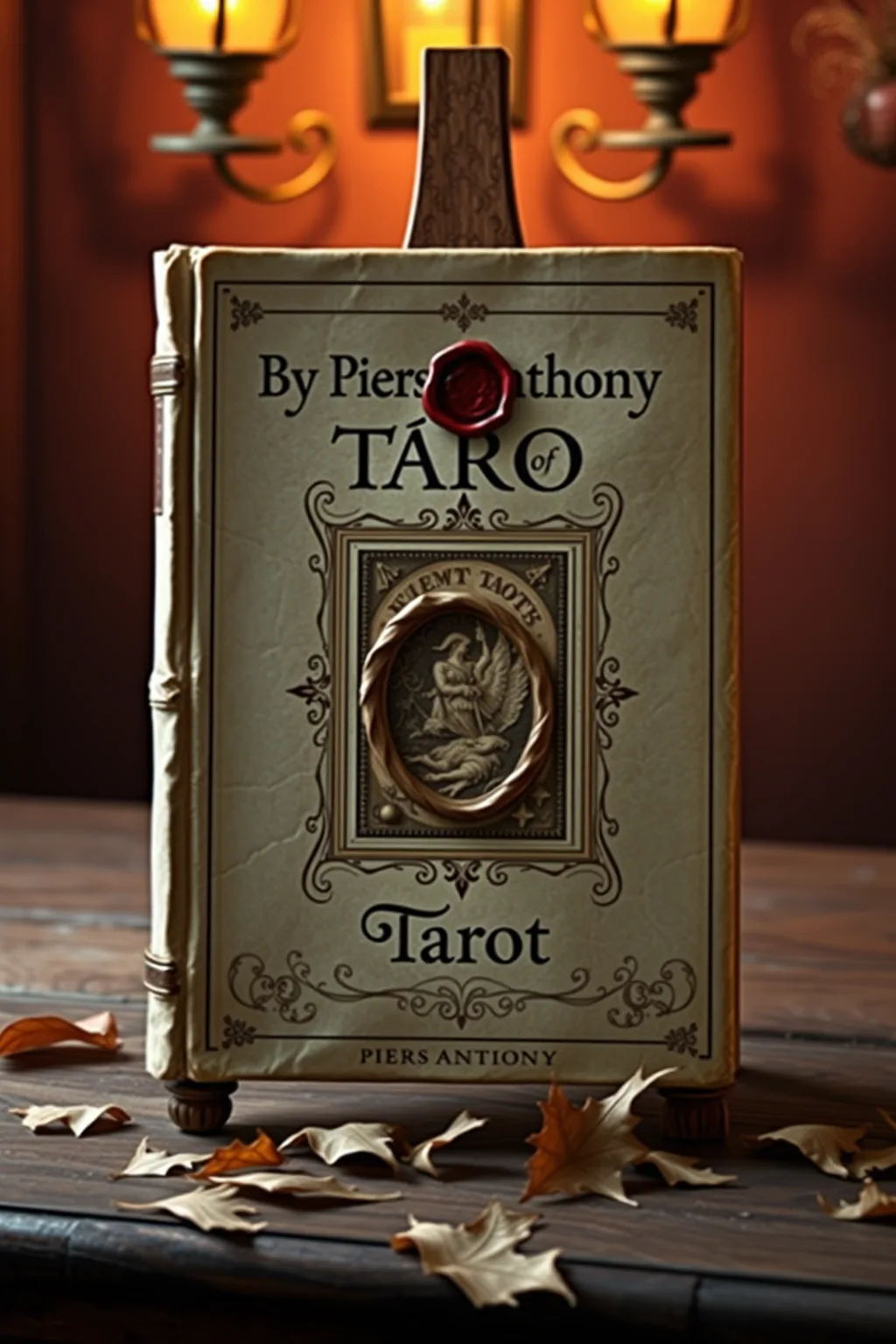
By Piers Anthony Tarot
 62
62

By Piers Anthony Tarot



Ophelia Vance, Mystical Literature Reviewer: Piers Anthony's Tarot is a masterclass in esoteric exposition, offering a unique and deeply insightful perspective on this ancient divinatory system. Anthony masterfully bridges the gap between complex symbolism and accessible understanding, making the profound accessible. His prose is both scholarly and evocative, guiding readers through the labyrinthine meanings of the Major and Minor Arcana with an assured hand. This work is an indispensable companion for anyone seeking to deepen their connection with Tarot's transformative power. It resonates with a rare authenticity, appealing to both serious practitioners and curious minds drawn to the mysteries of divination.
📝 Description
62
Piers Anthony's Tarot, published in 1989, examines the seventy-eight cards of the deck.
Piers Anthony, known for his fantasy novels, applies his storytelling skill to the Tarot in this 1989 work. He moves beyond simple fortune telling to consider the deeper symbolism within the seventy-eight cards. Anthony assigns layers of meaning to each card, aiming to connect with both new and experienced Tarot users. The book suggests that the Tarot can reveal hidden truths and universal principles.
Readers are encouraged to use the Tarot as a tool for self-understanding. It presents the cards as a way to grasp the forces that influence our lives and to develop intuition. The Tarot is framed not just as a reference, but as a means for personal growth and a way to see existence in new terms. The author intends for the book to change how readers perceive their reality.
This book engages with the Western esoteric tradition of Tarot, which views the cards as more than a divinatory tool. It aligns with interpretations that see the Tarot as a symbolic language or a map of the human psyche and spiritual development. Unlike purely historical or academic studies of the cards, Anthony's approach integrates personal reflection and the potential for psychological insight, positioning the Tarot as a system for understanding life's patterns and personal growth.
💡 Why Read This Book?
Embark on a profound journey of self-discovery as Piers Anthony illuminates the esoteric depths of the Tarot. This book offers a unique blend of scholarly insight and mystical intuition, perfect for seekers yearning to understand life's grander patterns. Whether you are a budding diviner, a seasoned practitioner, or a philosopher of the arcane, you will find new dimensions of meaning within its pages, unlocking ancient wisdom for modern application.
⭐ Reader Reviews
Honest opinions from readers who have explored this book.
❓ Frequently Asked Questions
What is the primary focus of Piers Anthony's Tarot?
The book's primary focus is to unveil the profound symbolic language and esoteric significance of the Tarot, moving beyond simple prediction to explore its role as a map for spiritual growth and self-understanding.
Is prior knowledge of Tarot required to read this book?
While some familiarity can enhance the experience, Piers Anthony's clear and insightful prose makes the book accessible to beginners eager to learn the foundational principles of Tarot symbolism and interpretation.
How does Piers Anthony's approach differ from other Tarot books?
Anthony's approach is characterized by his unique narrative style and his ability to imbue each card with a rich tapestry of mythological, psychological, and philosophical connections, offering a fresh and deeply personal perspective.
Can this book be used for practical divination?
Absolutely. While rich in theory, the book provides practical insights and interpretations that can be directly applied to readings, empowering users to connect with their intuition and gain clarity.
What kind of reader will most benefit from this book?
Seekers of hidden knowledge, practitioners of divination, students of mythology and symbolism, and anyone interested in the philosophical underpinnings of the Tarot will find immense value in this comprehensive work.
🔮 Key Themes & Symbolism
The Tarot as a Spiritual Map
This theme explores the Tarot not as a mere tool for fortune-telling, but as a profound symbolic map charting the archetypal journey of the human soul. It explores how the seventy-eight cards represent stages of spiritual evolution, the challenges faced, and the ultimate realization of one's potential. The emphasis is on the Tarot's capacity to guide individuals through the labyrinth of life, offering insights into their inner landscape and the cosmic forces at play, thus fostering personal transformation and enlightenment.
Archetypal Symbolism and Universal Truths
Here, the focus is on the potent archetypal imagery embedded within the Tarot, drawing parallels to universal myths and psychological structures. Anthony unpacks how figures like The Fool, The Hierophant, and The Lovers are not just static representations but dynamic forces that resonate with the collective unconscious. The exploration highlights the Tarot's ability to tap into timeless truths, offering a mirror to the human condition and revealing the interconnectedness of all beings through a shared symbolic language.
The Dance of Fate and Free Will
This crucial theme examines the intricate interplay between destiny and personal agency as depicted in the Tarot. It investigates how certain cards might suggest predetermined paths or karmic influences, while others empower the individual to make choices and shape their future. The book encourages readers to understand the Tarot not as a rigid prophecy, but as a dynamic dialogue between the forces that shape us and the choices we make, fostering a sense of empowerment and conscious participation in one's life journey.
💬 Memorable Quotes
Direct passages from the work, attributed to the author.
“Each card, a doorway to a forgotten self.”
— It highlights the Tarot's potential for introspection and self-discovery, presenting each card as an opportunity to connect with aspects of one's identity that have been overlooked or suppressed.
“The Fool's leap is the soul's first, fearless breath.”
— This poetic line captures the essence of The Fool card as a symbol of new beginnings, pure potential, and the courage required to embrace the unknown with unadulterated faith.
“Symbolism is the language of the universe speaking to the heart.”
— Emphasizes the profound, emotional, and spiritual communication that occurs through symbolic representation, suggesting that symbols bypass intellectual barriers to reach deeper levels of understanding.
💡 Key Ideas
Editorial paraphrase of the work's core concepts — not direct quotes.
The cards whisper secrets the mind has yet to conceive.
This quote suggests the Tarot's ability to bypass rational thought and access intuitive, subconscious knowledge, revealing truths that lie beyond ordinary perception.
Destiny is not written in stone, but traced in the shifting sands of choice.
This quote underscores the dynamic nature of fate, asserting that while influences may exist, personal decisions and actions play a vital role in shaping one's life path, promoting agency.
🌙 Esoteric Significance
Tradition
This work delves deeply into the Western Esoteric Tradition, drawing heavily on Hermeticism, Kabbalah, and Jungian psychology. It interprets the Tarot as a microcosm of the universe and a macrocosm of the individual psyche, aligning with practices that seek hidden knowledge and spiritual enlightenment through symbolic systems and archetypal understanding.
Symbolism
The Tarot's symbolism is paramount, with each of the seventy-eight cards acting as a potent glyph representing complex philosophical, psychological, and spiritual concepts. From the elemental forces in the Minor Arcana to the archetypal journeys of the Major Arcana, the book elucidates how these visual metaphors serve as keys to understanding the human condition, the cycles of life, and the divine.
Modern Relevance
In a world often characterized by fragmentation and disconnection, the Tarot offers a powerful tool for integration and self-awareness. Piers Anthony's interpretation highlights its enduring relevance as a means to access intuition, navigate personal challenges, and foster a deeper connection with oneself and the cosmos. It provides a timeless framework for understanding life's complexities and promoting personal growth in the 21st century.
👥 Who Should Read This Book
This book is a treasure for a diverse audience. For the **beginner**, it serves as an useful and accessible introduction to the symbolic language of the Tarot, explaining its core principles. **Scholars** of mythology, religion, and esoteric studies will appreciate the depth of research and the unique interdisciplinary connections made. **Seekers** on a spiritual path will find a profound guide for introspection and self-discovery, using the Tarot as a map for their inner journey. **Practitioners** of Tarot divination, regardless of their current level of expertise, will discover fresh perspectives and advanced insights to enrich their readings and deepen their practice.
📜 Historical Context
Piers Anthony's exploration of the Tarot emerges from a rich lineage of esoteric thought that blossomed and evolved through various historical periods. While the Tarot's origins are debated, its significant rise in occult circles began in the 18th century with figures like Antoine Court de Gébelin, who linked its imagery to ancient Egyptian mysteries. The 19th century saw further development with occultists like Eliphas Lévi, who codified its connection to Kabbalah and astrology. The 20th century witnessed a surge in popular interest, particularly with the Rider-Waite-Smith deck, which standardized much of the iconography still used today. Anthony's work, while contemporary, stands on the shoulders of these historical practitioners and scholars, engaging with the established symbolism while offering his unique authorial voice and speculative imagination to the ongoing conversation about the Tarot's profound mysteries and divinatory power.
📔 Journal Prompts
Reflect on the archetype that most appeals to your current life phase and explore its influence using a Tarot card as inspiration.
How does the concept of 'The Fool's Leap' apply to a recent risk you took or are considering taking?
Consider the interplay of fate and free will in a significant past decision. Which Tarot cards might represent these forces?
Identify a recurring symbol in your dreams or daily life and explore its potential meaning through the lens of Tarot imagery.
What 'hidden knowledge' does a specific Tarot card reveal to you about a challenge you are currently facing?
🗂️ Glossary
Archetype
In Jungian psychology and esoteric traditions, an archetype is a universal, archaic pattern and image that derives from the collective unconscious and is inherited. In Tarot, these are embodied by the figures in the Major Arcana.
Divination
The practice of seeking knowledge of the future or the unknown by supernatural means. In the context of Tarot, it involves interpreting the cards' symbolism to gain insights into questions, situations, or potential outcomes.
Esoteric
Intended for or likely to be understood by only a small number of people with a specialized knowledge or interest. Refers to hidden or inner teachings, often spiritual or mystical in nature.
Hermeticism
A philosophical and religious tradition based on writings attributed to Hermes Trismegistus, a syncretic figure combining Greek Hermes and Egyptian Thoth. It emphasizes spiritual knowledge, alchemy, astrology, and the belief that 'as above, so below'.
Kabbalah
A system of Jewish mysticism that explores the nature of God and the universe through the interpretation of scripture and symbolic representations, notably the Tree of Life. Many Tarot systems incorporate Kabbalistic principles.
This book appears in 3 collections
🔮 Readers Also Liked
Browse all →
More by Piers Anthony
All books →
From the “Tarot” Collection
View all →

More Free Divination & Tarot Books
View all →