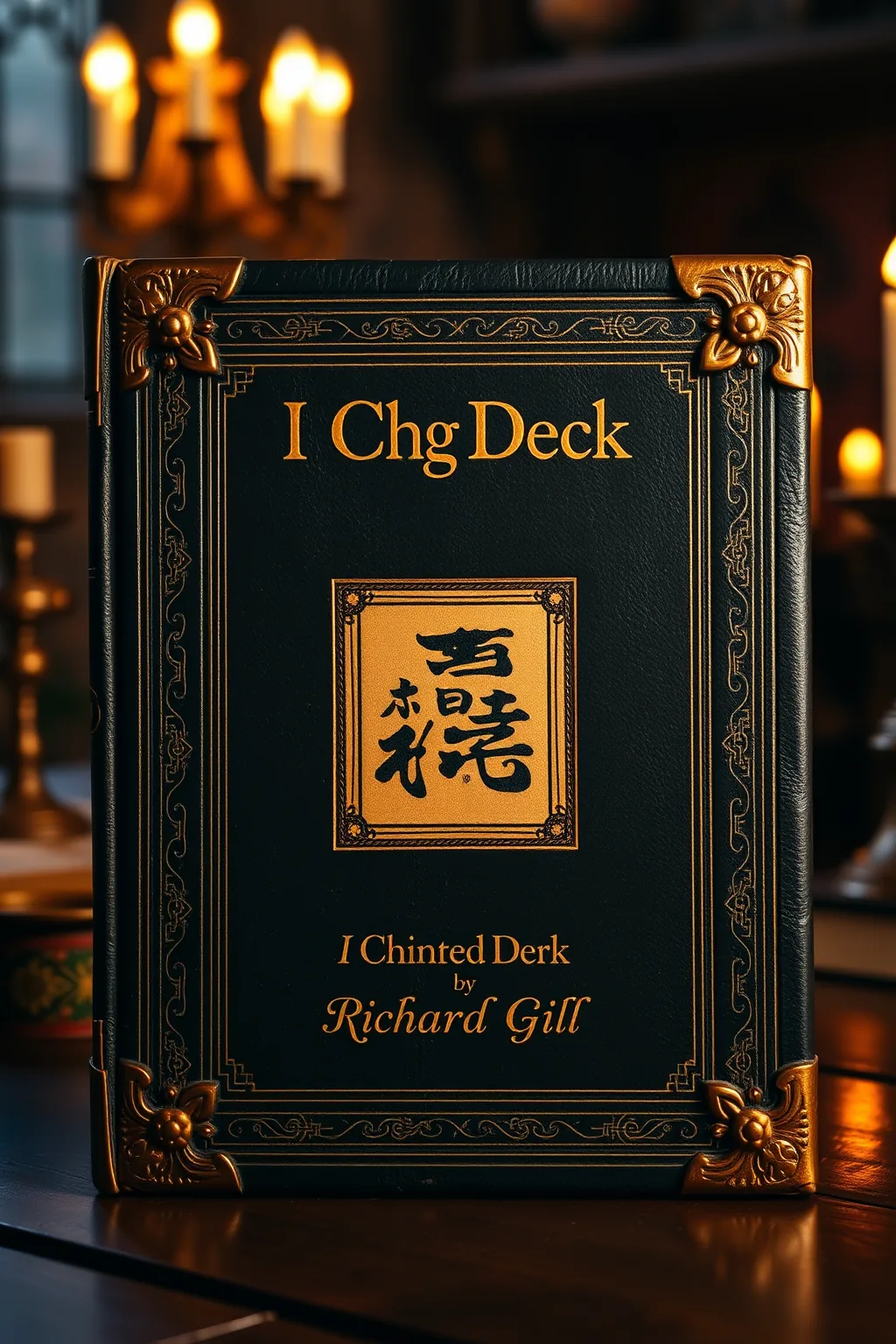
I Ching Deck
 61
61

I Ching Deck



Silas Hawthorne (Hermetic Studies Editor) — Richard Gill's I Ching Deck is a triumph of esoteric cartography. It distills the immense philosophical weight of the Yi Jing into an accessible, yet profoundly deep, divinatory system. The artwork is imbued with a subtle resonance, enhancing the intuitive connection to each hexagram. Gill's interpretations strike a perfect balance between scholarly accuracy and practical application, making this an invaluable resource for both seasoned practitioners of ancient wisdom and those new to the profound currents of Chinese metaphysics. It truly bridges the gap between theory and lived experience, offering clarity and guidance on life's myriad paths.
📝 Description
61
Richard Gill's I Ching Deck translates the ancient Chinese oracle into a usable card system.
This deck presents the I Ching, the Chinese oracle of change, through a set of illustrated cards. Richard Gill developed this system to make the complex hexagrams of the Yi Jing more accessible. Each card corresponds to a hexagram, depicting the interplay of Yin and Yang and offering interpretive guidance.
The deck functions as a tool for divination and contemplation. It aims to illuminate the underlying patterns of existence and assist users in understanding personal circumstances. Rather than solely predicting the future, the cards encourage reflection on life's constant flux and the principles of the Tao. The visual language of the cards seeks to bridge the gap between the text of the I Ching and practical application.
The I Ching is one of the oldest Chinese classics, functioning as a book of wisdom and divination. Its principles revolve around the dynamic interplay of opposing forces, Yin and Yang, and the constant process of transformation. For centuries, it has been a central text in Chinese philosophy, religion, and cosmology, influencing thinkers and practitioners across East Asia. This deck situates itself within the tradition of making these ancient principles available for personal use and understanding, translating textual complexity into a more immediate visual and symbolic format.
💡 Why Read This Book?
Embark on a transformative journey into one of the world's oldest and most revered oracles. The I Ching Deck by Richard Gill offers a unique, visually rich approach to understanding the fundamental principles of change, balance, and destiny. Ideal for seekers of profound wisdom, students of Eastern philosophy, and practitioners of divination seeking to deepen their connection with universal forces. It's an invitation to consult the cosmic currents and unlock your inner potential.
⭐ Reader Reviews
Honest opinions from readers who have explored this book.
❓ Frequently Asked Questions
What is the I Ching?
The I Ching, or Book of Changes, is an ancient Chinese divination text and philosophical classic, revered for its profound insights into the cycles of change and the principles of the universe. It is one of the oldest Chinese classics.
How does this deck work?
The deck comprises 64 hexagrams, each representing a specific situation or stage of change. By casting coins or yarrow stalks, you generate hexagrams that provide guidance and illumination on your questions.
Who is Richard Gill?
Richard Gill is an author and illustrator known for his work in esoteric and metaphysical literature, particularly his accessible interpretations of ancient wisdom traditions.
Is this deck suitable for beginners?
Absolutely. The deck is designed to be both informative for scholars and intuitive for beginners, offering clear explanations and evocative imagery to facilitate understanding and practice.
What is the philosophical significance of the I Ching?
The I Ching's philosophy centers on the constant flux of existence, the interplay of opposing forces (Yin and Yang), and the importance of aligning oneself with the natural flow of the Tao for wisdom and harmony.
🔮 Key Themes & Symbolism
The Nature of Change and Transformation
Fundamentally, the I Ching explores the ceaseless ebb and flow of existence. This deck invites contemplation on how all things are in a state of flux, from the grand cosmic cycles to the minutiae of personal experience. Understanding these transformations allows for a more harmonious navigation of life's challenges and opportunities, fostering adaptability and resilience in the face of inevitable shifts. It's an exploration of growth, decay, and the perpetual renewal that underpins reality.
The Interplay of Yin and Yang
This theme explores the fundamental duality that governs the universe as understood by the I Ching. Yin, representing the receptive, passive, and feminine principle, and Yang, embodying the active, assertive, and masculine principle, are not opposing forces but complementary aspects of a unified whole. The hexagrams illustrate the dynamic balance and interaction between these energies, offering insights into how their harmonious interplay leads to creation and stability, while their imbalance results in disruption.
Seeking Guidance and Self-Knowledge
The I Ching Deck serves as a profound tool for introspection and divination, offering a sacred dialogue with the deeper currents of consciousness. By consulting the hexagrams, individuals can gain clarity on their present circumstances, explore potential future trajectories, and uncover hidden motivations or patterns influencing their lives. This process fosters self-awareness, encourages mindful decision-making, and empowers individuals to align their actions with the wisdom of the Tao, leading to personal growth and fulfillment.
💬 Memorable Quotes
Direct passages from the work, attributed to the author.
“When you are certain of your path, you will find your way.”
— This speaks to the power of conviction and inner clarity. When one is aligned with their true purpose, the universe often conspires to guide them towards their destination.
“Stillness leads to clarity.”
— This aphorism points to the meditative and contemplative aspects of divination. True insight often arises when the mind is quiet and receptive to subtle promptings.
“Harmony is found in balance.”
— This expresses the core principle of Yin and Yang. Achieving equilibrium between opposing forces is essential for well-being, stability, and a profound sense of peace.
💡 Key Ideas
Editorial paraphrase of the work's core concepts — not direct quotes.
The superior man understands the changes of things.
This quote highlights the I Ching's emphasis on adaptability and foresight. It suggests that wisdom lies in recognizing and responding intelligently to the inevitable transformations of life.
The best way to predict the future is to create it.
While the I Ching offers foresight, this quote emphasizes agency. It suggests that while we can understand potentials, our actions actively shape the unfolding of events.
🌙 Esoteric Significance
Tradition
The I Ching is a core part of East Asian esoteric traditions, deeply intertwined with Taoism, Confucianism, and ancient Chinese cosmology. It represents a sophisticated system of understanding universal principles, divine order, and the interconnectedness of all phenomena. Its esoteric nature lies in its ability to act as a mirror to the soul and a guide to reading through the subtle energies that govern existence, offering a path to enlightenment through understanding the cosmic dance.
Symbolism
The hexagrams are the primary symbols, each composed of six stacked lines, either broken (Yin) or solid (Yang). These lines represent fundamental forces and archetypal situations. The trigrams (three-line combinations) further subdivide these meanings. The symbolism extends to the imagery and poetry associated with each hexagram, creating a rich lexicon of archetypal scenarios and cosmic patterns that speak to the human condition.
Modern Relevance
In the modern era, the I Ching remains remarkably relevant as a tool for psychological insight, ethical guidance, and spiritual development. It offers a profound antidote to the fragmentation and uncertainty of contemporary life, providing a framework for understanding change, fostering resilience, and seeking inner harmony. Its principles of balance, adaptation, and mindful action resonate deeply with individuals seeking meaning and a deeper connection to the universal flow.
👥 Who Should Read This Book
The I Ching Deck by Richard Gill is a valuable collection for a diverse audience. **Beginners** seeking an accessible entry point into ancient divination will find its clear presentation and evocative art immensely helpful. **Scholars** of Eastern philosophy and comparative religion will appreciate its faithful yet insightful interpretation of a foundational text. **Spiritual seekers** looking for deeper self-understanding, guidance, and a connection to universal wisdom will find it an invaluable companion. **Practitioners of divination**, including Tarot readers and astrologers, can integrate its unique insights to enrich their craft and broaden their divinatory vocabulary.
📜 Historical Context
The I Ching, or Book of Changes, emerged from ancient Chinese shamanistic traditions and philosophical inquiries that date back as far as the Western Zhou Dynasty (c. 1046–771 BCE). Initially used for divination, it evolved into a complex philosophical text that profoundly influenced Chinese thought, culture, and spirituality, including Confucianism and Taoism. Its wisdom has been a constant companion through millennia of dynastic changes, social upheavals, and intellectual revolutions. The philosophical underpinnings of the I Ching, particularly its focus on the cyclical nature of change, the balance of complementary forces, and the importance of aligning with the Tao, provided a stable framework for understanding the world and one's place within it, offering solace and guidance across diverse eras.
📔 Journal Prompts
Reflect on a recent significant change in your life. Which hexagram from the deck best represents this transition, and why?
Consider the interplay of Yin and Yang in a current challenge you are facing. How can embracing both aspects lead to a more balanced resolution?
What does the concept of 'destiny' mean to you? How does the I Ching's perspective on fate and free will resonate with your own beliefs?
If the I Ching is a 'Book of Changes,' what 'changes' are you most resistant to, and what might be the wisdom in embracing them?
How can the principles of the I Ching inform your daily decisions and interactions to cultivate greater harmony and understanding?
🗂️ Glossary
Hexagram
A symbol composed of six stacked lines, either solid (Yang) or broken (Yin), representing a specific situation or stage of change in the I Ching.
Trigram
A fundamental symbol of three lines (either solid or broken) that forms the building block of a hexagram, representing eight basic archetypal forces.
Yin
The receptive, passive, dark, feminine principle in Chinese philosophy, often associated with the moon, earth, and stillness.
Yang
The active, assertive, light, masculine principle in Chinese philosophy, often associated with the sun, heaven, and movement.
Tao (or Dao)
The fundamental principle of the universe in Taoism, often translated as 'The Way.' It represents the natural order, the source of all things, and the path to harmony.
This book appears in 3 collections
🔮 Readers Also Liked
Browse all →









From the “Tarot” Collection
View all →





More Free Divination & Tarot Books
View all →