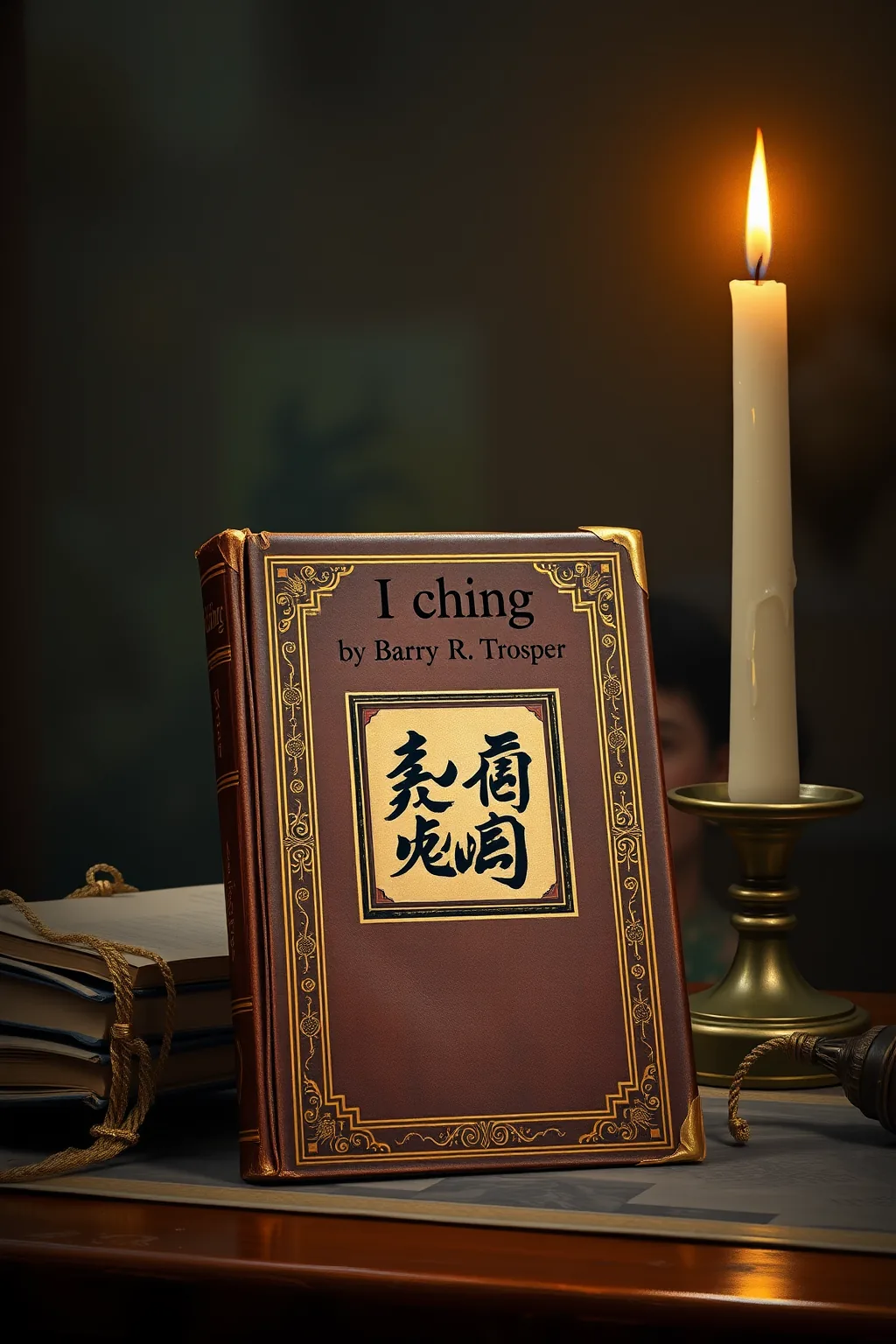
I ching
 61
61

I ching



Lorelei Sage, Contemplative Literature Editor: Barry R. Trosper's 'I Ching' offers a luminous portal into one of humanity's most enduring spiritual and philosophical traditions. Trosper masterfully deciphers the intricate symbolism, rendering the ancient oracle accessible yet preserving its profound mystery. His translation is both scholarly and spiritually attuned, making this edition a vital resource for serious students of Eastern philosophy and esoteric practices. The lucid explanations of hexagramic transformations and their profound implications for personal growth and understanding the cosmic order are particularly commendable. This 'I Ching' is an indispensable companion for anyone seeking to align with the Tao and navigate the currents of change with profound insight.
📝 Description
61
Barry R. Trosper's 2002 translation of the I Ching offers a detailed textual analysis alongside its divinatory use.
This edition of the I Ching, translated and explained by Barry R. Trosper, aims to present the classic Chinese text beyond its use as a simple divination tool. Trosper's work focuses on the hexagrams and their changing lines, seeking to uncover the symbolic meanings that address fundamental questions about existence. It positions the I Ching as a system for understanding the forces that influence our world and our personal growth.
The book encourages a thoughtful approach, suitable for those interested in philosophy, spiritual development, or practical application. It provides a framework for contemplating change, the connections between phenomena, and finding a balanced way to move through life's transitions. The translation is intended to act as a reflective tool, guiding readers to face life's changes with greater understanding.
The I Ching, or Book of Changes, is a foundational text in Chinese philosophy and continues to be a central work in esoteric traditions worldwide. Its origins are ancient, with its core principles dating back millennia. The text combines a system of divination based on hexagrams with deep philosophical insights into the nature of change, order, and the cosmos. Many esoteric practitioners view it as a map of universal processes and a guide for personal transformation, believing its principles apply to both macrocosmic and microcosmic levels of reality.
💡 Why Read This Book?
Uncover the secrets of cosmic cycles and personal transformation. Barry R. Trosper's 'I Ching' provides a profound, accessible guide to this ancient oracle, revealing its deep philosophical underpinnings and practical divinatory wisdom. Ideal for seekers of wisdom, students of metaphysics, and practitioners of ancient arts who wish to understand the universal principles of change and harmony.
⭐ Reader Reviews
Honest opinions from readers who have explored this book.
❓ Frequently Asked Questions
What is the I Ching?
The I Ching, or Book of Changes, is an ancient Chinese divination text and philosophical classic. It comprises 64 hexagrams, each representing a distinct situation or stage of transformation, offering profound insights into the dynamics of the universe and human experience.
How does one use the I Ching for divination?
Divination typically involves casting yarrow stalks or coins to generate a hexagram, which is then interpreted using the text's commentaries and line statements to gain guidance or insight into a specific question or situation.
What is the philosophical significance of the I Ching?
Its philosophical core lies in the concept of constant change and the interplay of Yin and Yang. It teaches that understanding these dynamic forces allows one to live in harmony with the Tao, the fundamental order of the universe.
Is this translation suitable for beginners?
Yes, Barry R. Trosper's edition is renowned for its clarity and insightful commentary, making it an excellent starting point for those new to the I Ching, while still offering depth for experienced practitioners.
What makes this edition unique?
Trosper's translation emphasizes the esoteric and philosophical dimensions, offering a rich interpretation of the symbolism and underlying principles, making it more than just a divinatory manual but a profound spiritual text.
🔮 Key Themes & Symbolism
The Dance of Yin and Yang
This theme explores the fundamental duality of existence, the interplay between passive (Yin) and active (Yang) forces that govern all phenomena. The I Ching illustrates how these opposing energies are not in conflict but are complementary and interdependent, constantly transforming into one another. Understanding this cosmic dance is crucial for perceiving the underlying patterns of change and achieving balance in one's life and in the world. The hexagrams act as visual representations of these dynamic interactions, offering useful insights into the cyclical nature of creation and dissolution, and the equilibrium that sustains reality.
The Art of Transformation
At its heart, the I Ching is a treatise on the inevitability and nature of change. It teaches that life is a continuous process of evolution, with each situation containing the seeds of its own transformation. This theme explores how to navigate these shifts with wisdom, recognizing that resistance to change leads to stagnation, while mindful adaptation fosters growth and resilience. The shifting lines within the hexagrams symbolize the subtle yet powerful transitions that occur, guiding the reader to understand the opportune moments for action, patience, or introspection, thus mastering the art of flowing with life's currents.
Cosmic Harmony and Personal Destiny
This theme examines the interconnectedness of the individual with the greater cosmic order. The I Ching posits that by aligning oneself with the natural rhythms and principles of the universe, one can achieve a state of profound harmony and fulfill their destined path. It offers a framework for understanding how our choices and actions resonate with universal energies, influencing our personal destiny. The hexagrams serve as guides, informative the path towards synchronicity with the Tao, enabling individuals to act with intention and clarity, thereby shaping a life of purpose and well-being.
💬 Memorable Quotes
Direct passages from the work, attributed to the author.
“Change is the only constant.”
— A foundational principle, reminding us that impermanence is the nature of reality, urging acceptance and adaptability.
“Within stillness, find motion.”
— Highlights the paradoxical nature of existence, where profound inner peace can lead to potent outward action.
“The wise man adapts to the times.”
— Emphasizes the importance of flexibility and attunement to external circumstances for successful navigation of life.
“Every end is a new beginning.”
— Illustrates the cyclical nature of events, where endings are not absolute but transitions into future possibilities.
“Seek balance in all things.”
— A timeless directive for achieving well-being and harmony by moderating extremes and finding equilibrium.
🌙 Esoteric Significance
Tradition
Rooted deeply in ancient Chinese Taoist and Confucian traditions, the I Ching is considered a foundational text within East Asian esotericism. It is viewed not just as a divinatory manual but as a cosmic blueprint, a repository of universal laws and principles that govern existence. Its esoteric significance lies in its intricate symbolic language and the sophisticated system of correspondences it employs, aiming to unlock a deeper understanding of the subtle energies that shape both the macrocosm and the microcosm.
Symbolism
The core symbolism of the I Ching revolves around the 64 hexagrams, formed by combinations of six lines, each being either solid (Yang) or broken (Yin). These binary elements represent the fundamental forces of nature and consciousness. The trigrams, three-line combinations, further elaborate on universal archetypes like Heaven, Earth, Thunder, and Water. The changing lines within the hexagrams signify transformation, revealing the dynamic processes of causality and the pathways for navigating specific situations with wisdom.
Modern Relevance
In the modern era, the I Ching continues to offer profound relevance as a tool for self-awareness, ethical guidance, and navigating complexity. Its principles of cyclical change, balance, and interconnectedness resonate deeply in a world grappling with rapid transformation and uncertainty. For contemporary seekers, it provides a timeless framework for understanding personal challenges, fostering resilience, and aligning one's actions with a greater sense of purpose and universal flow. It remains a potent oracle for introspection and strategic decision-making.
👥 Who Should Read This Book
This 'I Ching' is an essential read for dedicated spiritual seekers yearning for profound self-understanding and cosmic insight. Scholars of Eastern philosophy and comparative religion will find Trosper's nuanced translation and commentary invaluable. Practitioners of divination and esoteric arts will discover a powerful oracle for deepening their practice. Beginners curious about ancient wisdom traditions will appreciate its accessible yet profound approach. Anyone seeking to navigate life's inevitable changes with greater wisdom, intention, and harmony will find this book a transformative guide.
📜 Historical Context
The I Ching, originating in ancient China, likely developed over millennia, with its earliest forms dating back to the Western Zhou Dynasty (c. 1046–771 BCE). Initially used for divination and statecraft, it evolved into a profound philosophical and cosmological text, deeply influencing Taoism, Confucianism, and Chinese thought for over two thousand years. Its wisdom permeated aspects of governance, medicine, art, and personal ethics. The text's enduring relevance lies in its ability to address universal human concerns about change, destiny, and the search for harmony within a constantly shifting world, making it a central to Eastern philosophical tradition and a vital bridge to ancient wisdom.
📔 Journal Prompts
Reflect on a recent situation where change was inevitable. How did you respond, and what could the I Ching offer?
Consider the interplay of Yin and Yang in your daily life. Where do you see balance, and where is there imbalance?
What does the concept of 'destiny' mean to you in relation to your own choices and actions?
How can understanding cosmic principles help you approach personal challenges with greater equanimity?
Identify a current 'transition' in your life. What hexagram might represent this phase, and what guidance does it offer?
🗂️ Glossary
Hexagram
A symbol composed of six stacked horizontal lines, either solid (Yang) or broken (Yin), representing a specific situation or stage of transformation within the I Ching.
Trigram
A symbol composed of three stacked horizontal lines, either solid (Yang) or broken (Yin), forming eight fundamental archetypes that combine to create the hexagrams.
Yang
The active, masculine, light, and assertive principle in Taoist philosophy, represented by a solid line in the I Ching.
Yin
The passive, feminine, dark, and receptive principle in Taoist philosophy, represented by a broken line in the I Ching.
Tao
The fundamental, ineffable principle that underlies and governs the universe; the 'Way' or 'Path' of natural order and flow.
This book appears in 3 collections
🔮 Readers Also Liked
Browse all →









From the “Tarot” Collection
View all →








More Free Divination & Tarot Books
View all →